
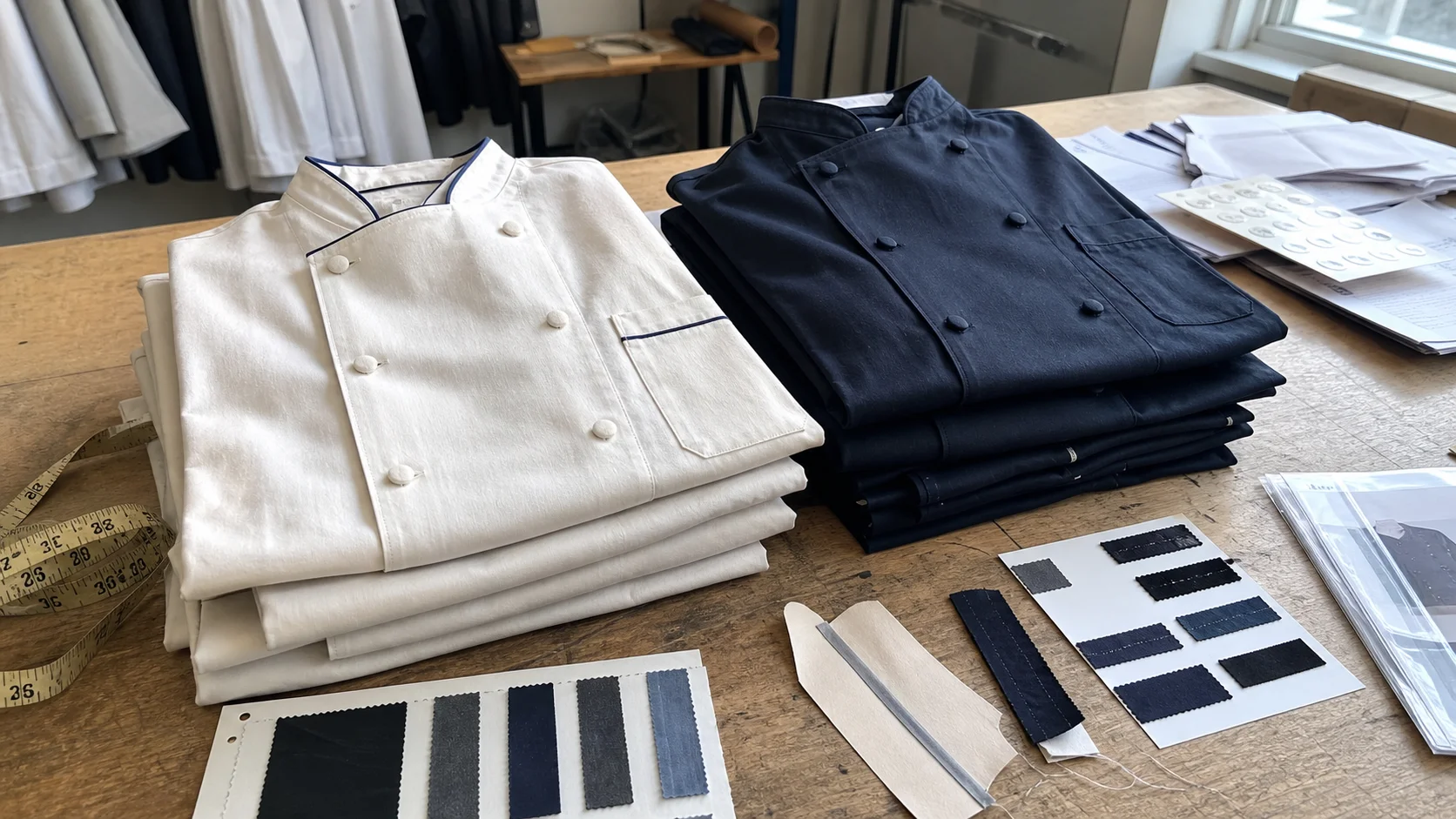
A quality-focused outline for reviewing chef coat MOQ pricing, construction specs, inspection points, and cost risks when security contractors source...
Chef Coat MOQ Pricing Review for Security Contractors - Fabrikn production reference
Security contractors usually buy uniforms with a strict operational lens: fast replenishment, consistent appearance across sites, durable construction, and a price that works across seasonal headcount changes. Chef coats may look like a foodservice-only item, but they are often sourced by security providers working in hotels, casinos, event venues, hospitals, corporate campuses, cruise operations, and back-of-house access control roles where staff need to match hospitality dress standards.
This chef coat MOQ pricing review for security contractors looks at the real purchasing variables: minimum order quantities, fabric and trim specifications, sample approval, size ratios, inspection risks, and lead-time tradeoffs. The goal is not to chase the cheapest coat. The better target is a repeatable uniform program that does not create fit complaints, inconsistent whites, weak snaps, or surprise replenishment costs.
Chef coats are not standard security uniforms, but they are useful in specific contract environments. In hotels, banquet halls, stadium kitchens, casinos, healthcare foodservice areas, and corporate dining facilities, security staff may need a garment that blends into the operational dress code while still looking professional. A black tactical shirt may be inappropriate in a premium hospitality setting. A clean white or black chef coat can satisfy site image requirements without looking casual.
Security contractors may use chef coats for several roles:
The sourcing challenge is that chef coats are built for culinary work, not necessarily security duty. Security staff may carry radios, keys, access cards, mobile devices, and sometimes body-worn equipment. A standard chef coat with light stitching, shallow pockets, or poor movement tolerance may fail faster than expected. That is why MOQ and pricing should be reviewed together with construction quality, not separately.
For broader uniform sourcing support, contractors can review service options at Fabrikn services, especially when comparing sampling, production oversight, and inspection requirements.
MOQ means minimum order quantity. For chef coats, MOQ depends on whether the buyer selects ready-stock styles, semi-custom modifications, or fully custom manufacturing. Security contractors often make the mistake of asking for a low MOQ and then requesting custom fabric, special buttons, sleeve pockets, embroidery, extended size grading, and separate packing. Each requirement increases supplier setup work.
Typical MOQ ranges are:
MOQ should be reviewed by style, color, and size range. A supplier may say the MOQ is 300 pieces, but that may mean 300 pieces per color, not total. If a contractor needs white, black, and charcoal, the practical MOQ can become 900 pieces. If the buyer also wants men’s and women’s fits, the effective commitment may double again.
For security contractors with multiple client sites, the best MOQ strategy is usually a controlled core program: one or two colors, one standard fabric, consistent trims, and a clear replenishment plan. Small design changes across each client contract may look appealing, but they increase inventory fragmentation and make inspection harder.
Chef coat pricing varies widely because the garment looks simple but has several cost-sensitive parts. Double-breasted fronts, snap closures, collar shaping, reinforced seams, sleeve vents, and multiple pockets all affect labor time. Fabric weight and washing performance also change the price.
The main cost drivers include:
A low unit price can be legitimate for a simple stock coat in a polyester-rich blend. It becomes risky when the same low price is quoted for a custom security contractor program with branding, pocket changes, and extended sizing. Something has to give: fabric quality, stitching density, trim durability, inspection effort, or delivery reliability.
The table below gives practical market-style ranges for planning. Actual pricing depends on country of manufacture, fabric availability, order size, compliance expectations, freight method, and currency movement. Security contractors should use these ranges as a review framework, not as a final quotation.
Chef Coat Type Typical MOQ Indicative Unit Price Range Best Use Case Main Risk Ready-stock basic coat 24-100 pcs Lower range, often suitable for urgent orders Short contracts, trials, emergency replenishment Inconsistent stock, limited size availability, fewer customization options Stock coat with embroidery 50-200 pcs Low to mid range plus logo setup Small security teams in hospitality locations Embroidery puckering, poor logo placement, delayed decoration Semi-custom coat 200-500 pcs Mid range Multi-site contractors needing consistent appearance Sample mismatch, pocket placement errors, MOQ by color Fully custom coat 500-1,500 pcs Mid to higher range Large security providers with stable annual demand Longer development, higher upfront commitment, grading risk Custom fabric or custom-dyed coat 1,000-3,000 pcs Higher range Brand-specific uniform programs Shade variation, lab dip rejection, fabric mill delaysPrice negotiation should not focus only on the first order. Ask what happens when a contract adds 30 guards after launch, or when a hotel site needs only 18 replacement coats in size 2XL. A supplier that gives a very attractive 500-piece price may charge much more for replenishment. If the contractor cannot hold inventory, the landed cost per usable coat may rise sharply.
Fabric choice is the center of chef coat performance. Security teams need coats that look clean after repeated washing, allow movement, and avoid excessive heat buildup. Culinary coats can be warm because they are designed to protect against kitchen conditions. For security staff working long shifts, fabric comfort matters.
For white chef coats, opacity should be checked before production. Thin white fabric can look cheap and may reveal undershirts, radio harnesses, or personal items. Black coats hide stains better but can show lint, fading, and shade variation between lots.
Do not approve a quote without a written specification sheet. At minimum, define fabric composition, gsm, weave, color standard, button or snap type, thread color, stitch density expectation, pocket dimensions, label artwork, packing method, and measurement tolerances.
A chef coat program for security contractors should not move straight from quote to bulk order. Sampling is where most avoidable problems are caught. The sample process does not need to be complicated, but it must be disciplined.
The pre-production sample is the most important approval point. It should be retained as the production reference. If the supplier changes fabric, snaps, thread, label, or pocket placement after approval, the buyer should require written confirmation and, where necessary, a revised sample.
Security contractors should test samples under realistic use. That can include sitting, reaching, radio handling, bending, repeated snap opening, and washing. A coat that looks fine on a hanger may pull across the shoulders or ride up during active duty. Fit issues are expensive after bulk production because uniforms are distributed quickly and returns are difficult to organize across job sites.
Lead time is rarely just sewing time. A supplier may say production takes 30 days, but that may exclude fabric booking, trims, sample approval, logo digitizing, packaging, inspection, and international freight. Security contractors often work around contract start dates, so lead-time assumptions need to be conservative.
Typical timing ranges are:
Several factors can extend delivery:
Contractors should separate the “must-have launch quantity” from the “full program quantity.” If a new site begins in six weeks, it may be sensible to use ready-stock coats for launch and transition to custom coats later. The tradeoff is a possible appearance difference between initial and later uniforms, so color and styling should be kept as close as possible.
Chef coats are straightforward garments, but bulk production still carries inspection risk. For security contractors, the highest-cost defects are not always dramatic. Small problems become expensive when distributed across many sites.
Inspection should include workmanship, measurements, trims, labeling, packaging, and quantity checks. AQL inspection is commonly used in apparel, but the acceptable level should reflect contract risk. For a high-profile hospitality client, visible defects and shade inconsistency may need tighter control than a basic back-of-house program.
Fabric testing is also worth considering. Shrinkage, colorfastness to washing, colorfastness to perspiration, seam strength, and snap pull strength are relevant. If coats will be industrially laundered, the buyer should state that clearly before fabric selection. Domestic wash assumptions are not the same as commercial laundry conditions.
Purchasing judgment: the cheapest chef coat is rarely the lowest-cost coat if it fails laundering, loses snaps, or arrives with inconsistent sizing. Security contractors should review cost per acceptable, usable garment, not only quoted unit price.
Sizing is one of the most practical issues in uniform procurement. Security contractors may have high turnover, rapid deployment requirements, and varied body types across regions. A chef coat that is cut too slim can create immediate complaints. A coat that is too oversized may look untidy and interfere with movement.
Common purchasing mistakes include ordering too many medium and large sizes, underestimating XL to 4XL demand, and failing to consider gender fit. Unisex chef coats can work, but they are not ideal for every workforce. If a contractor uses one unisex cut, the sample should be checked on a realistic size range, not only on a standard fit model.
A basic size ratio for a general uniform program might include S through 3XL, with heavier weighting in M to XL. Yet security contractors should base ratios on employee data where available. If the workforce includes many larger sizes, extended sizes should be part of the original production plan. Ordering 4XL separately later can be costly because fabric yield, pattern grading, and low-volume cutting reduce efficiency.
If a contractor cannot commit to 500 pieces at once, stock-based ordering may be better than full customization. The tradeoff is less control over fabric and design. If the contractor can forecast annual demand, a custom or semi-custom program may reduce inconsistency and improve long-term pricing.
Branding turns a generic chef coat into part of the contractor’s uniform system. The most common options are embroidery, woven labels, heat transfers, and removable name patches. Each has a different risk profile.
Security contractors should be cautious with large visible logos if the coat is meant to blend into a hospitality environment. Some client sites prefer subtle branding. Others require contractor identification for access control. The specification should define logo size, placement, thread colors, and whether branding varies by client contract.
For companies planning a broader uniform identity, background information on sourcing and manufacturing support can be reviewed at Fabrikn about us. Buyers ready to discuss a specific chef coat MOQ pricing review can use the Fabrikn contact page.
The best chef coat MOQ decision depends on contract stability. A contractor with one short-term event should not force a custom program. Ready-stock coats with reliable decoration may be enough. A contractor managing several hospitality security accounts should consider a semi-custom program, because consistency and replenishment control become more valuable over time.
Here is the practical buying view:
Security contractors should ask suppliers direct questions before placing an order:
A careful chef coat MOQ pricing review for security contractors should compare three numbers: first-order unit cost, replenishment cost, and defect risk. The lowest first-order price may not survive that comparison. Contractors need dependable garments that can be issued quickly, laundered repeatedly, and reordered without redesigning the program each time.
The strongest sourcing position is built before negotiation. Define the garment. Confirm the size range. Approve a real sample. Check fabric and trim performance. Set inspection expectations. Then compare pricing. That sequence gives security contractors better leverage and fewer surprises.
Get a free quote from Fabrikn — your trusted B2B clothing manufacturer with 10+ years of experience. MOQ as low as 200 pieces.
Get a Free Quote →Ready-stock chef coats may be available from 24 to 100 pieces. Stock coats with embroidery often start around 50 to 200 pieces. Semi-custom chef coats commonly require 200 to 500 pieces, while fully custom programs may require 500 to 1,500 pieces or more. Custom fabric or custom color can push the MOQ above 1,000 pieces.
They can be suitable in hospitality, catering, hotel, casino, healthcare foodservice, and event environments where security staff need to match a formal back-of-house or service dress code. They are less suitable for roles requiring tactical equipment, high visibility, weather protection, or heavy-duty utility storage.
A 65/35 polyester-cotton twill in a midweight range is often a practical starting point because it balances durability, wash performance, and cost. White coats need opacity checks, while black coats need colorfastness and lint visibility review. Industrial laundry requirements should be stated before fabric selection.
Ready-stock orders may dispatch in a few days to two weeks. Embroidered stock orders often need one to three weeks. Semi-custom production commonly takes 30 to 60 days after approval, and fully custom production can take 60 to 100 days or more. Custom fabric, lab dips, inspection failures, and freight delays can extend timelines.
Key inspection points include measurements, shade consistency, seam strength, snap or button attachment, embroidery quality, fabric opacity, labels, size markings, carton packing, and quantity accuracy. For security contractors, packing errors can be especially disruptive because uniforms may need to be distributed across several sites.
Ready-stock coats are better for urgent, low-volume, or uncertain contracts. Custom or semi-custom coats are better when the contractor has predictable demand, multiple client sites, or a long-term uniform standard. The decision should include replenishment MOQ, not only the first bulk price.
Keep the design simple, limit color options, use common fabric, standardize trims, avoid unnecessary custom dyeing, and plan size ratios carefully. Cutting inspection, approving vague specs, or choosing very thin fabric can reduce the quote but often increases the cost of defects and replacements.