
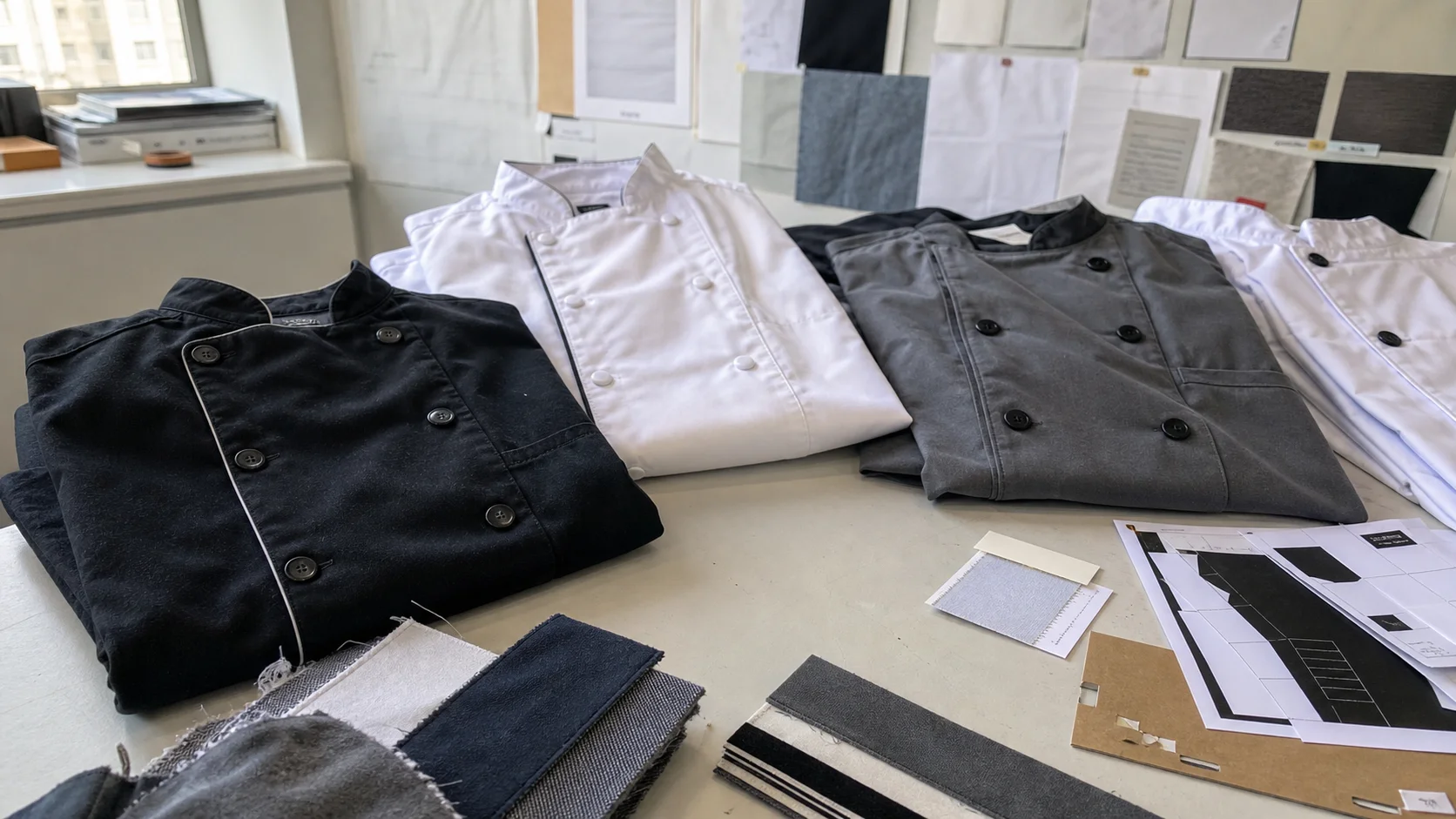
A field-service focused audit framework for evaluating a chef coat manufacturer’s needle policy, from stitch integrity and snag risk to repair rules,...
This checklist is for field service teams, sourcing managers, and quality staff auditing a chef coat manufacturer’s needle policy before bulk production starts. The topic sounds narrow, but the risk is broad. A weak needle control system can create broken-needle contamination, missed metal fragments, delayed approvals, and avoidable claims after shipment. In food-service apparel, that matters because chef coats are worn in kitchens where hygiene expectations are already high and the tolerance for foreign-object risk is low.
The right audit is not a paper exercise. It should test whether the factory can prove control over needles from issue to use, through breakage response, replacement logs, machine maintenance, and final inspection. It should also fit the realities of MOQ pressure, sample timing, trim selection, and production lead time. A manufacturer may quote an attractive price, but if its needle policy is vague, poorly documented, or loosely enforced, the commercial savings can disappear quickly.
Chef Coat Needle Policy Audit Checklist - MOQ, Cost & Sourcing manufacturing guide
Chef coats are usually sewn from woven cotton, cotton-poly blends, or performance fabrics with dense construction, reinforced seams, and repeated topstitching. That construction raises the number of needles in use across collar, front placket, sleeve hems, cuffs, pocket attachments, and logo placement. The more operations involved, the more places a broken needle can create a hidden defect.
A strong needle policy is a basic foreign-object control. It should define who issues needles, how needle counts are tracked, what happens after a break, and how the factory verifies that all fragments are recovered before production restarts. For a food-service garment, that control is not optional. It is part of the buyer’s risk management, especially where garments are sold into restaurant groups, catering suppliers, institutional food service, or branded hospitality programs.
Needle control also affects quality consistency. A factory that cannot manage broken needles tends to have weak discipline in adjacent areas such as machine maintenance, operator training, inspection logs, and traceability. That does not mean the factory is unsuitable, but it does mean the buyer should price in higher supervision and a stricter approval process.
A cheap quote is not cheap if the factory cannot prove needle accountability. In chef coats, foreign-object control is part of the product, not a separate compliance nice-to-have.
The audit should cover the policy itself, the physical controls, and the records used to enforce it. Field service teams should not limit the review to one sewing line. Needle risk exists across sample rooms, bulk lines, embellishment areas, repairs, and rework stations. If the factory uses subcontracted finishing or outside embroidery, the scope should include those operations as well.
At minimum, the audit should confirm four things:
For supplier onboarding, many buyers combine this audit with a broader capability review. If the factory needs help building the process, it is often more practical to start through the services page, then route detailed questions through the contact us page, and use the about us page to understand the company structure and sourcing approach. Those links do not replace the audit, but they help frame the relationship before production starts.
The checklist below is structured for a field audit. It is meant to be used line by line, with evidence collected during the visit. A verbal answer is not enough unless the factory can show records or demonstrate the control in practice.
Audit Area What to Verify Pass Signal Risk Signal Written policy Document covers issue, use, breakage, recovery, replacement, and escalation Current, signed, and used on the floor Generic or outdated SOP with no owner Needle inventory Needles are counted in and out by type and size Daily or shift records exist Open box access, no reconciliation Breakage response Operators stop work and report immediately Broken pieces are logged and recovered Operator replaces needle without reporting Fragment recovery Magnet, visual sweep, and line clearance process Recovery checklist completed before restart No proof fragments were found Machine controls Needle guards, maintenance checks, correct needle size for fabric Records match machine setup Frequent skipped maintenance or makeshift repair Training Operators and supervisors trained on needle policy Training records and refreshers available Training is informal or undocumented Final inspection Metal detection or equivalent risk control where applicable Test pieces and calibration logs exist No final check or no evidence of testing Traceability Needle incidents traceable to order, line, and date Records retained and searchable Only verbal memory, no systemAsk who owns the needle policy. It should not be “everyone” and therefore no one. A designated quality or production manager should be accountable for the procedure, records, and corrective actions. If the factory cannot name the owner, enforcement is likely inconsistent.
Needles should be issued in controlled quantities, typically by machine type, needle size, and production order. Open access to bulk needles weakens traceability. A practical system tracks the number issued, used, replaced, and returned or discarded. This is especially relevant when chef coats include different fabrics across styles, such as lightweight cotton for summer garments and heavier brushed twill for premium lines.
The factory should have a clear response when a needle breaks: stop the machine, secure the area, recover all fragments, record the incident, and inspect the affected garment or work zone. The policy should state who signs off before production restarts. A line supervisor’s signature matters more than a generic form if the signature is tied to a real control point.
The audit should confirm that the factory uses a logical recovery process. That often includes a magnet, careful hand search, machine-area sweep, and, where relevant, a secondary metal check. A single quick glance is not enough. The procedure should be aligned to the size of the broken needle and the fabric structure. Dense black twill, for example, can make visual recovery difficult, which raises the value of a disciplined search sequence.
After a break, the affected area should be cleared before any continuation of work. The risk is not limited to the operator’s own bundle. Nearby work-in-progress can be exposed as well. Field teams should ask how the factory defines the incident boundary: one garment, one bundle, one machine, or one production section. A vague answer usually means the scope is not controlled.
Training should cover machine operators, mechanics, quality inspectors, and line supervisors. The audit should request training dates, attendance logs, and refresher frequency. A useful question is whether new operators are allowed to sew on production orders before they can explain the breakage procedure. If not, the policy is probably not embedded.
Needle control should not end at the sewing line. Final inspection should include a method that can detect foreign-object risk at a reasonable level for the product. Some programs use metal detection, while others rely on controlled visual and tactile checks if the product structure and end-use risk allow it. For chef coats, buyers often prefer a more conservative approach because the garment is used in food environments.
A field service team should leave the factory with copies or photos of the key records. If a document exists but cannot be produced quickly, it is not operationally useful.
Records should be current, dated, and signed where necessary. A common problem is a policy written at head office, while the floor runs on memory. That gap is where risk accumulates.
Good records are simple enough for operators to use and specific enough for auditors to verify. They should identify the product style, order number, machine number, needle type, and responsible supervisor. If the factory produces multiple chef coat variants, the records should distinguish between the styles. A lightweight breathable coat may need a different needle and stitch setting than a heavyweight double-breasted version with reinforced buttons and sleeve cuffs.
The floor visit is where policy meets reality. The checklist should not be limited to a document review in the office. Walk the line and test whether the policy is visible in daily work.
Needle type matters. A chef coat made from tightly woven cotton or poly-cotton twill can tolerate a different needle point and size than one made from softer, brushed, or coated material. Incorrect needle selection can increase thread breaks, skipped stitches, and needle breakage. That creates more labor and more contamination risk. The cheapest needle is often the one that is chosen correctly for the fabric and stitch density.
Field teams should check whether the needle policy references the actual spec package, not just a general garment category. Useful items include fabric weight, weave, finish, thread count where relevant, button type, snap system, embroidery density, and reinforcement zones. Heavy embroidery on chest logos or sleeve patches can change the needle load enough to require a separate control note.
Spec Item Why It Matters Audit Question Fabric weight Influences needle choice and breakage rate Is the needle size matched to the GSM and weave? Thread type Changes tension and stitch stability Are thread specs approved before bulk? Buttons or snaps Can create hard points and resistance Are attachment operations separately controlled? Embroidery or logos Raises needle stress on dense areas Is a special needle setting used for logo zones? Reinforcement panels Adds thickness and increases breakage risk Are thick seams sampled before bulk start?The sample stage is where many needle problems can be predicted. If the sample room already shows excessive breakage, the bulk line will not improve on its own. Field service teams should confirm that sample approval includes not just appearance, but manufacturability.
A practical approval sequence usually looks like this:
MOQ should be discussed at the sample stage because the factory may accept a low MOQ only if the style is simple and the fabric is already in stock. For custom chef coats with embroidery, special buttons, or contrast piping, the MOQ often rises. Typical ranges vary by supplier, but a practical planning band for many cut-and-sew programs is 300 to 1,000 units per color or style for standard woven chef coats, with lower or higher thresholds depending on fabric reservation, decoration, and trim complexity. If a factory quotes far below that range, ask how it protects traceability and whether the cost was hidden in setup fees or material surcharges.
Sample approval should include a written note on needle policy expectations. That note can be short: needle type, breakage response, incident log requirement, and final inspection method. The goal is to prevent a factory from treating the policy as optional after the order is booked.
Needle policy affects commercial terms more than many buyers expect. Tight controls add some labor, some documentation time, and in certain cases extra inspection. That is a real cost. It is also cheaper than replacing a failed shipment or handling a customer complaint after delivery.
Lead time depends on more than sewing capacity. It is influenced by fabric sourcing, dyeing or finishing, trim procurement, sample approval cycles, embroidery booking, and the time needed to close any needle-related corrective action before bulk release. A simple stock-fabric chef coat can move quickly. A custom program with branded trims and a new fabric base can slow down sharply if the factory must reset its control documents or retrain operators.
Cost or Lead-Time Driver Effect on Needle Policy Buyer Judgment Low MOQ Less spread of setup cost, more pressure on efficiency Worth it only if control records stay intact Custom fabric Needle selection and breakage risk become style-specific Approve lab dips, shade, and hand-feel early Embroidery Dense stitching increases needle stress Separate approval for logo zone settings Metal detection Adds equipment and test discipline Useful when contamination risk must be minimized Rework and repair Higher probability of needle loss Limit repair loops or isolate them tightlyThere is a tradeoff between speed and control. A factory can often produce faster if it skips documentation and relies on operator experience. That approach is fragile. For food-service garments, a measured delay at the front end is usually acceptable if it gives you a stable production run and a better audit trail.
The most common failure is not dramatic. It is a small process drift: a broken needle is replaced without logging, the fragment is not fully recovered, and the bundle moves on. That single miss can create a latent foreign-object issue.
Other failure points include:
Inspection risk is highest when the style is simple enough to be treated casually. A basic chef coat can be more dangerous from a control perspective than a more complex style because teams assume there is nothing to monitor. The simplest garments can still hide the strongest process gaps.
For buying decisions, the right question is not whether a factory has a needle policy. The real question is whether the policy changes how the line behaves on a normal production day.
A straightforward scoring system helps field teams avoid vague conclusions. One practical approach is to rate each area as pass, partial, or fail. A pass means the control exists and is evidenced on the floor. A partial means the control exists but is not consistent or fully documented. A fail means the control is missing or not credible.
Recommended decision logic:
Focus on the high-risk items first. A missing written policy is serious, but a broken-needle incident without recovery and no line clearance is usually worse. If the factory cannot explain its response to a needle break in under a minute, the control is probably not internalized.
The audit should sit inside the normal sourcing process, not as an afterthought before shipment. The most efficient sequence is to review capability before quoting, confirm controls during sampling, and recheck the policy during the pre-production meeting. That way, the factory knows needle management is part of commercial qualification, not a late-stage quality surprise.
For teams managing multiple suppliers, standardizing the checklist helps with comparison. The same audit form can be used across basic white chef coats, branded hospitality uniforms, and premium presentation styles. This makes it easier to compare suppliers on a like-for-like basis even when fabric, trim, or MOQ differ.
When the supplier is already approved, use the audit to reset expectations before a new order. A common mistake is assuming a prior good run guarantees current compliance. Needle policy discipline can drift when the line changes, the supervisor rotates, or the style becomes more complicated.
For sourcing teams that need support with supplier qualification or order planning, it can be useful to align the audit with broader production services and supplier onboarding through the services page, then clarify commercial and operational questions via the contact us page. Background on company structure and sourcing focus can be reviewed on the about us page.
Get a free quote from Fabrikn — your trusted B2B clothing manufacturer with 10+ years of experience. MOQ as low as 200 pieces.
Get a Free Quote →It is a review of how a manufacturer controls sewing needles, responds to breakage, records incidents, and protects against foreign-object contamination during chef coat production.
Chef coats are used in kitchen environments where hygiene and foreign-object control matter. A missed needle fragment creates a risk that goes beyond garment appearance.
Many suppliers work in the range of 300 to 1,000 units per style or color for standard programs, though exact MOQ depends on fabric availability, decoration, and trim complexity.
Ask for the needle control SOP, issue and return logs, breakage records, training logs, machine maintenance records, and final inspection or metal detection verification logs if used.
Not always, but it is a strong control where foreign-object risk needs to be minimized. The decision should reflect fabric type, production complexity, and buyer risk tolerance.
The biggest red flag is a broken-needle response that is verbal only, with no recovery log, no line clearance, and no supervisor sign-off before production restarts.
Hold bulk release until corrective action is completed and evidenced. Partial controls are common, but they should not be treated as acceptable without closure.
Yes. Simple styles can be more dangerous from a control standpoint because teams may underestimate the risk and skip discipline on the floor.