
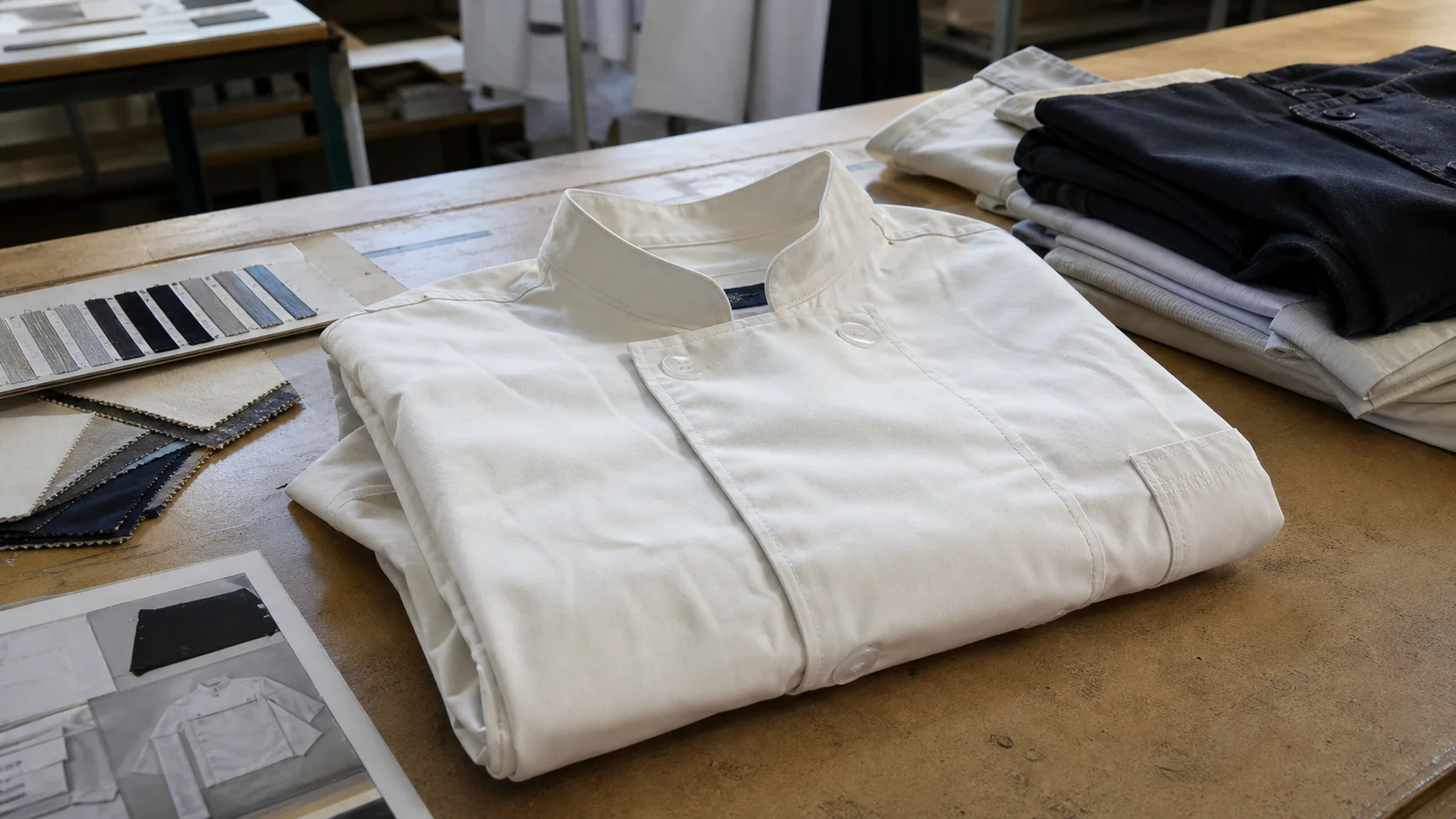
A sourcing-focused outline for auditing a chef coat supplier’s needle control policy, broken needle records, and garment safety controls before issuing...
Chef Coat Needle Policy Audit for Buyers - MOQ, Cost & Sourcing manufacturing guide
A chef coat supplier needle policy audit is not paperwork for the sake of paperwork. It is a practical sourcing control that protects buyers from broken needle contamination, shipment rejection, brand damage, and avoidable production delays. For field service teams, the needle policy is one of the clearest indicators of whether a factory treats safety controls as a daily operating discipline or only as a document prepared for customer visits.
Chef coats may look simple compared with fashion outerwear or technical uniforms, but they still carry sewing-risk exposure. A typical chef coat includes dense stitching, plackets, collars, cuffs, bar tacks, buttonholes, pocket seams, side vents, labels, and sometimes contrast piping or embroidery. Every one of these operations uses needles, and every needle can break if operators use the wrong size, stitch through thick seam intersections, run machines at unsuitable speed, or fail to replace worn needles on time.
For B2B buyers, the issue is not only whether the supplier owns a metal detector. A metal detector at final packing is useful, but it is a last gate. Strong control starts before production, continues at sewing-line level, and is verified during in-line and final inspection. A buyer should be asking: who issues needles, who records replacements, what happens when a needle breaks, who searches for fragments, and how the batch is released after the incident?
This matters even more when the chef coats are supplied to hotel groups, restaurant chains, catering operators, culinary schools, institutional kitchens, and facilities management companies. These buyers often reorder the same garment repeatedly. A weak supplier may pass one shipment by luck, but repeat programs need consistent controls. Needle discipline is part of supplier reliability, not a side issue.
Purchasing judgment: if a chef coat factory cannot explain its broken needle procedure clearly at sewing-line level, treat that as a sourcing risk even if the price looks attractive.
A chef coat supplier needle policy audit should be done before bulk production whenever possible. It is cheaper to identify control gaps at onboarding than to negotiate after a shipment is finished, packed, and urgently needed by a uniform program.
Buyers should request the supplier’s written needle control policy, but the document is only the starting point. The field service team should compare the policy with actual factory practice. Many factories can produce a basic policy file. Fewer can show clean records, trained operators, controlled storage, incident logs, and proper quarantine handling.
A buyer should also check whether the policy applies to subcontractors. Chef coat production may be partly outsourced for embroidery, washing, pressing, or button attachment. If the main supplier controls its own sewing room but sends panels or finished garments to an uncontrolled subcontractor, the buyer still carries the risk.
For buyers building a structured sourcing program, it is useful to align the audit with broader supplier onboarding. Fabrikn’s sourcing and production support pages at /services/ can be used as a reference point for thinking about supplier management, production follow-up, and inspection planning.
A reliable needle policy should be simple enough for factory staff to follow every day. Complicated forms can look impressive, but weak execution is common when operators do not understand the process or supervisors treat records as end-of-day paperwork.
Needles should be stored in a controlled cabinet, room, or locked box. Operators should not keep loose spare needles in drawers, machine trays, pockets, or personal toolkits. The factory should be able to show current needle inventory and issue records.
For chef coats, common needle types may vary depending on fabric. A lighter poly-cotton poplin may use a different needle than a heavy cotton drill, twill, or canvas-like chef jacket. The supplier should define approved needle sizes by operation and fabric type. A practical technical file may specify needle system, size, point type, thread ticket, stitch density, seam allowance, and machine type.
Needles should be issued by a responsible person, usually a line supervisor, mechanic, quality controller, or tool-room staff member. A one-for-one exchange policy is preferred. When an operator needs a replacement needle, the old needle is returned before a new one is issued. This reduces uncontrolled needle accumulation at the machine.
For broken needles, the procedure must be stricter. The operator should immediately stop sewing and notify the supervisor. The supervisor should collect all fragments, attach them to a broken needle report, and verify that the full needle has been recovered. If all pieces are not found, the affected garment bundle and surrounding work must be quarantined.
The incident log should record the date, time, production line, style number, purchase order, operator, machine number, operation, needle size, reason for breakage if known, action taken, and final release decision. Strong factories also record whether metal detection was performed after the incident.
The buyer’s field team should not only check that logs exist. They should review whether the records make sense. A factory with hundreds of machines and no broken needle incidents over several months may not be recording properly. A factory with frequent breakages on the same operation may have an engineering problem, such as thick seam buildup, wrong needle size, poor machine adjustment, incorrect thread tension, or rushed operators.
Fragment recovery is the core of the policy. If a needle breaks, the factory must prove that every piece has been recovered. A partial recovery should trigger quarantine. Work-in-progress from the operator’s table, nearby bundle, machine area, waste bin, and floor area should be checked.
Chef coats with multi-layer plackets, sleeve cuffs, collar stands, and reinforced pockets may trap fragments in folds or seam allowances. This is why a quick visual check is not enough. The supplier should have magnets, handheld detectors where appropriate, and access to calibrated metal detection for affected garments.
Metal detection is a common requirement for uniforms, workwear, childrenswear, food-service garments, and hospitality apparel. For chef coats, it is especially relevant because the wearer works around food preparation areas. A broken needle fragment in a chef coat pocket, cuff, placket, or seam is a serious customer complaint risk.
The buyer should check whether the factory’s metal detector is calibrated and suitable for the product. Calibration records should be current. Test cards or certified test pieces should be used at defined intervals, commonly at start-up, after breaks, after maintenance, and at the end of a shift. The factory should document rejected pieces and re-check actions.
Control Area Good Practice Buyer Risk if Missing Needle storage Locked storage with nominated issuer Loose needles enter production without traceability Needle issue One-for-one replacement record Operators keep spare needles at machines Broken needle handling Stop work, recover fragments, quarantine if incomplete Fragments may remain inside chef coats Metal detection Calibrated checks with reject log Final packed goods may contain metal contamination Subcontractor control Same policy applied to outsourced processes Risk moves outside the main factory’s recordsField service teams are the buyer’s eyes on the ground. Their job is not to admire the factory tour. Their job is to verify whether production controls are real, repeatable, and relevant to the order being placed.
A practical audit starts with document review, then moves to factory-floor observation. The auditor should ask the factory to show the needle storage area, current issue log, broken needle log, metal detector, quarantine zone, and current chef coat production line if available. If the factory is not currently sewing chef coats, the team can still review similar woven jacket or uniform production.
Direct questioning is useful. Operators usually reveal whether the policy is practiced. If an operator says they replace needles themselves from a drawer, the written policy is not being followed. If a supervisor cannot show where broken fragments are stored, the incident system is probably weak.
The field team should also observe the type of chef coat being produced. A light short-sleeve cook shirt has different risk exposure than a long-sleeve double-breasted chef coat with thick front panels and bar-tacked pockets. Dense areas increase needle stress. Thick seam intersections should be reviewed for machine suitability and needle choice.
Buyers can score needle policy compliance as acceptable, conditional, or unacceptable. An acceptable supplier has controlled storage, clear issue records, trained operators, broken needle incident handling, quarantine, and metal detection. A conditional supplier may have the basics but needs corrective action before bulk production. An unacceptable supplier has loose needles, no real incident process, no quarantine discipline, or no final metal detection where required by the buyer.
Purchasing judgment: a conditional supplier can be used for low-complexity orders only if corrective actions are verified before cutting bulk fabric. Do not wait until final inspection to solve needle control problems.
Needle policy has a cost impact, even if it does not appear as a separate line item on the quote. Strong factories spend time on training, records, calibration, maintenance, metal detection, and quality supervision. Weak factories can quote lower because they skip controls. The buyer needs to decide whether the price gap is worth the operational risk.
For chef coat sourcing, typical MOQ ranges depend on fabric availability, color, trims, size ratio, branding, and whether the garment uses stock fabric or custom-developed material. A stock white poly-cotton chef coat may be possible from around 300 to 500 pieces per style in some supplier setups. Custom colors, heavier fabric, special buttons, embroidery, private labels, or full-size assortments may push practical MOQs to 800 to 1,500 pieces per style. Custom fabric weaving or dyeing can move the MOQ higher, often 2,000 to 3,000 pieces or more depending on mill requirements.
Small buyers often ask for 100 pieces per design across many sizes. That can be difficult for a factory making fully compliant uniform production because cutting, sewing setup, trims allocation, labeling, inspection, packing, and documentation costs are spread over too few units. A supplier may accept the order, but the unit cost will rise, or the production may be placed in a smaller workshop with weaker controls.
Buyers should not evaluate chef coat suppliers only by FOB price. A factory that quotes a lower price but lacks metal detection, needle logs, and proper inspection control can create expensive claims. A rejected shipment can cost more than the original saving, especially for time-sensitive uniform rollouts.
If the buyer needs help structuring supplier conversations, technical expectations, or production follow-up, a practical next step is to contact a sourcing partner through /contact-us/ before confirming the purchase order.
Needle policy audit should connect with sample approval. A sample room may not operate exactly like bulk production, but it still reveals how the supplier thinks about garment engineering. If the sample has puckering, skipped stitches, broken thread, uneven buttonholes, or needle damage marks, the bulk order may face higher breakage risk.
The technical file should include construction details that affect sewing risk. For example, buyers should define seam type, stitch per inch, thread color, thread quality, button attachment method, pocket placement, bar tack positions, collar interlining, cuff construction, and placket layers. Vague specifications cause factories to improvise. Improvisation can lead to thicker seam areas, unsuitable needles, and inconsistent workmanship.
Fabric and trim specifications also matter. A 65/35 poly-cotton fabric at 160 gsm behaves differently from a 100% cotton twill at 220 gsm. Stretch fabrics may require different needle choices and tension settings. Resin buttons, metal snaps, press studs, or hidden fasteners each add different machine operations. If embroidery is required, the embroidery supplier should follow the same sharp tool and needle control expectations.
Lead time is not fixed by garment type alone. It depends on fabric availability, lab dips, strike-offs, trim sourcing, sample approval speed, order quantity, production-line capacity, public holidays, inspection scheduling, and shipping method. For stock fabric chef coats, a practical production lead time may fall around 30 to 45 days after sample and trim approval. For custom fabric or custom-dyed colors, 60 to 90 days is more realistic. Delayed sample comments can add one or two weeks quickly.
Needle policy corrective actions can also affect lead time. If the audit finds missing logs, uncontrolled storage, or no metal detector process, buyers should allow time for corrective action and verification. Rushing into bulk production after a failed control audit is a poor tradeoff.
Final inspection should not be treated as the only quality gate. For chef coats, in-line inspection is often more useful because problems can be corrected before hundreds or thousands of garments are finished. Needle control should be checked during both in-line and final inspection.
AQL inspection can catch visible defects, but broken needle contamination needs a specific control process. Inspectors should review metal detection records, calibration checks, rejection logs, and broken needle incident records. They should also confirm that finished cartons are not mixed with unscanned goods.
One common risk is partial inspection after packing. If the factory metal-detects garments before final pressing or before button attachment, later operations may reintroduce metal risk. The buyer should define when detection must occur. For many programs, metal detection after all sewing and finishing operations is the safer requirement.
Chef coats are often packed by size and color for distribution to restaurants, hotels, or regional warehouses. Packing accuracy matters. A clean needle policy does not replace carton control. Field teams should check size ratio, carton marks, barcode labels, polybag warnings where required, and packing list accuracy.
Cartons should not contain loose staples, broken blades, or metal clips. If the supplier uses staples in packing, buyers should consider prohibiting them for uniform shipments. Tape and carton sealing methods should be specified. Packing tables should be kept clean, and finished garments should not be placed directly on dirty floors or uncontrolled surfaces.
A buyer-facing checklist keeps audits consistent across suppliers. It also helps purchasing teams compare factories beyond price. The checklist should be short enough for field use but detailed enough to reveal weak controls.
Audit Item Evidence to Request Pass/Concern Written needle policy Current controlled document with responsible person Pass only if factory practice matches document Needle inventory Storage cabinet, issue log, stock balance Concern if needles are loose at machines Broken needle records Incident forms with fragments attached Concern if records are blank for long periods Operator training Training records and operator interviews Concern if operators cannot explain procedure Quarantine control Marked area and release process Concern if quarantined goods are mixed with normal WIP Metal detector Calibration records and reject log Concern if checks are irregular or undocumented Subcontractor control Approved vendor list and control agreement Concern if embroidery or washing is unmanagedIf a supplier fails the audit, the buyer has three choices. The first is to reject the supplier and move to another source. The second is to approve conditional corrective action with a firm deadline before bulk cutting. The third is to reduce order complexity or move only a limited trial order, though this should not be used when safety controls are clearly absent.
Strong sourcing decisions are not only about finding the lowest MOQ or fastest lead time. A good chef coat supplier should be able to make the garment consistently, document the process, and protect the buyer from avoidable safety complaints. Buyers can review broader company background and sourcing orientation through /about-us/ when planning supplier evaluation standards.
For repeat chef coat programs, buyers should include needle policy requirements in the purchase order, supplier manual, or quality agreement. The requirement should state that all needles and sharp tools must be controlled, broken needle incidents must be documented, affected goods must be quarantined, and finished garments must pass metal detection where specified.
The buyer should also define the consequences of non-compliance. This may include shipment hold, 100% re-screening, third-party inspection, corrective action, chargebacks where contractually agreed, or supplier disqualification for repeated failures. The point is not to punish suppliers. The point is to make expectations clear before production starts.
For new suppliers, do not place a large multi-SKU rollout before verifying the control system. Start with a controlled program, inspect early, and scale only after the supplier proves consistency. For established suppliers, do not assume yesterday’s audit still applies. Machines change, supervisors leave, subcontractors shift, and production pressure rises during peak periods.
Price, MOQ, and lead time still matter. A buyer may choose a higher-cost supplier because the factory has better documentation and stronger final controls. That can be the right decision for corporate uniform programs where failed delivery or safety complaints create wider business disruption. A lower-cost supplier may still be suitable for simple low-risk orders if corrective actions are verified and the buyer maintains inspection discipline.
Bottom line: needle policy is a buying filter. If the supplier cannot control small sharp objects, it may also struggle with measurement discipline, packing accuracy, subcontractor control, and delivery reliability.
Get a free quote from Fabrikn — your trusted B2B clothing manufacturer with 10+ years of experience. MOQ as low as 200 pieces.
Get a Free Quote →A chef coat supplier needle policy audit checks how a factory controls sewing needles and other sharp objects during production. It reviews written procedures, needle issue records, broken needle logs, fragment recovery, quarantine handling, operator training, and metal detection records.
Chef coats are worn in food-service environments, so metal contamination risk is taken seriously. Broken needle fragments can become trapped in seams, cuffs, plackets, pockets, or folded garment areas. A proper needle policy reduces the chance of contaminated garments reaching the buyer.
MOQ depends on fabric, color, trim, size range, and branding. Stock fabric chef coats may be possible around 300 to 500 pieces per style in some cases. Custom colors or trims often move practical MOQs to 800 to 1,500 pieces. Custom fabric development may require 2,000 to 3,000 pieces or more.
For many uniform and food-service programs, metal detection is a sensible requirement. It should happen after sewing and finishing operations, not too early in the process. Buyers should request calibration records, test procedures, and reject logs.
The operator should stop work immediately and notify the supervisor. All needle fragments should be recovered and attached to an incident record. Affected garments and work-in-progress should be quarantined if full recovery is not confirmed. The goods should be checked before release.
It depends on the buyer’s risk standard and product category, but absence of metal detection is a concern for chef coats supplied to professional food-service environments. If the factory does not own a detector, the buyer should verify whether a controlled external detection process is available before approving production.
They should compare written procedures with factory-floor practice. Useful checks include operator interviews, workstation inspections, needle storage review, broken needle record review, quarantine area inspection, and metal detector log verification.
The best timing is before purchase order approval or at least before bulk fabric cutting. Follow-up checks should be done during in-line inspection and final inspection, especially for new suppliers or large uniform rollouts.
Yes. Proper control requires training, supervision, records, metal detection, maintenance, and quality management. These costs may be included in the garment price. A cheaper supplier without controls can create higher downstream risk through claims, delays, or rejected shipments.
Major red flags include loose needles at machines, no broken needle logs, no fragment recovery, operators who do not know the procedure, missing metal detector calibration records, unmanaged subcontractors, and no quarantine area for affected goods.