
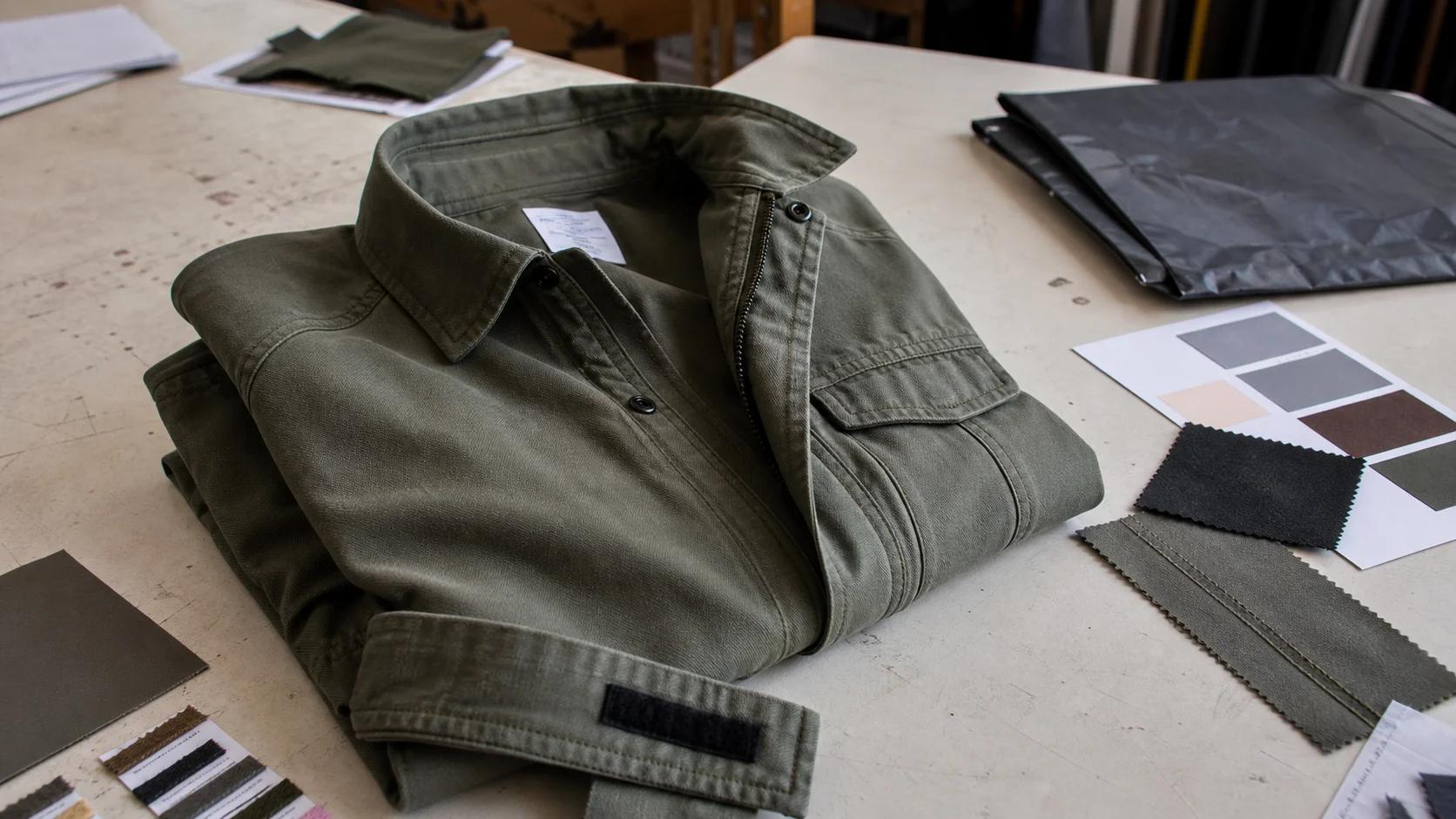
A quality inspection outline for security contractors ordering chef coats, focused on colorfastness risks, lab tests, wash simulations, shade control, and...
Chef Coat Colorfastness Audit for Secure Orders - Fabrikn production reference
Chef coat order colorfastness audit for security contractors is not a cosmetic detail. It is a purchasing control point. Security contractors that supply food-service uniforms for guarded facilities, event kitchens, government support sites, transport catering units, or controlled-access hospitality programs need garments that keep a consistent appearance under repeated laundering, sweat, rubbing, heat, and cleaning exposure.
A chef coat may look acceptable on a sample hanger and still fail after five industrial washes. Dark piping may bleed into a white body. Black coats may turn brownish or grey. Navy trims may stain white cuffs. Embroidered logos may run around the thread edge. For a contractor managing uniforms across multiple sites, that becomes more than a quality complaint. It affects staff presentation, contract compliance, replacement cost, and inventory control.
Colorfastness auditing is the process of checking whether fabric, trim, thread, buttons, labels, and decoration can hold color within agreed limits. For secure orders, the audit should be documented before bulk approval and verified during production. The goal is not to chase laboratory perfection on every garment. The goal is to reduce predictable failures before money is tied up in finished stock.
Buyers sourcing chef coats through a B2B apparel partner should treat colorfastness as part of the technical package, not as a vague “good quality” expectation. If you need support turning uniform requirements into a controlled production brief, review the manufacturing and sourcing scope on Fabrikn’s services page.
A proper audit starts with the full garment, not only the main shell fabric. Chef coats often combine several color-risk components. A white poly-cotton coat may include black plastic buttons, contrast piping, woven neck labels, polyester sewing thread, embroidery, heat-transfer labels, and pocket bartacks. Each component can react differently during washing and wear.
Security contractors usually need dependable repeat orders. That means one approved batch must be reproducible across future purchase orders. The audit should define shade, acceptable variation, test methods, washing method, packaging controls, and inspection criteria. Without those details, disputes become subjective.
The audit should also check color transfer risk from garment to garment. This is often missed. A dark chef coat packed tightly against white garments may transfer shade if moisture, steam, or residual dye is present. Polybags reduce some risk, but poor drying after finishing can still create staining inside packaging.
Purchasing judgment: if a supplier says “the fabric is colorfast” but cannot confirm the test method, staining grade, wash temperature, or approved care process, the statement is not strong enough for a controlled uniform order.
Chef coats are commonly made in poly-cotton twill, plain weave, herringbone, poplin, canvas-style workwear fabric, or cotton-rich blends. White remains the traditional color, but contractors may specify black, charcoal, navy, burgundy, grey, or brand-specific shades for different staff roles. Each choice carries a different colorfastness profile.
White fabric has less dye bleeding risk, but it can suffer from staining caused by trims, labels, contrast thread, or dirty production handling. Dark fabrics have more obvious fading and crocking risk. Bright colors, especially red, royal blue, and deep black, often need closer testing because dye migration and shade change can be more visible after laundering.
The buyer should request fabric weight in GSM, yarn count or construction where available, shrinkage target, color code, finish type, and care instructions. For chef coats used in controlled facilities, the care route matters. Domestic washing at 40°C is very different from industrial laundering at 60°C or 75°C with alkaline detergent.
Security contractors should avoid approving a shade from a screen image, catalog photo, or loose verbal description. Use a physical lab dip or strike-off. For repeat programs, keep an approved master swatch in a sealed, labeled file. Shade bands can be useful when the fabric is reordered across dye lots.
A chef coat colorfastness audit should use tests that reflect actual use. Not every order needs every laboratory test, but secure orders need enough evidence to support bulk acceptance. The most relevant tests usually include washing, rubbing, perspiration, water, and sometimes chlorine or light exposure.
This checks whether the fabric changes shade or stains adjacent fabric during washing. It is one of the most important tests for chef coats because kitchen uniforms are washed frequently. The buyer should specify the wash temperature, detergent type, cycle length, and drying method. If the contractor uses industrial laundry, the test should be closer to that environment rather than a gentle home-wash setting.
Typical acceptance grades may be set using grey scale ratings. Many commercial apparel orders target grade 4 or above for color change and staining, while some dark shades or cost-sensitive programs may accept grade 3-4 with written approval. For security contractor uniforms, grade expectations should be conservative because replacements and complaints are expensive.
Rubbing tests check whether color transfers when the fabric is rubbed dry or wet. Dark chef coats, dark aprons, black trims, and navy collars deserve attention. Wet rubbing is often weaker than dry rubbing, especially on cotton-rich dark fabric.
Weak crocking can cause dark marks on white undershirts, light aprons, towels, chairs, or adjacent garments. In a secure facility, even small appearance defects may be escalated because staff presentation is part of contract performance.
Chef coats worn in hot kitchens are exposed to sweat around collars, underarms, cuffs, and back panels. Perspiration testing checks color change and staining under acidic or alkaline sweat conditions. This is relevant for black, navy, red, and contrast-trim coats.
If the garment includes embroidery near the chest or sleeve, the embroidery thread should also be checked. Some embroidery looks clean at first but bleeds after heat, moisture, and pressure.
Water fastness and storage migration matter when garments move through humid shipping lanes or sit in warehouses. A tightly folded chef coat with a dark collar against a white chest panel may show contact staining if dye or finishing chemicals are unstable. This is not common in well-controlled production, but when it happens, the full carton may be affected.
Kitchen environments often involve chlorine, peroxide, degreasers, sanitizers, and strong detergents. No buyer should assume a colored chef coat is bleach-resistant unless it is specifically engineered and tested for that purpose. A black coat that passes standard washing may still show orange marks after chlorine contact.
Care labels should be realistic. If the coat cannot tolerate chlorine bleach, the label and staff instructions must say so. For white coats, optical brighteners and chlorine use can change shade over time. Buyers supplying multiple sites should align garment care instructions with the laundry process actually used on site.
Pre-production control is where most colorfastness problems should be caught. Waiting until final inspection is risky because finished garments may already be cut, sewn, pressed, packed, and invoiced. A disciplined approval process reduces the chance of bulk rejection.
The technical package should include garment sketches, size chart, fabric composition, GSM, construction, shade reference, trim details, logo method, label position, care label wording, packing instructions, and inspection standard. For colorfastness, specify required test methods and minimum grade levels.
Where brand colors or role-based color coding matters, use Pantone references only as a starting point. Pantone on paper does not perfectly translate to textile dye. Physical lab dips remain necessary.
Lab dips should be reviewed under controlled lighting. Buyers should check shade in daylight-equivalent light and under the lighting likely used at the facility. If garments will be worn under warm kitchen lighting, shade perception may shift.
Trim color must be reviewed at the same time. A navy body with black buttons may be acceptable, but a navy body with mismatched dark thread can look careless. For white chef coats with contrast piping, the contrast trim should be tested against the white body fabric before bulk cutting.
Fit samples focus mainly on measurement, construction, pocket placement, collar shape, sleeve length, and mobility. Color may not be final at this stage if substitute fabric is used. Buyers should clearly mark whether the sample is approved for fit only or approved for fabric and color as well.
Confusion at this stage causes problems. A factory may assume a sample approval covers the full garment, while the buyer may think color remains pending. Written sample comments should separate fit, fabric, trim, logo, and packaging approvals.
Before cutting bulk fabric, test the actual fabric lot. This is especially important for dark shades, contrast fabrics, or repeat orders where a new dye lot is introduced. The pre-production test should include washing and rubbing at minimum. If the order is large or used in high-heat sites, include perspiration and water fastness.
The pre-production sample should be made with actual bulk fabric, actual trims, actual thread, actual logo method, and intended care label. This is the most important garment sample before bulk manufacturing.
A buyer should not release full production based only on a salesman sample or catalog sample. For secure uniform orders, the pre-production sample should be sealed and referenced as the production standard. Keep one approved sample with the supplier and one with the buyer if possible.
Bulk inspection should check whether production matches the approved standard and whether any new color risks appeared during manufacturing. Colorfastness is partly a lab issue and partly a production-control issue. Poor handling, mixed dye lots, damp packing, and wrong trims can create failures even when the original fabric was acceptable.
Fabric rolls should be inspected before cutting. Check shade continuity across rolls, roll-end variation, stains, oil marks, uneven dyeing, and fabric face consistency. For critical orders, separate rolls by shade lot and use shade grouping in cutting. Mixing roll shades across panels can create visible garment mismatch.
A common issue is using one roll for front panels and another roll for sleeves without shade control. The coat may pass measurement inspection but fail visually because the sleeves look slightly different from the body.
Inline inspection catches problems while sewing is still underway. Check thread shade, button shade, piping placement, collar/cuff shade consistency, and logo color. If embroidery is used, inspect thread tension and backing removal. Excessive steam pressing can sometimes expose trim bleeding or shade marks, especially on contrast details.
Final inspection should include workmanship, measurement, packaging, labeling, quantity, assortment, and visual shade checks. The inspector should compare finished garments to the approved sample and shade standard. Cartons should be opened from different production lots if the order was produced over multiple days.
AQL inspection is commonly used in apparel orders. Typical general inspection levels may use AQL 2.5 for major defects and 4.0 for minor defects, though stricter levels may be needed for uniform programs with contractual penalties. Color bleeding, visible shade mismatch, staining, and wrong trim color should normally be treated as major defects.
For higher-risk orders, a small wash check on finished garments can be useful before shipment. This does not replace formal lab testing, but it may reveal obvious bleeding, shrinkage, or trim staining. The test must be planned because washing and drying sample garments takes time.
Purchasing judgment: a final inspection without any wash or rub evidence is weak for dark chef coat orders. It may verify sewing quality, but it does not prove the coat will survive the first laundry cycle.
Minimum order quantity depends on fabric availability, color, trim customization, logo method, and factory setup. For standard white chef coats using stock fabric, MOQs may start around 100 to 300 pieces per style or color with some suppliers. For custom-dyed fabric, the MOQ may move to 500, 800, 1,000, or more pieces because the mill needs a dye lot minimum.
Small orders can still be made, but buyers should understand the tradeoffs. A supplier may use available stock fabric, which reduces lead time but limits shade control. Custom fabric improves control, but it raises MOQ, development time, and upfront approval work. For security contractors running recurring uniform programs, custom fabric may be worthwhile once demand is stable.
Lead time also varies. Sampling may take 7 to 20 days once fabric and trims are available. Lab dips may add 5 to 10 days per round. Bulk production for standard chef coats may take 25 to 45 days after approvals, while custom-dyed fabric, special trims, or laboratory testing can extend the schedule. Shipping method, inspection booking, and payment terms also affect delivery.
Buyers should not compress the color approval stage to save a week, then risk replacing hundreds of garments. If timing is tight, the better compromise is to use proven stock fabric in approved colors, not to skip testing on a risky custom shade.
Before placing a chef coat order for security contractors, buyers should ask direct questions. The supplier’s answers will show whether they understand uniform-grade production or only basic apparel selling.
If the supplier cannot answer these questions clearly, the buyer should either reduce the order risk with a smaller pilot run or move to a more controlled sourcing process. For contractors managing public-facing teams, a lower unit price is not helpful if the order creates replacement pressure after the first wash cycle.
For discussion on a controlled sourcing brief, buyers can reach out through Fabrikn’s contact page.
Colorfastness standards should match the order risk. A small café buying a few fashion-style chef coats may accept more variation. A security contractor supplying uniforms under a service contract usually cannot. The garment is part of a controlled operating system. Consistency matters.
For secure orders, the strongest purchasing route is to build a controlled approval chain: fabric specification, lab dip, trim approval, test report, pre-production sample, incoming fabric check, inline inspection, final inspection, and retained standard. This does not need to be overcomplicated, but it must be written down.
Price comparisons should be made on equal specifications. One supplier may quote lower because they use stock fabric with unknown wash performance. Another may quote higher because they include bulk fabric testing and shade control. The cheaper quote is not always wrong, but the buyer must know what is being removed.
Stock fabric is sensible when the shade is standard, the order is urgent, the budget is tight, and the supplier has recent test evidence for that fabric quality. White chef coats in standard poly-cotton twill are often good candidates, provided trims and logos are controlled.
Custom testing is recommended for black, navy, red, burgundy, or any contrast-heavy chef coat. It is also recommended when garments will be industrially laundered, used in humid environments, stored for long periods, or supplied under a contract with strict appearance requirements.
A pilot order is useful when the contractor is introducing a new uniform design or moving from white coats to dark coats. A pilot of 50 to 100 pieces may reveal laundering, fit, shrinkage, and color issues before a larger rollout. Some suppliers may resist very small custom runs, so buyers may need to use stock fabric for the pilot and custom development for the rollout.
The best audit is not only about rejecting defects. It supports better decisions before production starts. Security contractors should use colorfastness checks to choose the right fabric route, negotiate realistic lead times, and reduce claim exposure after delivery.
Several defects are easy to overlook during a standard visual inspection. Shade difference under folded panels may not be visible until the coat is worn. Wet crocking does not show unless tested. A label may be accurate for domestic washing but unsuitable for a contractor’s actual laundry process. A dark trim may pass when tested alone but fail when stitched against white fabric.
Inspectors should be briefed with the risk profile of the order. A generic checklist may catch skipped stitches and open seams, but it may not focus enough on color migration. For chef coats, inspection should include collar edges, cuff folds, underarm seams, pocket mouths, button plackets, and embroidery zones.
Carton assortment also matters. If multiple colors are shipped together, the packing plan should prevent dark garments from pressing directly against light garments. Moisture control is important in long-distance freight. Cartons should be dry, clean, and free from strong odors. Garments should be fully dry after pressing before they are packed.
Repeat orders are where documentation pays off. Security contractors may reorder the same chef coat every quarter or every season. If the first order was approved informally, the second order may drift in shade, fabric weight, thread color, or button quality.
A practical repeat-order file should include the approved garment sample, approved fabric swatch, colorfastness reports, size specification, trim cards, logo artwork, care label wording, carton marking, inspection standard, and previous order defect notes. The supplier should confirm any material changes before production.
When programs grow, buyers may consider a vendor manual or uniform quality manual. This does not need to be long. A clear two-page quality appendix can prevent many problems if it defines colorfastness expectations, inspection levels, packaging rules, and escalation steps.
For buyers evaluating a sourcing partner’s background and approach, Fabrikn’s about page provides useful company context.
A chef coat order colorfastness audit for security contractors should be treated as a contract-protection measure. The audit verifies that the garment can keep its appearance through washing, wear, handling, and storage. It also creates a written standard that helps suppliers, buyers, inspectors, and laundry teams work from the same expectations.
The strongest buyers do not wait for color complaints. They specify the fabric, approve physical shade standards, test the correct components, check bulk material before cutting, and inspect finished garments against a retained sample. This approach costs more time upfront, but it protects the order value and reduces avoidable replacement claims.
In uniform sourcing, the safest order is not always the lowest quoted order. It is the order where fabric performance, trim compatibility, production controls, and inspection evidence all line up before shipment.
Get a free quote from Fabrikn — your trusted B2B clothing manufacturer with 10+ years of experience. MOQ as low as 200 pieces.
Get a Free Quote →Colorfastness means the ability of fabric, trim, thread, and decoration to resist fading, bleeding, or staining during washing, rubbing, perspiration, water exposure, and storage. For chef coats, it is especially important because the garments are washed often and exposed to heat, sweat, detergents, and kitchen chemicals.
Security contractors often supply uniforms under service agreements where appearance, consistency, and replacement control matter. A failed chef coat order can create staff presentation issues, contract complaints, and extra inventory cost. Stricter audits reduce these risks before bulk shipment.
Black, navy, burgundy, red, and other dark or saturated shades usually carry higher fading and crocking risk. White coats have lower dye-fading risk but can be stained by dark trims, embroidery, labels, or poor handling. Contrast designs need special attention.
At minimum, buyers should consider colorfastness to washing and rubbing. For higher-risk chef coat orders, add perspiration, water fastness, and testing of contrast trims against the main fabric. If industrial laundering is used, the test conditions should reflect the real laundry process as closely as possible.
Standard stock chef coats may start around 100 to 300 pieces, depending on supplier and customization. Stock colored fabric may require 200 to 500 pieces. Custom-dyed fabric often needs 500 to 1,500 pieces or more because of mill dye lot minimums. Special trims can add separate MOQ requirements.
Sampling can take about 7 to 20 days once materials are ready. Lab dips may add 5 to 10 days per round. Bulk production often takes 25 to 45 days after approvals for standard orders. Custom dyeing, special trims, lab testing, inspection, and shipping can extend the timeline.
Final inspection can catch visible shade mismatch, staining, wrong trims, and packaging issues. It cannot fully prove wash durability unless testing or a finished-garment wash check is included. Colorfastness should be controlled before cutting and verified through testing where order risk justifies it.
Previous reports are useful but not always enough. The report should match the same fabric quality, shade family, dye method, and finish. For secure orders, testing the actual bulk fabric lot is safer, especially for dark colors or repeat orders using a new dye lot.
The biggest mistake is approving a garment sample for appearance without confirming fabric performance. A chef coat can look correct before washing and still fail in use. Buyers should separate fit approval, fabric approval, trim approval, and colorfastness approval.