
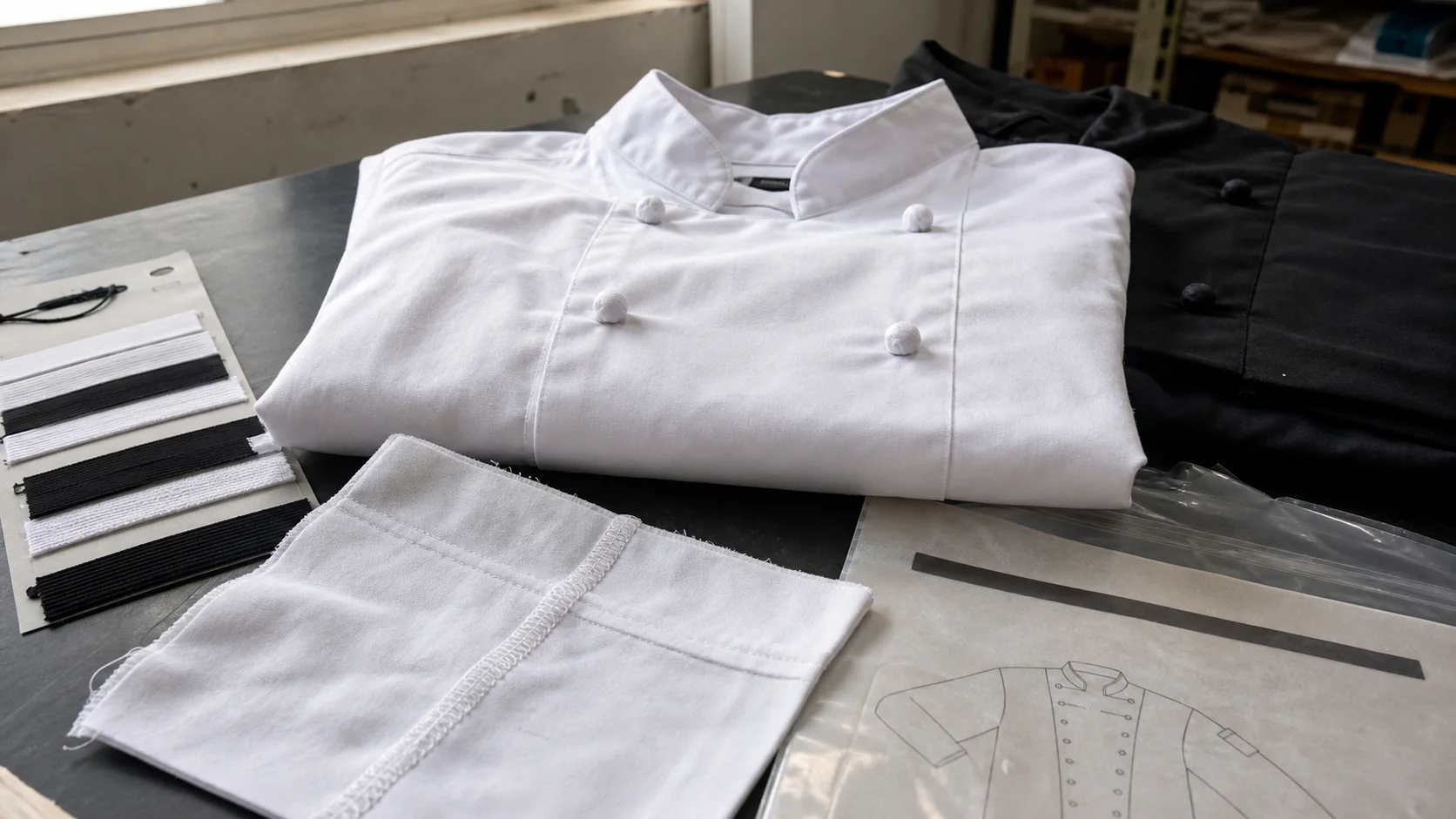
A product-specific SEO outline for warehouse safety teams evaluating chef coat factory seam strength, reinforcement quality, test evidence, and sourcing...
Chef Coat Seam Strength Review for Safety Buyers - MOQ, Cost & Sourcing manufacturing guide
Chef coat seam strength is not only a garment quality issue. For warehouse safety teams, catering operators, food production buyers, and uniform sourcing managers, it affects worker comfort, replacement cost, and operational risk. A chef coat may look acceptable on a hanger, but weak seams can fail during lifting, reaching, washing, or repeated bending. Once that happens, the garment stops doing its job as a protective professional uniform.
The keyword here is practical durability. Buyers sourcing from a chef coat factory need to review seam performance before approving bulk production, especially when uniforms will be issued across warehouses, commercial kitchens, central commissaries, food logistics hubs, or institutional catering sites. These environments are harder on garments than showroom photos suggest.
A warehouse safety team usually focuses on protective footwear, gloves, visibility, slips, and machine safety. Uniform seams can look like a smaller issue. That is a mistake when garments are used daily and laundered aggressively. Torn underarms, split side seams, loose sleeve seams, and failing button plackets create snag risks, poor appearance, and premature replacement costs.
Buying judgment: seam strength should be treated as a required performance checkpoint, not as a minor finishing detail. If the factory cannot explain its seam type, stitch density, fabric compatibility, and inspection process, the order carries avoidable risk.
For B2B uniform buyers, the right target is not the strongest seam possible at any cost. The target is a seam construction that matches the fabric weight, garment use, wash cycle, MOQ, and budget. Overbuilding every seam can raise cost and reduce comfort. Underbuilding key stress points usually costs more later through returns, complaints, and reorders.
If your sourcing team needs production support, specification review, or supplier coordination, Fabrikn’s apparel manufacturing services can be reviewed at https://fabrikn.com/services/. For buyers comparing chef coat factory options, a structured seam review should sit inside the wider sourcing process rather than being left to final inspection.
A chef coat factory seam strength review for warehouse safety teams should cover more than a simple pull at the side seam. Buyers should check the garment by stress zone, fabric behavior, thread quality, seam allowance, stitch type, reinforcement, and laundering impact. The goal is to identify whether the garment can survive real operating conditions.
Safety buyers should also separate seam strength from seam appearance. A neat seam is not automatically a strong seam. A seam can be straight, clean, and visually acceptable while still having poor thread tension, low stitch density, short seam allowance, or weak backtacking. These problems often become visible only after washing or stress testing.
In chef coats, the most common construction risks come from mismatch. A heavy twill fabric joined with weak thread may pucker or break. A lightweight poplin coat with excessive stitch density may perforate along the seam line. Stretch panels require different seam choices from rigid cotton. A good factory should understand these tradeoffs before sampling.
Review Point What to Check Buyer Risk if Ignored Seam allowance Consistent allowance, usually around 0.8 cm to 1.2 cm depending on seam type Seam slippage, fraying, early splitting Stitch density Suitable SPI, often 8 to 12 stitches per inch for woven chef coats Weak seams or fabric perforation Thread quality Polyester or polyester-core thread matched to fabric weight Thread breakage after wash or stress Stress points Backtacking, bartacks, or reinforced seams where needed Pocket tears, underarm failures, placket damage Wash performance Review after industrial or commercial wash simulation Shrinkage stress, seam puckering, twistingChef coats fail in predictable places. Buyers should ask the factory to identify these points before production and show how the construction plan addresses them. If the factory only responds with general quality claims, the sourcing team should request a technical sample and a written construction breakdown.
The underarm is usually the first area to fail in low-cost chef coats. Workers reach overhead, lift cartons, carry trays, and bend through the torso. That movement pulls across the sleeve attachment and underarm intersection. If the armhole shape is too tight, the fabric has low tear strength, or the seam allowance is narrow, the garment may split even when the fabric itself is acceptable.
For warehouse safety teams, this issue matters because torn underarms can catch on shelving, equipment edges, or stacked packaging. It also causes workers to continue wearing damaged garments when replacement stock is not available. A sourcing team should review the armhole pattern, seam type, and reinforcement at the underarm intersection before approving production.
Side seams are exposed to body movement, size variation, and laundering shrinkage. A chef coat ordered in a narrow fit may look modern but perform poorly across a mixed workforce. Buyers should be careful when specifying slim silhouettes for operational uniforms. A slightly more generous ease allowance can reduce seam stress and improve comfort.
In bulk uniform programs, sizing spread affects seam strength in practice. If workers are issued coats that are too small due to limited size availability, even a strong seam will be overworked. Sourcing decisions should include size range planning, not only garment construction.
Chest pockets and sleeve pen slots are small details that receive frequent abuse. Workers use them for pens, food thermometers, order slips, ID cards, and sometimes handheld devices that are too heavy for the pocket design. A pocket attached with weak stitching or poor corner reinforcement can tear quickly.
Ask for bartacks or reinforced stitching at pocket corners when pockets are functional rather than decorative. This adds small cost, but it is usually justified for warehouse and food service operations. For very low-price programs, buyers may choose fewer pockets instead of weak pockets.
Chef coats often use double-breasted fronts, cloth-covered buttons, plastic buttons, snaps, or hidden closures. The front placket experiences pulling every time the garment is worn or removed. If the placket interlining is too weak, or the stitching is too close to the fabric edge, the area can distort after washing.
Snaps can reduce button loss but may create stress at attachment points if the fabric is not reinforced. Buttons are easier to repair but may loosen under industrial laundering. There is no universal best choice. The correct closure depends on wash method, repair process, wearer preference, and safety requirements.
Seam strength starts with the fabric. A factory cannot consistently produce a strong seam if the fabric has low tear strength, unstable shrinkage, or poor yarn construction. Buyers should treat the chef coat fabric specification as the foundation of the seam review.
Common weight ranges for chef coat fabrics often sit between 150 gsm and 240 gsm, depending on climate, kitchen heat, durability needs, and budget. Lightweight coats may suit hot environments, but they usually need careful reinforcement at stress points. Heavier coats can last longer, yet they may reduce comfort and increase wearer complaints in warm facilities.
Thread selection matters as much as fabric selection. Polyester thread is commonly used because it resists shrinkage and has good strength. Cotton thread can be used for certain garment concepts, but it usually offers less durability in commercial laundering. Polyester-core spun thread can be a good balance for workwear-style chef coats because it combines strength with a softer appearance.
Logo decoration can affect seam strength when placed too close to pocket edges, plackets, or shoulder panels. Dense embroidery adds stiffness and can create fabric distortion after wash. Heat transfer logos reduce stitching holes but may crack or peel if the wash process is aggressive. Buyers should align decoration placement with the garment’s stress map.
Purchasing judgment: do not approve fabric based only on handfeel and color. Ask for shrinkage, colorfastness, tear strength, and seam slippage data where available. If formal lab testing is outside budget, at minimum require wash-tested samples before bulk approval.
Chef coat seam strength depends on how the garment is assembled. Factories may use lockstitch, chainstitch, overlock, flat-felled seams, or combinations depending on price level and design. Each construction has tradeoffs.
Construction Type Common Use Strength Profile Buyer Tradeoff Lockstitch Plackets, topstitching, collars, pockets Clean and stable when tension is correct Slower than some operations, cost can rise on detailed garments Overlock Inside seam finishing Good edge control, moderate strength May not be enough alone for high-stress seams Safety stitch Side seams, sleeve seams, workwear seams Stronger combined seam and edge finish Slightly bulkier and may cost more Flat-felled seam Premium or heavy-duty seams Durable and enclosed Higher labor time, less flexible for some patterns Bartack Pocket corners, vents, stress points Localized reinforcement Small added cost but usually high valueStitch density should be specified rather than guessed. Too few stitches per inch can weaken the seam. Too many can perforate lightweight fabric and create a tear line. For woven chef coats, a typical range may be around 8 to 12 SPI, adjusted by fabric weight and seam type. Heavy twills may use a different setting from lightweight poplin.
Thread tension should be reviewed in samples. Loose tension can create loops and snagging. Excessive tension can cause puckering, broken stitches, or reduced elasticity. A clean seam should lie flat without tunneling, skipped stitches, or visible imbalance between top and bobbin threads.
Seam allowance is another practical checkpoint. Very narrow allowance can reduce cost slightly by saving fabric, but it raises the risk of seam slippage and fraying. Excessive allowance can create bulk, especially in collars, cuffs, and plackets. For many woven chef coats, buyers often see allowances around 0.8 cm to 1.2 cm, though exact requirements depend on construction and factory method.
Not every seam needs reinforcement. Over-specifying reinforcement can make the coat stiff, expensive, and uncomfortable. Key reinforcement areas usually include pocket corners, sleeve vents, side vents, underarm intersections, and closure stress points. A practical sourcing spec should state where reinforcement is required and where standard stitching is acceptable.
For warehouse safety teams, underarm and pocket reinforcement usually deliver better value than decorative topstitching. Clean appearance matters, but operational uniforms should prioritize long wear life and reduced failure claims.
Chef coat factory sourcing is shaped by MOQ, fabric availability, customization level, and production complexity. Seam strength requirements can affect cost, but usually not as dramatically as fabric choice, decoration, packaging, and order size.
These ranges are typical planning references, not guaranteed quotes. A factory may accept smaller orders if fabric is in stock, production lines are available, or the buyer accepts a surcharge. A supplier may also require higher MOQ if the garment needs dyed-to-match rib, custom snaps, special packaging, or multiple size ratios.
Cost pressure is where seam strength often gets compromised. When buyers push only for the lowest unit price, factories may reduce seam operations, simplify reinforcement, use lower-cost thread, or narrow seam allowance. These savings may look small on paper but can create large replacement costs across a uniform program.
A practical cost strategy is to reinforce only the areas that fail most often. For example, a buyer may specify standard overlock plus topstitching for low-stress seams, safety stitch for side seams, bartacks at pockets, and reinforced underarms. This approach usually offers better value than applying premium construction everywhere.
Lead time also depends on sourcing decisions. A standard chef coat using available fabric may be produced faster than a custom fabric program. Typical sample development may take 7 to 21 days depending on pattern work, fabric availability, and decoration. Bulk production may take 30 to 60 days after sample approval for many programs, with longer schedules when fabric dyeing, custom trims, lab testing, or peak-season capacity are involved.
Shipping adds another variable. Air freight can solve urgent deployment needs but raises landed cost sharply. Sea freight lowers cost for larger orders but requires better planning and inventory forecasting. Buyers responsible for warehouse safety should coordinate uniform rollout dates with production and logistics buffers, not only factory sewing time.
For direct sourcing discussions or project scoping, buyers can contact Fabrikn through https://fabrikn.com/contact-us/. Sharing garment photos, target quantity, size range, fabric preference, and wash conditions will make the sourcing conversation more useful.
Sample approval is the buyer’s best opportunity to prevent seam problems before bulk production. A single showroom sample is not enough if the order will be used in active kitchen or warehouse environments. The sample process should include fit, construction, wash, stress, and production-readiness checks.
Warehouse safety teams should not approve a chef coat only on the smallest or most average size. Large sizes often reveal pattern and seam stress problems that are not visible in medium samples. If a size 2XL or 3XL is part of the order, review mobility and seam strain in those sizes before bulk cutting.
A basic in-house stress review can be useful even if formal laboratory testing is not ordered. Pull the underarm seam by hand, inspect pocket corners, open and close buttons or snaps repeatedly, and check seams after washing. This does not replace lab testing, but it catches obvious weaknesses before production.
For larger orders, third-party or in-house lab testing may include seam strength, seam slippage, tensile strength, tear strength, dimensional stability, colorfastness to washing, and colorfastness to perspiration. The need for testing depends on order value, risk tolerance, compliance requirements, and intended use.
Buyer caution: if the factory changes fabric, thread, trims, or construction after sample approval, the approved sample no longer represents bulk production. Require written confirmation of any substitution before cutting starts.
Final inspection is important, but it should not be the first time seam strength is reviewed. By final inspection, the order is already produced. If seam construction is wrong across the lot, the buyer faces repair, discount negotiation, shipment delay, or rejection. The better approach is to control risk through sample approval, inline checks, and final inspection.
AQL inspection can identify visible defects, but seam strength problems may require more targeted checks. Inspectors should be instructed to review specific stress points, not only general workmanship. If the purchase order includes seam construction requirements, those requirements should be part of the inspection checklist.
Inline inspection is valuable for chef coat production because seam problems can be corrected before the whole batch is finished. If the first production pieces show skipped stitches or poor underarm joining, the factory can adjust machine settings, needle size, thread tension, and operator handling. Waiting until final inspection reduces options.
Packaging can also affect garment condition. Over-compression can create hard creases, especially on collars and plackets. Poor folding can stress buttons or snaps. Moisture exposure during storage or shipping may cause odor, mildew, or label damage. These are not seam strength issues directly, but they affect the buyer’s acceptance decision.
Good sourcing questions are specific. Asking “Is the seam strong?” usually produces a generic yes. Asking about stitch type, thread, reinforcement, wash testing, and inspection creates accountability. The supplier’s answers also reveal how technically prepared they are.
The buyer should also ask who owns the technical specification. In some sourcing models, the buyer provides a complete tech pack. In others, the factory develops the construction plan from a reference sample. Both can work, but unclear responsibility leads to disputes. If seam strength is important, it must be written into the purchase documentation.
A simple chef coat tech pack should include front and back sketches, measurement table, size grading, fabric details, trims, stitch construction, seam allowance expectations, label placement, decoration artwork, packing method, and inspection criteria. It does not need to be overcomplicated, but it must be specific enough for production.
Buyers evaluating manufacturing partners can also review company background and sourcing approach at https://fabrikn.com/about-us/. For uniform programs, supplier fit is not only about price. It is about communication, sampling discipline, technical understanding, and consistency across repeat orders.
A chef coat factory seam strength review should be a standard part of uniform sourcing for warehouse safety teams. The garment may be categorized as apparel, but in daily operations it functions as workwear. Weak seams create avoidable replacement cost, poor worker satisfaction, and potential snag or exposure risks.
The best sourcing decision is balanced. Do not overpay for construction that the use case does not require. Do not strip out reinforcement that protects high-stress areas. For many B2B chef coat programs, the strongest value comes from durable midweight fabric, polyester or polyester-core thread, appropriate stitch density, reinforced pockets, stable plackets, and special attention to underarm and side seam performance.
MOQ and cost should be negotiated with technical requirements in view. A low MOQ pilot can be useful for testing fit and durability before a larger rollout. A larger MOQ may reduce unit cost and allow more customization, but it increases risk if seam details have not been proven. Buyers should approve samples carefully, document construction, and require inspection checks that match real use.
For warehouse safety teams, the practical rule is straightforward: test the garment where it will fail, not where it looks best. Check underarms, side seams, pockets, plackets, and closure points. Wash the sample. Review larger sizes. Confirm that bulk production will match the approved construction. These steps take time, but they are cheaper than replacing a uniform program that fails in the field.
Get a free quote from Fabrikn — your trusted B2B clothing manufacturer with 10+ years of experience. MOQ as low as 200 pieces.
Get a Free Quote →There is no single universal standard for every chef coat because fabric, fit, wash method, and use conditions vary. Buyers should define performance through fabric quality, seam type, stitch density, reinforcement points, wash testing, and inspection criteria. Larger or higher-risk orders may justify lab testing for seam strength and seam slippage.
Typical MOQs may start around 100 to 300 pieces for stock fabric and standard construction. Custom logo programs often move toward 300 to 500 pieces. Custom fabric colors, special blends, or workwear-grade construction may require 500 to 1,000 pieces or more. Exact MOQ depends on fabric, trims, decoration, size range, and supplier capacity.
Underarm seams, side seams, pocket corners, sleeve seams, and front plackets are common failure points. These areas receive repeated movement, pulling, abrasion, and wash stress. Buyers should inspect these zones during sample approval and final inspection.
No. Heavier fabric can improve durability, but seam strength also depends on thread, stitch density, seam allowance, sewing tension, and pattern fit. A heavy fabric sewn poorly can still fail. A lighter fabric with correct reinforcement may perform well in the right environment.
Flat-felled seams are durable and clean, but they are not always necessary. They add labor and can increase cost. Safety stitching, proper overlock plus topstitching, or targeted bartacks may provide better value depending on the garment and budget.
Review fit and mobility, pull gently at stress seams, inspect pocket reinforcement, operate buttons or snaps repeatedly, and wash the sample before approval. For larger programs, request a pre-production sample and consider lab testing for seam slippage, tear strength, shrinkage, and colorfastness.
Sampling may take about 7 to 21 days depending on design complexity and material availability. Bulk production often takes about 30 to 60 days after approval, with longer timelines for custom fabric, special trims, testing, or peak-season factory capacity. Shipping time should be planned separately.
Yes. Targeted reinforcement usually gives the best value. Bartacks at pocket corners, better thread, correct stitch density, improved underarm construction, and stable placket interlining can improve durability without turning the garment into an expensive premium product.
A practical tech pack should include sketches, measurements, grading, fabric specs, trim details, stitch construction, seam allowance notes, reinforcement points, label placement, decoration artwork, packing instructions, and inspection criteria. Clear documentation reduces disputes and helps the factory maintain consistency.
A pilot order is sensible when the supplier is new, the construction is custom, or the uniform will be used in demanding warehouse or food production conditions. A small order may have a higher unit cost, but it can reveal fit, seam, wash, and worker acceptance issues before a larger rollout.