
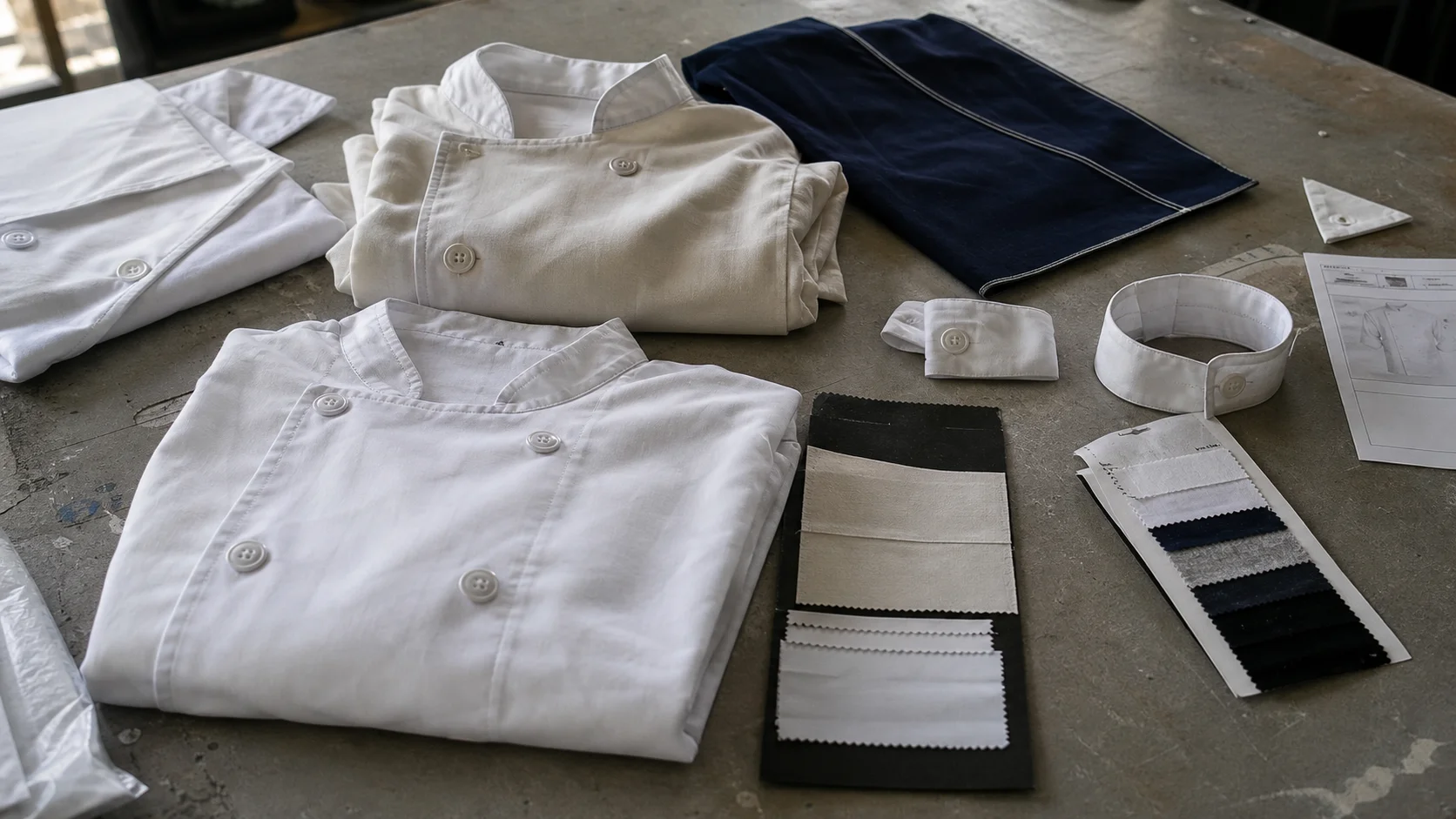
A sourcing-focused outline for evaluating chef coat manufacturers through practical wash tests, durability checks, and cost controls for field service teams.
Chef Coat Wash Test Review for Field Team Buyers - MOQ, Cost & Sourcing manufacturing guide
A chef coat manufacturer wash test review is not just a lab exercise. For field service teams, it is a practical sourcing checkpoint that decides whether a uniform program will hold up after repeated laundering, daily travel, site visits, food demonstrations, training events, and customer-facing service work.
Field team buyers often source chef coats for people who are not working in one controlled kitchen. These teams may include culinary sales reps, service technicians, product trainers, catering support crews, retail demo staff, hospitality field managers, and food equipment support teams. The coat still needs to look professional, but the wear conditions are different from a restaurant line cook’s routine.
The main sourcing risk is simple: a chef coat can look excellent in a pre-production sample and disappoint after five commercial washes. Shrinkage, seam twisting, puckering, yellowing, button failure, color fading, collar distortion, and embroidery distortion are all common problems. Once these issues appear in bulk inventory, the buyer has limited leverage and high replacement cost.
A structured wash test reduces that risk before purchase orders are locked. It gives buyers evidence on fabric stability, garment construction, trim durability, and branding performance. It also creates a fair benchmark for comparing suppliers. A lower unit price may not be cheaper if the coat loses shape quickly or requires replacement after a short field cycle.
Purchasing judgment: do not approve a chef coat program for field service teams based only on hand feel, showroom appearance, or a single unwashed fit sample. Ask for wash-tested samples and review them against a written standard.
Chef coats for field service teams have a different job than chef coats for back-of-house kitchen staff. The garment is part uniform, part sales tool, part protective layer, and part brand presentation. It may be worn in offices, grocery stores, hotels, trade shows, training kitchens, customer sites, and vehicles. That means the coat must balance durability, easy care, fit consistency, and appearance.
For a field team buyer, wash testing matters because garments circulate through mixed laundering conditions. Some companies use industrial laundry. Others let staff wash coats at home. Some teams need stain release after sauce, oil, coffee, flour, or cleaning chemical exposure. Others need crisp appearance after travel. The manufacturer cannot control all wash conditions, but the buyer can specify reasonable test methods before bulk production.
Typical use cases include:
These teams may not need the heaviest traditional kitchen coat. A lighter poly-cotton blend may be more comfortable for travel and all-day wear. A premium cotton-rich coat may look better but may shrink more and require sharper laundering control. A stretch blend may improve mobility but can create concerns around recovery, seam stability, and heat resistance. The best option depends on laundering method, brand expectation, climate, and replacement budget.
A useful chef coat wash test should not be vague. Buyers should ask the manufacturer to test specific points and provide measurable results where possible. “Washed and approved” is too loose for a field uniform program. A buyer needs enough detail to compare samples and hold production accountable.
Dimensional stability means how much the garment changes size after washing and drying. For chef coats, the most important points are chest width, body length, sleeve length, shoulder width, collar circumference, and cuff opening.
Common commercial tolerance targets are often around 3% shrinkage for stable woven blends, though exact limits depend on fabric type, finishing, and buyer requirements. Cotton-rich garments may need more cautious tolerances unless the fabric is properly pre-shrunk. Buyers should request measurements before wash and after at least three wash cycles. For high-use programs, five wash cycles gives a more realistic view.
Seam twisting is a common issue in lower-cost coats or poorly stabilized fabric. After laundering, side seams may rotate toward the front or back. Sleeves may twist along the arm. Plackets may lean. This is especially visible on white coats and creates a sloppy field appearance.
Buyers should review the coat on a hanger and on a fit model after washing. Flat measurements alone can miss visible skew. If the coat is used for customer visits, visible twisting should be treated as a rejection risk, not just a technical flaw.
White chef coats must be tested for yellowing, greying, and optical brightener changes. Black or dark coats need testing for fading and shade change. Colored piping, contrast collars, embroidery thread, logo patches, and buttons should also be checked.
For field teams, shade consistency matters because staff may stand together at events. If one batch fades faster or washes warmer than another, the uniform program looks inconsistent. Buyers should ask whether the fabric has been tested for wash fastness, rubbing fastness, perspiration, and chlorine sensitivity where relevant.
Stain release is often more important for field service teams than buyers expect. A coat used in demonstrations may face tomato sauce, oil, chocolate, coffee, spice, dairy, and flour. A service technician may encounter grease or cleaning residue. The wash test should include realistic stains, not only clean-water laundering.
Polyester-rich fabric may dry quickly and resist shrinkage, but oil stains can cling to polyester. Cotton-rich fabric may absorb more moisture and feel natural, but it can stain and wrinkle more easily. Stain-release finishes can help, yet they may lose performance after repeated laundering. Buyers should ask whether stain-release performance is tested after multiple wash cycles, not only on new fabric.
Chef coat trims include buttons, snap closures, fabric-covered buttons, piping, sleeve pockets, pen pockets, neck loops, labels, patches, and embroidery. Wash tests should check whether trims crack, loosen, bleed, shrink, distort, or become uncomfortable.
Field team garments often include logo embroidery or heat-transfer branding. Both require wash testing. Embroidery can pucker if fabric shrinks differently than thread. Heat transfers can crack, peel, or become glossy if the wrong application method is used. Patch backing can bubble after washing if adhesive or stitching is weak.
The fabric decision drives most wash test outcomes. Buyers should not treat all chef coat fabrics as interchangeable. Weight, fiber content, weave, finish, shrinkage control, and color all affect performance.
For many field service uniform programs, a 65/35 polyester-cotton twill in a medium weight is the practical starting point. It usually offers better dimensional stability and easier care than cotton-heavy options. The tradeoff is comfort and stain behavior, especially with oil-based stains. Buyers should not assume heavier is always better. Heavy coats may look structured but can be uncomfortable in travel, warm climates, and long customer visits.
Fabric weight should be specified clearly, usually in GSM or ounces per square yard. A typical chef coat fabric may range from about 150 GSM for lighter service coats to 240 GSM or more for heavier traditional coats. Field teams often perform well in the mid-range because the coat needs to travel, wash, and dry without excessive bulk.
Buyers should also specify weave and finish. Twill is common because it offers durability and a professional drape. Plain weave may feel lighter but can wrinkle or lose structure faster depending on yarn quality. Finishes such as stain release, wrinkle resistance, or soil release should be named and tested after laundering. A finish that works on the first wear may not survive the actual replacement cycle.
Wash testing exposes construction weaknesses that may not be visible in a new sample. A manufacturer can produce a neat-looking sample with careful pressing, but repeated laundering reveals whether the garment is built properly.
Chef coats should have secure seams, especially at armholes, side seams, shoulder seams, sleeve openings, and pocket attachments. Buyers should review stitch density and seam type. Too few stitches can weaken the garment. Too many stitches can perforate fabric or create puckering. Bulk production should match the approved sample.
For high-use field teams, reinforced stress points are worth the small cost increase. Pocket corners, sleeve pen pockets, underarm seams, and placket ends should be checked after washing and wearing. Loose threads after one wash are a warning sign. Open seams after three washes are a clear rejection issue.
The collar and front placket create the first impression. If the collar rolls, bubbles, or collapses after washing, the coat looks cheap even if the fabric is strong. Interlining quality matters. A low-grade interlining may shrink differently from the shell fabric, causing puckering or waviness.
Cuffs need attention as well. Long sleeves may have fold-back cuffs, French-style cuffs, or simple hemmed cuffs. Each style responds differently to washing. Fold-back cuffs can distort if interlining or stitching is uneven. Short sleeve coats reduce cuff issues but may not match the brand image or safety needs of some teams.
Field teams often need function more than traditional chef styling. Sleeve thermometer pockets, pen slots, chest pockets, hidden phone pockets, or utility loops may be requested. Every added detail creates a wash risk. Pockets can sag, twist, or trap lint. Patch pockets can shrink differently from the body fabric. Utility loops can tear if they are not bartacked properly.
Buyers should decide which features are truly needed. A cleaner coat with fewer trims is often more durable, cheaper, and easier to wash. Extra features are justified only when they support real field tasks.
A disciplined sample approval process protects the buyer and gives the manufacturer a clear target. The process should move from fabric approval to fit approval, then wash testing, branding review, and final pre-production approval.
Buyers should avoid compressing all approvals into one sample unless the order is small, low-risk, and based on an existing supplier style. Custom chef coats for field teams need more control, especially when logos, special pockets, non-standard sizing, or brand colors are involved.
A practical wash test for approval might include three home-laundry cycles and one higher-temperature commercial-style cycle, depending on expected use. If the team uses industrial laundry, the test should reflect that reality. If employees wash garments at home, the care label must be realistic. A coat that only survives delicate washing may not be suitable for a field service uniform program.
Buyers should photograph samples before and after washing. Measurements should be recorded in a table. The same size should be tested across competing manufacturers. For example, comparing one supplier’s medium to another supplier’s large creates misleading results. If possible, test both a core size and an edge size, such as medium and 2XL, because grading problems often appear in larger sizes.
MOQ is a central issue in chef coat sourcing. Buyers want flexibility, but manufacturers need enough volume to cover fabric purchasing, pattern work, cutting setup, trim sourcing, logo setup, production line allocation, and quality control. The right MOQ depends on customization level.
These ranges are typical, not universal. A supplier may accept lower MOQs if fabric is available, the pattern is simple, and production capacity is open. A supplier may require higher MOQs if the garment uses special fabric, custom dyed trim, unusual buttons, extended sizing, or complicated branding.
Cost should be reviewed across the full uniform lifecycle, not only unit price. A cheaper coat that shrinks 5%, yellows quickly, or loses buttons after repeated wash cycles may create more cost through replacements, complaints, and inconsistent presentation. A slightly higher unit price can be justified if the coat passes wash testing and reduces replacement frequency.
For sourcing support, buyers can review apparel development and production options through Fabrikn services. A structured sourcing process is especially useful when comparing manufacturers across MOQ, sample quality, and wash-test reliability.
Lead time is often underestimated. A chef coat program with wash testing, logo approval, and multiple sizes cannot be treated like a simple reorder unless the design is already locked. Buyers should plan backward from the required in-hand date, not the production start date.
Typical timing may look like this:
Stage Typical Timing Dependency Fabric and trim sourcing 1-3 weeks Availability of approved fabric, buttons, labels, and branding materials. Proto or fit sample 1-2 weeks Pattern readiness and clear tech pack details. Wash testing 1-2 weeks Number of wash cycles and drying method. Pre-production sample 1-2 weeks Final comments from fit, wash, and branding review. Bulk production 4-8 weeks Order volume, factory capacity, fabric lead time, and complexity. Inspection and shipment 1-4 weeks Inspection booking, packing requirements, and shipping method.A realistic custom program may require 8-14 weeks before shipment, and longer if fabric is custom dyed or lab testing is required. Rush production increases error risk. The most common rush-related failures are wrong trim substitution, incomplete size grading checks, skipped wash testing, and packaging mistakes.
Buyers should also reserve time for internal stakeholder approval. Field service managers, marketing teams, HR, safety teams, and finance may all have input. Delays often happen because logo placement, care label language, or sizing strategy is not approved early enough.
Even a well-approved sample does not guarantee perfect bulk production. Inspection is the buyer’s final chance to catch issues before shipment. For chef coats, inspection should include measurements, workmanship, shade consistency, trims, packaging, and selected wash checks when timing allows.
Inspection risk is higher when the order includes many size breaks, multiple logo versions, regional packing instructions, or mixed colors. A national field rollout may require carton-level sorting by team, location, or employee. That packing detail should be specified before production, not after goods are finished.
Wash testing during bulk inspection can be useful but has limits. If the buyer waits until final inspection to discover shrinkage, the production lot may already be complete. The better approach is to approve wash-tested pre-production samples and then run spot wash tests from early production. This creates a chance to correct problems before the whole order is made.
A scorecard helps buyers compare suppliers objectively. It also reduces internal debate because the evaluation is based on visible results and agreed standards.
Test Area What to Check Pass Indicator Buyer Concern if Failed Shrinkage Chest, length, sleeve, collar after 3-5 washes Within agreed tolerance Fit complaints and size exchanges. Twisting Side seams, sleeves, placket alignment No visible distortion on body Poor field appearance. Color White brightness, black fading, contrast trim bleeding No unacceptable shade change Inconsistent team presentation. Collar and placket Rolling, bubbling, puckering Flat, stable structure after laundering Garment looks low quality. Branding Embroidery, patch, heat transfer No puckering, peeling, cracking, or bleeding Brand damage and replacement cost. Trims Buttons, snaps, pockets, labels Secure and unchanged after wash Repairs, returns, and safety complaints. Wrinkle recovery Appearance after drying and light pressing Meets care expectation Staff non-compliance or poor presentation. Stain release Common food and field stains Acceptable removal under care instructions Shorter garment life.Scoring does not need to be complicated. A 1-5 rating by category can work well. The buyer should mark any failure that is a dealbreaker. For example, minor wrinkling may be acceptable if the team expects pressing. Logo peeling after three washes should not be acceptable for a branded field program.
The best chef coat manufacturer for a field service team is not always the one with the lowest MOQ or the lowest unit cost. The better choice is the supplier that can prove fabric stability, repeatable construction, reasonable lead time, and clear communication during sampling.
Buyers should start with the laundering reality. If employees wash garments at home, choose fabrics and care labels that tolerate normal home laundry. If garments go through industrial laundry, ask for fabric and trim confirmation suitable for that process. If the team travels frequently, consider lighter fabric, wrinkle recovery, and packability. If the brand image is premium, test cotton-rich or structured options but budget for care requirements.
For most field service teams, the safest purchasing path is a modified stock or semi-custom chef coat before moving into full custom development. This allows the buyer to test fit, branding, washing, and staff feedback without committing to high MOQs. Once the design is proven, a larger custom production run can reduce unit cost and improve consistency.
Buyers should ask manufacturers for the following before placing a bulk order:
Clear documentation matters. A chef coat program should have a basic tech pack, even if the design is simple. The tech pack should include design sketches or photos, measurement specs, fabric details, trim details, logo placement, stitch requirements, care label, packaging, and inspection standard. This reduces misunderstanding and gives the buyer a reference if bulk production differs from the approved sample.
For buyers still comparing supplier routes, the company background and working model can also matter. Reviewing Fabrikn’s sourcing approach can help buyers understand whether the support model fits a uniform development program. For project-specific questions, buyers can contact the team through Fabrikn’s contact page.
A chef coat wash test review for field service teams should be treated as a purchasing control, not a formality. The wash test tells the buyer whether the garment can survive the real conditions of the job: repeated laundering, travel, branding exposure, food stains, movement, and public-facing use.
The strongest buying decision balances MOQ, cost, lead time, and wash performance. A low-cost coat may be acceptable for short-term events or small pilots. A more stable, better-tested coat is usually the better choice for recurring field use. When the uniform is part of customer-facing brand presentation, wash performance should carry meaningful weight in supplier selection.
The practical recommendation is to test before scaling. Approve fabric first. Confirm fit second. Wash-test the garment with trims and branding included. Review results against a written scorecard. Then place the bulk order with inspection checkpoints tied to the approved pre-production sample. This process takes more time upfront, but it reduces expensive surprises after the coats are already distributed to the field.
Get a free quote from Fabrikn — your trusted B2B clothing manufacturer with 10+ years of experience. MOQ as low as 200 pieces.
Get a Free Quote →It is a structured review of how a chef coat performs after laundering. The buyer checks shrinkage, twisting, color change, seam quality, trim durability, branding stability, and overall appearance before approving bulk production.
Three wash cycles are a practical minimum for many sourcing decisions. Five cycles provide a better view for field service teams that wash garments frequently. Industrial laundry programs may need more demanding test conditions.
Many buyers aim for shrinkage around 3% or less on stable woven blends, but the correct tolerance depends on fabric, fit, and care method. Cotton-rich coats may need tighter fabric control or more allowance in the size spec.
Polyester-cotton blends are usually more stable, easier to care for, and more cost-efficient. Cotton coats may feel more premium and breathable, but they often wrinkle and shrink more. The better choice depends on field use, laundering, and brand expectations.
Stock chef coats with logo decoration may start around 50-200 pieces. Modified stock styles often fall around 200-500 pieces. Fully custom coats commonly require 500-1,500 pieces, while custom fabric or dyed colors may require 1,000-3,000 pieces or more.
Yes. Embroidery can pucker, distort, or cause fabric tension after washing. Heat transfers and patches should also be tested because peeling, cracking, bubbling, or adhesive failure can appear after repeated laundering.
The main risks are size inconsistency, seam defects, button failure, shade variation, logo placement errors, trim substitution, care label mistakes, and incorrect packing by size or location.
It can be suitable for short events, limited pilots, or low-frequency wear. For recurring field service use, a coat with proven wash stability is usually a better value even if the unit price is higher.
Skipping wash testing is risky when the order includes custom fabric, special trims, branding, new sizing, or a new supplier relationship. Prior experience helps, but the approved sample should still be tested under expected care conditions.
The buyer should approve the pre-production sample, fabric specification, trim list, size chart, care label, logo placement, packaging method, measurement tolerance, wash test results, and inspection standard before bulk production begins.