
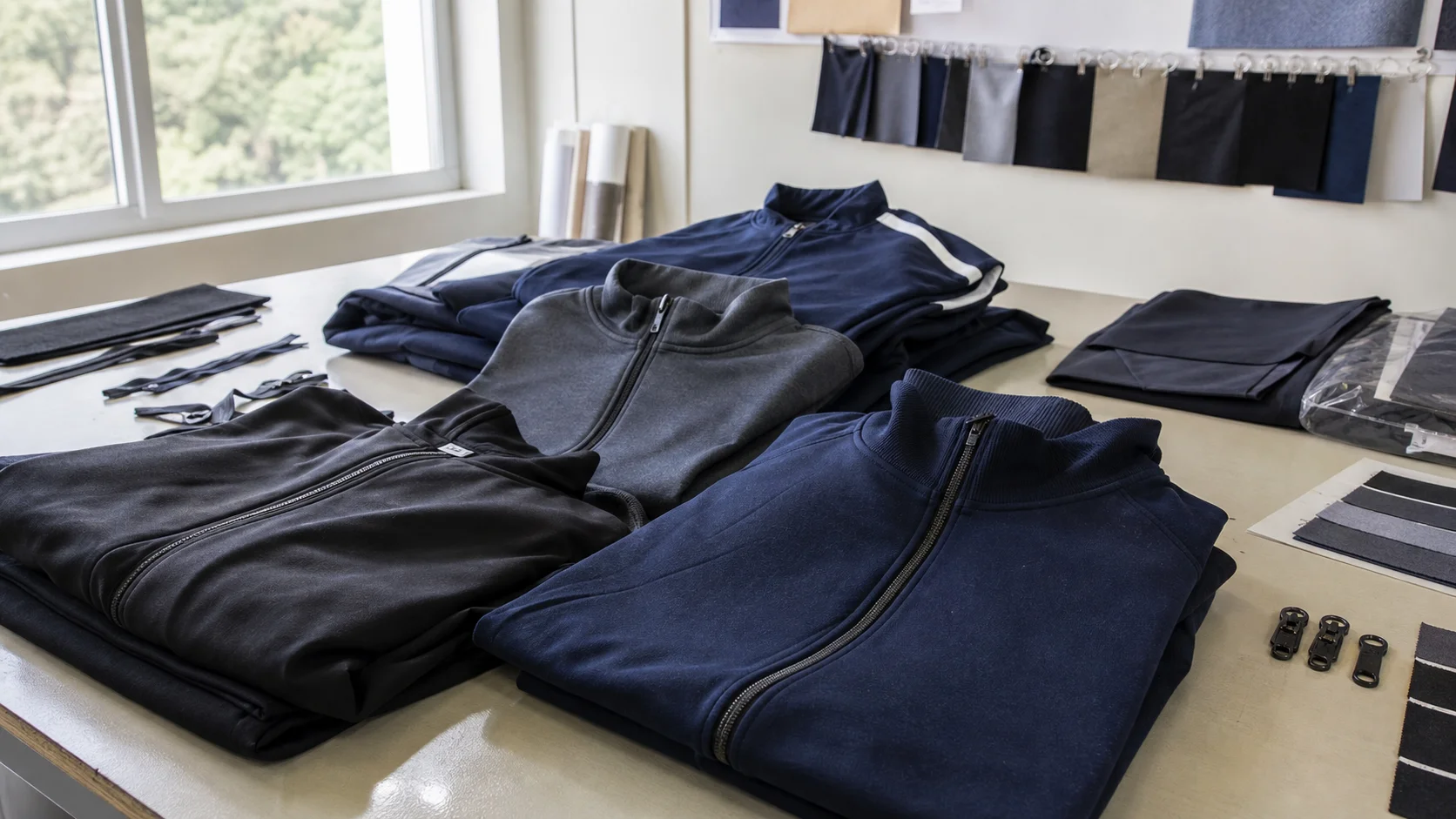
A focused outline for wholesale buyers planning compliance on children's jackets, covering labeling, safety testing, material rules, and production...
Children's Jacket Compliance Checklist for Wholesale Buyers - Fabrikn production reference
Wholesale buyers sourcing children’s jackets do not get much room for error. A jacket can look right on a sales sample and still fail on fiber labeling, drawcord rules, flammability, or trim safety once production starts. Compliance planning belongs at the buying stage, not after the goods are packed.
This checklist is written for wholesale teams buying into the Outerwear & Jackets category. It focuses on the practical side of compliance planning for children’s jackets wholesale buyers: what to confirm, what to document, where risk usually appears, and how to set up approval steps so the order does not drift out of spec. For project support and broader sourcing assistance, see the services page, the about us page, and the contact page.
Children’s jackets sit in a higher-risk part of the apparel market. The buyer is not only managing appearance, fit, and price. The order also needs to survive legal review, retailer compliance gates, and physical testing. If one requirement is missed, the result can be delayed shipment, relabeling costs, rework, or a refused delivery.
Good compliance planning reduces that risk by pushing the important decisions upstream. That means confirming the target market first, then matching the jacket specification to the correct standards, then locking the manufacturing route before bulk production starts. Buyers who skip this sequence often end up paying for corrective work that could have been avoided with a cleaner tech pack and tighter sample approval.
The exact rules depend on the destination market, retailer policy, and age grade, but the compliance pillars are consistent. Children’s jackets usually need review in the following areas:
Buyers should treat “compliance” as a package of separate checks, not one certificate that covers everything. A supplier may have a valid factory system and still miss a trim restriction or use a zipper pull that creates a hazard on a children’s style.
Use the checklist below as a buying gate before sample sign-off and again before bulk approval. The order is deliberate. The earliest items shape the later testing and inspection plan.
Checklist item What to confirm Buyer risk if missed Target market Country or region of sale, age band, retail channel, and any retailer-specific standard Testing to the wrong rule set, relabeling, or shipment delay Age grading Infant, toddler, little kid, or older child sizing criteria Incorrect safety requirements and wrong fit assumptions Garment category Everyday jacket, insulated jacket, rainwear, fleece layer, or performance shell Wrong test methods, wrong fabric construction, wrong trim choices Labeling Fiber content, care instructions, size, origin, and language requirements Retail noncompliance and re-labeling costs Drawcords and cords Presence, placement, length, and end finishes Safety failure and style rejection Trim security Buttons, snaps, appliqués, patches, toggles, and decorative pieces Choking or detachment risk Chemicals Finish chemistry, print inks, coatings, water repellency, and lab test scope Restricted substance failure Packaging Polybag warnings, carton marks, barcode location, and carton strength Warehouse rejection or compliance relabeling Testing plan Pre-production tests, lab submission timing, and final inspection coverage Late discoveries after production is completeBuyers should require a written compliance matrix for each style, not a generic supplier promise. That matrix should show the intended market, applicable safety and labeling rules, approved materials, required tests, and the responsible party for each step.
Children’s jackets are highly sensitive to material substitutions. A small change in shell fabric, lining, or trim can alter test results and even the product category. For that reason, the spec sheet has to be tight enough that production cannot improvise its way into noncompliance.
Buyers should define the fabric by construction, composition, weight, and finish. A shell described only as “polyester” is not enough. The order should state the weave or knit, fiber blend, GSM or oz/yd², coating if any, and intended performance finish. If the jacket depends on weather resistance, identify whether the water repellency is a surface finish, laminate, or bonded layer.
Typical wholesale orders may start with MOQ ranges around 300 to 1,000 pieces per color for simpler children’s jackets, while more technical or heavily customized styles can run higher. The tighter the material spec and color count, the easier it is for the factory to control compliance. Mixed fabric sourcing across multiple mills may lower risk on availability, but it usually increases testing coordination and lead time.
Trims deserve the same attention as the main fabric. Confirm zipper brand or equivalent standard, zipper tape composition, puller shape, snap size, button attachment method, and any decorative components. Children’s products often fail on small details: a loose tack, sharp edge, weak stitch count, or puller geometry that creates a hazard during use.
For jackets with detachable hoods, faux fur trims, patches, or badges, the buyer should ask for a component list and a security method for each piece. If the factory proposes heat-sealed labels, rubber badges, or transfer prints, ask for wash durability and migration test coverage where relevant.
Stitch density, seam allowance, reinforcement points, and closure construction all affect durability and compliance. The buyer should review pocket openings, hood attachment, chin guard placement, elasticized cuffs, and hem finishes. Where a garment has cords or adjusters, the construction must be checked against the target market’s youth safety requirements before bulk cutting starts.
The fastest way to create compliance trouble is to leave “equivalent trim allowed” in the tech pack without defining the equivalence standard. That can save time at quotation stage and cost time at production stage.
Children’s jacket compliance should move through a fixed sample path. The buyer does not want production to begin on a style that has only been judged by photos or rough prototypes.
The development sample is for shape, style line, and basic construction review. It should confirm the intended silhouette, sizing approach, fabric hand, and trim placement. It is not the stage for final approval. Buyers should treat this sample as a working reference only.
Before the pre-production sample, the supplier should submit fabric swatches, trim cards, lab dips, and color standards. This is the moment to check composition declarations, finish claims, and any safety-sensitive components. If the buyer skips this step, the factory may proceed with substitute components that are hard to unwind later.
The pre-production sample should use the final approved materials and the intended production method. It should reflect the actual stitching, labeling, packaging, and finishing route. This is the sample to measure carefully and, where required, send for test submission. Buyers should not approve bulk until the sample passes both visual review and the necessary lab checks.
Testing scope depends on the market and style, but common checks include fiber content verification, flammability or ignition behavior where required, drawcord safety, colorfastness, pH, restricted substances, and mechanical safety of trims. Technical outerwear may also need seam strength, hydrostatic resistance, or coating-related checks.
A size set helps confirm grading consistency across the full range. A top-of-production sample, or an early production review, helps catch line issues before the bulk run is complete. This matters on children’s jackets because small deviations in hood size, sleeve length, or fastening placement can create both fit and compliance problems.
Compliance planning affects schedule as much as product quality. Buyers often underestimate how long it takes to move from concept to approved bulk. The lead time depends on how many custom elements need sourcing, whether fabrics are stock or mill-dyed, and how many test rounds are required.
A simple children’s jacket using stock fabric and basic trims may move faster than a waterproof or insulated style that needs custom laminate, taped seams, or special finishing. For wholesale planning, a conservative timeline usually includes fabric booking, trim approval, sample rounds, lab testing, bulk production, and final inspection. Each gate can add days or weeks.
MOQ also affects compliance. Lower minimums may look attractive, but they can limit fabric options, increase cost per unit, and reduce the supplier’s willingness to run multiple test batches. Higher MOQs can improve mill booking and pricing, yet they increase exposure if the style fails a late-stage test. Buyers should match MOQ to channel demand, not to the factory’s preferred production volume alone.
A practical approach is to separate the first order into a test run and a replenishment plan where possible. That reduces inventory risk while still leaving room to correct sizing, labeling, or component issues after sell-through data comes in.
Even when paperwork looks complete, physical inspection can expose weak points. Children’s jackets are exposed to more handling than many buyers expect. Warehousing, packing, and customer use all test the same details.
Inspection should be tied to compliance, not treated as a separate box to tick. A cosmetic defect on a child’s jacket can become a safety issue if it involves a detached trim, a broken closure, or an exposed sharp edge. Buyers should align inspection sampling, AQL targets, and defect classification with the product’s end use and market exposure.
Wholesale buyers do best when they spend on the parts of the order that protect saleability and hold back on cosmetic extras that do not change the product’s market fit. On children’s jackets, that usually means prioritizing correct fabric sourcing, safe trims, and proper testing over decorative complexity.
It is rarely smart to chase the lowest unit price if the supplier is vague on test reports or substitutes components freely. A slightly higher factory quote can be cheaper in practice when it includes stable material sourcing, cleaner documentation, and fewer revisions. The same logic applies to packaging and labeling. A clear label program costs little compared with a delayed container.
Buyers should also be cautious about over-customization on the first order. Heavy embroidery, excessive appliqués, special coatings, and mixed media panels can all increase failure points. A cleaner first run makes it easier to establish the compliance baseline. Once the product proves stable, design complexity can be introduced in later seasons with less risk.
When the jacket is intended for a retailer with strict onboarding, the buyer should request their compliance pack early and build the product spec around that pack. When the buyer is selling through independent wholesale or e-commerce channels, the internal compliance record still needs to be just as strict. The market may not ask for the file on day one, but the shipment will still need to stand up if questioned later.
Before approving bulk, the buyer should be able to answer yes to each of these points:
This is the point where disciplined buyers separate themselves from reactive buyers. If the answer to any of the above is unclear, bulk should pause until the gap is closed.
Get a free quote from Fabrikn — your trusted B2B clothing manufacturer with 10+ years of experience. MOQ as low as 200 pieces.
Get a Free Quote →Children’s jackets combine garment quality with child safety and labeling requirements. The product may look simple, yet the tolerance for trim issues, cord hazards, and documentation errors is lower than in many adult categories.
Testing should be planned at the sample stage, not after bulk cutting. The safest process is to test the final materials and the pre-production sample before approving the full order.
Many factories quote roughly 300 to 1,000 pieces per color for simpler styles, though technical outerwear can sit higher. Final MOQ depends on fabric type, trim sourcing, print complexity, and whether the style needs special testing.
Drawcords, decorative trims, fiber labeling, and inconsistent components are common trouble spots. Loose snaps, weak zippers, and poorly controlled fabric substitutions also create avoidable risk.
No. Photo approval is useful for direction only. Bulk should be approved from a physical pre-production sample using final materials, final labels, and the intended construction method.
A useful file includes the target market, approved tech pack, material declarations, trim list, test reports, labeling copy, inspection criteria, and written sign-off on the final sample. That file should be kept style by style, not mixed across seasons.
For wholesale buyers, compliance planning is not paperwork after the fact. It is part of product development, costing, and shipment control. The cleaner the spec and approval flow, the fewer surprises appear at packing, inspection, or receipt.