
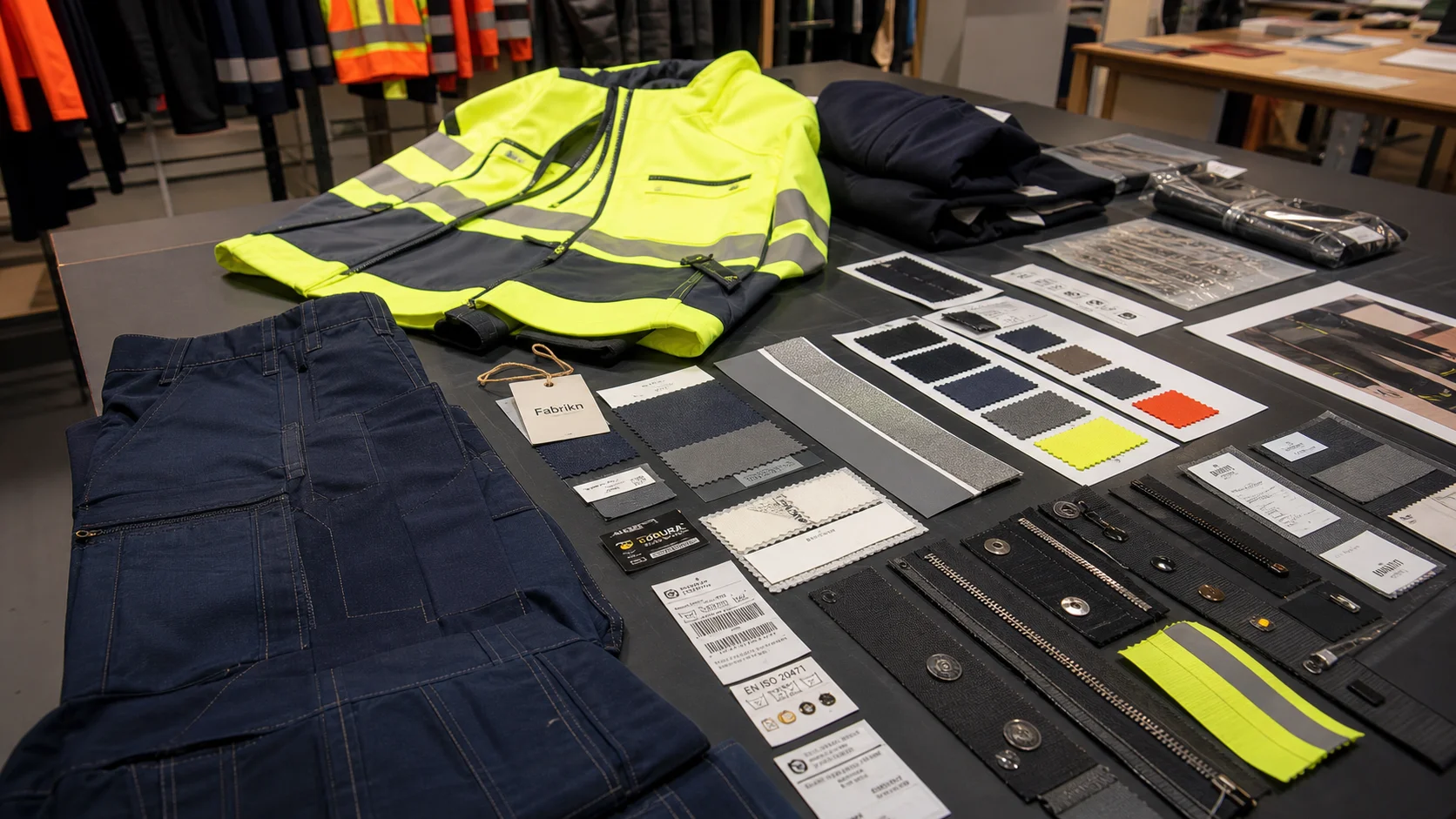
A sustainable fashion outline for buyers approving mono material cleaning crew uniforms before factory release, with checkpoints for recyclability,...
Workwear Release Checklist for Cleaning Crew Buyers - Fabrikn production reference
Cleaning crews need uniforms that survive daily movement, chemical exposure, repeated laundering, and public-facing work. Buyers also have a new sourcing pressure: sustainability claims must be easier to verify. That is why mono material workwear has become a serious option for facility service companies, cleaning contractors, hospitality housekeeping teams, and institutional procurement teams.
A mono material uniform is made primarily from one fiber family, such as 100% recycled polyester or 100% cotton, instead of a complex blend. The goal is simpler recycling, easier material disclosure, and fewer hidden trim conflicts. For cleaning crews, the decision is not only environmental. The uniform still has to pass the release checklist: fit, function, color, wash performance, seam strength, labeling, packaging, and final inspection.
This article provides a factory release checklist for cleaning crew buyers sourcing mono material workwear uniforms. It focuses on practical purchasing decisions, typical MOQ ranges, sample approval steps, lead-time variables, fabric and trim specifications, and inspection risks that often appear late in production.
Cleaning crew uniforms are often purchased as a cost-controlled operational item. The garment is expected to be durable, easy to wash, consistent in color, and available in repeat orders. Sustainability used to sit behind those requirements. Today, more buyers need uniforms that support internal ESG reporting, client contract requirements, and waste reduction targets.
Mono material workwear helps because it reduces fiber complexity. A polo shirt made from 100% polyester is easier to identify and potentially recycle than a polo made from polyester, cotton, elastane, and mixed-fiber trims. A tunic made from one major fiber type gives procurement teams a cleaner material story and may reduce sorting problems at end of life.
The tradeoff is important. Mono material does not automatically mean low impact, recyclable, or better quality. A 100% polyester uniform may dry quickly and resist wrinkles, but it can retain odor if the fabric construction is wrong. A 100% cotton uniform may feel breathable, but it can shrink more and dry slowly after industrial laundering. A 100% recycled polyester garment may support recycled content targets, but it still needs strong colorfastness, pilling resistance, and stable measurements.
Purchasing judgment: choose mono material workwear when it supports a clear operational and sustainability goal. Do not approve it only because the claim sounds cleaner. The release checklist must confirm that the uniform performs under real cleaning crew conditions.
For cleaning crews, common uniform items include polos, T-shirts, tunics, trousers, cargo pants, aprons, lightweight jackets, vests, and housekeeping dresses. The most realistic mono material options are usually 100% recycled polyester, 100% virgin polyester, 100% cotton, or fabrics designed within a single polymer family. Elastane-free constructions are preferred if recyclability is the priority, but buyers must check whether the lack of stretch affects comfort and mobility.
A factory release checklist works best when the buyer has already defined the uniform program. Many delays happen because the factory is asked to quote before the buyer has fixed the garment list, staff size curve, wash process, branding method, and replacement cycle.
Start by separating essential garments from optional garments. A basic cleaning crew uniform may require two polo shirts and two trousers per worker. A hospitality housekeeping program may need tunics, aprons, dresses, or lightweight jackets. Outdoor cleaning teams may need weather-resistant layers, but water resistance can complicate mono material claims if coatings, membranes, or mixed trims are added.
Buyers should also define whether uniforms are laundered at home, in a commercial laundry, or through an industrial rental program. Home laundering gives more variation in wash temperature and detergent. Commercial laundry may increase mechanical stress. Industrial laundering can expose garments to higher temperatures, harsher chemistry, and tumble drying. This changes fabric selection and test requirements.
For brands and procurement teams building a new uniform program, supplier capability matters as much as garment design. A factory or sourcing partner should be able to manage fabric development, sampling, size grading, quality control, and shipment documentation. Buyers can review broader production support through Fabrikn services when planning a structured apparel program.
The factory release stage is the point where the buyer confirms that the supplier can proceed from approved development into bulk production. This is not the time for loose assumptions. Every fabric, trim, label, measurement, color, packing method, and quality standard should be documented.
A release checklist protects both sides. The buyer gets a clear benchmark for inspection. The factory gets a locked reference to avoid repeated changes during production. In workwear, this matters because small details create large operational problems. A pocket placed too low can interfere with movement. A collar that curls after washing makes the uniform look old. A zipper tape made from a different polymer may weaken a mono material claim. A dark color that bleeds can damage other laundry items.
The checklist should include technical approval, sustainability approval, production approval, and shipment approval. Buyers should not treat sustainability as a separate marketing task. If the uniform is sold or reported as mono material workwear, the claim must be connected to the bill of materials, trim selection, label content, packaging, and end-of-life plan.
Fabric is the largest part of the uniform cost and the biggest driver of performance. For cleaning crews, buyers should avoid approving fabric based only on hand feel. The material has to handle frequent washing, bending, reaching, kneeling, carrying supplies, and contact with mild cleaning agents.
Common mono material options include 100% recycled polyester pique for polos, 100% polyester interlock for T-shirts, 100% cotton twill for trousers, 100% polyester mechanical stretch woven for trousers, and 100% polyester fleece for lightweight layers. If the buyer wants a garment that is recyclable within one fiber stream, the factory should confirm whether sewing thread, zipper tape, buttons, labels, and major trims align with that fiber family where feasible.
Fabric weight should be selected by use case. For polos, a typical range may be 150 to 220 gsm depending on climate and durability requirements. For T-shirts, 140 to 190 gsm is common. For woven trousers, 180 to 260 gsm may suit indoor cleaning, while heavier fabrics can be considered for maintenance-adjacent tasks. Aprons and tunics may range from 160 to 240 gsm, depending on opacity and abrasion needs.
The tradeoff is straightforward. Lighter fabrics improve comfort and drying speed but may show wear faster. Heavier fabrics can look more professional and resist abrasion, but they may feel hot during active cleaning shifts. Dense polyester can be durable, but it may need moisture management treatment or a specific knit structure to reduce discomfort. Cotton can be comfortable, but shrinkage and color fading must be tightly controlled.
Buyers should request test reports from a recognized lab when the order size and client requirements justify the cost. For smaller programs, at minimum, ask for mill test data and conduct internal wash trials before bulk approval. One wash is not enough. A practical wash trial for cleaning crew uniforms should include at least 5 to 10 wash cycles before final release, with measurements recorded before and after.
Trims often undermine mono material claims. A garment may be described as 100% polyester, but the zipper teeth, puller, button, elastic, woven label, interlining, badge backing, and thread may be mixed materials. In strict circularity programs, this is a problem. In practical workwear sourcing, the buyer should decide the acceptable level of mono material alignment before production.
Thread is one of the first trim decisions. Polyester thread is usually practical for polyester uniforms and often used for cotton workwear because of strength. If the product is positioned as mono material cotton, polyester thread may create a technical mismatch. Cotton thread can support material consistency, but it may not provide the same durability in high-stress seams. The buyer has to decide whether durability or fiber purity is the priority.
Buttons and zippers require similar judgment. Polyester buttons can support a polyester-based uniform. Metal snaps may improve strength but add a non-mono component. Hook-and-loop closures are convenient but often collect lint and can damage other garments in laundry. Elastic waistbands improve fit, but elastane or rubber content complicates mono material recycling.
Branding also matters. Embroidery may use polyester thread and adds density that can pucker lightweight fabric. Heat transfers can crack after repeated laundering if the quality is weak. Woven badges may use mixed yarns and adhesive backings. Printed logos can be cost-effective, but ink chemistry and wash durability should be checked.
Purchasing judgment: do not reject every mixed trim automatically. A small non-mono component may be acceptable if it significantly improves safety, durability, or fit. The key is honest documentation and a defined claim level.
Cleaning crew uniforms are active workwear. Staff bend, stretch, carry tools, push carts, climb stairs, lift bins, and reach overhead. A uniform that looks clean on a hanger can fail quickly if the pattern restricts movement.
Fit approval should include role-based movement checks. A polo should not ride up excessively when reaching. A tunic should allow bending without pulling across the back. Trouser waistbands should remain comfortable when kneeling or squatting. Sleeve openings should not catch on handles or cleaning equipment. Pocket positions should be reachable and secure.
Unisex sizing can reduce inventory complexity, but it may not serve all body types well. Separate men’s and women’s fits improve comfort but increase SKU count, stock risk, and MOQ pressure. A practical compromise is a core unisex style for tops with broader size grading, plus trouser fits separated by body shape where the workforce needs it.
Pattern approval should also consider modesty and professional appearance. Cleaning crew uniforms are often worn in hotels, hospitals, offices, schools, and residential properties. Fabrics should not become transparent under bright lighting. Tops should maintain coverage during movement. Trouser rise and inseam options should match the workforce rather than a generic size chart.
Sampling is where buyers should slow down. Rushing sample approval usually creates higher costs later. A cleaning crew uniform may look simple, but repeat orders depend on clear standards. Each sample stage should answer a different question.
The first sample usually checks general design, construction direction, and fabric hand feel. It may not use final fabric or trims. The fit sample checks pattern, measurements, and movement. The salesman sample or approval sample may be used for internal presentation or client sign-off. The pre-production sample is the most important factory release sample because it should represent final fabric, trims, labels, branding, measurements, and workmanship.
Buyers should not approve bulk production from a photo alone unless the product is a repeat style with no meaningful changes. Physical samples reveal hand feel, stretch, shade, logo texture, seam bulk, and pocket function. If approval must be remote, ask for detailed measurement reports, high-resolution images, wash test results, and a couriered sample before cutting bulk fabric.
For a new mono material cleaning crew uniform, a realistic sampling process may take 3 to 8 weeks, depending on fabric availability, lab dip timing, logo method, buyer response speed, and whether multiple fit rounds are needed. Complex programs with several garments and extended size ranges can take longer.
MOQ is one of the first commercial pressures in workwear sourcing. Buyers often want low quantities across many sizes, colors, and roles. Factories prefer efficient production runs with fewer fabric colors and fewer SKUs. Mono material fabrics can help if the same fabric is used across multiple garments, but custom recycled fabric or special dye lots may increase MOQ.
Typical MOQ ranges vary by factory, fabric, and customization level. For basic T-shirts or polos using available fabric, buyers may see MOQs around 300 to 500 pieces per style and color. For custom fabric, custom dye, or recycled yarn commitments, MOQ may rise to 800 to 1,500 pieces per color. Woven trousers or tunics may start around 300 to 600 pieces per style, with higher minimums if the fabric is custom-developed. Small-batch production may be possible, but unit costs rise sharply and trim sourcing becomes less flexible.
Buyers should structure orders around operational reality. If a cleaning company has 250 staff and each worker needs three tops, one top style may reach a practical MOQ. If the buyer splits the order into five colors, two fits, and twelve sizes, each SKU becomes harder to produce efficiently. A tight color and style architecture usually creates better pricing and more reliable replenishment.
Pricing should be compared on landed cost, not only FOB cost. Freight, duties, testing, sampling, packaging, relabeling, replacements, and inspection costs can change the real economics. A cheaper fabric that fails after 20 washes is not cheaper if replacements are frequent. A slightly higher unit price may be justified if the garment lasts longer and supports fewer emergency reorders.
For buyers still shaping their sourcing plan, it can help to discuss project scope before asking for a final quote. A production partner can usually give more accurate guidance when garment count, fabric direction, target MOQ, and delivery date are known. Buyers can use Fabrikn’s contact page to start that conversation with a clear brief.
Lead time is not one number. It is a chain of decisions. The fastest programs use existing fabric, standard colors, simple trims, and approved patterns. The slowest programs require custom recycled yarn, custom dyeing, several fit rounds, lab testing, branded trims, and staggered deliveries.
For cleaning crew mono material workwear, a practical new development timeline may run 8 to 16 weeks from confirmed brief to shipment, though this can vary widely. Repeat orders using approved fabric and trims may be shorter, often 4 to 10 weeks depending on capacity and material availability. Large programs, strict testing, and peak-season factory loading can extend those estimates.
Buyers should separate development lead time from production lead time. Development includes tech pack finalization, fabric sourcing, lab dips, sampling, fit review, and test approval. Production includes fabric knitting or weaving, dyeing, cutting, sewing, finishing, inspection, packing, and export documentation. Freight adds time, especially if sea shipment is used to control cost and emissions.
Purchasing judgment: do not compress the pre-production sample stage to recover lost time. If the release sample is wrong, bulk production will repeat the same mistake at scale.
Quality control for cleaning crew uniforms should focus on durability, consistency, and appearance after laundering. The first inspection risk is measurement variation. Uniforms are ordered across many sizes, and a small grading problem can create high return rates. Buyers should approve a size set and define tolerances clearly.
The second risk is shade variation. Cleaning crew uniforms are often worn in groups, so shade differences are visible. Fabric rolls should be checked against an approved shade band before cutting. If tops and bottoms are made from different fabric constructions, the buyer should not expect perfect shade matching unless this is specified and tested.
The third risk is seam failure. Trousers, tunics, and polos all have stress points. Crotch seams, pocket corners, side seams, armholes, plackets, and shoulder seams need reinforcement where appropriate. Bartacks should be neat and placed correctly. Seam allowance should match the construction standard.
The fourth risk is poor logo durability. A uniform may pass visual inspection before washing but fail after repeated laundering. Heat transfers can peel, embroidery can pucker, and prints can crack. Logo approval should include wash testing and abrasion review where relevant.
The fifth risk is packaging mismatch. Cleaning crew programs often require size sorting by location, department, or employee group. If cartons are not labeled correctly, the receiving process becomes slow and error-prone. Packing instructions should be part of the release checklist, not added after production.
AQL inspection can be used for bulk orders. Common garment inspection levels may use AQL 2.5 for major defects and AQL 4.0 for minor defects, although the final standard should match the buyer’s risk tolerance and customer requirements. For uniforms used in hospitals, airports, schools, or regulated facilities, buyers may need stricter controls.
Sustainable fashion claims require documentation. For mono material workwear, buyers should define what they are claiming before they request proof. “Mono material,” “recycled polyester,” “recyclable,” “lower impact,” and “designed for recycling” are different claims. Each needs different evidence.
If the uniform uses recycled polyester, buyers may request recycled content certificates where available, transaction documentation, and supplier declarations. If the uniform is described as mono material, the bill of materials should show the fiber composition of fabric, thread, labels, trims, and packaging. If the garment is promoted as recyclable, the buyer should understand whether there is an actual take-back or recycling pathway. A recyclable design without a collection system may still end up as waste.
Chemical compliance is also part of sustainable sourcing. Cleaning crew uniforms should meet the buyer’s restricted substances requirements. Dyes, finishes, prints, transfers, and trims can all create compliance risk. If garments have anti-odor, moisture management, stain release, or antimicrobial finishes, the buyer should request the finish chemistry, durability claims, and compliance documentation.
Packaging should be reviewed too. Individual polybags protect garments during shipping and distribution, but they create plastic waste. Bulk packing reduces packaging but can increase handling marks and size-sorting errors. Recycled polybags or paper bands may support sustainability goals, but they must still protect the uniform and meet warehouse requirements.
Supplier transparency is useful, but buyers should avoid unsupported storytelling. A factory profile, production capabilities, and process explanation can help evaluate a partner. Broader company context can be reviewed through Fabrikn’s about page when assessing alignment with a sustainable apparel sourcing program.
The table below gives buyers a practical release checklist for cleaning crew mono material workwear uniforms. It can be adapted for polos, tunics, trousers, jackets, aprons, and housekeeping dresses.
Release Area What to Confirm Why It Matters Buyer Decision Garment Scope Style list, colors, size range, quantities, delivery locations Prevents SKU confusion and wrong production planning Freeze the assortment before final costing Mono Material Claim Main fabric and trim fiber alignment Supports accurate sustainability communication Define whether trims must match or only main fabric Fabric Weight GSM, construction, yarn type, opacity Affects durability, comfort, and appearance Balance wash life against heat and movement Color Lab dip, shade band, colorfastness test Uniform programs need consistent appearance Approve only against physical standards Fit Measurement chart, tolerances, size set, movement test Controls comfort and return rates Use real wear positions, not hanger review Construction Seam type, stitch density, bartacks, pocket reinforcement Cleaning work puts stress on seams and pockets Reinforce high-stress areas even if cost rises slightly Branding Logo size, placement, method, color, wash durability Logo failure makes uniforms look unprofessional Approve after wash testing, not only visual review Labels Care, fiber, size, origin, compliance markings Incorrect labels create legal and operational risk Check final label artwork before production Testing Shrinkage, pilling, colorfastness, strength, chemical exposure Confirms performance before bulk shipment Set minimum test standards before quoting Packing Folding, polybag, carton ratio, size stickers, location sorting Distribution errors waste time after delivery Include packing method in the purchase order Inspection AQL level, defect list, measurement method, reporting format Creates an objective release gate Inspect before final payment or shipment where possibleA cleaning crew mono material uniform program should be simple, repeatable, and honest. Buyers get the best results when they reduce unnecessary variation and increase technical clarity. Too many styles, colors, trims, and logo placements make the program harder to produce and harder to replenish.
Start with the worker’s day. If the crew is active, choose fabric that breathes, dries quickly, and resists odor. If staff handle visible front-of-house tasks, prioritize color retention, collar stability, and a polished fit. If the client requires sustainability reporting, choose material documentation that can be defended. A weak sustainability claim is a purchasing risk, especially in B2B contracts where customers may ask for evidence.
For most cleaning crew buyers, 100% recycled polyester is a practical starting point for polos and lightweight tops because it can support durability, quick drying, and recycled content goals. For trousers, a polyester mono material woven with mechanical stretch may work, but it must be tested for comfort and seam strength. Cotton can be suitable in lower-heat, comfort-focused programs, yet shrinkage and drying time should be managed carefully.
Buyers should also consider repair and replenishment. A uniform that can be reordered in the same shade and fabric is more valuable than a novelty fabric that disappears after one season. Ask the supplier whether the fabric is stock-supported, custom-developed, or dependent on one mill. Ask how long the supplier can maintain the style and whether shade continuity is realistic across repeat orders.
The best factory release checklist is not complicated. It is complete. It gives the factory a clear production standard and gives the buyer a defensible approval trail. For cleaning crew uniforms, that approval trail should cover worker comfort, durability, wash performance, sustainability claims, and delivery accuracy.
Mono material workwear can be a strong choice for sustainable fashion programs when it is sourced with discipline. The buyer’s job is to make the claim practical: one material direction, documented components, tested performance, and a uniform that workers can wear comfortably through repeated shifts.
Get a free quote from Fabrikn — your trusted B2B clothing manufacturer with 10+ years of experience. MOQ as low as 200 pieces.
Get a Free Quote →Mono material workwear is uniform apparel made mainly from one fiber type, such as 100% polyester or 100% cotton. For cleaning crews, it may include polos, trousers, tunics, aprons, and lightweight jackets designed with fewer mixed-material components to support simpler material disclosure and potential recycling.
It can be a practical choice for tops because it dries quickly, holds color well, and can support recycled content goals. Buyers should still test pilling, odor retention, shrinkage, colorfastness, and logo durability before factory release.
Typical MOQs may range from 300 to 1,000 pieces per style and color for many tops and workwear items. Custom fabric, custom dyeing, recycled yarn commitments, special trims, and extended size ranges can increase minimums.
Buyers should usually review a development sample, fit sample, size set sample, branding sample, wash test sample, and final pre-production sample. The pre-production sample should represent the final fabric, trims, labels, measurements, logo method, and workmanship.
A new program may take about 8 to 16 weeks from confirmed brief to shipment, depending on fabric availability, sampling rounds, lab dips, testing, factory capacity, and freight method. Repeat orders using approved materials may be shorter.
Not always. Strict circularity programs may require trims to match the main fiber family where feasible. Practical workwear programs may allow some mixed trims if they improve durability, fit, or safety. The buyer should document the claim clearly and avoid overstating recyclability.
The main risks are measurement variation, shade inconsistency, seam failure, logo damage after washing, fabric pilling, incorrect labels, and packing errors. These should be checked before shipment using a defined inspection standard.
Yes, but only if the fabric, trims, labels, and logos are tested against the intended laundry process. Industrial laundering can be harsher than home washing, so shrinkage, colorfastness, seam strength, and logo durability need special attention.