
A practical outline for auditing sleeve print maps and colorfastness on cleaning crew uniforms before bulk production, covering placement specs, ink...
Category: Decoration & Printing
Cleaning crew uniforms take more abuse than many buyers expect. Sleeves are constantly in contact with disinfectants, detergents, diluted bleach, wet surfaces, carts, bags, and repeated laundering. That makes the sleeve print map worth auditing as carefully as the base fabric. A clean artwork placement on paper is not enough. The decoration has to survive the actual use case, and for cleaning crews that means repeated wash cycles, chemical exposure, abrasion at the cuff, and color shift that can make the uniform look tired long before the garment wears out.
This article covers a practical sleeve print map colorfastness audit for cleaning crew uniforms. It focuses on what to check before bulk production, what testing is worth requesting, where failures usually happen, and how to balance appearance, cost, and durability. For buyers who need production support, see services, or use the contact page to request a print and uniform quote. Background on the company approach is available on the about page.
Sleeve Print Map Audit for Cleaning Crew Uniforms - Decoration & Printing manufacturing guide
A sleeve print map audit is a review of the decoration plan for the sleeves before bulk production starts. In uniform sourcing, the sleeve area is not just a design location. It is a wear zone. The audit checks placement, size, color, printing method, and durability expectations against the actual job conditions.
For cleaning crew uniforms, the audit should answer a few direct questions:
The point is not to create the most decorative garment. The point is to produce a uniform that still looks controlled and professional after real service use. That standard is often lower in artwork complexity, but higher in performance demands.
Cleaning crews work in environments where textiles meet aggressive agents more often than casual apparel does. Detergents, disinfectants, oxygen bleach, chlorine bleach, softeners, and industrial laundering all affect print performance. A sleeve print that looks fine at delivery can still fail after a short service cycle if the ink system, curing process, or base fabric is wrong for the job.
Colorfastness matters for three reasons.
Clients notice uniforms that look faded, patchy, or stained. Even when the garment is technically functional, poor appearance makes the crew look less controlled. That is especially true for sleeve branding, because sleeve graphics are visible from the side and at arm level during interaction.
A failed sleeve print usually cannot be repaired economically. If the garment is still structurally sound but the decoration has washed out or cracked, the buyer faces early replacement or brand inconsistency across the team.
Some prints resist water but fail in the presence of cleaning chemicals. Others hold color initially but bleed into the surrounding fabric after heat or alkaline wash. A decent visual proof sample is not enough. The print has to be checked under conditions that approximate use.
The most common sourcing mistake is treating “colorfast” as a marketing label instead of a test result. For cleaning crew uniforms, the print has to be tested against laundering and chemical exposure, not just approved for appearance.
A useful sleeve print map goes beyond a simple artwork mockup. It should describe the decoration in production terms so the factory can execute consistently and the buyer can inspect it properly.
The map should show exact distances from the cuff, shoulder seam, and side seam. Sleeve decorations often fail when the artwork is positioned too close to a high-flex zone. A logo that sits right at the elbow crease may crack faster than one placed a little higher on the bicep.
Specify height, width, and direction clearly. Cleaning crew branding usually benefits from simple shapes, readable text, and limited fine detail. Small registration errors become visible fast on sleeves, especially on knit or textured fabrics.
List Pantone references or a clear color standard. If the artwork includes white, black, gray, or neon accent colors, note whether exact shade matching is required or whether a production tolerance is acceptable. Sleeve prints on dark garments can look different after curing, and that difference needs to be accepted or corrected before bulk.
The map should identify whether the sleeve uses screen print, heat transfer, embroidery, reflective transfer, or a hybrid construction. For cleaning crews, print method choice matters because chemical resistance and laundering durability vary by system.
If the base uniform uses polyester, cotton, poly-cotton, or stretch fabric, the map should note that explicitly. Decoration behavior changes with fiber content, coating, and surface finish. A print that performs on plain cotton may not behave the same on a stain-resistant polyester blend.
The best sleeve print map audit is not complicated. It is disciplined. The buyer or sourcing team should review the map in a sequence that mirrors production risk.
Start with the operating environment. Is the uniform used in light housekeeping, hotel cleaning, industrial sanitation, or facility maintenance? Does the crew encounter bleach, quats, peroxide cleaners, or hot wash cycles? This matters because each chemical profile affects print selection differently.
Sleeves bend constantly. A design that crosses a flex point is more likely to crack, distort, or peel. Ask the factory to show the artwork on a sleeve mockup with the garment in both a relaxed and bent position. A print can look centered on a flat pattern and still behave badly in motion.
For printed uniforms, the equivalent of a fabric lab dip is a strike-off or pre-production sample. Check color under daylight and indoor light. If the uniform must match an existing corporate shade, compare against a physical standard whenever possible, not only a digital image.
The sample should be laundered multiple times before approval. For cleaning crew uniforms, five washes is a minimum sanity check, while ten to twenty cycles gives a better view of real degradation. Some buyers request abrasion rubbing on the sleeve area because cuffs and forearms often contact cleaning tools, carts, and work surfaces.
Once the sample passes, the production file should freeze the approved artwork, color code, print method, curing method, and placement dimensions. Small changes in ink batch, curing time, or transfer film can create meaningful differences after laundering.
Not every program needs a full lab certification package, but some test structure is worth paying for. The correct test depends on fabric type and budget, yet a few checks are consistently useful for cleaning crew uniforms.
Test Area Why It Matters Typical Buyer Expectation Wash fastness Measures color loss and bleeding after laundering Should remain visually stable after repeated home or industrial wash cycles Rub fastness Checks transfer from print to adjacent surfaces or skin Important for sleeves that brush against equipment and walls Bleach resistance Critical for uniforms exposed to disinfectants and cleaning agents Should be tested specifically if chlorine or oxygen bleach is in scope Heat resistance Confirms the print stays stable during curing and ironing Needed when uniforms are professionally finished or pressed Adhesion check Shows whether the print lifts, peels, or cracks after stress Especially important for transfers and layered graphicsStandard test language should be clear. If a supplier says a print is colorfast, ask against what test method and what reference standard. A statement without method, cycle count, or pass threshold is not very useful for procurement.
Colorfastness is not only about ink. The fabric and trims can help or hurt the final result. A strong sleeve print can still look poor if the base garment absorbs dye unevenly or if the print sits on a surface that was not prepared correctly.
Polyester and poly-cotton blends are common in cleaning crew uniforms because they balance appearance, wash durability, and cost. Pure cotton is comfortable, but it can shrink and hold stains more easily. High-polyester fabrics often keep shape better and can support transfer decoration well, though they may be less forgiving if breathability matters in hot service environments.
Screen print is still a practical choice for bold logos and simple sleeves. It often gives better durability when the ink system is matched correctly to the fabric. Heat transfers can produce sharper small details and better color matching, but their long-term behavior depends heavily on film quality, adhesive selection, and press settings. Embroidery is durable, though on sleeves it can be bulky and less comfortable if the area flexes often.
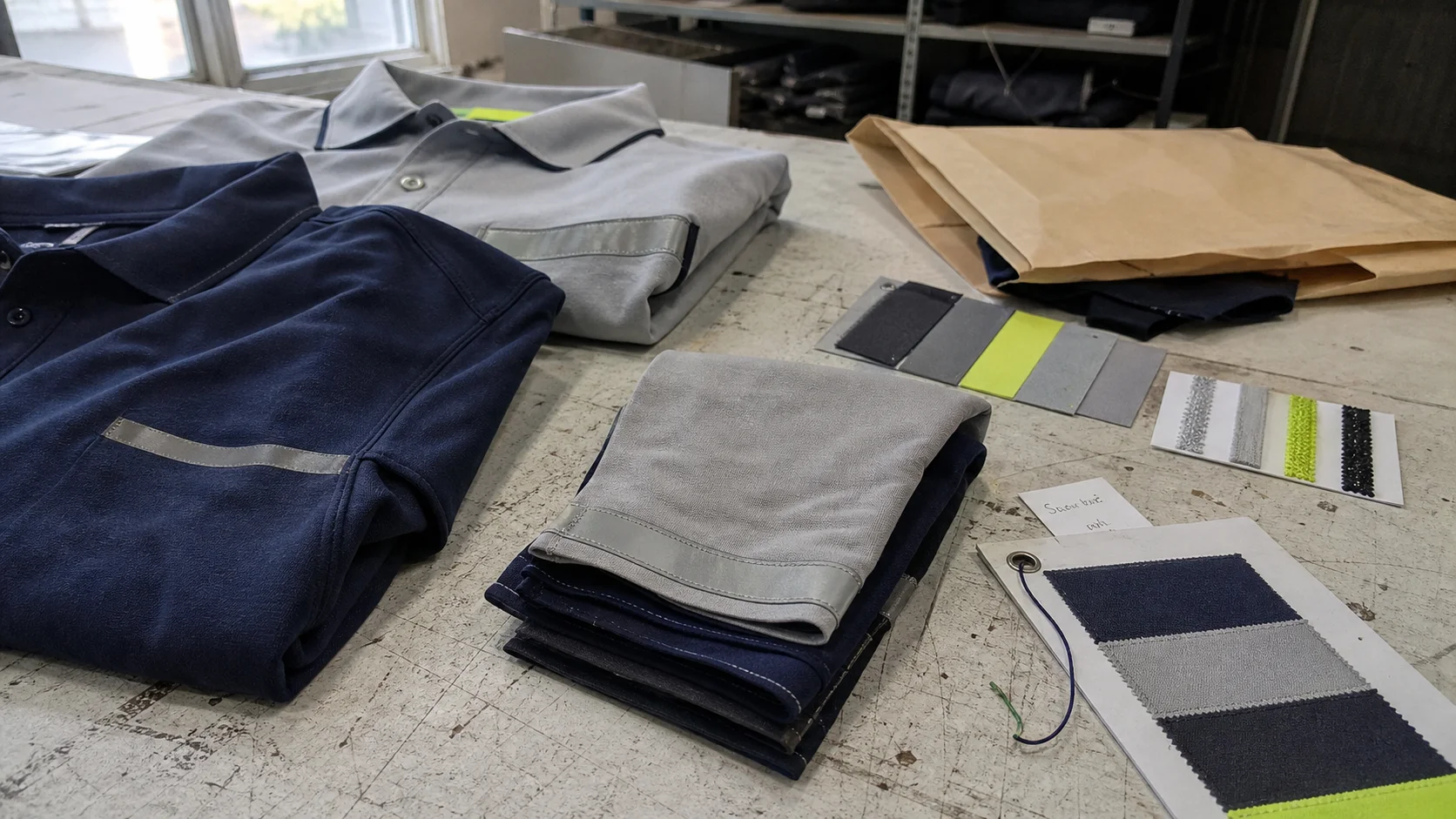
Cuffs, seam tapes, and garment finishes matter because they influence cleaning performance. If the sleeve includes reflective tape or bonded trims, the print area should not interfere with those materials. Heat-sensitive trims can warp during curing. That risk should be checked before production, not after.
Material Choice Practical Benefit Tradeoff Poly-cotton sleeve fabric Balanced durability and comfort Print behavior can vary by blend ratio 100% polyester sleeve fabric Good shape retention and laundering resistance Requires the right ink or transfer system Screen print Strong for simple graphics and repeatability Less ideal for fine gradients or photographic art Heat transfer Good detail and flexibility for limited runs Press settings and film quality drive performance Embroidery Durable and premium in appearance Bulkier on sleeves and more expensive for large areasCleaning crew uniform programs often fall into one of two patterns: a small recurring reorder or a larger rollout across multiple sites. That changes the economics of sleeve decoration.
For printed sleeve uniforms, sample runs may start at one to three sets for approval. Production MOQ can vary widely by factory and print method. A practical range often falls between 100 and 300 pieces per colorway for standard programs, while highly customized decoration or multiple size runs can push the minimum higher. Embroidery and complex transfer work may require different thresholds.
Expect at least one visual sample, one fit sample if the garment is newly developed, and one decorated pre-production sample if the print is critical. If the supplier proposes skipping decorated sampling, the buyer should treat that as a risk. The cost saved upfront can be lost quickly if the sleeve graphic fails after bulk washing.
Lead time depends on fabric availability, print method, sample turnaround, and whether testing is done in-house or through a third party. A simple screen-printed run on existing fabric can move quickly. A new custom fabric, new print system, or special chemical-resistance requirement can add days or weeks. Seasonal demand also matters. Uniform orders tied to opening schedules or contract starts should build in buffer time for revisions.
For programs with strict launch dates, it is better to simplify the sleeve artwork and lock the color earlier than to push for a more complex decorative effect that risks delay. That is often the right tradeoff in operational uniform buying.
Most print failures are not surprises. They usually come from avoidable specification gaps.
If the logo sits too close to the cuff, it gets hit by friction and cleaning chemicals more often. If it crosses a seam, the print can distort. Good placement should protect the artwork from the most aggressive wear zones.
Under-cured ink may look acceptable at first and then crack, bleed, or peel after washing. Over-curing can also cause problems, especially on synthetic fabrics or when adhesives are involved. The curing process should match the substrate and ink system, not just a generic production habit.
Some colors shift after heat or chemical exposure. Red, navy, and black are common trouble spots, especially when printed over a dyed base fabric. A buyer should always inspect the decoration after wash testing, not only on the day of approval.
Cleaning crews may use different chemicals from one site to another. A print that survives standard detergent may fail when disinfectant concentration is higher than expected. That is why the end-use brief matters so much. The supplier cannot test for a risk it does not know exists.
Thin lines, gradients, tiny text, and multiple colors increase the chance of registration errors and visual fading. Sleeve graphics for cleaning crews usually perform better when they are simple, high-contrast, and easy to identify from a distance.
A sleeve print map audit is not about maximizing every visual detail. It is about keeping the uniform serviceable under real working conditions. The best spend is on the parts that affect longevity and consistency.
Spend more on the print system if the uniforms will be washed frequently, exposed to chemicals, or used in front-facing client work. Spend more on sample rounds if the garment is new, the fabric is unfamiliar, or the decoration sits in a highly stressed area. Spend more on testing when the cost of failure is higher than the cost of validation.
Save money by keeping the artwork simple, reducing the number of colors, avoiding oversized sleeve graphics, and aligning the decoration spec with a fabric that already has a proven laundering record. That is the practical path for most cleaning uniform programs.
The most reliable uniform program is usually not the most decorative one. It is the one that locks the artwork, tests the print against real wear, and avoids unnecessary complexity in the sleeve zone.
A buyer can use this short checklist before approving a sleeve print map:
That checklist is basic, but it prevents most avoidable procurement mistakes. A clear sleeve print map lowers the chance of disagreement between sourcing, production, and quality control.
Bulk inspection should include more than counting pieces. Random cartons should be checked for placement consistency, print opacity, edge definition, and post-wash appearance if the program allows a pilot cycle. For cleaning crew uniforms, inspect cuffs and sleeve edges carefully because those areas often show the earliest wear.
It is useful to compare bulk units against the approved sample in consistent lighting. Color deviation on sleeves is easier to miss when the garment is folded or partially shaded. If the artwork includes small text or icons, check legibility at working distance, not only at close range.
Inspection should also look for secondary issues such as print smell after curing, tackiness, or film stiffness. Those are signs that the print system may not age well in the laundry process.
A sleeve print map audit for cleaning crew uniforms is a control step, not a design exercise. The real decision is whether the decoration will survive the laundry cycle, chemical exposure, and daily friction that cleaning teams put on workwear. When the artwork is simple, the placement is sensible, and the colorfastness checks are tied to the actual use case, the result is more stable and cheaper to maintain over time.
For sourcing teams, the main discipline is to treat sleeve print as a performance component. Approve the sample carefully, confirm the test method, lock the spec, and keep the artwork aligned with the realities of the job. That approach usually produces a better outcome than chasing a more complex graphic that looks strong on screen but weak in service.
Get a free quote from Fabrikn — your trusted B2B clothing manufacturer with 10+ years of experience. MOQ as low as 200 pieces.
Get a Free Quote →It is the production guide that defines where the sleeve artwork goes, how large it is, which colors are used, and which decoration method is required. For cleaning crews, it should also include durability expectations.
Wash fastness is the most important. Rub fastness, bleach resistance, and adhesion checks are also useful because cleaning uniforms face laundering, friction, and chemical exposure.
There is no single best method. Screen print is often efficient for simple graphics, heat transfer can handle detail, and embroidery is durable but bulkier. The right choice depends on the fabric and the laundering conditions.
Many suppliers work around 100 to 300 pieces per colorway for production, though decorated sample runs can be smaller. MOQ varies by print method, fabric, and customization level.
At minimum, one decorated pre-production sample should be reviewed. New garments or higher-risk programs should also include fit and visual samples before bulk approval.
Common causes include weak curing, poor ink-fabric compatibility, wrong placement, chemical exposure, and overly complex artwork. A print that passes visual review can still fail in the laundry if those points are not controlled.
If the uniform will be exposed to bleach or disinfectant chemistry, yes. The exact requirement should match the actual cleaning protocol used by the crew.