
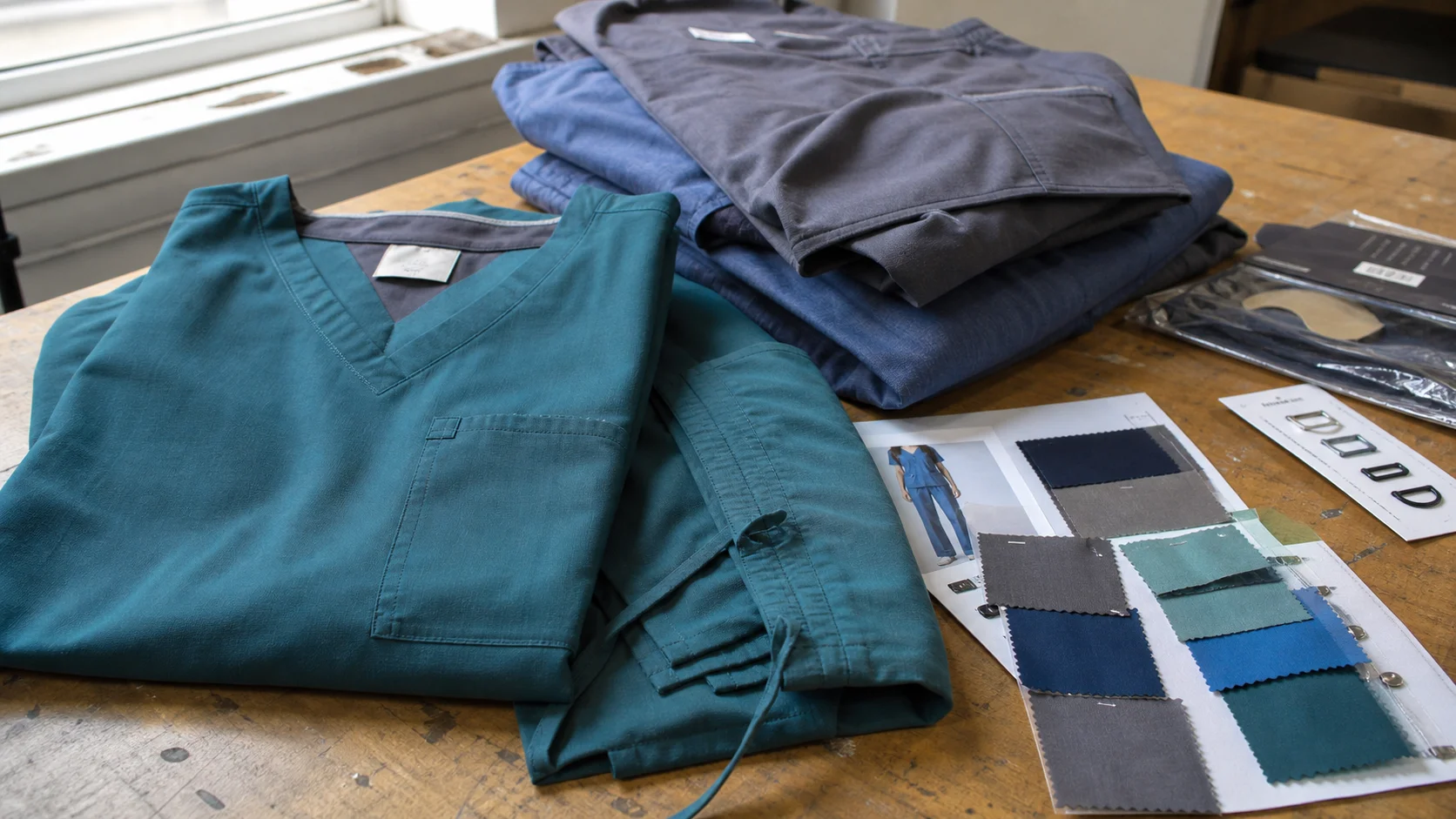
A practical SEO outline for clinic purchasing teams calculating the true landed cost of scrub uniforms, lab coats, and workwear sets from manufacturer...
Clinic Scrub Uniforms Landed Cost Buying Guide - Quality & Inspection manufacturing guide
For clinic purchasing teams, scrub uniforms look simple on a quotation sheet. A top, a pant, a logo, a size range, and a unit price. The landed cost is rarely that simple. A low ex-factory price can become expensive once fabric performance, embroidery set-up, carton dimensions, duties, freight, inspection, rejected goods, and replenishment delays are included.
This guide is written for buyers comparing workwear uniform manufacturers for clinic scrub programs. It focuses on practical landed cost control, not just unit price negotiation. The goal is to help purchasing, operations, and quality teams evaluate scrub suppliers with fewer surprises from sampling through bulk delivery.
Clinic scrub uniforms are operational products. They must look consistent at reception, survive repeated laundering, allow movement during shifts, and arrive in the right size mix before onboarding dates. The purchasing decision affects staff presentation, inventory planning, and replacement budgets.
A workwear uniform manufacturer may quote a scrub set at an attractive FOB or ex-factory price. That quote is only one part of the cost. The actual landed cost includes the purchase price plus all expenses required to get usable uniforms into the clinic’s stockroom or distribution point.
For clinics, the hidden cost usually comes from three areas: poor specification control, freight inefficiency, and quality failure. A scrub top that shrinks after wash, a pant with weak pocket stitching, or a mismatched shade between reorders can force replacements. Those replacement costs often exceed the savings from choosing the cheapest initial quote.
Purchasing judgment: treat scrub uniforms as a controlled workwear program, not a one-time apparel order. The right landed cost calculation protects both budget and staff readiness.
Clinic buyers should ask manufacturers to quote clearly by style, fabric, color, logo method, size range, packing method, delivery term, and inspection arrangement. If those elements are vague, the landed cost cannot be compared fairly.
A useful landed cost calculation starts with the unit garment price and then adds every cost that must be paid before the uniforms are ready for use. The exact formula depends on the buying term, country of import, order volume, and transport mode.
Cost Component What It Includes Common Risk Product cost Scrub top, scrub pant, fabric, trims, sewing, finishing, packing Low quote based on weaker fabric or reduced construction Logo and branding Embroidery, heat transfer, woven label, neck print, set-up charges Logo placement errors or color mismatch Sampling cost Development sample, fit sample, pre-production sample, courier Multiple rounds caused by incomplete tech pack Inspection cost Inline inspection, final random inspection, lab testing if required Late defect discovery after shipment booking Export and inland charges Local transport, export documents, terminal handling where applicable Charges excluded from an ex-factory quote International freight Air, sea, courier, or consolidated transport High air freight due to late production Import duty and taxes Customs duty, VAT/GST, brokerage, clearance fees Wrong HS code or missed tax treatment Domestic delivery Warehouse receipt, clinic allocation, last-mile delivery Cartons not packed by department or size Failure allowance Rejects, shortages, returns, replacement pieces No buffer for quality issues or staff exchangesA simple working formula is:
Landed cost per usable set = total order cost delivered to destination divided by accepted usable scrub sets.
The word “usable” matters. If a clinic orders 1,000 sets but 40 sets fail inspection, arrive with shade problems, or cannot be allocated because of incorrect sizing, the real cost per usable set rises. Buying teams should include expected defect allowance and size exchange allowance in the calculation.
For a stable clinic program, a realistic buffer may be 2% to 5% depending on supplier reliability, complexity, and the strictness of acceptance criteria. High-risk first orders, contrast trims, complex embroidery, or many size combinations may require tighter inspection and a larger contingency.
Scrubs are not all built the same. Two manufacturers may quote the same “poly-cotton scrub set” at different prices because the construction, fabric weight, finishing, and size grading are not equal. A clinic purchasing team should lock the product specification before comparing quotes.
Important scrub specifications include:
Fabric weight is a direct cost driver. A 145 GSM fabric will usually cost less than a 180 GSM fabric, but it may feel lighter, show more wear, or provide less structure. Stretch fabric improves comfort but adds cost and may require better shrinkage and recovery testing. Cotton-rich scrubs can feel more breathable, yet may wrinkle more and need stronger wash testing if the clinic uses industrial laundering.
Construction also changes cost. A basic V-neck top with two pockets is cheaper than a top with multiple utility pockets, contrast panels, badge loops, side knit panels, and reinforced seams. Extra pockets sound useful, but each pocket adds sewing minutes and inspection points. For clinics with tight budgets, choose functional details that staff actually use.
Purchasing judgment: do not over-specify fashion details if the clinic’s main need is durable, consistent, easy-to-reorder workwear. Spend the money on fabric performance, fit control, and reliable color continuity first.
Minimum order quantity is one of the main cost levers in scrub manufacturing. MOQs depend on fabric availability, dyeing requirements, logo work, size spread, and whether the manufacturer is producing from stock fabric or custom fabric.
Typical MOQ ranges can vary, but clinic buyers often see these patterns:
Order Type Typical MOQ Range Best Use Tradeoff Stock fabric, standard color 100 to 300 sets per style/color Small clinics, trial orders, urgent replenishment Less control over exact shade and fabric continuity Custom logo on standard scrub 200 to 500 sets per style/color Clinic groups needing branded uniforms Logo set-up and placement control required Custom color or dyed fabric 500 to 1,000 sets per color or more Multi-location clinics with brand color standards Longer lead time and higher shade approval risk Fully custom style and fabric 800 to 2,000 sets per style/color or more Large healthcare networks and long-term programs Higher development cost, stronger forecasting neededThese ranges are directional. A manufacturer may accept lower MOQs for repeat buyers, available fabric, or simple styles. They may require higher MOQs for custom-dyed stretch fabrics, special trims, or fragmented size ratios. The key is to ask what is driving the MOQ. If the MOQ is fabric-related, splitting the order into many colors may raise cost sharply. If it is sewing-line related, combining sizes within one style may be easier.
Clinic purchasing teams should build the size ratio from staff data, not from generic retail assumptions. Scrub programs often need more medium to XL sizes, but this varies by region, gender mix, and fit type. Unisex scrubs reduce style complexity but can create fit complaints. Separate men’s and women’s fits improve comfort but increase SKU count and MOQ pressure.
A practical first-order approach is to keep the core style range narrow, approve a reliable size chart, and order a modest overage in common sizes. For replenishment, negotiate whether the manufacturer can hold fabric, repeat the shade, or combine production with other orders. Those terms affect landed cost as much as the quoted unit price.
Skipping sample discipline is a common cause of landed cost failure. A scrub uniform may look acceptable in a photo but fail in fit, pocket placement, fabric hand feel, shrinkage, or logo durability. Sample approval should be structured and documented.
A typical scrub approval process includes:
Purchasing teams should not approve bulk production from a sample made in substitute fabric unless the risk is understood. A sample in a different fabric can hide shrinkage, drape, color, and sewing behavior problems. If time is tight, approve style only and clearly state that bulk fabric, trims, and color remain pending.
Sample approvals should include comments in measurable terms. “Make it better” is not useful. “Reduce chest measurement by 2 cm on size M and grade proportionally” gives the manufacturer a clear correction. “Move embroidery 2 cm higher from approved pocket opening” avoids interpretation errors.
For clinic programs, staff wearer trials can be useful, but they must be controlled. Give trial wearers a feedback form covering fit, comfort, pocket use, bending, sitting, laundering, and appearance after wash. Avoid letting every individual preference rewrite the spec. The purchasing team should separate comfort issues from personal taste.
Fabrikn’s sourcing and uniform development support can be reviewed at fabrikn.com/services/ for teams that need structured help moving from product brief to manufacturer-ready specifications.
Fabric is usually the largest material cost in scrub uniforms. The wrong fabric decision can create ongoing replacement cost. The right fabric depends on how the clinic uses and washes the uniforms.
Any performance claim should be treated carefully. If a supplier claims antimicrobial, fluid resistance, moisture wicking, or easy-care performance, the buyer should request test standards, test reports, and expected wash durability. Unsupported claims can create compliance and marketing risk, especially in healthcare settings.
Trims are smaller than fabric in cost, but they affect comfort and durability. Elastic that rolls, drawcords that fray, labels that irritate the neck, or snaps that corrode can lead to complaints. Trim approvals should include physical samples, not only photos.
Clinic branding commonly uses embroidery, heat transfer, woven labels, or printed neck labels. Embroidery gives a durable, professional appearance but can pucker lightweight fabric if density is too high. Heat transfer is clean and consistent but must be checked for wash durability, cracking, and edge lifting.
Logo cost depends on stitch count, color count, size, placement, and set-up. A small chest embroidery may be economical. A large back logo or multi-color sleeve branding increases both cost and defect risk. If the clinic has multiple departments, using different embroidery colors can help staff identification, but it complicates production and packing.
Purchasing judgment: if the uniform must last through frequent laundering, logo durability is not optional. Approve a logo strike-off and wash it before bulk production.
Scrub uniform inspection should be planned before production starts. Waiting until cartons are ready creates leverage problems. The manufacturer may be under shipping pressure, and the clinic may need uniforms urgently. That is when compromises become expensive.
A sensible quality plan for clinic scrubs includes incoming material checks, inline production checks, and final random inspection. Larger orders or first-time suppliers justify more control. Repeat orders with a stable supplier may use lighter inspection, but only if past performance supports it.
Common AQL levels for apparel final inspection may include general inspection level II with AQL 2.5 for major defects and AQL 4.0 for minor defects. Some healthcare buyers use stricter rules for visible stains, wrong logos, or incorrect labels because these defects affect immediate usability. The acceptance standard should be agreed before production.
Wash testing is especially important for scrubs. A garment can pass visual inspection before washing but fail after laundering. Buyers should define test conditions that reflect real use: home wash, commercial laundering, tumble drying, ironing, or disinfecting processes where relevant. If a clinic uses industrial laundry, confirm that the fabric and trims are suitable for that process.
Shade control is another frequent problem. Navy, ceil blue, pewter, royal blue, and burgundy can vary noticeably between dye lots. A clinic using uniforms across multiple locations should maintain approved color standards and ask whether reorders will come from the same fabric lot or a new dye lot. New dye lots need lab dip or bulk shade approval.
Inspection costs money, but failed shipments cost more. For first orders, inspection is usually worth the expense. For small repeat orders from a proven supplier, inspection can be adjusted, but carton checks and measurement audits should not disappear entirely.
Lead time is not only sewing time. It depends on fabric availability, sample approval speed, trim sourcing, logo set-up, production capacity, inspection booking, freight mode, and customs clearance. Clinic teams often underestimate the calendar time required before uniforms are ready for staff distribution.
Stage Typical Time Range Main Dependency Specification and quotation 3 to 10 working days Completeness of tech pack and order details Development or fit sample 7 to 21 days Style complexity, fabric availability, logo requirements Lab dip or fabric approval 7 to 20 days Custom color, dyeing schedule, approval rounds Pre-production sample 7 to 14 days Bulk fabric and trim readiness Bulk production 25 to 60 days Order size, factory capacity, fabric lead time Inspection and packing 2 to 7 days Inspection result, rework needs, carton labeling International transport 3 to 10 days by air, 20 to 45 days by sea on many lanes Mode, routing, season, customs clearanceThese are general ranges, not guarantees. Public holidays, fabric mill delays, shipping congestion, and late approvals can change the schedule. A clinic buying team should work backward from staff onboarding dates, new branch openings, or contract start dates. If uniforms are needed on a fixed date, the schedule should include buffer.
Rushed timelines usually raise landed cost. Air freight may rescue a late order, but it can destroy the savings from offshore manufacturing. Partial air shipment is sometimes a better compromise: ship enough sizes for immediate onboarding by air, then send the balance by sea or consolidated freight.
Purchasing judgment: the cheapest freight plan is often the one protected by early approvals. Late sample comments and slow purchase order release are hidden landed cost drivers.
Freight and duty can change the final landed cost more than buyers expect. Scrubs are relatively light, but packaging method, order volume, carton dimensions, and transport mode still matter. A quote that looks good on product cost may lose value if cartons are bulky or the order is too small for efficient freight consolidation.
Clinic buyers should understand the delivery term used in the quote. Common terms include ex-factory, FOB, CIF, DAP, and DDP. Each term assigns different responsibilities and costs between buyer and supplier.
Term Buyer Should Check Ex-factory Local pickup, export handling, freight, insurance, duty, and delivery may be excluded. FOB Supplier covers export to port; buyer handles main freight, import, and destination delivery. CIF Main freight and insurance included to destination port; import clearance and local delivery still need review. DAP Delivered to named place, but import duty and tax may remain buyer responsibility. DDP Delivered duty paid; convenient, but confirm what is included and whether the supplier can legally and reliably handle import obligations.DDP can be convenient for clinics without import infrastructure. It is not automatically the lowest-cost option. The supplier or freight partner may add margin for risk. FOB can be better for buyers with reliable freight forwarders and customs brokers. Small clinics may prefer DAP or DDP for simplicity, while larger healthcare groups often benefit from controlling freight and customs directly.
Scrub uniforms are usually classified as apparel, but exact classification depends on fabric composition, gender designation, garment type, and local customs rules. Buyers should confirm HS codes with a qualified customs broker. A wrong classification can lead to underpaid duty, shipment delays, penalties, or unexpected tax bills.
Country of origin also matters. Duty rates, documentation requirements, and preferential trade rules vary. If a supplier offers a certificate of origin or claims preferential duty treatment, purchasing teams should verify eligibility rather than assuming savings.
Clinic scrub orders often include many sizes. Poor packing can cause receiving delays and distribution errors. Good packing can reduce labor cost at destination, even if the unit product price is unchanged.
Set packing is convenient for distribution, but separate packing can be better when staff mix top and pant sizes. If the clinic often issues different top and bottom sizes, forced set packing may create inventory imbalance. That imbalance becomes a landed cost problem because extra pants or tops remain unused.
A proper supplier comparison should include more than the garment price. Use a structured comparison to separate low price from good value.
Evaluation Area Questions to Ask Good Sign Warning Sign Specification understanding Can the manufacturer interpret fabric, measurements, trims, logo, and packing requirements? Clear questions and written spec confirmation Generic quote with missing assumptions MOQ flexibility What drives MOQ: fabric, dyeing, trims, or production line? Explains MOQ by material and style logic Refuses detail or changes MOQ after order Sampling discipline What sample stages are offered before bulk? Provides development, fit, logo, and pre-production approvals Pushes bulk production before final approval Quality control What inspections and tests are expected? Accepts written tolerances and inspection plan Claims inspection is unnecessary Lead-time reliability What affects schedule and what is the critical path? Breaks down fabric, sampling, production, inspection, shipping Quotes a short lead time without conditions Reorder support Can the supplier repeat color, fit, fabric, and logo? Keeps approved standards and discusses dye-lot control No plan for repeat consistency Landed cost visibility Which costs are included and excluded? Quote states term, packing, freight assumptions, and extra charges Only provides unit priceClinic purchasing teams can also ask about supplier capability, development process, and communication structure. General company information and sourcing background can be reviewed at fabrikn.com/about-us/ when evaluating whether a partner fits the program’s needs.
The best scrub supplier is not always the lowest quote. It is the supplier that can deliver acceptable uniforms at a predictable total cost. A clinic should evaluate the manufacturer’s ability to control repeat quality, not only the first shipment.
A lower-cost supplier can be a good option when the scrub style is simple, fabric is standard, colors are available, logo work is basic, and the clinic can accept limited customization. This approach suits small clinics, short-term programs, or non-patient-facing support roles where brand precision is less demanding.
The buyer should still protect the order with approved samples, a clear size chart, and final inspection. Low cost is acceptable. Uncontrolled cost is not.
Paying more usually makes sense when the clinic needs a stable brand color, frequent reorders, custom fit, stretch fabric, strict logo placement, or multi-location distribution. The added cost can buy better development support, stronger material consistency, and fewer operational disruptions.
For clinics with staff retention concerns, comfort matters. Uncomfortable scrubs create complaints and replacement pressure. Better fabric and fit may cost more per set, but the program can be cheaper over its lifecycle if staff wear the garments longer and exchange fewer sizes.
A supplier should raise concern if they cannot provide fabric details, avoid measurement tolerances, refuse pre-production sample approval, give unclear delivery terms, or promise unrealistic lead times. Another warning sign is a quote that changes materially after the buyer asks basic questions about packing, logo, or inspection.
Clinic buyers should also be cautious with suppliers who treat inspection as an insult. Professional apparel manufacturers understand that inspection is part of commercial risk control. It protects both buyer and manufacturer when the standard is clear.
Before issuing a purchase order, clinic purchasing teams should confirm the following points in writing:
Each item reduces ambiguity. Ambiguity is expensive in apparel sourcing because it usually appears late, after fabric is cut or goods are packed.
There are smart ways to reduce scrub landed cost without weakening the product. The first is SKU simplification. Fewer colors, fewer logo versions, and fewer style variations help the manufacturer buy fabric and run production efficiently. This also helps the clinic manage inventory.
The second is fabric standardization. If multiple departments can use the same fabric in different colors, the buyer may improve consistency and simplify testing. If the same navy fabric can be used for tops, pants, jackets, and reorder stock, the total program becomes easier to control.
The third is planned replenishment. Emergency orders cost more because they often require air freight, short production slots, or small-batch handling. A quarterly or semiannual forecast gives the manufacturer better planning visibility and gives the clinic more leverage on price and continuity.
The fourth is packaging alignment. If receiving teams spend hours sorting mixed cartons, the landed product cost is not the only cost that matters. Department packing, size labels, and clear carton marks may add a small production cost but reduce warehouse labor and errors.
The fifth is disciplined approvals. Every sample round costs time and often courier fees. A complete brief, accurate measurements, and clear artwork reduce avoidable revisions. If internal stakeholders approve slowly or contradict each other, the supplier will not be able to protect the schedule.
Inspection failure does not only delay shipment. It can trigger rework, repacking, extra inspection visits, missed freight bookings, air upgrades, and staff shortage problems. A failed order can also create internal costs: purchasing time, operations escalation, and temporary uniform alternatives.
Typical scrub inspection failures include:
The purchase agreement should state how failures are handled. Options include supplier rework, replacement, discount, delayed payment, or rejection depending on severity. For critical defects such as wrong logo, incorrect color, or unsafe construction, discounts may not be useful because the clinic still cannot issue the garments.
Purchasing judgment: negotiate failure remedies before placing the order. After a failed inspection, the buyer’s leverage is weaker if the terms are vague.
A strong request for quotation helps manufacturers quote accurately. A weak RFQ encourages low assumptions and later cost increases. Clinic teams should include enough detail for suppliers to calculate fabric, labor, trims, packing, and delivery correctly.
A complete RFQ should include:
If a clinic does not yet know the exact fabric, the RFQ can ask for two or three options. For example, request a basic poly-cotton option, a stretch comfort option, and a premium easy-care option. This allows a cleaner comparison of landed cost versus performance.
Teams ready to discuss a clinic scrub uniform program can use fabrikn.com/contact-us/ to start a supplier conversation with order requirements, target volumes, and delivery expectations.
Clinic scrub uniforms are a recurring operational purchase, so the buying decision should be based on landed cost per usable set rather than quoted unit price. The lowest quote can still be expensive if it creates quality failures, staff fit complaints, air freight, or inventory imbalance.
A good workwear uniform manufacturer should help clarify fabric choices, MOQ logic, sample approvals, lead-time dependencies, inspection standards, and packing needs. The purchasing team should control the brief, approvals, and landed cost calculation. When both sides work from a precise specification, the clinic gets a more predictable uniform program and fewer budget shocks.
Get a free quote from Fabrikn — your trusted B2B clothing manufacturer with 10+ years of experience. MOQ as low as 200 pieces.
Get a Free Quote →Landed cost is the total cost to get usable scrub uniforms delivered and ready for clinic use. It includes garment price, logo work, samples, inspection, freight, duty, taxes, clearance, local delivery, and allowances for rejects or shortages.
Typical MOQs range from about 100 to 300 sets for stock fabric and standard colors, 200 to 500 sets for branded standard scrubs, and 500 to 1,000 sets or more for custom-dyed fabric. Fully custom programs can require 800 to 2,000 sets or more depending on fabric and style complexity.
Clinics can reduce landed cost by simplifying colors and styles, standardizing fabric, planning replenishment early, avoiding emergency air freight, improving packing instructions, and approving samples correctly before bulk production.
FOB can be better for buyers with their own freight forwarder and customs broker. DAP or DDP can be simpler for clinics without import experience. DDP is convenient, but buyers should confirm all duties, taxes, and delivery charges are truly included.
The most important checks include fabric shade, measurements, seam strength, pocket reinforcement, logo placement, wash shrinkage, colorfastness, label accuracy, and carton assortment. For first orders, final random inspection and wash testing are strongly recommended.
Set packing is convenient when staff receive matching top and pant sizes. Separate packing is better when staff commonly need different top and bottom sizes. The wrong packing method can create unused inventory and raise the real landed cost.
Lead times vary because fabric availability, custom dyeing, sample approval, logo set-up, production capacity, inspection, freight mode, and customs clearance all affect the schedule. Late approvals and fabric delays are common reasons for missed delivery dates.
A good RFQ should include style details, fabric requirements, quantity by size and color, logo artwork, measurement chart, packing instructions, delivery date, shipping destination, inspection expectations, and preferred delivery term.