
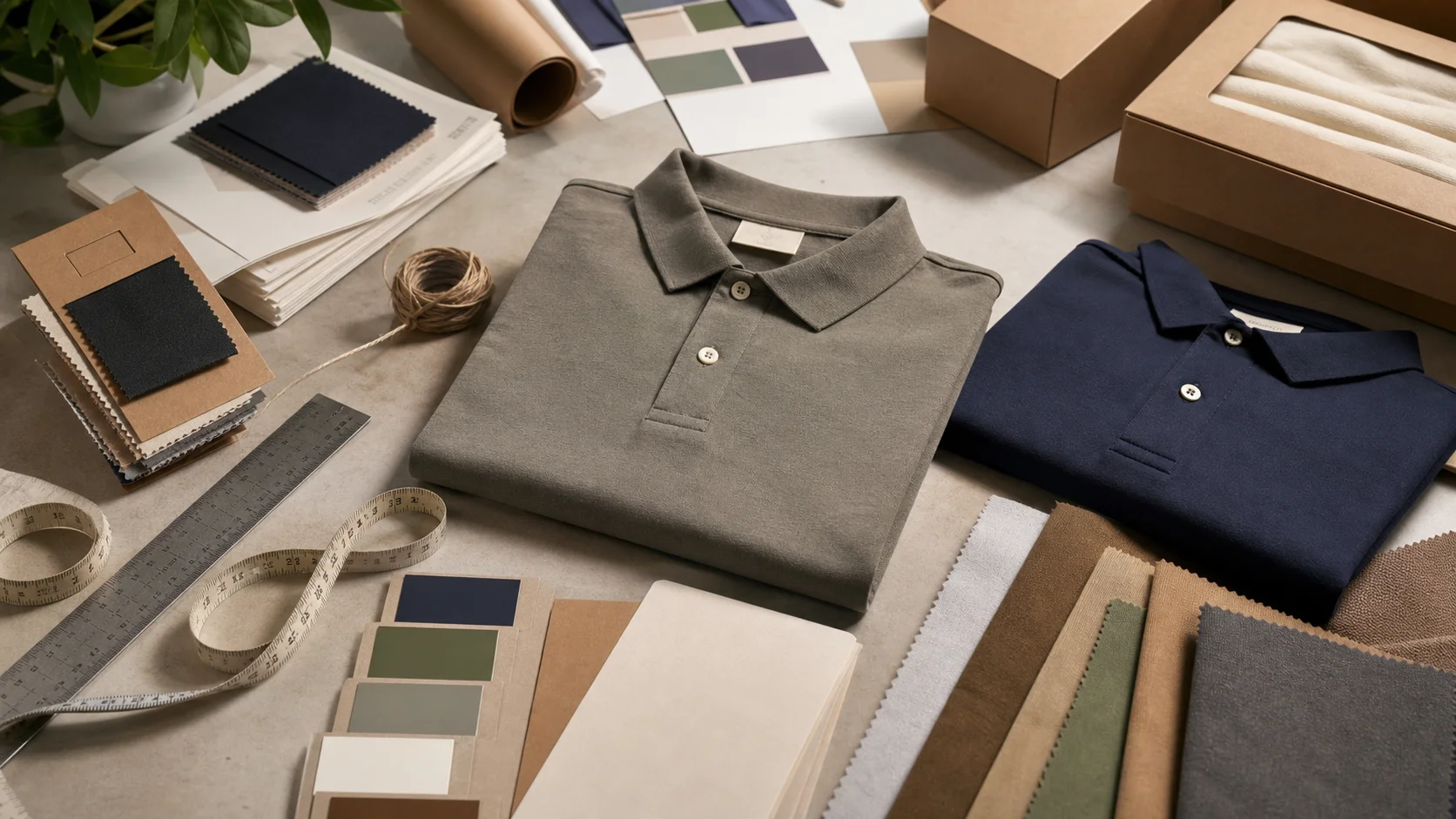
Clothing Factory Minimum Order with checks for samples, fit, MOQ, QC evidence, pricing terms, and delivery risk.
Fast answer: Clothing Factory Minimum Order: A Clear Explanation for Brands should be judged by production evidence, not by a generic sourcing promise. The buyer needs sample proof, cost breakdowns, QC checkpoints, and delivery buffers in writing.
Ask for recent sample photos, measurement tolerances, fabric or print test assumptions, decoration test notes, packing examples, and a named inspection checkpoint. These details show whether the team can repeat an approved sample at bulk volume.
Separate garment cost, decoration, labels, packaging, sampling, testing, freight, and rush charges. When every cost line is visible, it becomes easier to reduce colorways, adjust size depth, or reserve more time for sampling.
If you are launching a fashion brand, expanding a private label collection, or sourcing a new supplier, one of the first terms you will encounter is minimum order quantity, often shortened to MOQ. In simple terms, a clothing factory minimum order is the smallest number of units a manufacturer is willing to produce in one production run.
That number can catch people off guard. In many cut-and-sew programs, it might start at 100-300 pieces per style, while more customized programs can require 500-1,000+ units to be cost-effective. Big spread, same reason: setup, materials, and labor all have to be paid for somehow.
For many brands, MOQ is confusing at first. Why does one factory ask for 100 pieces while another asks for 1,000? Why are some products easier to produce in small batches than others? And how do you judge MOQ when you are trying to balance budgets, inventory risk, and growth?
This article gives a straightforward clothing factory minimum order explanation so brands can better understand how MOQ works, why factories require it, and how to make smarter sourcing decisions.
Whether you are working with a startup budget or scaling into larger wholesale production, knowing how MOQ affects your supply chain can help you avoid costly mistakes and plan your product launches more effectively. For example, a basic cotton tee sourced from a stock fabric program may land around $2.50-4.00 per unit at 500 MOQ, while a more technical hoodie or washed heavyweight fleece style may price higher because of garment dyeing, rib trim, and extra sewing steps.
Small decisions now can save a season later.
If you are exploring manufacturing support, you can also learn more about our production capabilities on the Fabrikn services page or reach out through our contact page to discuss your project.
A clothing factory minimum order is the lowest quantity of garments, fabric, or materials that a manufacturer will accept for a specific product. This minimum can apply to:
In the apparel industry, MOQ is not just a number chosen at random. It reflects the factory’s production setup, material sourcing requirements, labor planning, and financial reality. A factory needs enough volume to make the job efficient and profitable while covering fixed costs such as pattern development, cutting, sewing, sampling, finishing, quality control, and packing.
In a typical production line, that setup may include CAD pattern making, Gerber or Lectra marker planning, automatic fabric spreading, single-needle lockstitch machines, overlock/serger machines, coverstitch machines, and bartack machines. All of that takes coordination.
In practice, MOQ can vary widely depending on the type of clothing and the level of customization. For example, a simple t-shirt in a standard 100% combed cotton jersey, 180-220 GSM, may have a much lower minimum than a technical jacket with custom trims, YKK zippers, seam sealing tape, and multiple panels. A garment made in a stock fabric program in Guangzhou may start at 300-500 pieces, while a custom dye or custom knit program in Dhaka or Ho Chi Minh City may need 1,000+ pieces to justify mill or dye-house setup.
Many brands see MOQ as a barrier, but from the factory’s perspective, minimum orders are a practical necessity. Manufacturing clothing involves several fixed and variable costs, and those costs must be spread across the number of units produced.
Before production begins, a factory often needs to create patterns, prepare markers, cut fabric, set up machinery, and brief the production team. These setup tasks require time and labor whether the order is 50 pieces or 5,000 pieces. If the order is too small, the per-unit cost becomes too high.
What happens when the setup takes almost as long as the run? A standard cut-and-sew line may spend 2-6 hours on setup alone for a basic style, and longer for styles requiring embroidery digitizing, wash development, or special finishing.
Factories are usually not sourcing everything one piece at a time. Fabric mills, dye houses, zipper suppliers, label vendors, and packaging companies often have their own minimums. A clothing factory must coordinate these upstream requirements, and the combined minimums can influence the final MOQ presented to the brand.
For example, a woven label supplier may require 5,000 labels, while a custom hangtag printer may require 1,000 pieces, even if the garment order itself is only 300 units.
Factory workflows are built for efficiency. Cutting a small number of garments takes nearly the same setup as cutting a larger run, but the larger run distributes overhead across more units. Higher volume generally lowers cost per piece, which is one reason factories prefer orders that match their production scale.
In major hubs such as Guangzhou, Istanbul, Dhaka, and Ho Chi Minh City, larger sewing floors can keep multiple lines running with better labor utilization, reducing idle machine time on lockstitch, overlock, and coverstitch operations.
Once a production line is running smoothly, a factory can better standardize quality across a larger batch. Very small orders may interrupt workflow or require special handling that increases cost and complexity.
Factories with certifications such as WRAP, BSCI, OEKO-TEX Standard 100, GOTS, or GRS often have structured quality and compliance systems, including incoming fabric inspection, inline checks, final AQL inspections, and documentation for fiber content and chemical compliance.
MOQ is rarely a single universal number. Instead, it is usually calculated based on the specific product and the details of the order. A factory may quote different minimums for different elements of the same garment.
For example, a factory may say:
This means the final order quantity depends on how many colors, sizes, and variations you want. A brand ordering 3 colors and 5 sizes may need to hit a much larger total quantity than expected because the minimum must be met across each SKU or production combination. If the factory requires 100 pieces per color and you want black, navy, and olive, your minimum may effectively become 300 units before sizes are even split.
It is also important to understand the difference between production MOQ and sample MOQ. Sampling usually involves fewer units and a different cost structure.
Samples are created to test fit, construction, and design details before moving into bulk production. The cost per sample is usually much higher than the cost per piece in a full production order. A proto sample or fit sample may take 7-14 business days, while bulk production commonly runs 18-22 business days after approved materials and pre-production confirmation, depending on factory capacity and fabric availability.
Want a fast rule? Samples prove it first. Bulk proves it at scale.
For brands wanting to learn more about the company behind Fabrikn, visit our About Us page.
Several factors influence the minimum order quantity a clothing factory sets. Understanding these can help you negotiate more effectively and choose products that align with your budget.
The more complex the garment, the higher the MOQ tends to be. A basic cotton tee is simpler to cut and sew than a performance hoodie with multiple panels, custom prints, rib trims, and specialized finishing.
Complex garments require more planning, more materials, and more production time. A simple tee might be made on a 4-thread overlock with basic hemming, while a structured jacket could involve lining, interfacing, topstitching, and multiple trimming stages. And every extra step adds cost.
Stock fabrics usually allow lower MOQs because the material already exists. Custom fabrics often require mills to produce a new batch, which means larger minimums.
If a factory is using an in-stock organic cotton jersey or recycled polyester fabric, the order may be easier to place at a lower quantity. But if the brand wants a custom-spun yarn, custom knit structure, or a new color developed through lab dyeing, the minimum will usually be higher.
More colors often mean more complexity. Each additional color may require separate fabric dyeing, screen setup, or print production. That can increase the minimum order quantity or the overall cost.
For instance, a one-color screen print on a 200 GSM tee is usually easier to produce than a six-color discharge print with oversized front and back placements. Same garment, very different setup.
Different manufacturing regions work at different scales. Factories in China, Turkey, Vietnam, Bangladesh, and Portugal each serve different types of brands and order sizes. Some specialize in high-volume production, while others focus on smaller, boutique runs.
Labor costs, supplier networks, and factory specialization all play a role. A boutique factory in Los Angeles may accept 50-100 pieces for a premium line, while a larger export factory may prefer 500+ units to make the line efficient.
Factories are often more flexible with brands that place repeat orders, communicate clearly, and pay on time. A new brand may face a higher starting MOQ, while a long-term partner may negotiate better terms.
Trust matters. If a factory knows the brand will come back, it is easier to justify a smaller first run.
MOQ varies widely by product category. Here are some general examples of what factories may require:
These are not fixed industry rules. They are just common ranges. A small factory may agree to a lower order if the garment is simple, while a larger factory may require more volume even for basic products.
There is also a difference between basic and specialized production. A plain crewneck tee made from stock fabric may be accessible at lower quantities, while a garment washed hoodie with applique, custom drawcords, and branded hardware will usually need a larger run.
Brands are not powerless when MOQ looks too high. There are several ways to work with factories more strategically.
Instead of launching five styles at once, start with one or two core pieces. That lets you concentrate volume and meet factory minimums without overextending your budget.
A tight launch can be smarter than a wide one. Fewer SKUs mean less risk and often better pricing.
One of the easiest ways to lower MOQ is to use existing materials. Stock fabrics, standard zippers, and common trims reduce setup complexity and avoid extra supplier minimums.
This approach works especially well for essentials like tees, hoodies, joggers, and basic activewear.
Too many colorways or size splits can push an order above your target budget. If possible, begin with the colors that are most likely to sell and keep the size range focused on your core customer.
One strong color can outperform three weak ones. It is boring advice, but it saves money.
Some factories can combine similar orders or align your project with existing production runs. This is not always possible, but when it works, it can reduce setup costs and lower the effective MOQ.
Factories are more likely to accommodate smaller orders when they see long-term potential. Clear communication, realistic timelines, and prompt payment can make a difference.
Sometimes the best way to lower MOQ is not to push harder. It is to prove you are easy to work with.
Before committing to a supplier, ask detailed questions so you understand exactly what the MOQ means.
Getting these answers upfront prevents misunderstandings later. A low advertised MOQ can look attractive, but hidden material or finishing requirements may still make the order more expensive than expected.
MOQ is more than a factory policy. It is a planning tool that affects pricing, inventory, cash flow, and product strategy.
When you understand MOQ, you can:
Brands that understand these tradeoffs usually make better sourcing decisions. They know when to go small, when to scale, and when to push for a better production setup.
At Fabrikn, we work with brands that need practical manufacturing support, whether they are launching their first collection or growing an established line. MOQ questions come up early in almost every project, and that is normal. The key is to match the right factory, fabric, and production plan to your business goals.
We help brands evaluate garment types, material options, and production paths so they can find a minimum order that makes sense. In some cases, that means starting with a smaller run and standard materials. In others, it means planning a larger order to unlock better pricing and stronger production efficiency.
If you want to discuss your next project, visit our services page or contact us to start the conversation.
MOQ stands for minimum order quantity. It is the smallest number of units a factory will produce for a specific garment, fabric, or variation.
Sometimes, yes. Factories may lower MOQ if you use stock materials, limit colorways, or show potential for repeat business.
Custom garments often require special fabrics, trims, setup time, and supplier minimums, all of which raise the order threshold.
Not always. Lower MOQ reduces inventory risk, but it can also increase cost per unit. The right number depends on your budget and sales plan.
Look for manufacturers that specialize in startups, small batches, or stock fabric programs. Ask direct questions about style, color, and material minimums before you commit.
If you would like help reviewing a production plan or comparing MOQ options, Fabrikn can help you sort through the details.