
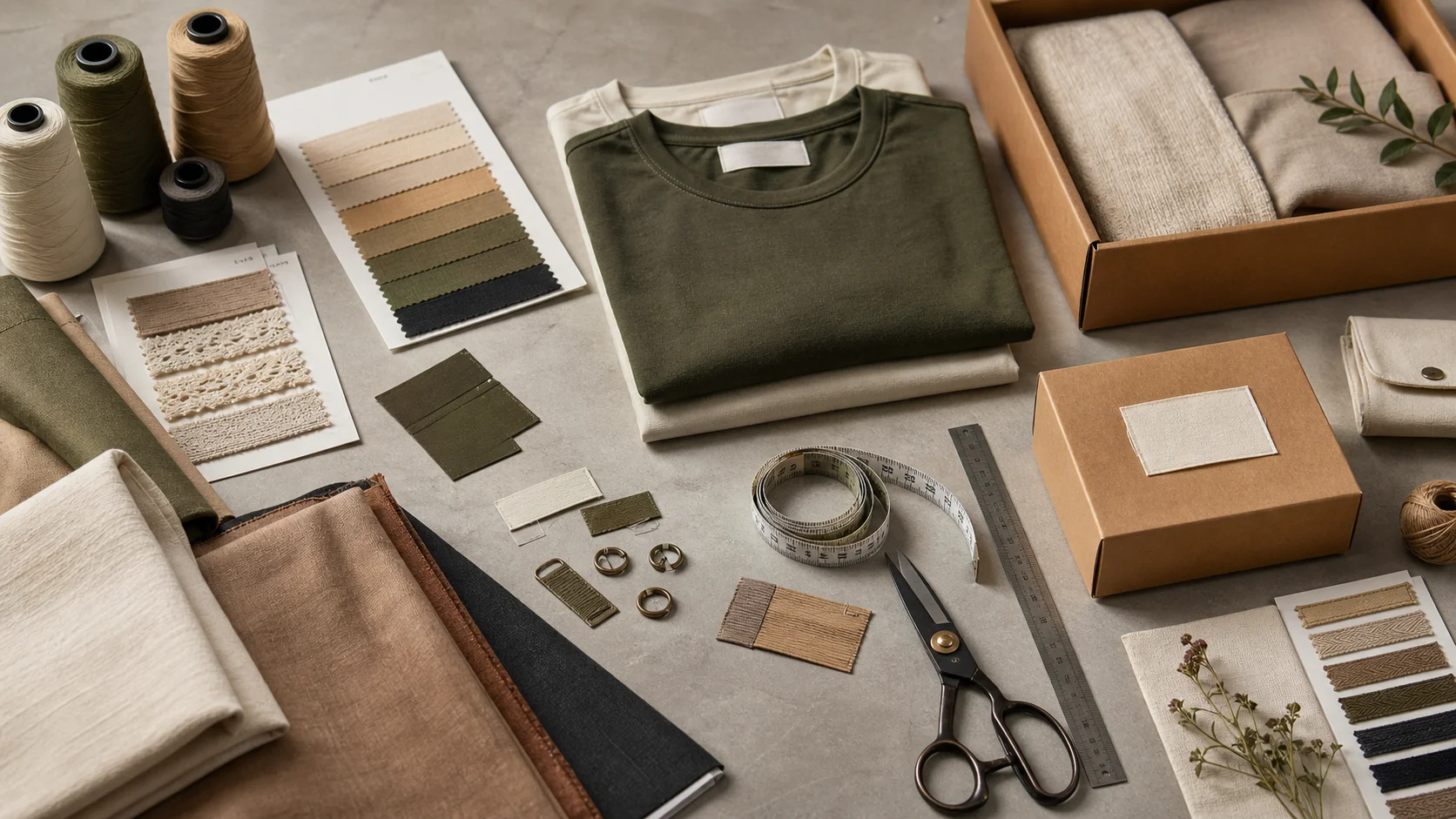
Clothing Manufacturing Cost Breakdown with checks for samples, fit, MOQ, QC evidence, pricing terms, and delivery risk.
Fast answer: Clothing Manufacturing Cost Breakdown: Fabric, Trim, Labor, and Freight should be judged by production evidence, not by a generic sourcing promise. The buyer needs sample proof, cost breakdowns, QC checkpoints, and delivery buffers in writing.
Ask for recent sample photos, measurement tolerances, fabric or print test assumptions, decoration test notes, packing examples, and a named inspection checkpoint. These details show whether the team can repeat an approved sample at bulk volume.
Separate garment cost, decoration, labels, packaging, sampling, testing, freight, and rush charges. When every cost line is visible, it becomes easier to reduce colorways, adjust size depth, or reserve more time for sampling.
A factory quote can look tidy right up until the hidden charges start marching in. That is why the clothing manufacturing cost breakdown for startups is never a single line on a page; it is a stack of small decisions that refuse to stay small for long. I’ve watched first-time founders obsess over a $2.80 sample fee while the real bill kept swelling: pattern corrections, lab dips, freight, hangtags, and the sort of extras that turn “cheap” into expensive fast.
Turkey, Portugal, Vietnam, Los Angeles — same headache, different accent. The biggest quote on paper was sometimes the safest bet in practice because it bought better communication, fewer sample rounds, and tighter quality control. In Turkey, a knit tee at 500 pieces might land at $4.20 to $6.10 FOB. Vietnam can come in at $2.60 to $4.00 for the same style, but a 2,000-piece minimum, a 4 to 6 week sampling cycle, and freight risk change the math. Los Angeles often starts at $8.50 to $14.00 per tee, yet a 100-piece run with 7 to 10 day sample turnaround can be cheaper for a founder who cannot finance 90 days of inventory.
Small orders bend unit price out of shape. Factories still pay for the cutting table, marker, thread matching, grading, and inspection whether they make 100 pieces or 5,000. On a 300-piece order, a $600 setup fee adds $2.00 per unit. On 3,000 pieces, it adds 20 cents. Startups miss that arithmetic all the time.
Cost is never one number. It is a stack of fixed and variable charges, and every sourcing decision changes the stack. I’ve worked with founders who saved $1.40 a unit offshore, then burned $3.20 more on air freight, import clearance, and late-season markdowns because the delivery slipped by 18 days.
The clothing manufacturing cost breakdown for startups usually starts with fabric, labor, trims, and factory overhead. Fabric often takes 25% to 40% of cost of goods sold, labor 10% to 25%, trims 5% to 15%, and overhead 10% to 20%. That spread moves with complexity. A basic 180 GSM cotton tee has a small bill of materials and limited sewing time. A lined blazer with canvas, shoulder pads, sleeves, fusible interfacing, and lining can push labor and overhead far beyond fabric cost. Denim with enzyme wash or stone wash adds even more because laundering, distressing, and rework sit outside normal cut-and-sew production time.
Approving a style before the tech pack is finished is the expensive mistake. A strong tech pack can cost $150 to $500 per style, patterns often run $75 to $300, and fit samples may take 2 to 5 rounds before approval. Color approvals, lab dips, shrinkage tests, and wash testing can add another $100 to $600 per style, depending on how exacting the brief is.
One brand I advised last year paid $280 for a pattern, then rushed production with incomplete measurements. The result was 11% size variation across a 1,200-piece run. That mistake cost more than the original development budget. It also pushed launch back by 19 days.
Factory margin, wastage, and compliance fees can quietly add 8% to 18% to the invoice. Wastage covers fabric loss in cutting, defects, and overage for shade matching. Compliance fees may include social audits, chemical restrictions, or testing tied to OEKO-TEX standards. According to ISO, standardized quality systems reduce process variation, and that matters when a manufacturer is balancing six orders at once. Skip those costs and you usually pay for them later in returns, rework, and credibility.
Map every line: fabric, trims, CMT, overhead, freight, duties, testing, packaging, and rejects. If a quote omits one of those, it is not complete. It is merely polite.
China still offers strong price efficiency on volume, especially for tees, fleece, and activewear, with many factories working best at 1,000 to 3,000 pieces per style. Vietnam stays competitive on knits and sportswear, with labor usually below U.S. levels and less volatile than many founders expect, but MOQ requirements can land at 500 to 1,500 pieces. India pulls attention for cotton-heavy programs and embroidery, with unit costs on simple styles sometimes 10% to 25% below southern Europe, though communication and lead times vary by factory and supplier.
Portugal and Turkey deserve more credit than startups usually give them. I’ve visited Portuguese workshops that produced 150-piece runs with fewer defects than offshore factories twice their size. Turkey can be especially efficient for midweight jersey, sweatshirts, and fashion denim, with tee production around $4.00 to $7.50, sweatshirts around $10.00 to $18.00, and denim jackets often ranging from $18.00 to $32.00 depending on wash and trims.
The United States is the most expensive on paper, but not always on total landed cost. A Los Angeles cut and sew shop may quote $9.00 to $16.00 for a tee, $18.00 to $34.00 for a hoodie, and much more for tailored pieces, yet the speed can save a collection that needs 2 to 4 week turnaround. That is where private label clothing services become useful for brands testing demand without overcommitting to massive runs.
Here’s what most people miss: a European factory with a 200-piece minimum can beat an offshore supplier on total cost if you only need 250 units, because you avoid 6 weeks of freight, 2 sample flights, and a dead season. I have seen that happen more than once.
According to trade.gov trade guidance, trade timing and logistics affect landed cost as much as labor. For startup categories, tees and sweatshirts travel well, denim tolerates slightly longer lead times, and activewear usually demands tighter fabric consistency. Nearshore is not automatically pricier; it depends on order size, speed, and the risk of markdowns from late delivery.
The first production run is rarely the first bill. Most startups need 2 to 5 sample iterations before approval, and every revision can trigger a new pattern check, fabric reorder, or trim adjustment. A $90 sample can become a $540 development cycle before you have a sellable garment.
Setup charges are where cash disappears quietly. Screen prep for print can run $25 to $80 per color, knitting setup may start at $150 and reach $500, wash approvals can cost $100 to $300, grading often adds $80 to $250, and packaging line setup may tack on another $100 to $400. MOQ math matters just as much. A brand ordering 100 to 300 units per style often pays 20% to 60% more per unit than a label ordering 1,000 or more.
Small is not bad. Small is expensive in different ways. A 200-piece run may protect cash flow, but if the factory’s minimum is 500 pieces, the quote becomes less about product cost and more about unused capacity. For children’s styles, where custom baby clothing manufacturing often requires stricter safety checks and softer trims, the development path can be even longer because snaps, labels, and fabric testing matter more.
I’ve seen founders assume sampling is a one-time spend. It is not. It is a toll road to first delivery.
A basic tee, hoodie, and tailored jacket sit in three different cost worlds. For a 300-piece run, a basic 180 GSM tee might cost $4.20 to $7.80, a fleece hoodie $11.00 to $22.00, and a tailored jacket $28.00 to $65.00 depending on lining, structure, and trims. That range is wide because panel count, stitching density, and finishing change everything.
A tee may use 4 to 6 panels and simple coverstitch construction. A hoodie adds kangaroo pockets, rib cuffs, drawcords, hood construction, and heavier fabric at 280 GSM to 420 GSM. A tailored jacket can use 12 to 20 pieces, fusible interlining, sleeve heads, lining, buttons, and pressing. Each added step increases CMT cost, which is the cut, make, trim labor bill factories quote separately or bury inside finished pricing.
Margin pressure changes with retail strategy. If your wholesale target is 2.5x landed cost, a $6 tee can wholesale at $15 and retail around $32 to $38. In DTC, the same tee may need a landed cost under $5 to support a $28 to $34 price point after returns and paid acquisition. Hybrid brands usually sit between those models and need enough margin to absorb both wholesale discounts and direct shipping costs.
Fabric choice shifts the equation fast. French terry 320 GSM can make a hoodie feel premium, but it can also add $1.20 to $2.40 per unit compared with a lighter fleece. A stretch twill jacket may look refined yet cost more than expected because of shrink control and pressing time. If the product is premium, the price must support the build. If the price is fixed, the build has to shrink. There is no magic middle.
Start with a line-by-line budget instead of a single target number. I build the clothing manufacturing cost breakdown for startups in five buckets: BOM, sampling, production, freight and duties, and post-delivery reserves. The BOM should include fabric, trims, labels, thread, packaging, hangtags, cartons, and polybags. Sampling should include tech packs, patterns, fit sessions, test washes, and color approvals. Production should include CMT, overhead, and a reject allowance. Freight and duties should be estimated before the first order, not after the invoice lands.
Deposit structure matters for cash flow. A 30% to 50% upfront payment is common, with the balance due before shipment or on delivery. That means a $18,000 order can require $6,000 to $9,000 before a single piece leaves the factory floor. If your launch budget only covers production and not the deposit, you are not funded.
Founders also forget the quiet costs. Testing can add $200 to $1,000, labeling and barcode setup may run $75 to $250, packaging inserts can add $0.15 to $0.80 per unit, storage can cost $20 to $60 per pallet per month, and returns reserves should sit at 3% to 8% of projected sales. For brands working on cut and sew manufacturing, the detail burden is even higher because every measurement, trim, and stitch line has to be specified before production starts.
I recommend a 10% to 15% contingency buffer on every launch budget. On a $40,000 production plan, that means $4,000 to $6,000 held back for rejects, delays, and reorders. It is not pessimism. It is math.
Reduce complexity before you squeeze labor. Simplify trims. Cut color count from six to three. Standardize fabric bases across styles. Postpone embroidery, stone wash, enzyme wash, and specialty coatings until the core line sells. Those changes can trim 8% to 20% from development and production without making the garment feel cheap.
Negotiation works best on specs, volume, and timing. Factories rarely reduce labor rates much, because wages, utilities, and compliance costs are real. They do respond to clearer tech packs, stable repeat orders, and fewer revisions. If you commit to 800 units instead of 300, the factory can spread setup costs farther. If you ask for three sizes instead of five, grading gets easier and faster. That is where the conversation should live.
Do not bargain away compliance, testing, or fair wages. I’ve toured factories where the cheapest quote came from skipping water treatment, underpaying sewing operators, or ignoring chemical testing. The apparent savings were small, often under $1.50 per unit, and the downstream risk was huge. Better factories are not always cheaper, but they are usually less fragile.
Founders launching babywear, sleepwear, or gift sets should be especially strict on safety and handfeel. If the brief requires minimum irritation and clean finishing, a vendor experienced in get a free quote can help you sanity-check MOQ, testing, and lead time before you commit.
The cheapest factory quote often becomes the most expensive decision after freight, rework, and missed sales are added back in.
Use this 7-day sourcing checklist. Day 1: write the spec sheet. Day 2: confirm fabric, trims, and quantities. Day 3: request 3 quotes. Day 4: compare sample timelines, not just price. Day 5: check compliance and testing. Day 6: calculate landed cost with a 12% buffer. Day 7: choose the manufacturer that can deliver on time, not the one that flatters your spreadsheet. If the clothing manufacturing cost breakdown for startups still looks fuzzy after that, keep trimming the spec until it doesn’t.
Most startup garments split into fabric, labor, trims, overhead, and development. Fabric usually makes up 25% to 40% of COGS, while labor often runs 10% to 25% and trims 5% to 15%. Sampling, freight, duties, and rejects can add another 10% to 20% to the real cost.
Basic tees can land at $4.20 to $7.80, hoodies at $11.00 to $22.00, and tailored jackets at $28.00 to $65.00 depending on region and complexity. Small runs of 100 to 300 units usually pay 20% to 60% more per unit than larger runs. Freight and duties can add another 8% to 18%.
Sampling often takes 2 to 5 rounds, and production lead times can range from 3 to 10 weeks depending on factory location and order size. A local Los Angeles run may move in 2 to 4 weeks, while offshore programs may need 6 to 12 weeks plus freight. Complex garments usually take longer.
Yes. Reduce color count, simplify trims, standardize fabrics, and delay expensive washes or embellishments until sales justify them. Keep compliance testing, fair wages, and proper finishing intact. Those are the costs that protect you from returns, fines, and brand damage.
Portugal, Turkey, and Los Angeles are often strong choices for low MOQs and faster communication, especially for 150 to 500 units. Vietnam, India, and China can be better on unit price, but they usually require larger volumes and longer planning. The right choice depends on your cash flow, not just the quote.