
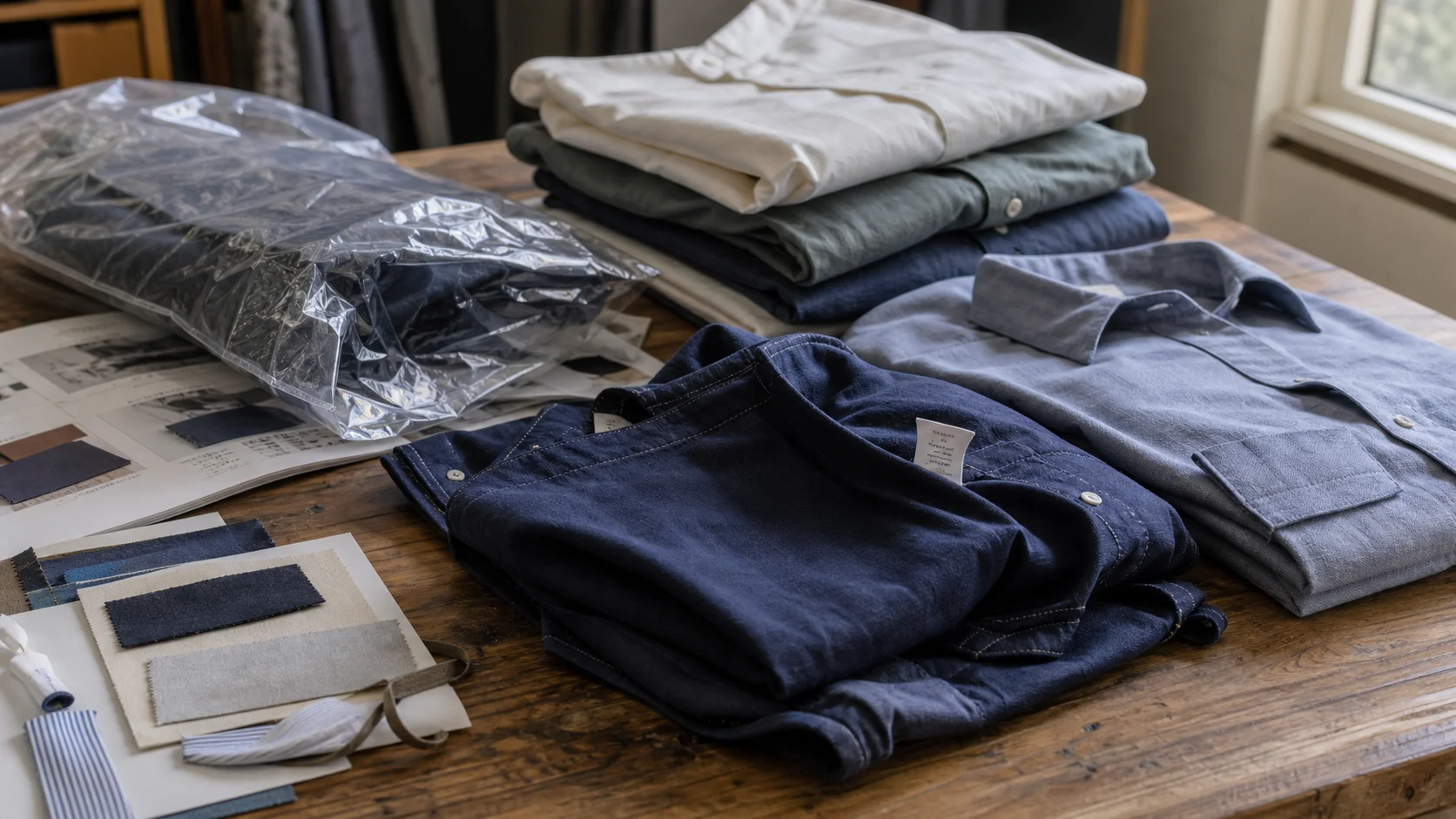
Clothing Packaging with Care Instructions compared by sample evidence, fabric or trim specs, MOQ, AQL terms, cost lines, delivery timing, and rework...
Fast answer: Clothing Packaging with Care Instructions: Material, Print, MOQ, and QC Terms should be judged by production evidence, not by a generic sourcing promise. The buyer needs sample proof, cost breakdowns, QC checkpoints, and delivery buffers in writing.
Ask for recent sample photos, measurement tolerances, fabric or print test assumptions, decoration test notes, packing examples, and a named inspection checkpoint. These details show whether the team can repeat an approved sample at bulk volume.
Separate garment cost, decoration, labels, packaging, sampling, testing, freight, and rush charges. Clear cost lines make it easier to reduce colorways, adjust size depth, or reserve more time for sampling.
A $148 viscose dress came back from a customer after one wash, and the packaging looked immaculate: tissue paper, foil-stamped sleeve, a tidy hangtag, the works. Missing was the care instruction insert. The woven label buried inside the side seam was folded under the stitching.
That single omission turned into 37 return requests on a 1,200-piece run, plus 19 one-star reviews that all sounded the same. Customers did not say the construction failed. They said they were confused about washing, drying, and ironing. In my experience, that pattern repeats more often than brands admit, especially on softer fabrics like modal jersey, silk blends, and enzyme-washed cotton.
When I visited factories in Portugal and Vietnam, the first people to spot this kind of mistake were not the merchandisers or the compliance teams. It was usually the floor staff packing cartons at 6 p.m., because they see hundreds of finished pieces in the last 2% of the process, after QC has already signed off on seams, measurements, and shade bands. That is exactly why packaging errors hide so well. They arrive late, after the “real” inspection is done.
In Guangzhou's Panyu district the packaging processors run the PFM-320 automatic polybagger and a Komori UV Lithrone press to print icons onto GOTS-certified 300 GSM recycled board; the OEKO-TEX Standard 100 adhesives and GRS-certified inks keep the silkscreened instructions legible after 30-degree humidity swings. When the packs move to Dhaka, the WRAP- and BSCI-certified floor team hand-sews satin loops with a Janome twin-needle and laser-slots each swing tag, so the garments still arrive in 18-22 business days of the PO release. At the Ho Chi Minh City Saigon South facility, a Heidelberg CX102 folder-gluer and Schumacher ultrasonic sealer press 100% GOTS-certified cotton inserts into polypropylene-free sleeves that survive the ocean journey.
Here is the larger point. Clothing packaging with care instructions is not decoration. It is part instruction manual, part liability shield, part brand signal. A good package tells the customer how to keep the garment alive for 12 months or 3 years. A bad one sends them straight to a refund form. According to the ISO, standardized communication matters because consistency reduces interpretation errors, and fashion buyers feel that in returns data long before they see it in a style deck.
I have watched a premium box protect a garment beautifully and still fail commercially because the care copy was hidden under a flap. I have also seen a plain polybag outperform a luxury sleeve because the wash instructions were visible, legible, and attached to the product through shipping. Presentation matters. Clarity pays the bills.
Clear care guidance cuts avoidable returns, and the math is less forgiving than most founders expect. On a 10,000-unit order, even a 2% reduction in wash-related returns saves 200 pieces from boomeranging back through the warehouse, customer service, and resale pipeline. If each return costs $8 to process and $12 to restock, that is $4,000 in avoidable expense before you count the lost margin on damaged goods.
The hidden cost is not only the refund. It is the ticket volume. I have seen brands with 500 monthly customer emails about “Can this be tumble dried?” or “Is steam safe on this pleated skirt?” Those messages consume labor, delay replies, and often end in goodwill credits worth $10 to $25 each. Clothing packaging with care instructions can reduce those questions by giving the answer before the confusion starts.
Different categories need different levels of detail. Basics like 180 GSM cotton tees usually need simple wash icons, temperature guidance, and shrinkage notes. Knits, especially 100% merino or 12-gauge cashmere blends, need flat-dry instructions and pilling warnings. Tailoring needs pressing guidance, sleeve protector notes, and occasionally dry-clean-only language. Activewear needs heat warnings because bonded seams, elastane, and silicone trims react badly to high dryer settings. Occasionwear may need bead, lace, or embellishment care notes that run longer than the product description.
Here’s what most people miss: expensive garments can create more frustration, not less, if the packaging looks premium but the care guidance is vague. A $220 blazer wrapped in satin tissue can still trigger complaints if the insert says only “handle with care.” Customers paid for quality. They expect precision.
One factory owner in Istanbul showed me the data from a 4,000-piece tailoring program. After adding a bilingual care card and a clearer fold-over sleeve, their post-purchase service queries dropped by 28% in six weeks. Packaging spend rose by $0.17 per unit. Returns fell enough to cover that increase 11 times over.
That is why clothing packaging solutions should be treated as commercial infrastructure, not a last-minute design task. For private label brands, the gap is even wider because the retailer does not have a physical shop assistant standing next to every garment. The package has to do that work.
At an Istanbul workshop near Maslak the bilingual care cards are printed on a Heidelberg Speedmaster CD 102, UV-coated on both sides, and sent through a 4-head ultrasonic sealer before being paired with satin sleeves; the plant is WRAP- and BSCI-certified, and even with the 18-22 business day turnaround for die-cutting and foil stamping the teams can pack 1,200 pieces per shift while the compliance officer logs each GOTS and OEKO-certified claim.
Not every format carries care content equally well. Swing tags are the most visible, but they are also the easiest to lose once a garment is tried on, re-folded, or clipped to a hanger. They work best for shirts, tees, denim, and knitwear where the buyer needs fast scanning at shelf or unpacking. A 350 GSM cardstock tag can hold icons, barcode, SKU, and a 40-60 word care block without looking crowded.
Insert cards are better for density. They fit more language, more symbols, and more legal copy. I have seen an A6 card with English, French, and German care text, plus fiber content and recycling notes, survive a 3-4 week ocean shipment better than a laminated sleeve that scuffed at the corners. A card printed on 300 GSM coated stock is usually more durable than it looks, especially if tucked inside folded shirts or dresses.
Belly bands are elegant for folded garments because they keep the piece tidy while leaving the care copy front and center. They work well for dresses, premium tees, and lightweight knits. Garment bags, by contrast, suit delicate pieces, wedding capsules, and retail-ready tailoring. They offer protection, but they are not the best place for readable care instructions unless the copy is on an attached hangtag or outer label.
The cheapest insert often wins. That sounds backwards, but in my factory visits I have seen a $0.06 paper card outperform a $0.38 foil sleeve because the card stayed attached, stayed flat, and stayed readable through shipping. A luxe sleeve can look better on a mood board and fail in a carton with 24 units stacked under pressure. Function beats gloss when the truck leaves the dock.
To keep every care block consistent, some brands run the 350 GSM card through a Komori 6-color offset press, then feed it into a Bobst digital die-cutter to create 2 mm microperforated edges; OEKO-TEX Standard 100 adhesives and UV-curable varnishes keep the text intact even in 40°C humidity, and a Kongsberg CNC cutter can route a 100% organic cotton poplin hangtag in one pass. That level of automation keeps the copy readable and the inserts attached after the garment hits the conveyor.
Budget packaging is usually where brands either save money or create expensive confusion. On a 1,000-unit run, a digital print insert can cost $0.05 to $0.12 each, while a coated card with one specialty finish may land at $0.18 to $0.35. Woven labels with care symbols add another $0.10 to $0.28, depending on width, stitch count, and whether they are stitched into the seam or heat-applied. Recycled sleeves, especially kraft or uncoated board, usually sit between $0.22 and $0.60.
At the budget end, the simplest package is often the smartest: one card, one language, one barcode, one symbol set. At mid-market, brands tend to add bilingual copy, better board stock, and a cleaner fold presentation. Premium brands spend more on tactile finishes, embossing, metallic ink, or custom die cuts, but those choices do not automatically improve usability. I have seen a $1.10 package underperform a $0.14 one because the care instructions were hidden under a glued flap.
Order quantity changes everything. A 250-piece pilot might carry setup fees of $150 to $300, while a 500-piece MOQ for a wrap-around belly band printed on 18-point GOTS-certified board and finished with spot UV or foil stamping ranges from $2.50-4.00 per unit. Adding 12% recycled PET windows or OEKO-TEX Standard 100 adhesives tacks on another $0.05 to $0.12 but keeps the instruction card attached through ocean transit. The lead time for that run, including die cutting on a Heidelberg GTO and hand-gluing with a Böhler four-head, is typically 18-22 business days, and when you stack the savings from fewer returns the incremental spend disappears.
In Guangzhou's Baiyun district the lines run the PFM-320 automatic polybagger, a Komori UV Lithrone, and a Foba automatic hot foil machine—each batch of GOTS-certified 300 GSM cards is fed through a Cognex vision system so the right wash symbols match the correct style. The GRS-certified inks are tacky enough to bond to OEKO adhesives, and the 2.5-second laser perforations from an Epilog 36EXT keep the edges flat without tearing.
The Dhaka facilities I visit are WRAP- and BSCI-certified, and they specialize in hand-finishing. Teams use Janome twin-needle machines to sew satin loops, an ICB CO₂ cutter to slot swing tags, and a single-head ultrasonic sealer to tack brass grommets in place. Their focus on manual care ensures even enzyme-washed cotton jerseys have consistent contact points between the garment and its care copy.
At the Ho Chi Minh City sister plant, a Heidelberg CX102 folder-gluer, Schumacher 4-head ultrasonic sealer, and Kongsberg digital cutter manufacture belly bands for activewear capsules. They frequently combine pad-printed icons from a M&R Challenger unit with Tencel modal hangtags, then seal everything with OEKO-TEX Standard 100 adhesives so heat-sensitive seams and bonded elastane do not curl the edges.
Istanbul's Maslak district workshop prefers high-touch finishing. They use a Heidelberg Speedmaster CD 102 for double-sided printing, a Bobst die-cutter for complex windows, and a Domino UV inkjet for variable data. The plant keeps a WRAP and BSCI audit trail, plus they log each GOTS, OEKO, and GRS claim before the cards board the FedEx pallet bound for Europe.
Sustainability is a series of compromises. A 100% recycled kraft card is lighter on the planet, but unless it is laminated with OEKO-TEX Standard 100 varnish, the ink may bleed on enzyme-washed cotton garments. A GOTS-certified cotton insert paired with WRAP-compliant adhesives keeps claims tight, yet the extra weight can push freight costs up if you are shipping 24 units per carton. GRS-certified recycled PET windows look premium, but they might also trigger confusion if the care copy relies on multi-panel fold-outs that don’t want to stay flat.
Certifications guide the trade-offs. GOTS ensures the fiber content description is accurate, OEKO-TEX Standard 100 guarantees non-toxic inks and adhesives, WRAP and BSCI keep the workplace ethical, and GRS verifies recycled content. A factory might skip metallic foil to stay within those programs, or they may accept an extra $0.08 per unit for a biodegradable PLA sleeve if the care instructions help the customer wash the garment at 30°C instead of 40°C, which extends the life of both the item and the packaging.
Map every care instruction to the garment. If the piece is 100% merino, the tech pack should call out “lay flat to dry, reshape while damp” and specify these words in both the swing tag and the folded card. Ask your packager to print the copy on a Komori or Heidelberg offset press and then use a Kongsberg cutter for ultra-precise folds; consistent formatting keeps the icons readable for quality staff across Guangzhou, Dhaka, and Ho Chi Minh City.
Validate certifications. Request the latest WRAP, BSCI, OEKO-TEX Standard 100, GOTS, and GRS certificates from the packaging supplier and confirm the adhesives, inks, and board stock match those claims in the bill of materials. If you are pairing the card with a garment bag, have the vendor show you the measurable difference between a recycled PET bag that survived a 40°C humidity test and a cheaper option that cracked.
Run a pilot. Allow 18-22 business days for a sample set of 50-100 units so the supplier can print, die-cut, and assemble the care inserts with the right machines, whether that is a Schumacher ultrasonic sealer or a Böhler four-head gluer. Once the samples arrive, test them through your polybagging line and use your fulfillment team to simulate a customer unboxing; the faster you catch adhesives that peel off or cards that fold wrong, the fewer returns you face later.
Q: How quickly can I get a compliance-ready care insert sample?A: Most vendors in Guangzhou, Dhaka, and Istanbul can deliver a certified sample in 7-10 business days if you provide a digital tech pack specifying the fabric (e.g., 100% organic cotton poplin), the symbols, and any barcode data; the sample will print on OEKO-TEX Standard 100 board and be run through their Komori or Heidelberg presses.
Q: What is the MOQ for a bilingual care card run?A: Expect a 500-unit MOQ, with prices between $2.50-4.00 per unit for a wrap-around belly band or insert card printed on 300 GSM GOTS-certified stock, plus an additional $0.05-$0.12 if you add metallic ink or a GRS-certified PET window.