
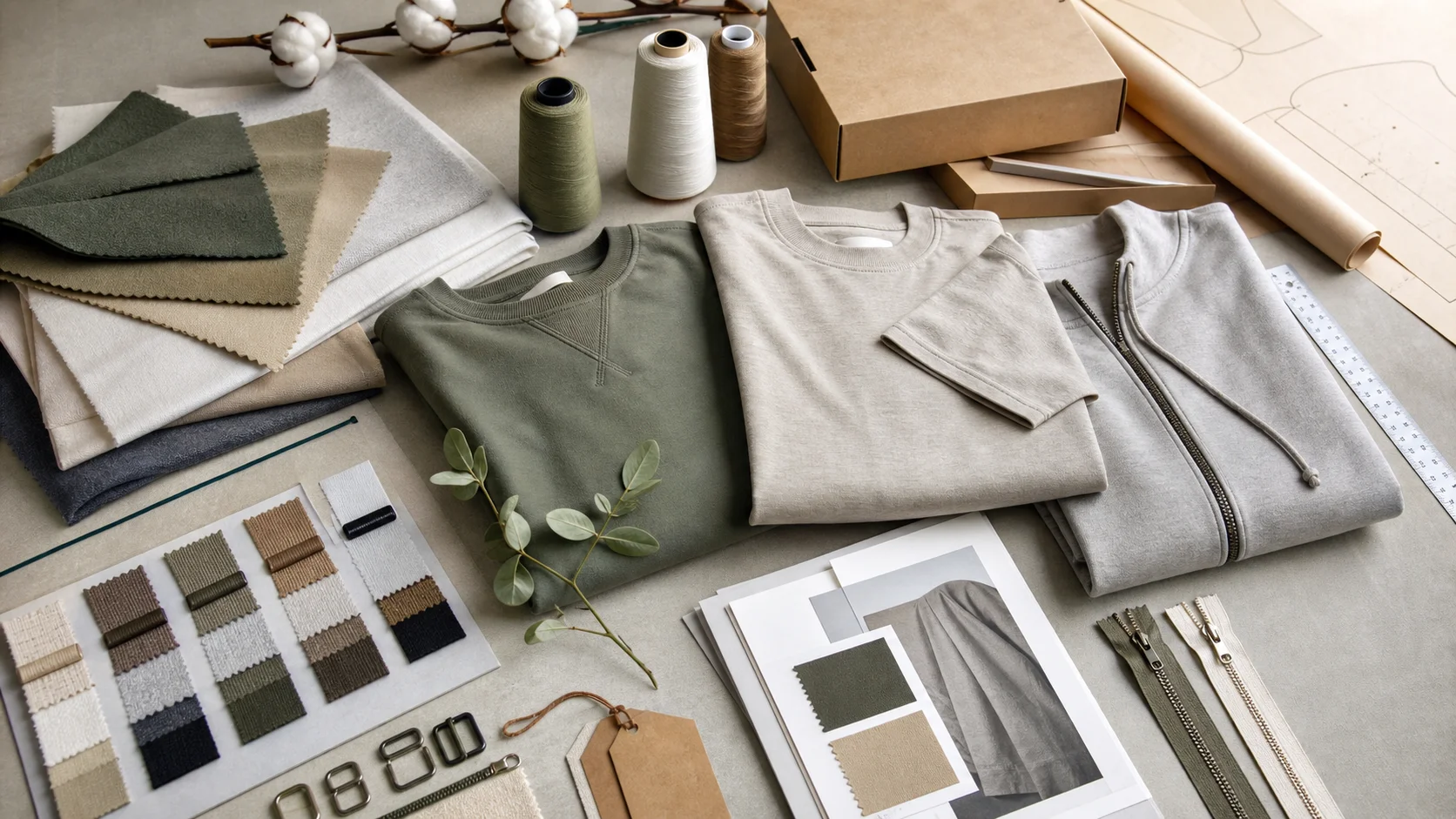
Compare Factory Direct Apparel Sourcing Options compared by sample evidence, fabric or trim specs, MOQ, AQL terms, cost lines, delivery timing, and rework...
Fast answer: Compare Factory Direct Apparel Sourcing Options: Tech Pack, Sample Gate, MOQ, and QC Terms should be judged by production evidence, not by a generic sourcing promise. The buyer needs sample proof, cost breakdowns, QC checkpoints, and delivery buffers in writing.
Ask for recent sample photos, measurement tolerances, fabric or print test assumptions, decoration test notes, packing examples, and a named inspection checkpoint. These details show whether the team can repeat an approved sample at bulk volume.
Separate garment cost, decoration, labels, packaging, sampling, testing, freight, and rush charges. Clear cost lines make it easier to reduce colorways, adjust size depth, or reserve more time for sampling.
Factory direct apparel sourcing can be one of the smartest ways for brands, retailers, wholesalers, and private label businesses to improve margins, gain production control, and bring products to market more efficiently. But while the “factory direct” model sounds simple, the decision process behind choosing the right manufacturer is often complex. Not every factory offers the same quality, communication, pricing structure, compliance standards, or level of flexibility. If you compare options too quickly, you may end up with delayed shipments, inconsistent quality, hidden costs, or a supplier relationship that cannot support growth.
This guide explains how to compare factory direct apparel sourcing options in a practical, business-focused way. Whether you are launching a new clothing line, expanding an existing collection, or looking to replace a current supplier, the right comparison framework will help you make a more informed decision. You will learn which factors matter most, how to evaluate manufacturers, what red flags to avoid, and how to balance cost with performance.
If you are exploring a production partner, you can also review Fabrikn’s services, learn more on our about us page, or contact us to discuss your sourcing needs.
Factory direct apparel sourcing means purchasing garments directly from a manufacturer rather than through multiple intermediaries such as traders, wholesalers, or sourcing agents. In this model, the factory handles production, and in many cases, assists with material sourcing, sampling, development, branding, packaging, and quality control.
The main advantage of factory direct sourcing is the ability to work closer to the source of production. This often improves communication, reduces markup layers, and gives buyers more control over design specifications and manufacturing standards. For apparel businesses, this can translate into better product customization, more competitive pricing, and improved supply chain visibility.
However, “factory direct” does not automatically mean “best.” Two factories may both offer direct sourcing, yet differ significantly in specialization, minimum order requirements, ethical standards, production capabilities, and responsiveness. That is why comparing options methodically is essential.
Comparing factory direct apparel sourcing options is more than a cost exercise. The right factory can help you scale reliably, while the wrong one can damage your brand reputation. Apparel sourcing affects product quality, delivery timelines, inventory planning, customer satisfaction, and long-term profitability.
Businesses often focus only on unit cost, but the cheapest quote can be expensive in the long run if the factory misses deadlines, produces defective goods, or cannot accommodate repeat orders. A stronger comparison process helps you look at total value, not just invoice price.
When you compare suppliers properly, you can:
Not every factory is suited for every apparel category. Some specialize in knitwear, activewear, denim, outerwear, children’s clothing, uniforms, or luxury garments. A factory that excels in casual T-shirts may not be the best choice for technical sportswear or tailored jackets. When comparing options, review the factory’s core product focus, sample portfolio, and experience with similar materials and construction methods.
Look beyond basic production claims. Compare the factory’s machinery, sewing lines, pattern development capability, cutting systems, finishing processes, embroidery or printing support, and packaging services. A capable factory should be able to handle your current needs and support future product complexity.
Consistency is as important as craftsmanship. Ask how the factory manages quality control at each stage, from fabric inspection to final packing. Request product samples, test reports if applicable, and details on defect handling. Strong factories usually have structured inspection procedures, trained QC teams, and clear standards for acceptable tolerances.
Communication is often the difference between a smooth project and a difficult one. A good supplier should respond clearly, ask relevant questions, and provide accurate information about feasibility, lead times, and costs. Slow or vague communication early in the process is usually a warning sign. Compare how each factory handles emails, sample feedback, technical questions, and production updates.
Unit price matters, but so do sample fees, tooling costs, development charges, shipping, customs-related expenses, and payment terms. A transparent factory will provide a detailed quotation that explains what is included. When comparing prices, look at landed cost and overall value rather than relying on the base factory quote alone.
MOQ can have a major impact on cash flow and inventory risk. A factory that is ideal for a growing brand may offer lower MOQs, while larger manufacturers may require higher order volumes to justify setup costs. Compare MOQs across product styles, colors, and sizes, and confirm whether the factory can support phased growth as your business expands.
Lead time includes sampling, material procurement, production, inspection, and shipping preparation. If your brand runs seasonal launches or fast replenishment programs, production speed matters significantly. Compare not only the quoted lead time but also the factory’s ability to handle repeat orders, peak seasons, and urgent reorders without compromising quality.
Depending on your market, you may need factories that follow labor, safety, environmental, or product-specific compliance standards. Certifications can be useful indicators, but you should also verify actual practices. Compare whether factories meet your requirements for social compliance, chemical restrictions, labeling laws, and testing standards.
Sampling is where many sourcing issues become visible. A reliable factory should be able to translate your tech pack, reference garment, or design concept into a sample that matches expectations. Compare turnaround time, sample accuracy, revision flexibility, and how the factory handles feedback loops.
A sourcing partner should be able to grow with your business. Even if a factory looks suitable for your first order, it may not support larger volumes, more SKUs, or more complex designs later. Compare each option based on whether it can remain a viable partner as your brand expands.
Understanding the different sourcing models can help you compare them more effectively. Each comes with advantages and trade-offs.
This type of factory manages development, sourcing, cutting, sewing, finishing, and packaging. Full-service manufacturers are often the most convenient for brands that want a single point of contact. They can reduce coordination complexity, but may charge more for end-to-end support.
CMT stands for Cut, Make, Trim. In this model, the buyer supplies materials and sometimes trims, while the factory focuses on production. CMT factories can offer lower sewing costs, but they require more sourcing experience and more hands-on supply chain management from the buyer.
OEM, or Original Equipment Manufacturer, produces garments based on the buyer’s specifications. This is common for private label and custom apparel projects. OEM factories may also support material sourcing and development, but the buyer usually owns the design direction.
ODM, or Original Design Manufacturer, provides ready-made or pre-developed styles that can be customized. This model can be faster and more affordable for some businesses, but it may offer less differentiation than fully custom production.
When comparing models, think about how much control you need, how much internal sourcing expertise you have, and whether speed or customization is the priority.
To compare factory direct apparel sourcing options efficiently, start with a structured evaluation process. This helps you avoid choosing based on instinct alone.
Build a simple scorecard with categories such as product fit, quality, pricing, MOQ, lead time, communication, compliance, and scalability. Assign each category a weight based on your business priorities. For example, a premium brand may weight quality and workmanship more heavily, while a startup may prioritize MOQ and development support.
Ask for company profiles, product catalogs, sample images, certifications, client references where available, and quotation details. Compare how complete and professional each factory’s response is. A well-organized factory usually makes the process easier from the beginning.
Samples should be judged not only on appearance but also on stitching, fit, fabric handfeel, finishing, labeling, and packaging accuracy. If possible, compare samples side by side under the same criteria. Document revision notes and see how quickly and accurately the factory adapts.
During early discussions, evaluate whether the factory understands your technical requirements. Do they ask for a tech pack, size chart, fabric specifications, or reference product details? Good questions indicate manufacturing maturity. Compare factories based on how well they interpret your needs rather than how quickly they promise results.
If the factory can share customer references or relevant case studies, review them carefully. Ask about product complexity, on-time delivery, issue resolution, and repeat order history. Strong sourcing partners usually have a history of repeat customers and stable production relationships.
When comparing factory direct apparel sourcing options, some warning signs should prompt extra caution or disqualification.
One red flag alone may not be decisive, but patterns matter. If a factory is difficult to communicate with during the quotation stage, that often becomes worse once production begins.
Pricing should be compared on a like-for-like basis. Some factories quote only sewing, while others include fabric sourcing, trims, labeling, and packaging. To compare fairly, make sure each quote covers the same scope of work.
Ask these questions during comparison:
MOQs should also be compared in context. A factory with a slightly higher unit price but lower MOQ may be more suitable for a new brand testing the market. A larger manufacturer may be better if you already have predictable demand.
Lead times should include all stages of the process, not just sewing. If one factory can produce faster because it stocks certain fabrics or has stronger internal workflow, that may outweigh a slightly lower quote elsewhere. The real question is not only “who is cheapest?” but “who delivers the best overall value with the least risk?”
For apparel sourcing, quality control and compliance are not optional. Poor workmanship can cause returns, refunds, and brand damage. Compliance failures can create legal, reputational, or customs issues depending on the target market.
Compare factories by asking how they control fabric shrinkage, color consistency, stitching tolerances, measurement accuracy, and packaging integrity. If your product has performance claims, special finishes, or safety requirements, confirm that the factory can support testing or third-party inspections.
Also compare social and ethical compliance practices. Buyers increasingly expect responsible production, especially when working with consumer-facing fashion brands or corporate apparel programs. A factory that understands labor standards, workplace safety, and environmental controls may be a stronger long-term partner, even if it is not the lowest-cost option.
For many businesses, it is helpful to work with a manufacturer that can support multiple parts of the process, from sampling through final production. Fabrikn’s services page provides an overview of how a full production partner can simplify sourcing decisions.
The best factory direct apparel sourcing option is often not just the cheapest or fastest. It is the one that can build a stable, collaborative relationship with your business over time. Long-term sourcing relationships reduce friction, improve forecasting, and make it easier to launch new products.
To build a strong relationship, communicate clearly and professionally. Share detailed specs, production timelines, target budgets, and growth expectations early. Give feedback in a structured way and track key performance indicators such as defect rate, on-time delivery, and sample accuracy.
It also helps to align expectations around seasonality and scaling. Let your factory know whether you plan to reorder, introduce new styles, or expand into new markets. A good production partner can plan capacity more effectively when they understand your roadmap.
If you want to learn more about the team behind Fabrikn, visit our about us page. If you are ready to discuss a project, you can contact us to start the conversation.
Learning how to compare factory direct apparel sourcing options is one of the most valuable skills a clothing business can develop. The right decision can improve margins, reduce supply chain risk, strengthen product quality, and create a foundation for long-term growth. The wrong one can lead to delays, inconsistency, and unnecessary costs.
Instead of choosing a supplier based on price alone, compare the full picture: product specialization, manufacturing capability, quality systems, communication, pricing transparency, MOQ, lead time, compliance, and scalability. Use a scorecard, request samples, verify documentation, and look for a factory that can support both your immediate needs and your future expansion.
Factory direct sourcing works best when it is built on clarity, reliability, and collaboration. With the right manufacturer, you gain more than a vendor. You gain a production partner that can help your apparel business grow with confidence.
Get a free quote from Fabrikn — your trusted B2B clothing manufacturer with 10+ years of experience. MOQ as low as 200 pieces.
Get a Free Quote →The biggest factor depends on your business goals, but for most buyers, the most important combination is product fit, quality consistency, and reliable communication. Low pricing is useful only if the factory can also meet your quality and delivery expectations.
Review the factory’s past work, sample quality, technical capabilities, and specialization. A strong fit usually means the factory has experience with similar fabrics, garment construction, and finishing methods.
No. The lowest price can come with hidden risks such as poor workmanship, delayed delivery, or weak communication. It is better to compare total value, including quality, lead time, MOQ, and service level.
Ask for company details, product samples or photos, quotations, certifications if relevant, payment terms, lead times, and any quality control or compliance documentation that applies to your market.
Use the same product specifications, tech pack, quantity, and delivery expectations for each supplier. Then compare their responses using a scorecard that includes pricing, quality, communication, MOQ, and production capacity.
Sampling shows how well the factory can interpret your design and execute the product. It is one of the best ways to compare workmanship, communication, and flexibility before committing to bulk production.
Yes. Smaller factories can sometimes offer more flexibility, better communication, and lower MOQs. Larger factories may have better capacity and efficiency. The best choice depends on your needs, product type, and growth stage.