
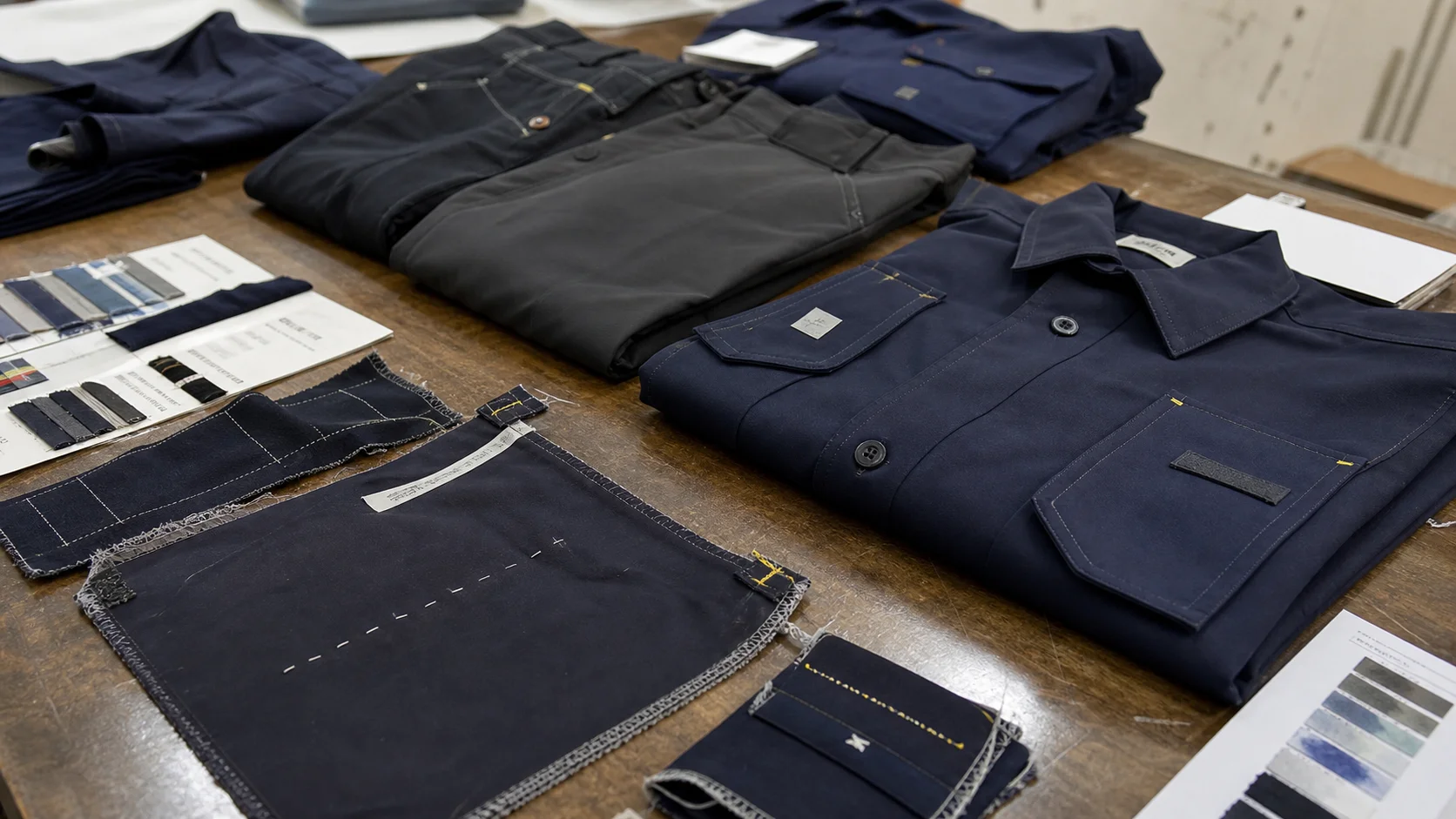
A practical SEO outline for security contractors auditing contrast bartack maps, factory placement controls, and colorfastness risks before approving...
Security contractor uniforms are judged on more than appearance. They have to hold up under daily wear, repeated laundering, abrasion at seams, and close inspection from procurement teams that care about consistency. A contrast bartack map sits at the intersection of decoration, construction, and compliance. It is a simple document in theory: a diagram that shows every bartack location, thread color, stitch count, and visibility requirement. In practice, it can decide whether a production run passes a uniform audit or comes back with costly rework.
This article covers the sourcing side of a contrast bartack map factory colorfastness audit for security contractors. The focus is practical. What should be documented, what should be sampled, where failures usually appear, and which tradeoffs matter when the garment must look sharp and survive hard use. For suppliers that need broader support, fabrikn.com pages such as /services/, /contact-us/, and /about-us/ are useful reference points for process and contact pathways.
Contrast Bartack Maps for Security Uniform Audits - Decoration & Printing manufacturing guide
A bartack is a dense reinforcement stitch used at stress points such as pocket corners, belt loops, placket ends, sleeve openings, and reinforcement tabs. A contrast bartack uses thread color that intentionally stands out against the garment fabric. On a security uniform, that contrast can be a styling cue, a brand marker, or a way to align with a corporate uniform standard.
A bartack map is the factory reference that shows where each bartack belongs, which thread color is used, how many stitches are required, and whether the bartack should be decorative, functional, or both. For audit work, the map should do more than show locations. It should make the construction intent unambiguous enough that different operators can reproduce the same result across sizes and production lots.
For security contractors, consistency is the point. A uniform program usually includes shirts, trousers, utility jackets, and sometimes outerwear. If one style has black bartacks on navy twill and another has charcoal bartacks on the same base cloth, procurement teams often treat that as a mismatch. If bartacks are meant to be visible, then shade variation, placement drift, and thread bleeding become quality issues, not design details.
Security uniforms are worn in public, often under pressure, and often for long shifts. The garment has to project authority while staying functional. That creates a narrow lane for decoration. Too little visual detail and the uniform looks generic. Too much and it can appear ornamental in a way that conflicts with a disciplined security image.
Contrast bartacks solve part of that problem by adding controlled visual definition. They can sharpen the look of a utility pocket, reinforce stress points in a visible way, and create a repeatable brand cue across a uniform program. Buyers like them when they are stable, simple to inspect, and easy to specify.
They also create risk. Contrast thread is more exposed to fading, crocking, and wash distortion than hidden reinforcement stitching. A bartack that looks crisp in a pre-production sample can turn dull, feathered, or uneven after laundering if the thread dye class is weak or the fabric finish is aggressive. That is why colorfastness belongs in the audit, not just appearance review.
A contrast bartack is not just decoration. It is a visible claim about construction quality. If the thread shade, stitch density, or placement drifts, buyers see the whole uniform program as inconsistent.
A factory cannot audit what has not been specified. The most common sourcing mistake is sending a style image and expecting the factory to infer the bartack logic. That usually produces avoidable revision rounds. A useful technical package should include the following:
The bartack map should also clarify which bartacks are critical-to-function and which are purely visual. That distinction matters because production teams may be willing to accept minor cosmetic variation on decorative points while rejecting functional stress-point shifts. Buyers should define that boundary early.
When contrast thread is involved, the fabric base matters more than many teams expect. A dark navy shell with a matte finish will show a bright bartack differently than a twill with a slight sheen. Heavily textured fabrics can make the bartack edge look irregular even when the machine settings are correct. The audit should reflect the actual material, not a generic assumption about woven cloth.
Colorfastness should be tested against the way the garment will actually be used. For security uniforms, the relevant stress points are laundering, perspiration, rubbing, and light exposure. The factory may have in-house checks, but buyers should ask for the testing method and the acceptance threshold. Test names matter less than whether the result aligns with the use case.
Contrast bartacks must hold color after repeated wash cycles. A common failure is visible shade loss in the thread before the garment fabric itself changes much. That produces an uneven look and can make the bartack appear greyed out or patchy. If the uniform is expected to be washed at industrial or commercial laundry settings, the test should reflect that temperature and detergent profile as closely as possible.
Rubbing is important when bartacks are located near cuffs, pocket edges, or waistbands that experience repeated contact. A thread that transfers dye under dry or wet rub can stain adjacent fabric or leave visible smears at the stitch points. This is a common problem with darker contrast threads on lighter garments and with poorly fixed dye lots.
Security staff often wear uniforms under heat, movement, and long shifts. Sweat exposure can change the appearance of contrast thread faster than regular wear alone. If bartack locations are near collar stands, underarm reinforcements, or waist areas, perspiration testing should be included, especially for tropical or summer programs.
Uniforms that see vehicle use, gate duty, or outdoor stations may fade differently on exposed panels and reinforcement points. Contrast thread can become visually louder in a bad way if the base cloth loses tone faster than the thread, or the reverse if the bartack dulls quickly while the shell remains stable. Either result can create a mismatched look.
A practical audit combines lab testing with visual review under controlled lighting. Buyers should compare the pre-production sample, top-of-production sample, and a laundered sample side by side. A thread that passes a lab score but looks visibly off on the actual garment can still fail commercial acceptance.
Audit Area What to Check Typical Risk Buyer Judgment Wash fastness Color retention after planned laundering Thread dulling, shade shift Reject weak dye systems for high-wash programs Dry rub Transfer from bartack to shell or lining Surface staining, visible smears Require testing on final fabric, not lab substitute Wet rub Transfer under moisture Color bleed at stitch points Especially important for dark-to-light contrast Perspiration Reaction to body sweat and heat Localized fading or staining Relevant for outdoor or long-shift uniforms Light exposure Fade under daylight or store display Uneven appearance over time Important for visible patrol wearMany programs fail because the spec sheet is too broad. Buyers ask for “high-quality contrast bartacks,” but quality has to be measured somehow. The following points are worth defining before production starts:
For security uniform programs, a useful rule is to keep bartacks visible but not exaggerated. Oversized bartacks can look promotional instead of uniform. Underbuilt bartacks can unravel or flatten after laundry. The right result is usually a tight, clean, repeatable stitch block that reads as purposeful rather than ornamental.
Thread shade matching is its own issue. Contrast does not mean high contrast at any cost. On navy, charcoal, or black garments, a restrained tonal contrast often ages better than a bright white or neon thread. Bright thread can be effective for some branded programs, but it increases visual maintenance risk. If a garment is meant for fast-moving security teams, the safer choice is usually a controlled contrast that survives repeated use without drawing attention to minor wear.
Sample approval should not be a single yes-or-no event. A better process has three checkpoints.
This sample proves the bartack map is technically possible. It is the stage to check placement logic, stitch size, and whether the chosen thread shows correctly on the target fabric. Small corrections are normal here.
This version should reflect production materials, actual thread lots, trims, and laundering method. It is the most important approval point. If the contrast color is not stable here, the batch should not move forward until the issue is corrected.
This sample confirms that the factory line can reproduce the approved result at scale. It is where buyers catch operator drift, machine variation, and thread tension changes that did not show on the pre-production piece.
The approval record should show whether bartack color, placement, and durability were accepted together or separately. That distinction helps later when a shipment is questioned. If only appearance was approved and wash results were pending, the file should say so plainly.
MOQ depends on the factory, fabric stock, and whether the bartack thread is a standard in-line color or a special-dyed order. For basic security uniform programs, production MOQs often start in the low hundreds per style and colorway. More customized programs, especially those requiring special shade matching or multiple bartack placements, can push the MOQ higher.
Lead time depends on more than sewing capacity. Buyers should account for fabric booking, thread sourcing, lab testing, sample revision cycles, and pre-shipment inspection. A fast sewing line does not help if the contrast thread is delayed or the fabric lot is rejected for shade variation.
As a sourcing rule, any audit that includes colorfastness should allow time for actual test cycles. Rushing a bar-tack approval based only on visual review is a false economy. It may save a week and cost a full production run later.
For buyers comparing suppliers, it helps to ask who controls thread sourcing, who signs off on test reports, and whether the factory can hold the same thread lot across the intended production window. Those details matter more than a generic promise of quick turnaround.
Inspection teams usually find the same few problems.
Colorfastness problems can hide behind otherwise clean construction. A bartack may pass a visual inspection before wash and still fail afterward. That is why the acceptance criteria should include both pre-wash and post-wash checks. If the program is for security contractors who will wear the garments regularly, post-wash appearance is the real benchmark.
Another risk is over-specification. Some buyers ask for exact visual uniformity on every bartack without accounting for fabric texture, seam stacking, or garment size differences. That leads to unrealistic rejection rates. The better approach is to define a practical tolerance band and reserve hard rejection for issues that affect function, brand integrity, or durability.
Before approving a contrast bartack program for security uniforms, buyers should verify the following:
If the supplier can document these points cleanly, the project is easier to manage. If they cannot, the buyer should expect preventable inconsistency. This is not a matter of style preference. It is a manufacturing control issue.
Suppliers that want a clearer process can review the general production approach on /services/, then use the inquiry path on /contact-us/ when a project needs thread matching, sampling, or uniform program coordination. Background information on the company and operating approach is available at /about-us/.
Buyers often ask whether contrast bartacks are worth the added cost. The answer depends on the uniform program. If the garment is a low-visibility utility item, a tonal bartack may be enough. If the uniform is part of a branded security system and must look disciplined in public, a controlled contrast finish is usually worth the expense.
It is sensible to spend on thread quality, sample validation, and wash testing. It is less sensible to spend heavily on decorative complexity that does not improve the uniform’s appearance or service life. A clean bartack map with durable thread and stable dyeing usually outperforms a flashy concept with weak execution.
The most defensible procurement stance is simple: pay for repeatability, not embellishment. The buyer should want a bartack that looks the same on day one, after the first wash, and after repeated wear. If the factory cannot demonstrate that stability, the design is not ready for scale.
A contrast bartack map is a small document with outsized impact. For security contractors, it connects branding, reinforcement, and quality control in a way that is easy to inspect and easy to get wrong. The best programs define thread color, stitch density, placement, and fastness expectations before production starts. They also keep sample approval and testing tied to the actual fabric, the actual wash cycle, and the actual end use.
Buyers who treat the bartack map as a controlled production spec, not a decorative afterthought, usually get better results. The garment looks sharper, the audit goes faster, and the production line has fewer excuses.
Get a free quote from Fabrikn — your trusted B2B clothing manufacturer with 10+ years of experience. MOQ as low as 200 pieces.
Get a Free Quote →It tells the factory where each bartack goes, what thread color to use, and how the reinforcement should look and perform. For security uniforms, it keeps appearance and construction consistent across production.
Yes, if the thread is visible. Contrast thread is more likely to reveal fading, bleed, or rubbing issues than hidden reinforcement stitching. Washing and rub testing are especially relevant.
There is no fixed number, but many programs start in the low hundreds per style and colorway. Special thread matching, multiple colorways, or custom finishing can raise the MOQ.
Wash fastness is usually the first priority because uniforms are laundered repeatedly. Rub and perspiration testing come next when the garment is worn for long shifts or in warm conditions.
Common reasons include thread lot changes, machine tension drift, fabric lot variation, and finishing effects after washing or pressing. A good sample does not guarantee stable bulk production unless the process is controlled.
Sometimes, but it increases visual maintenance risk. A controlled tonal contrast usually ages better and is easier to keep consistent across a uniform program.