
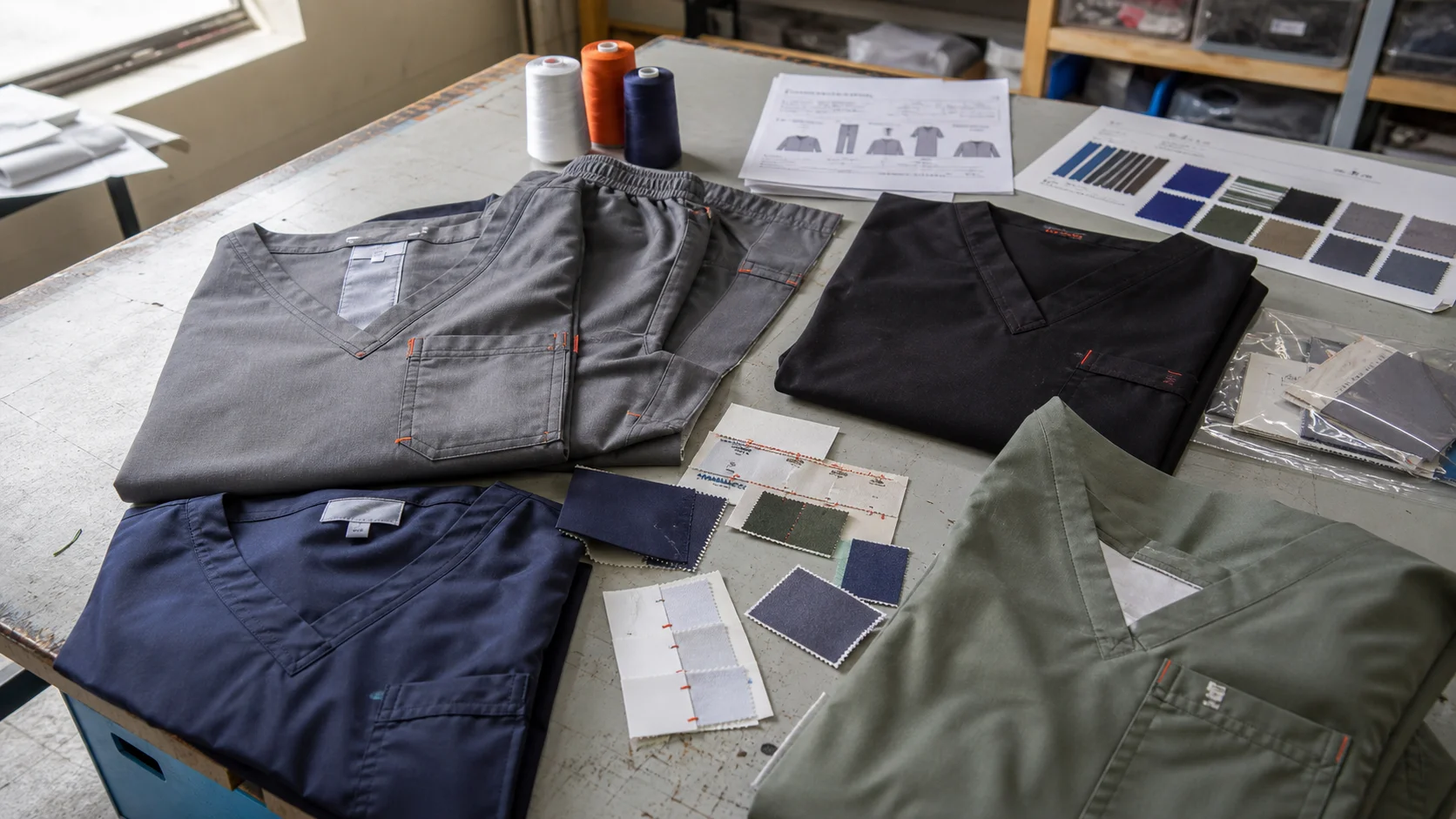
A clinic purchasing team’s SEO-ready compliance checklist for reviewing contrast bartack maps on uniforms, scrubs, lab coats, and workwear before...
Clinic purchasing teams do not usually lose margin on the garment body itself. They lose it on specification drift: the bartack lands in the wrong place, the contrast thread is off by a shade, the stitch count changes between pre-production and bulk, or the decoration map is not clear enough for production to follow consistently. In a clinical setting, those issues matter because uniforms need to look controlled, hold up to repeated laundering, and stay consistent across departments, sizes, and replenishment orders.
This checklist is written for buyers who need a practical way to evaluate a contrast bartack map before placing an order. It focuses on what should be confirmed before approval, what should appear on the technical pack, where production risk usually appears, and how to judge whether the supplier can actually execute the spec at scale. The goal is not decorative novelty. The goal is repeatable compliance.
For teams evaluating garment decoration partners or broader production support, the service scope at fabrikn.com/services/ is a useful place to compare what a vendor says it can handle against what the tech pack really requires. If supplier coordination becomes messy, the contact route at fabrikn.com/contact-us/ is the right next step. Buyers who need a sense of company background and operating focus can also review fabrikn.com/about-us/.
Contrast Bartack Map Checklist for Clinic Buyers - Decoration & Printing manufacturing guide
A contrast bartack map is the visual and technical instruction set that shows where bartacks are placed on a garment, what color thread is used, how many stitches are expected, and which construction points require reinforcement. In clinic apparel, this may apply to scrub pants, tunics, lab coats, work shirts, utility pockets, plackets, belt loops, side vents, pocket openings, and stress points around closures.
“Contrast” usually means the bartack thread is intentionally different from the base fabric or seam thread. That can be used for brand expression, department identification, or a clean visual cue on functional areas. A contrast bartack is not the same as a casual style detail. It becomes a controlled decoration and construction requirement, which means the map has to be explicit enough for production and inspection.
For purchasing teams, the map should answer a simple question: if three different operators sew the same garment on three different days, will the bartacks still land in the same place, use the same thread, and meet the same visual standard?
Clinic uniforms are washed frequently, handled hard, and expected to look uniform across staff groups. Bartacks are small, but they concentrate risk. A misplaced bartack can distort a pocket opening, weaken a seam edge, interfere with drape, or create a visible mismatch across sizes. Once a program moves into bulk, small errors become repeat problems.
Contrast bartack consistency also affects brand perception. In a clinic environment, clean presentation is part of operational trust. Staff uniforms often sit in the same visual field as patients, visitors, and other care providers. Buyers should treat the bartack map as a compliance document, not a style note.
There is also a commercial reason to be strict. Decoration ambiguity is one of the easiest ways for suppliers to protect themselves with vague language. If the map is incomplete, the factory may interpret stitch count, color tolerance, and placement on its own terms. That may be acceptable in low-risk casual apparel. It is not acceptable in a clinic supply program that depends on repeatability.
A good bartack map removes judgment from the sewing line. The more interpretation a production team needs, the higher the risk of variation in bulk.
The checklist below is the minimum control set a clinic purchasing team should request before approving contrast bartacks for bulk production.
That checklist sounds basic, but many purchasing failures begin because the parties assume the map is self-evident. It is not. A sewing operator cannot infer the buyer’s tolerances from a garment photo. The spec has to be measurable.
Good maps reference seams, edges, notches, pocket corners, button positions, and panel intersections. Bad maps use vague language like “top pocket area” or “near hem.” For clinic workwear, placement should be measured in millimeters from a fixed point, and the same reference should be used across all sizes where possible.
When bartacks are decorative and visible, placement error is easy to spot. When they are functional and hidden near stress points, placement error may not be visible until the garment fails after a few wash cycles. Both cases are costly.
Contrast thread should be approved as an actual sample, not only from a digital reference. Screen colors drift, and thread reflects light differently from fabric. Buyers should request physical thread cards or sewn strike-offs under normal lighting and, if relevant, under clinic lighting conditions. That matters when the contrast effect is part of the approved look.
Factories can execute bartacks with different lengths, widths, and densities depending on equipment and operator habit. If the buyer does not specify the acceptable range, bulk pieces can vary enough to create a visual mismatch across a production lot. The spec should state the expected range, not just “bartack reinforcement.”
Clinic garments may use cotton-rich twills, polyester blends, stretch poplins, or brushed knits. A bartack that works on a stable woven fabric may pucker a stretch blend or break a lightweight cloth. The map should be checked against the base material, fabric weight, and finish before approval. If the garment uses antimicrobial finishes or high-density weaves, testing should confirm that needle penetration does not damage the fabric surface excessively.
Sampling is more efficient when the buyer has already fixed the hard points. If the factory is asked to sample while key spec elements are still open, the team may approve a sample that cannot be reproduced in bulk. That is a common sourcing trap.
Spec Item What to Define Typical Risk if Left Open Bartack location Exact placement from seam or edge Random operator interpretation Thread color Physical swatch or code reference Shade mismatch across lots Stitch density Stitch count and length range Inconsistent visual width and strength Fabric type Composition, weight, finish Puckering, tearing, needle marks Approval process Strike-off, PPS, size-set, bulk signoff Sample approved without production proof Inspection criteria Placement tolerance and defect limits Disputes at receivingFor many clinic programs, a practical approach is to lock the decoration spec only after the first sewn sample is reviewed. That sample should not be treated as the final standard until the buyer sees the finished garment on the correct fabric, in the correct size range, with the intended thread color and actual wash performance where relevant.
Size grading can move bartack positions if pocket width, panel dimensions, or garment length changes across sizes. Some programs use the same relative placement for all sizes. Others shift the bartack slightly so it remains visually centered or functionally aligned. Either approach can work, but the rule has to be documented. Otherwise, size medium and size XXL may look like they belong to different programs.
A disciplined approval workflow is usually the difference between repeatable bulk and avoidable rework. The exact sequence varies by supplier capability, but a practical clinic buyer process typically includes these steps.
Sample approval should not be based only on a photo. Photos distort color, edge quality, and stitch definition. A physical review is better, and a wash test is often worth the time if the garments will be laundered frequently or exposed to repeated industrial cleaning.
When the supplier offers a sample faster than usual, the buyer should ask what was actually sampled. A garment sewn on substitute fabric, with temporary thread, or without the final trim set may look correct but fail in bulk. Speed is useful, but it should not hide a shortcut.
MOQ for contrast bartack programs depends on garment complexity, fabric availability, and whether the decoration is built into a standard production line or requires special setup. For many custom clinic apparel runs, a common order floor is somewhere in the low hundreds per colorway, and some factories prefer 300 to 1,000 pieces per style and color combination before they will price efficiently. Short runs are possible, but cost per piece usually rises when thread changeovers, sampling rounds, or extra inspection steps are required.
Lead time is equally sensitive. A simple decoration change on a stocked garment can move faster than a fully custom garment with special fabric, custom trims, and a new bartack map. A realistic lead time usually depends on fabric booking, trim approval, sample signoff, line capacity, and whether the supplier must test the bartack on a difficult substrate. Buyers should expect delays when any of those inputs are unstable.
There is a tradeoff between visual control and production efficiency. Bright contrast bartacks are useful for brand identity and functional emphasis, but they increase the chance of shade variation and thread stock issues. If the clinic program values uniformity above all else, a narrower contrast range or a tone-on-tone bartack may be easier to manage. If visibility is part of the brand standard, the team should accept tighter approval control and likely a slightly higher price.
Buyers comparing service capacity can use the product and process scope on fabrikn.com/services/ as a reference point for what should be clarified before RFQ. A supplier that cannot explain decoration sequence, thread matching, or final inspection should not be treated as production-ready.
Inspection should focus on repeatability, not just appearance on the best sample. A contrast bartack map can fail in several predictable ways.
Acceptance criteria should be written before production starts. A buyer should define what constitutes a major defect versus a minor defect, what placement tolerance is acceptable, and what visual variance is allowed in a single carton or shipment. That matters because a broad “looks fine” standard is not enforceable once the shipment has landed.
A final inspection should also check packaging integrity. A well-made garment can still reach the clinic in poor condition if packing pressure distorts the decoration, if labels shift, or if folded units rub against each other and create visible thread fuzz.
Good suppliers can answer specific production questions without drifting into generalities. If the answers are vague, the clinic team should slow down.
These questions are especially important when the vendor offers a broad service range and the clinic buyer is trying to determine whether the supplier can manage both garment construction and decoration control. If the operation needs clarification on sampling, decoration mapping, or production coordination, the contact route at fabrikn.com/contact-us/ is the most direct path to request detail.
Clinic purchasing teams often focus on first-order approval and then underestimate the replenishment problem. That is a mistake. A bartack map that is poorly controlled in the first order usually gets worse when the program is repeated months later and the original approvals are no longer top of mind.
Packaging should preserve the decoration in a stable state. Garments should be folded so the bartack area is not crushed or creased in a way that hides defects or creates false marks. Labels should reference the style, size, color, and revision level of the approved map. If a decoration revision is made, the old and new version should not be mixed in the same supply chain unless the buyer has explicitly accepted both.
Replenishment orders should reference the same approved materials, thread codes, stitch settings, and inspection standard. If the original thread supplier is unavailable, the buyer should request a fresh confirmation sample. The color difference may be small on paper and obvious on the garment.
Its main purpose is to standardize where bartacks go, what they look like, and how they are reproduced in bulk. In clinic apparel, that supports both durability and visual consistency.
Many suppliers work more efficiently at a few hundred pieces per style or colorway, and some prefer 300 to 1,000 pieces before pricing becomes stable. Exact MOQ depends on fabric, decoration complexity, and setup burden.
No. Digital color is not enough for contrast thread. A physical thread swatch or sewn sample is the safer approval standard.
Placement drift is one of the most common issues, followed by thread shade variation and puckering. These problems usually come from weak specs, rushed sampling, or poor line control.
It can. The key is to define the grading rule in the tech pack so the supplier knows whether placement stays fixed or moves with size.
At minimum, the buyer should review the sample on correct fabric, verify thread color, check placement, inspect stitch quality, and confirm wash performance if the garments will be laundered repeatedly.
Keep a locked spec package, retain approved physical samples, record thread and fabric references, and require the same revision level on repeat orders. A clean paper trail prevents a lot of avoidable variation.
Get a free quote from Fabrikn — your trusted B2B clothing manufacturer with 10+ years of experience. MOQ as low as 200 pieces.
Get a Free Quote →A contrast bartack map is a small document with a large impact. When it is clear, the clinic can buy garments that look controlled, hold up under use, and repeat reliably across orders. When it is vague, the result is usually inconsistency, rework, and avoidable disputes at inspection.
Clinic purchasing teams should treat the map as a controlled specification, not a styling note. Fix the placement, thread color, stitch count, fabric compatibility, and approval sequence before bulk. Ask for physical samples, not just images. Set inspection criteria early. That is the practical way to keep decoration compliant and the supply program stable.