
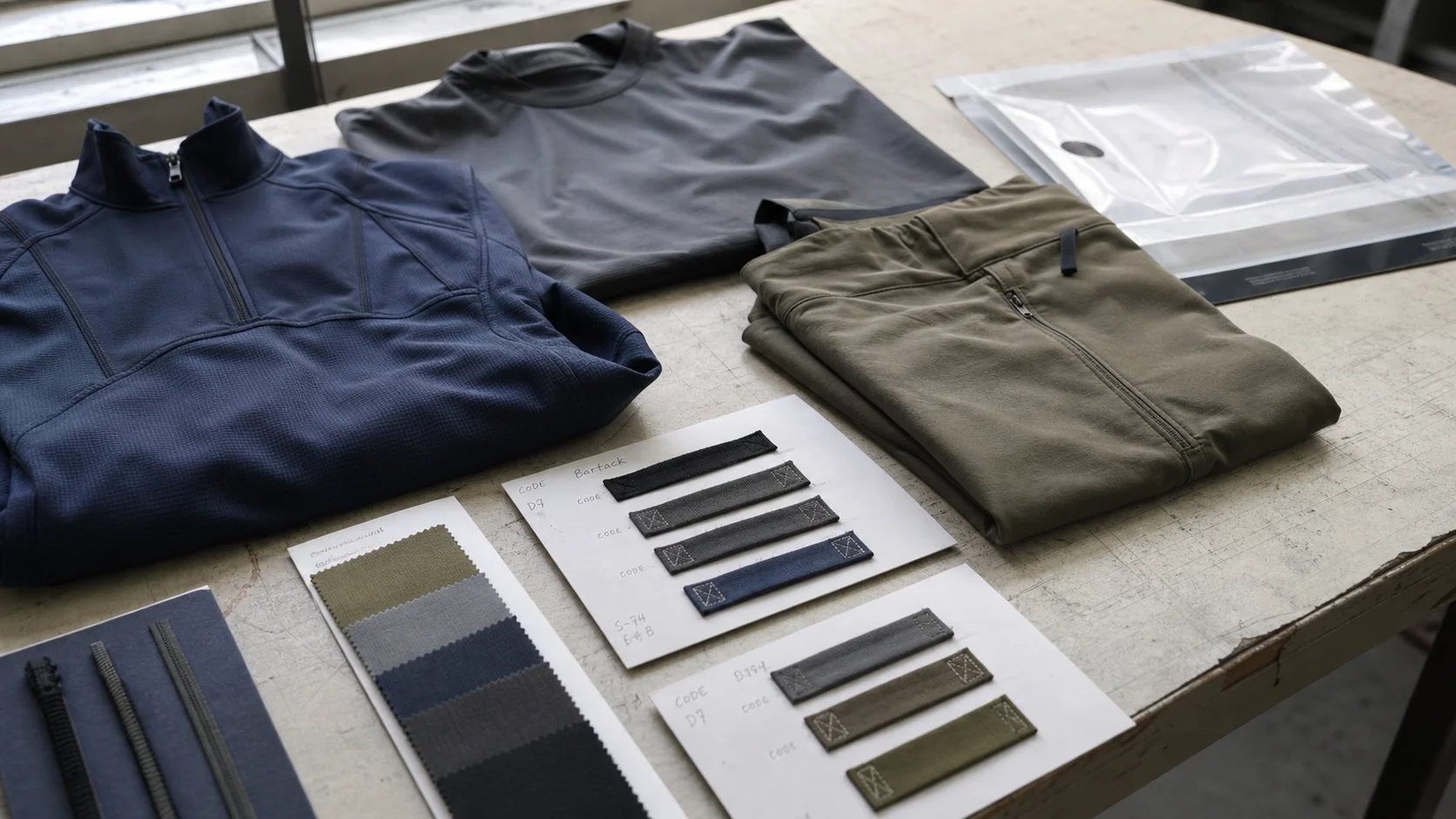
A product-specific SEO outline for security contractors sourcing decorated uniforms with contrast bartack maps, covering placement logic, factory...
Contrast Bartack Map Checklist for Security Buyers - Decoration & Printing manufacturing guide
For security contractors, uniforms are not only workwear. They are operating tools. A guard’s trousers, tactical shirt, vest cover, or utility jacket must hold up under repeated movement, radio use, belt load, pocket access, vehicle entry, long shifts, and high-wash schedules. Small reinforcement details decide whether the garment survives the contract period or fails early in the field.
Contrast bartacks are one of those small details. They reinforce stress points while making those reinforcements visible. A contrast bartack map tells the factory exactly where those stitches go, what thread color is used, how dense each bartack should be, and which points are mandatory for compliance. Without a map, production teams often make judgment calls. That is risky for security buyers because judgment calls vary by line, operator, subcontractor, and inspection day.
This article is a practical factory compliance checklist for security contractors sourcing garments with contrast bartack decoration and reinforcement. It focuses on buying control: how to brief suppliers, what to include in the tech pack, where to check samples, and how to reduce avoidable quality disputes before bulk production starts.
Purchasing judgment: if the bartack is both decorative and functional, treat it as a construction requirement, not only a design feature. Put it in the specification sheet, the measurement file, the sample comments, and the final inspection checklist.
Security uniform buyers often focus on fabric weight, color shade, badges, pocket count, and price. Those are important. Yet the difference between a reliable uniform program and a complaint-heavy program is usually found in reinforcement details: belt loops pulling out, pocket corners tearing, radio tabs loosening, shoulder epaulettes fraying, or zip pullers failing because the fabric area around them was not stabilized.
A contrast bartack map gives security contractors a repeatable standard. It also makes factory communication cleaner. The buyer can inspect against a drawing instead of a verbal expectation. The supplier can train sewing operators with a visual guide. The quality team can count bartack positions quickly. The commercial team can quote more accurately because bartack count affects sewing time.
For buyers building a new security uniform program, a reliable manufacturing partner should be able to review the bartack map during development and flag impractical placements before sampling. Fabrikn’s broader apparel development and production support can be reviewed through its services page when buyers need help converting design requirements into factory-ready specifications.
A contrast bartack map is a technical drawing or marked garment illustration that identifies every bartack location, stitch color, stitch size, and functional purpose. It should not be a loose comment such as “contrast bartacks on pockets.” That instruction leaves too much room for interpretation.
A proper map should include front view, back view, and close-up drawings for complex zones. For trousers, the map normally covers pocket corners, cargo pocket flaps, belt loops, fly base, seat seam stress points, tool pocket edges, knee panel corners, and hem tabs if used. For shirts and jackets, it may cover chest pocket corners, epaulettes, sleeve tabs, cuff plackets, radio loops, zip ends, flap corners, side vents, and ID loop attachments.
Security contractors should pay attention to revision control. One common sourcing problem is that the sales sample, fit sample, and pre-production sample each show slightly different bartack placements. If the map is not updated and signed off, bulk production may follow the wrong version. The compliance checklist should require the final map to be attached to the purchase order or production file.
The table does not replace the drawing. It supports the drawing. Factories need both because sewing operators work visually, while merchandisers and inspectors often work from tables and checklists.
Security contractors usually buy uniforms under performance pressure. The garments must be durable, consistent, and ready for deployment. A factory compliance checklist should cover more than social compliance or general quality. It should verify whether the supplier can execute the bartack map repeatedly across sizes, colors, and production lots.
Contrast bartacks increase visibility. That is useful for branding and inspection, but it also exposes mistakes. A navy trouser with orange bartacks looks sharp when aligned. It looks cheap when the bartacks drift, vary in length, or show loose thread tails. The supplier’s sewing discipline matters.
Buyers should be cautious when a supplier treats bartacks as a minor sewing detail. A supplier that cannot discuss stitch count, thread tension, seam thickness, or reinforcement backing may still produce casual garments well, but security uniforms require a different mindset. The better supplier will ask questions early: which pockets carry tools, whether belts carry equipment, how often the garment is washed, and whether contrast stitching is part of the customer’s brand identity.
Some buyers request one factory compliance checklist for every supplier. That approach is useful for consistency, but it should still allow style-specific details. A tactical pant has a different reinforcement profile than a guard polo. A softshell jacket with radio loops has different risks than a woven shirt with epaulettes. Keep the master checklist stable, then attach style-level bartack maps.
Buyers that want to discuss technical production readiness before placing an order can contact Fabrikn through the contact page with garment type, quantity target, fabric preference, and decoration requirements.
Placement is the first quality issue to control. A bartack in the wrong position may not reinforce the stress point. A bartack that is slightly crooked may still function, but it can fail appearance inspection because contrast thread makes it highly visible. For security garments, both function and presentation matter because uniforms represent authority and contract professionalism.
Trousers carry the heaviest stress load in most security uniform programs. Guards bend, climb stairs, sit in vehicles, run when required, and attach belts or tools. Cargo pockets may carry gloves, notebooks, flashlights, keys, or small devices. Belt loops may face constant pulling from duty belts.
Upper-body garments have different stress areas. The highest-risk points are usually pockets, epaulettes, sleeve openings, zip ends, shoulder attachments, and radio or ID loops. If the garment includes reflective tape, avoid placing bartacks too close to tape edges unless the construction has been tested. Needle punctures and dense stitching can affect appearance and durability near coated or reflective materials.
The map should specify the distance from seam edge where needed. For example, a cargo pocket corner bartack may sit 2-4 mm inside the pocket edge depending on construction. Too close to the edge can create fraying or weak bite. Too far inside can miss the stress point and look misplaced. Exact values should be confirmed during sampling on the actual fabric.
Contrast bartacks only work when thread choice is controlled. Buyers often approve the visual color but forget thread type. That creates problems when the factory substitutes a cheaper thread, uses a different ticket size, or selects a shade that looks acceptable under factory lighting but not under daylight.
Common choices include polyester spun thread, polyester core-spun thread, and bonded nylon or polyester for heavier-duty use. For most woven security uniforms, polyester thread is common because it offers strength, wash resistance, and colorfastness. Core-spun thread can provide a stronger, cleaner look for workwear. Bonded thread may be considered for very heavy tactical applications, but it can be overbuilt for standard uniforms and may affect seam appearance if not matched to the fabric.
Thread Option Typical Use Benefits Tradeoff Polyester spun Standard shirts, light trousers, basic uniforms Cost-effective, widely available May be less durable on high-load points Polyester core-spun Workwear trousers, jackets, utility uniforms Better strength and cleaner stitch appearance Higher cost than basic spun thread Bonded polyester or nylon Heavy tactical or equipment-bearing zones Strong, abrasion-resistant Can be too stiff or visible if not engineered wellBartack specifications should include length, width, and stitch density. A typical bartack may range from 8 mm to 18 mm depending on the garment zone. Belt loops and cargo pockets often need stronger, longer bartacks than pocket flaps on light shirts. Stitch density should be high enough to lock the area but not so dense that it cuts into the fabric.
Dense stitching can damage lightweight fabric. It can also create puckering on stretch fabric or coated fabric. This is why the factory should test the bartack on the actual bulk fabric, not only on a random fabric scrap. If the garment uses ripstop, twill, poly-cotton, stretch woven, or softshell, each fabric reacts differently to needle penetration and thread tension.
Security buyers may use contrast bartacks for brand recognition. Common combinations include black fabric with red bartacks, navy with silver-grey bartacks, khaki with black bartacks, or charcoal with high-visibility yellow. Those combinations can look effective, but they raise shade consistency risk.
Strong contrast is not always the best choice. A bright bartack improves visibility and branding, but it also shows every sewing defect. A tonal contrast, such as charcoal on black or light navy on dark navy, may be a better choice when the buyer wants a professional look with lower visual rejection risk.
Sampling is where most bartack problems should be caught. If they reach bulk production, the cost of correction rises quickly. A supplier may need to unpick dense bartacks, which can leave needle holes, fabric damage, or visible marks. In many cases, a badly placed contrast bartack cannot be repaired cleanly.
The pre-production sample is the key approval point. It should not be approved with open comments such as “improve bartacks in bulk.” That is too vague. If bartack length, position, color, or tension is wrong, the buyer should request a corrected sample or at least a corrected panel before bulk cutting. For urgent orders, buyers sometimes accept risks to protect delivery. That decision should be recorded clearly.
A practical approval workflow protects both buyer and supplier. The supplier knows what has been accepted. The buyer has evidence if bulk production varies. The inspector has a reference that is more reliable than memory or general comments.
Minimum order quantity depends on fabric sourcing, trim availability, color complexity, factory capacity, and whether the garment is custom-developed or based on an existing block. For security uniform programs with contrast bartacks, typical MOQs may range from 300 to 500 pieces per style for simpler garments if fabric is available. Custom fabric colors, special thread shades, multiple size splits, and complex pocket systems can push practical MOQs to 800, 1,000, or more pieces per style.
For trousers and jackets with multiple bartack points, the issue is not only MOQ. It is sewing time. A garment with 8 bartacks is different from a tactical trouser with 30 or more bartacks. Each bartack requires machine time, operator handling, thread trimming, and inspection. If the buyer wants high-contrast, highly visible bartacks, the factory must spend more time controlling alignment.
These are general commercial ranges, not fixed rules. Some suppliers may accept lower quantities with a surcharge or if they already have suitable fabric in stock. Buyers should be careful with very low MOQs on highly customized security garments. Low quantity can be useful for pilot programs, but it may come with higher unit price, limited fabric choice, less automated production setup, and weaker leverage during corrections.
Lead time usually depends on fabric availability first, then sampling speed, trim approval, production capacity, and inspection booking. A straightforward repeat order using stocked fabric and approved bartack settings may move faster. A new uniform program with custom fabric, special contrast thread, multiple samples, embroidery, patches, reflective tape, and packaging requirements will take longer.
Purchasing tradeoff: the cheapest quote is often based on simplified construction, faster sewing, or less inspection time. If the contract requires uniforms to survive heavy use, reducing bartack count or using weak thread may save a small amount upfront and create replacement costs later. A better approach is to separate essential bartacks from decorative-only bartacks. Keep load-bearing reinforcement. Reduce cosmetic extras only if budget pressure is real.
Contrast bartacks are easy to inspect visually, but that does not mean they are easy to produce consistently. The quality control plan should check count, position, thread quality, tension, appearance, and strength. It should also check whether the bartack damages the fabric.
The final inspection checklist should include an exact count. If the approved map calls for 26 bartacks on a trouser, the inspector should count 26. Sampling plans based on AQL can be used, but high-risk functional points deserve special attention. Belt loops, radio loops, and cargo pockets should not be treated as purely visual details.
In-line inspection is more useful than final inspection for bartacks. Final inspection can find defects, but it cannot always fix them cleanly. Once a dense bartack is sewn in the wrong spot, unpicking may damage the fabric. Production quality teams should check early output from each sewing line before full-volume production continues.
Security contractors should ask suppliers whether defects are tracked by operation. If “bartack defect” is recorded as one broad category, root-cause correction becomes harder. A missing belt loop bartack is not the same as a crooked decorative pocket bartack. The former may create field failure. The latter may create appearance rejection. Both matter, but they require different corrective action.
Testing does not need to be excessive for every order, but buyers should match testing to garment use. Pull testing is sensible for belt loops, radio loops, ID tabs, and tool attachments. Wash testing is sensible when uniforms are laundered frequently. Abrasion testing may be relevant for tactical trousers or outerwear used in rough environments.
If the garment uses stretch fabric, confirm that bartacks do not restrict movement or cause localized tearing. If the garment uses coated softshell, confirm that the needle holes do not create unacceptable appearance or water-resistance concerns. If the garment uses flame-resistant or high-visibility materials, buyers should check whether the contrast thread and stitching method are compatible with the garment’s claimed performance requirements. Do not assume standard decoration thread is suitable for certified protective apparel.
Good documentation reduces disputes. A buyer should not rely on email comments alone for contrast bartack instructions. Put the requirement into the technical pack and purchase order. If the supplier issues a production file, check that the same information appears there too.
Contract buyers should also ask how the supplier handles approved sample storage. A sealed production reference sample should remain available until the order is completed. If a repeat order is planned, keep a retained sample for the next production run. Contrast thread shade can drift over time if the supplier changes thread source without approval.
For buyers evaluating production partners, company background and operating model can also matter. Fabrikn’s about page provides context for buyers reviewing sourcing support and apparel manufacturing coordination.
A scorecard helps security contractors compare suppliers beyond price. It is especially useful when two factories quote similar garments but one has stronger technical control. Scoring does not need to be complicated. It should highlight the risks that affect delivery, durability, and brand appearance.
Category What to Check Preferred Standard Buyer Judgment Technical understanding Supplier reviews map and asks relevant questions Clear comments before sampling Strong sign if supplier identifies risk points early Machine capability Automatic bartack machines and controlled settings Repeatable length, density, and tension Weak capability increases visual inconsistency Thread control Thread type, ticket size, and shade reference Documented in BOM Reject vague “matching thread” descriptions Sample accuracy PP sample matches final bartack map No open critical comments Do not approve bulk if functional points are wrong Inspection process Inline and final checks by map point Defects recorded by location Broad defect categories hide root causes Commercial clarity MOQ, lead time, and surcharge transparency Quote reflects actual construction Very cheap quotes may omit sewing time realityThe best supplier is not always the one with the lowest unit price. For security contractors, the better supplier is the one that understands repeatability. Uniform orders often involve replenishment, size exchanges, and contract renewals. If the first order has inconsistent bartacks, the problem usually becomes more visible on reorders because new lots sit beside old lots in the field.
Start with function. Identify which bartacks prevent failure and which bartacks serve decoration. Make the functional bartacks non-negotiable. Decorative contrast points can be adjusted if the budget or production risk is too high.
Use contrast carefully. Strong contrast gives a distinctive uniform look and makes inspection easier. It also increases rejection risk because every crooked or loose stitch stands out. If the security contractor needs a conservative appearance, consider tonal contrast or limit bright bartacks to selected zones.
Approve physical samples, not only digital references. Thread shade on a screen is not reliable. Ask for stitch-outs on the actual fabric. If the fabric is dark, inspect under different lighting because some contrast thread shades shift visually.
Do not overload lightweight garments with heavy bartacks. A dense bartack on thin fabric can create tearing rather than preventing it. If the buyer wants the visual detail on light shirts, the factory may need backing, adjusted density, or a shorter bartack length.
Keep the map stable after PP approval. Last-minute placement changes create confusion on the sewing line. If a change is necessary, update the map revision, sample comment sheet, and factory production file at the same time.
A contrast bartack map is a small document with a large effect on security uniform quality. It connects design, durability, production, inspection, and brand appearance. For security contractors, it also protects the buying process by turning subjective stitching expectations into measurable factory requirements.
The most reliable checklist includes placement drawings, thread specifications, stitch settings, sample approval stages, MOQ and lead-time assumptions, and inspection controls. Buyers should treat load-bearing bartacks as compliance points, not decorative options. A missing or weak bartack on a belt loop, radio loop, cargo pocket, or flap end can become a field complaint quickly.
Good sourcing judgment means balancing appearance with production reality. Contrast bartacks can improve the uniform, but only when the factory can execute them consistently. A clear map, disciplined sampling, and practical inspection standards give security buyers the best chance of receiving uniforms that look professional and hold up through contract use.
Get a free quote from Fabrikn — your trusted B2B clothing manufacturer with 10+ years of experience. MOQ as low as 200 pieces.
Get a Free Quote →A contrast bartack map is a technical drawing that shows every reinforced bartack location on a garment using contrast thread. It should include placement, thread color, stitch size, direction, and whether each bartack is functional or decorative.
Security uniforms face repeated movement, laundering, and equipment load. A checklist helps buyers confirm that pockets, belt loops, radio loops, flaps, and other stress points are reinforced consistently before bulk production ships.
Typical MOQs may start around 300-500 pieces per style for simpler garments using available fabric. Utility trousers, tactical pants, jackets, or custom-color programs often require 500-1,500 pieces depending on fabric, trims, size range, and factory setup.
Yes, they can. Each bartack adds sewing time, machine handling, thread trimming, and inspection. The cost impact depends on the number of bartacks, thread type, garment complexity, and visibility standard. Functional bartacks are usually worth the cost; decorative bartacks should be reviewed against budget.
Polyester thread is common for security uniforms because it has good strength and wash resistance. Core-spun polyester is often better for workwear and tactical garments. Heavier bonded thread may suit high-load areas, but it must be tested on the actual fabric.
Buyers should approve a physical thread or stitch sample on the actual bulk fabric. Digital color references are not enough. A sealed approval sample and thread shade code should be kept for production and future reorders.
The highest-priority points are usually belt loops, front pocket openings, cargo pocket corners, flap ends, fly base, back pocket corners, and any tool or radio attachment points. These areas face the most stress during use.
Sometimes, but repairs are risky. Unpicking dense bartacks can leave holes, fabric damage, or visible marks, especially on dark, coated, lightweight, or stretch fabrics. It is better to catch placement issues during sampling and in-line inspection.
Inspectors should count bartacks against the approved map, check placement symmetry, verify thread shade, review stitch tension, look for skipped stitches and loose tails, and test functional points such as belt loops or radio loops when required.
Yes. Functional bartacks protect stress points and should be mandatory. Decorative bartacks support styling and branding, but they can be adjusted or reduced if they create cost, lead-time, or quality risks.