
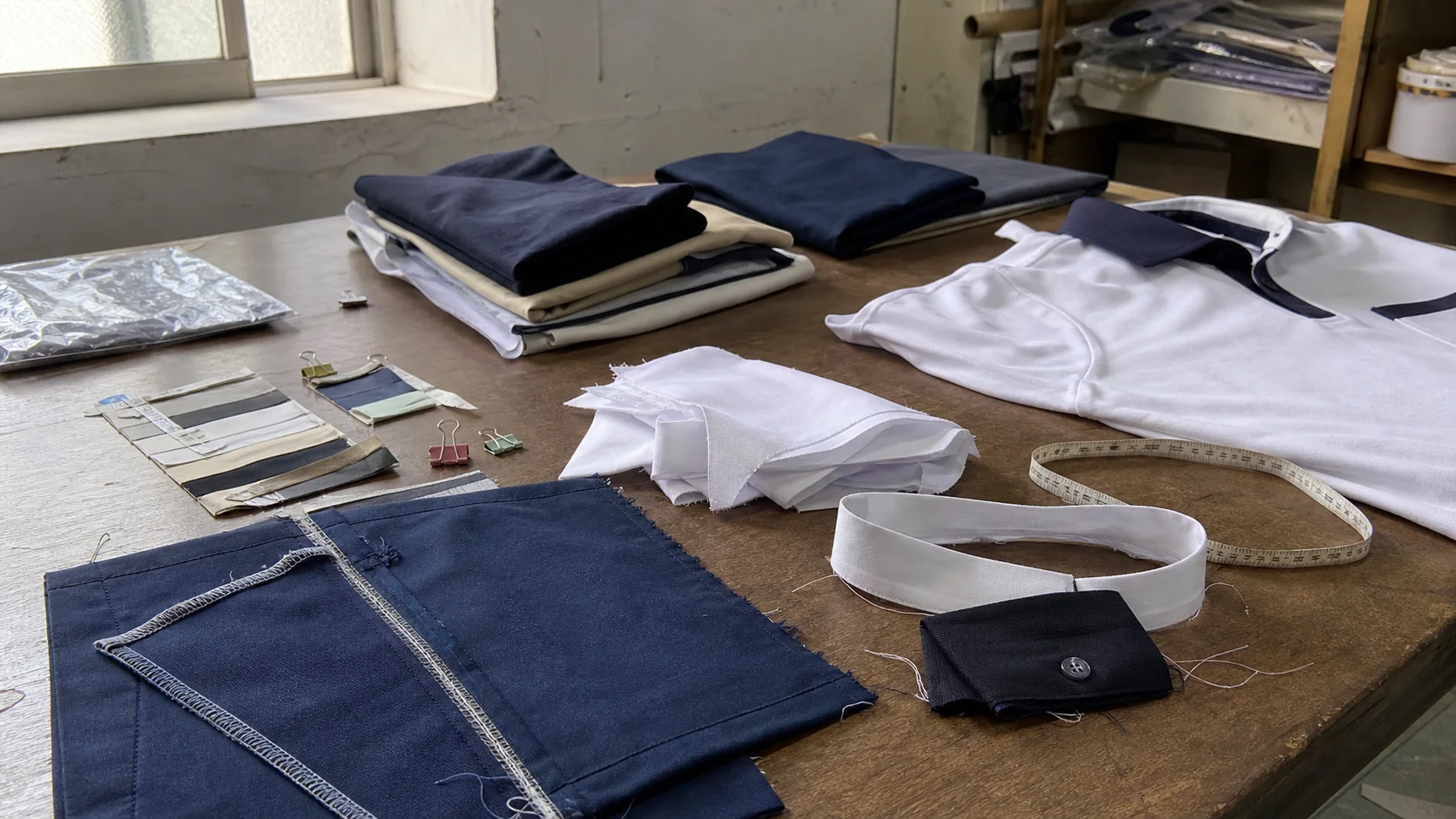
A practical guide for school operations teams evaluating contrast bartack maps, fabric durability, stitch placement, wash performance, and approval...
School uniform programs look simple from a distance. In practice, they depend on a chain of details that can fail quietly: stitch placement, thread visibility, fabric shrinkage, seam strength, color match, and wash durability. A contrast bartack map sits in the middle of that risk. It tells a supplier where reinforcement stitches must go, what color they should be, how they should look after laundering, and what level of repeatability the buyer expects across sizes and seasons.
For school operations teams, this is not just a decoration issue. Bartacks affect durability at stress points such as pocket corners, placket ends, belt loops, side vents, hem openings, and reinforcement zones on skirts, trousers, polos, and outerwear. When the bartack color is meant to stand out, testing must confirm two things at once: the stitch performs structurally and the contrast stays intentional rather than sloppy.
If your team is sourcing at scale, the question is not whether bartacks are attractive on a sample. The real question is whether the production line can keep them consistent across trims, fabric lots, and repeat orders. That is where a clear testing guide matters. If you need production support while building a uniform program, start with the factory capabilities listed at fabrikn.com/services/ and use the contact channel at fabrikn.com/contact-us/ once your spec sheet is stable.
Contrast Bartack Map Testing for School Uniform Buyers - Fabrikn production reference
A bartack map is a production reference that shows each reinforced stitch location on a garment. A contrast bartack map adds a visual requirement: the bartacks must be a deliberate contrasting color, not a random thread leftover from sewing. In school uniforms, that contrast may be used for brand identity, trim coordination, or a clean visual cue that separates schoolwear from standard commercial basics.
The map should be more specific than a sketch. It needs to identify placement, size, stitch count or stitch density, thread type, color reference, and the acceptable tolerance for shift. On some programs, the map also lists which sizes get which bartacks. A junior shirt may need different reinforcement than a senior trouser, and a PE garment may need stronger reinforcement than a classroom polo.
Buyers sometimes treat bartacks as a small decoration detail. That is a mistake. They sit at stress points and are exposed to repeated wash, flex, and abrasion. If the thread breaks down, the garment may not fail immediately, but it will look tired early and can lose confidence with parents and school administrators.
School operations teams buy for consistency, not novelty. That makes testing more important than it is in a one-off retail order. A uniform program usually needs stable appearance across multiple shipments and enough durability to survive a full school year, often longer.
Contrast bartacks matter because they are visible in person and in photographs. A batch that looks acceptable under showroom lighting can reveal mismatched thread, uneven stitch lengths, or poor density after the first wash. A slightly off-tone contrast thread may not sound serious, but once it repeats across hundreds or thousands of garments, the issue becomes visible enough for complaints.
Testing also protects the buyer from avoidable disputes. If the approval sample includes a bartack map and the production goods do not match it, the buyer has a documentable standard. Without that, quality arguments usually end in ambiguity, and ambiguity is expensive.
For uniform programs, the bartack is not a decorative afterthought. It is a visible quality control point that combines appearance, reinforcement, and repeatability.
A useful bartack spec should remove guesswork from the supplier side. It does not need to be long, but it does need to be precise. If the team wants contrast bartacks tested properly, these elements should be documented before sampling starts.
Mark the exact points that require bartacks. Typical school uniform locations include pocket corners, cuff ends, belt loops, side slits, placket bottoms, reinforcement at zipper stops, and stress points on bag straps or apron ties. A map should show left and right sides separately if placement is asymmetrical.
Specify thread color by Pantone reference, supplier thread code, or approved physical swatch. If the contrast is meant to be strong, define the acceptable range of visual deviation. If the contrast is subtle, say so clearly. The more subjective the color target, the more important the approved sample becomes.
Define the bartack length, width, stitch density, and thread material. Polyester core-spun thread is common in schoolwear because it handles laundering well, but the final choice depends on fabric and finish. A dense bartack may look secure but can pucker lighter fabrics. A looser bartack may look cleaner but fail too easily under load.
Write down the reason the bartack exists. If it is decorative only, say so. If it is structural, define the minimum expectation in terms the supplier understands, such as resistance to opening under normal wear or acceptable performance after repeated wash cycles. A clear function helps the factory choose the correct construction method.
Spec item What to define Buyer risk if omitted Placement Exact location on each garment panel Misplaced or missing bartacks Thread color Code, sample, or approved swatch Color drift between batches Stitch density Stitch count, width, and length Weak reinforcement or puckering Thread type Fiber content and weight Fading, breakage, or abrasion failure Acceptance standard Approved sample and tolerance notes Disputes at inspectionSchool programs should never approve a contrast bartack map from a drawing alone. The approval path needs physical confirmation. A practical flow is simple and disciplined.
This process sounds basic because it is. The problem is that many programs compress it. That usually leads to later rework. A clean first sample is cheaper than a production hold.
For larger orders, the approved sample should be retained as a sealed reference and matched to the final production note. If your organization manages several schools or seasonal drops, store the approved sample data centrally so the next reorder does not depend on memory or email threads. If internal alignment is still loose, an early planning call through fabrikn.com/about-us/ can help clarify production capacity and process expectations before you place a purchase order.
Contrast bartack testing is not isolated from the rest of the garment. Fabric behavior affects how the bartack lands, how it sits after washing, and whether the reinforcement creates visible distortion. A school uniform buyer should review the base fabric and all related trims at the same time.
Lightweight shirting can pucker when bartacks are too dense. Heavier twills and canvas-style schoolwear tolerate stronger reinforcement, but they can also reveal thread color more sharply. Knit fabrics pose a different issue because stretch can distort the bartack under movement if the machine setting is not balanced.
If the fabric shrinks significantly, the bartack may tighten after laundering and create a trapped, raised look. That can be acceptable on some outerwear, but it is less acceptable on classroom shirts where smooth appearance matters. A good test should include the expected wash cycle and drying method.
Needle size, point type, and thread weight should be matched to the fabric. An aggressive setup can cut yarns, leave puckers, or create skipped stitches. A weak setup can look neat in a sample but fail in regular use. This is where suppliers vary in skill, and where the buyer should ask for process detail instead of assuming the factory will optimize it automatically.
If the bartack sits near zippers, snaps, labels, or heat-transfer branding, all components need to be checked together. Some trims shrink or warp differently after heat exposure. A bartack that is positioned correctly before finishing can end up too close to a closure after pressing or laundering.
Typical MOQ ranges in schoolwear depend on garment complexity and supplier setup, but buyers often see practical minimums in the low hundreds per colorway for standard items and higher thresholds for customized contrast details. A heavily customized bartack map may push the MOQ upward because the factory needs additional programming, color matching, and operator control. That tradeoff is normal. Lower MOQ usually comes with a higher unit cost and less flexibility in finishing choices.
Lead time is usually less about sewing speed and more about decision speed. A contrast bartack map can be simple to sew once it is approved. The bottleneck is getting the design, color, sample, and test results aligned early enough for bulk production.
The main dependencies are straightforward:
When any of these steps slips, the order can still be completed, but the schedule becomes fragile. Buyers should treat contrast bartack approval as a gate, not a detail to tidy up later. If the program has a hard school opening date, the safest approach is to complete sample approval before fabric bulk commitment where possible.
Inspection teams should look at both appearance and mechanics. A bartack can pass a casual visual review and still fail under classroom use. The most common problems are predictable.
The thread color differs from the approved sample, often because a different dye lot or supplier substitute was used. Even small deviations become obvious on a contrast detail.
Some bartacks look tighter or looser than others across the same shipment. This usually points to weak machine control, inconsistent operator setup, or rushed line changeovers.
A dense bartack on lightweight fabric can gather the panel and create a raised or distorted surface. This is especially visible on shirts and blouses.
Low-grade thread, poor tension, or poor needle selection can produce frayed edges after laundering. The garment may still wear, but it looks worn faster than the buyer expects.
Bartacks appear slightly off the mapped position or are missing on one side of a paired garment. This is a serious problem because it signals poor process control.
Risk What to check Practical response Color drift Compare against sealed sample in daylight-equivalent light Reject, re-dye, or rework if within timeline Puckering Inspect after wash and press Adjust stitch density or backing method Misplacement Measure against the map and not just visual placement Hold lot and correct setup Broken stitches Check stress points after laundering and light pull testing Review thread and needle setupNot every school garment needs the same level of bartack control. A buyer should apply judgment based on the garment’s visibility, use intensity, and cost position. That means the standard can be tighter on a premium blazer and more flexible on a low-cost PE short, but the decision should be deliberate.
Tighten the standard when the bartack is highly visible, part of the school brand, or expected to survive frequent washing. Also tighten it when the school wants a premium finish and the uniforms are a parent-facing quality signal. In those cases, the contrast bartack is part of the product identity.
Relax the standard only when the garment is low-visibility, low-cost, and function-led. Even then, the buyer should not relax structural requirements. A cheaper garment can have less decorative precision, but it still needs the reinforcement to hold up through normal use.
The best purchasing position is practical, not perfectionist. A school uniform should look controlled, wear well, and be reproducible at scale. Decorative detail is useful only when it survives the realities of the supply chain. If the project is moving from design to sourcing now, it is usually better to lock the construction standard first and negotiate aesthetic refinement second.
These questions keep the conversation focused on production reality instead of vague assurances:
Strong suppliers answer these questions without drama. Weak suppliers dodge specifics, promise that it will “look fine,” or push all responsibility onto the buyer after the order is placed. That is not a contract-ready response.
Contrast bartack map testing is a small part of a school uniform program only in appearance. In practice, it is a control point for durability, visual consistency, and reorder stability. Buyers who test it properly reduce inspection disputes, avoid early wear complaints, and make future purchasing simpler.
The most reliable approach is straightforward: write the spec clearly, approve a physical sample on the intended fabric, wash-test it, and hold the supplier to the same reference during bulk production. That is the standard that keeps school operations teams out of avoidable rework and keeps uniform programs looking deliberate instead of improvised.
If you are consolidating sourcing notes, production requirements, or buyer questions, the safest next step is to align the bartack map with the broader uniform tech pack before you issue the final order.
Get a free quote from Fabrikn — your trusted B2B clothing manufacturer with 10+ years of experience. MOQ as low as 200 pieces.
Get a Free Quote →It is a production map that shows where bartack stitches go on a garment and specifies the contrasting thread color, stitch detail, and acceptance standard for those reinforcements.
Because bartacks affect both appearance and strength. A sample can look acceptable before washing and still fail after laundering or repeated wear.
It depends on the garment and supplier setup, but many programs see practical minimums in the low hundreds per colorway, with higher requirements for highly customized details or multiple school variants.
On fabric. Paper approval is not enough because fabric weight, weave, shrinkage, and finish all change how the bartack looks and performs.
Color drift, misplacement, puckering, broken stitches, and uneven stitch density are the most common problems.
The sewing itself usually adds little time. The longer lead-time risk comes from sample approval, thread sourcing, test revisions, and line setup.
Start by checking the service scope at fabrikn.com/services/, then move to the contact page at fabrikn.com/contact-us/ once the spec is ready.