
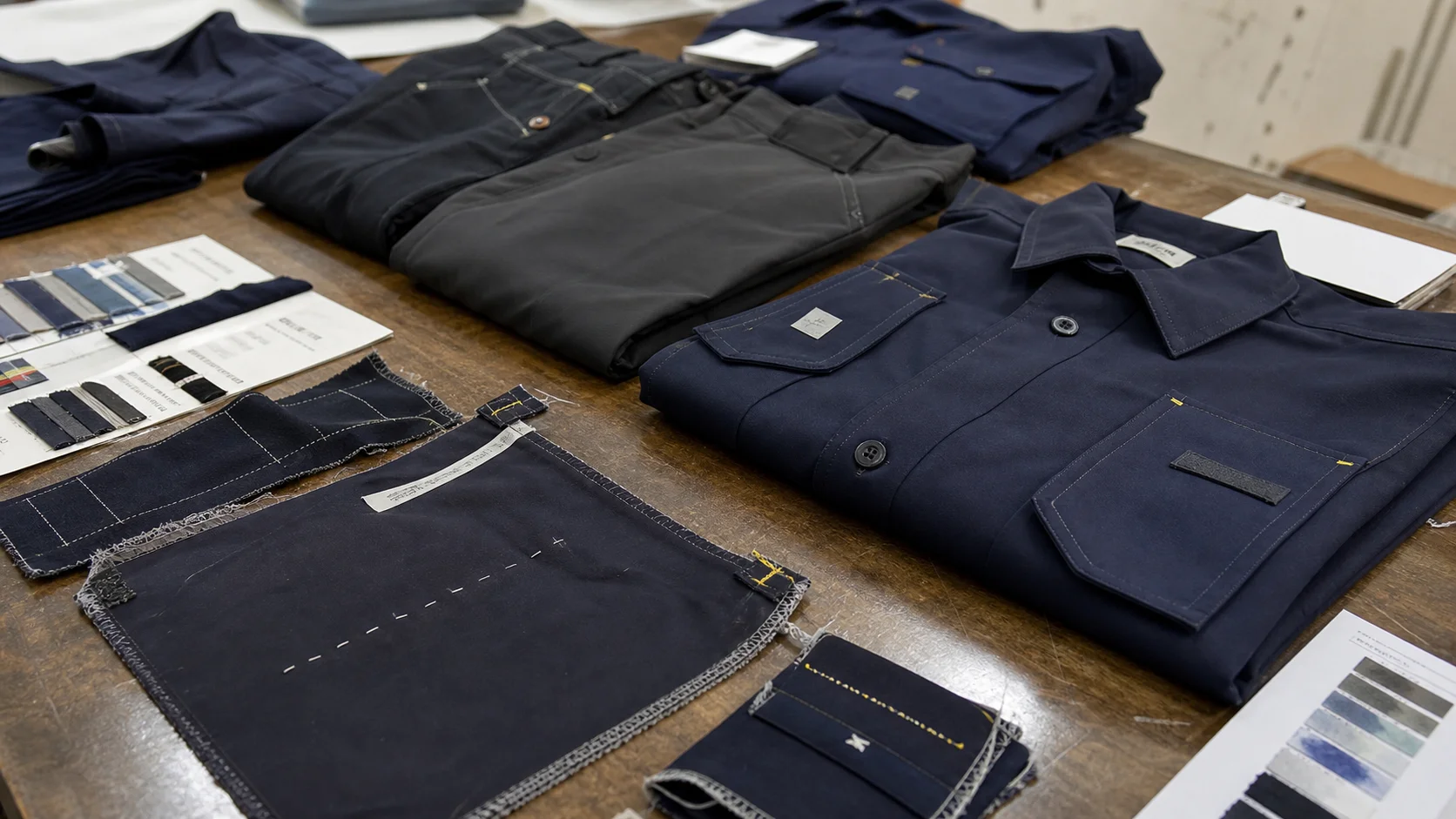
A practical testing outline for security contractors buying custom garments with contrast bartack maps, covering fabric compatibility, stitch placement,...
Contrast Bartack Map Testing for Security Contractors - Fabrikn production reference
Security contractors buy uniforms, tactical workwear, patrol outerwear, load-bearing accessories, and identification garments under tighter risk than ordinary apparel programs. A failed seam is not just a quality complaint. A failed bartack on a radio loop, pocket flap, ID tab, trouser stress point, or vest attachment can affect field performance, replacement cost, and wearer confidence. That is why a custom contrast bartack map fabric testing guide for security contractors should sit inside the technical package before bulk cutting starts.
Contrast bartacks are small, but they make big promises. They can reinforce stress points, highlight functional zones, support brand recognition, help inspection teams verify construction, and make repairs easier to identify. They also create risk if the thread shade, stitch density, placement, yarn strength, or substrate compatibility is wrong. A bright bartack on a dark ripstop pocket looks sharp in a showroom sample. On a contractor uniform washed weekly, rubbed against gear, and exposed to sun, sweat, oil, and abrasion, that same bartack may fade, pucker, snap, bleed, or become an unwanted visual target.
This guide explains how buyers, product developers, sourcing managers, and apparel manufacturers can test contrast bartack maps before production. It focuses on practical factory handover, fabric and trim specifications, sample approval, minimum order quantities, inspection risks, and purchasing tradeoffs for security contractor apparel.
A bartack is a dense reinforcement stitch used at high-stress points. It is common on belt loops, pocket corners, fly openings, zipper ends, shoulder tabs, badge tabs, cargo pocket edges, pen slots, radio loops, tool loops, and strap attachment points. A contrast bartack uses a thread color that is visibly different from the base fabric or main sewing thread.
A contrast bartack map is a technical drawing or written schedule that shows every bartack position, color, stitch count, length, width, direction, thread type, and tolerance across the garment or gear item. It should not be left to the sewing line to interpret. The map is a control document.
For security contractor apparel, the map usually combines function and appearance. Some bartacks are purely structural. Others are used to identify sizes, departments, access levels, brand colors, or inspection checkpoints. That combination makes testing more important. A decorative contrast stitch may be acceptable if it fades slightly. A structural bartack holding a radio tab cannot be treated casually.
Buying judgment: if a bartack is load-bearing, specify it as reinforcement first and decoration second. The color choice should never reduce seam strength, wash durability, or field discretion.
Factories sometimes ask whether the buyer really needs a full bartack map. For simple work pants, a written list may be enough. For security uniforms with many pockets, tabs, loops, and tactical details, a map prevents expensive ambiguity. It also gives the quality control team a measurable standard during inline and final inspection.
Security contractors often operate in environments where garments face more abuse than standard corporate uniforms. Field teams may kneel, climb, carry radios, wear body armor, sit in vehicles for long shifts, and wash garments frequently. Fabric and stitching must handle tension, abrasion, moisture, ultraviolet exposure, and repeated laundering.
Contrast bartacks add another layer of concern because the visible thread must keep its color and still perform mechanically. A thread that looks good on the lab dip card may not behave well on a coated nylon shell, polyester-cotton ripstop, stretch twill, or heavy-duty canvas. Dense stitching can also damage the fabric if the needle size, stitch count, or thread tension is wrong.
The testing goal is not to make every bartack indestructible. That would drive cost and slow production. The goal is to confirm that each bartack is appropriate for its job. Pocket mouth reinforcement, waistband stress points, epaulette anchor points, and equipment loops do not carry the same load. A good testing guide separates critical, major, and minor bartacks so the manufacturer can apply the right control level.
Security buyers should also think about visibility. Contrast bartacks can support branding and quick garment verification, but high-contrast colors may be unsuitable for low-profile, surveillance, or crowd-control use. A bright orange bartack on a black tactical trouser is easy to inspect. It may also be too visible for some assignments. This is a purchasing decision, not only a design decision.
The first step in testing is knowing which bartacks matter most. A custom contrast bartack map should group bartacks by garment zone and function. This helps the factory assign correct machines and lets the inspector focus on the most important stress points.
Not every point needs a contrast color. For some orders, a mixed approach works better: tonal bartacks for field-discreet zones and contrast bartacks for inspection-friendly zones. This reduces visual noise while still giving the buyer a recognizable detail.
This classification should be included in the tech pack. If all bartacks are treated as critical, cost rises and inspection becomes slow. If no bartacks are treated as critical, failures may appear after deployment. A tiered approach is more realistic.
Contrast bartack testing starts with the fabric. Dense stitching concentrates force into a small area. The fabric must be able to accept the needle penetration and hold the thread without tearing, puckering, melting, or showing excessive distortion.
Common security contractor fabrics include polyester-cotton ripstop, cotton-poly twill, nylon-cotton blends, mechanical stretch woven fabric, softshell laminates, coated polyester, Oxford cloth, and heavyweight canvas. Each behaves differently under bartack stitching. Ripstop may resist tearing but show puckering if thread tension is too high. Stretch fabrics may recover poorly if the bartack is too dense. Coated fabrics may suffer needle holes that reduce water resistance. Heavy canvas may need larger needles and stronger thread.
Thread choice matters just as much. Polyester thread is common for security uniforms because it offers good strength and colorfastness. Nylon thread may be used for some gear and webbing applications, but it can be more sensitive to UV degradation depending on grade and exposure. Cotton thread is rarely the first choice for high-stress security apparel unless there is a specific garment reason.
Buyers should avoid approving thread by digital image only. Screen color is not reliable enough for contrast bartacks, especially on dark navy, black, charcoal, ranger green, coyote, khaki, or high-visibility fabrics. A physical thread card or stitched strike-off is safer.
For programs that need broader development support, it is sensible to align the bartack map with the supplier’s garment development process. Fabrikn outlines manufacturing service capabilities at https://fabrikn.com/services/, which can help buyers think through how decoration, sewing, sampling, and bulk production steps should connect.
A useful bartack map is clear enough for production and strict enough for inspection. It should not be a vague comment such as “contrast bartacks at all stress points.” That instruction leaves too much room for interpretation.
The map should use front, back, side, and detail views of the garment. Each bartack should have a reference number. The reference number should connect to a table listing thread color, thread size, bartack dimensions, stitch count, classification, and tolerance. For complex garments, include separate maps for shell, lining, pockets, removable panels, and accessories.
Exact stitch count depends on the fabric, machine, thread, and required performance. As a practical starting point, many apparel bartacks fall around 21 to 42 stitches, with higher counts used for stronger reinforcement. Heavy-duty applications may need different settings. More stitches are not always better. Excessive density can cut the base fabric and create a perforation line.
Placement tolerance should also be realistic. A tolerance of plus or minus 1 mm may be possible on automated equipment and stable panels. It may be unrealistic on bulky seams, curved pocket edges, padded zones, or stretch fabric. A common practical range is plus or minus 2 mm to 3 mm for many garment bartacks, with tighter standards for visible symmetrical features and slightly wider tolerance for hidden reinforcement.
A fabric testing guide for security contractors should cover both performance and appearance. The goal is to simulate predictable field stresses before a purchase order becomes a warehouse problem.
Critical bartacks should be tested for strength. The test method depends on the garment and available lab resources, but the principle is simple: apply force to the bartacked area and measure failure behavior. Does the thread break? Does the fabric tear? Does the bartack pull out? Does the webbing slip? The failure mode tells the buyer whether the issue is thread strength, stitch density, fabric weakness, seam allowance, or construction design.
For a radio loop or load-bearing strap, the buyer should define expected use carefully. A bartack that survives normal pocket stress may not be suitable for hanging equipment. If the item carries gear, it may need a different reinforcement pattern, box stitch, cross stitch, or additional backing patch rather than a standard bartack alone.
Security uniforms rub against belts, body armor, vehicle seats, desk edges, and equipment. Contrast thread can fuzz, fade, or break under abrasion. Test panels should include bartacked seams, not only flat fabric swatches. A flat fabric abrasion result does not prove the bartack will survive at a pocket corner.
Abrasion testing should be prioritized for belt loops, thigh pockets, knee areas, and outerwear points that contact armor or bags. If the contrast thread fuzzes earlier than the base fabric, the garment may look worn too quickly even if it remains functional.
Wash testing is essential for contractor uniforms. A good approval should include repeated laundering, drying method, and visual assessment after cycles. Typical development checks may include 3 wash cycles for early screening and 5 to 10 cycles for stronger production confidence. Large or long-term programs may specify higher cycle counts, especially where garments are industrially laundered.
Track shrinkage, puckering, color change, thread bleeding, seam distortion, and bartack tightness. A contrast bartack can look excellent before washing and become wavy after shrinkage if the thread, fabric, and seam construction do not move together.
Contrast bartacks need colorfastness checks against washing, rubbing, perspiration, and light exposure. Dark garments with bright thread and light garments with dark thread both carry risk. Red, orange, neon, and deep navy thread shades often deserve extra caution because shade stability can vary by thread source and dye system.
Dry and wet rubbing tests are useful because security garments often face sweat and friction together. A contrast bartack that transfers dye to a light pocket flap, reflective tape, or lining can create a visible defect.
Dense bartacks can damage fabric. On coated or laminated materials, needle holes may compromise water resistance. On fine twill, the bartack may pucker. On stretch fabric, it may restrict movement and cause distortion. Inspect samples under normal light and angled light. Some defects are easier to see when the fabric is bent or stretched.
Needle selection should be part of the sample review. A ball point may suit knits, while sharp or specific woven points may suit woven fabrics. Heavy materials may require larger needles, but oversized needles can leave visible holes. The factory should adjust needle, thread, tension, and machine speed during sampling, not during bulk production.
A disciplined sample process reduces production disputes. Security contractor programs often involve multiple stakeholders, including procurement, operations, brand, compliance, and end users. Each group may care about different details. The sample approval process should force those requirements into one written standard.
The development sample checks concept, garment construction, bartack position, and contrast appearance. It may use available fabric and trim if final materials are not ready. This sample is not enough for bulk approval. It is mainly for design direction and risk spotting.
The strike-off is a stitched test panel using intended fabric, thread, needle, and machine settings. It should include all major bartack types: pocket corner, belt loop, loop base, flap edge, zipper end, and any load-bearing detail. Buyers should review color contrast, puckering, thread coverage, and back-side appearance.
The fit sample confirms sizing and mobility. Bartacks near movement zones should be checked while the garment is worn or flexed. A crotch gusset, shoulder tab, or knee panel can look fine flat and perform poorly when the wearer bends or reaches.
The pre-production sample should use approved bulk fabric, trims, thread, labels, packaging method, and sewing settings. This is the key approval sample. The contrast bartack map should be frozen at this point. Any change after approval should require written confirmation and, if relevant, a new test panel.
A small pilot run or top-of-production sample confirms the sewing line can repeat the approved result. This matters because a sample room can produce cleaner bartacks than a bulk line under speed pressure. Inspect the first output before the factory proceeds too far.
Buyers can contact potential production partners early through https://fabrikn.com/contact-us/ when the bartack map, fabric test expectations, and order timeline need to be discussed before quotation.
Minimum order quantity depends on fabric availability, thread dyeing, trim sourcing, garment complexity, and factory capacity. For custom security apparel with contrast bartack mapping, typical MOQs may start around 300 to 500 pieces per style for simpler garments if stock fabric and stock thread are used. More customized programs often sit around 800 to 1,500 pieces per style or color. Fully custom fabric, custom-dyed thread, specialized trims, or multiple sizes and colorways may push the effective MOQ higher.
Small orders are possible in some supply chains, but the unit price usually rises. The buyer may also face limited fabric options, simplified trim choices, or less flexibility on thread dyeing. Security contractors should be cautious about approving a low MOQ quote that depends on substitute fabric or unspecified thread. The first shipment may pass visually but fail under wash and field use.
As a general planning range, a repeat order using approved materials may move faster than a new program. A new custom uniform program with mapped contrast bartacks commonly needs several weeks for sampling and approvals before bulk production begins. Bulk production timing then depends on order quantity, complexity, and factory loading. Buyers should avoid promising deployment dates before the pre-production sample and fabric tests are approved.
Cost tradeoffs are direct. Contrast bartacks may require thread changes, tighter machine setup, more QC time, and higher rejection risk if placement is visible. Automated bartack machines improve consistency, but they still need correct programming and operator handling. If the contrast color is used in only a few locations, the factory may charge for setup inefficiency. If the same thread is used across the garment, production becomes easier.
Final inspection must do more than count cartons. Contrast bartacks are visible, measurable, and often easy to reject, but inspectors need the right checklist. The bartack map should be included in the inspection file along with the approved sample and trim cards.
AQL sampling should reflect product risk. Critical bartacks on load-bearing features deserve stricter review than decorative tabs. For field uniforms, inspectors should check both appearance and function. Pull gently on belt loops, pocket flaps, radio tabs, and hook-and-loop panels. This is not a substitute for lab testing, but it catches obvious production faults.
Shade control is another inspection risk. Contrast thread from different lots may appear slightly different under warehouse light, daylight, or LED light. The buyer should define the approved light source for color review when shade is important. Without that standard, disputes become subjective.
Packaging can also damage presentation. Dense garments folded under pressure may create creases across bartack zones, especially on coated or dark fabrics. Carton moisture can affect paper tags and sometimes stain light garments. Security contractors should request carton integrity checks, moisture review where relevant, and confirmation that garments are packed without stressing patches, tabs, or reinforced zones.
Contrast bartacks are worth specifying when they improve durability, inspection clarity, or brand identity. They are not worth adding everywhere. Too many contrast points can make a tactical garment look busy, increase QC defects, and slow production. The best programs use contrast with intent.
For low-profile security work, tonal bartacks may be better. For event security, transport teams, facility guards, or branded contractor uniforms, contrast bartacks can help create a consistent professional appearance. For mixed-use garments, consider contrast bartacks in internal or semi-visible areas and tonal reinforcement on exposed tactical zones.
Buyers should also separate what must be tested from what can be visually approved. Load-bearing bartacks need performance evidence. Decorative contrast details may only need shade, wash, and placement approval. This keeps the budget focused.
The right supplier should be able to discuss sewing construction, decoration, fabric behavior, MOQ, testing, and inspection together. A factory that treats bartacks as only a color detail may not be suitable for contractor apparel. A supplier that pushes unnecessary overengineering may also inflate cost. The best middle ground is a clear specification, targeted testing, and a realistic inspection plan.
For buyers evaluating production partners, the company background and operating focus matter. Fabrikn’s overview at https://fabrikn.com/about-us/ can be useful when assessing whether a supplier’s apparel manufacturing approach fits custom uniform and decoration requirements.
A contrast bartack map is a small document with large purchasing value. It turns a decorative idea into a controlled manufacturing instruction. For security contractors, that control matters because uniforms must look professional, survive hard use, and arrive consistently across sizes and repeat orders.
The safest path is straightforward: specify the fabric and thread, map every bartack, classify risk, test on real materials, approve a pre-production sample, and inspect against the same standard. Do not let color preference override strength. Do not let a clean showroom sample replace wash and abrasion review. Do not assume a factory will place every bartack correctly unless the map is clear.
Good contrast bartack testing does not need to be excessive. It needs to be targeted. Spend more control on load-bearing points and less on purely decorative stitching. That purchasing discipline keeps cost reasonable while protecting the garment’s field performance.
Get a free quote from Fabrikn — your trusted B2B clothing manufacturer with 10+ years of experience. MOQ as low as 200 pieces.
Get a Free Quote →A contrast bartack map is a technical guide showing every reinforced bartack location on a garment, including thread color, dimensions, stitch count, thread type, placement tolerance, and risk classification. It helps the factory sew consistently and helps inspectors check bulk production.
Security contractor garments often face heavy wear from equipment, movement, laundering, and abrasion. Bartack testing helps confirm that reinforced points such as radio loops, belt loops, pockets, and ID panels will hold up during field use.
Polyester-cotton ripstop, cotton-poly twill, nylon-cotton blends, canvas, Oxford cloth, and some softshell fabrics can work well if the thread, needle, and stitch density are matched correctly. Coated, laminated, stretch, and lightweight fabrics need extra testing because dense stitching can cause puckering, holes, or distortion.
Typical MOQs may start around 300 to 500 pieces per style for simpler programs using stock fabric and thread. More customized security apparel often falls around 800 to 1,500 pieces per style or color, especially when custom fabric, custom thread, or specialized trims are required.
A practical process includes a development sample, stitched bartack strike-off, fit or size set sample, pre-production sample, and top-of-production sample. Simple repeat orders may need fewer steps, but new custom programs should not skip the pre-production sample.
Critical bartacks are usually found on radio loops, belt loops, load-bearing straps, crotch stress points, shoulder tabs, and equipment attachment zones. These should receive stronger testing and inspection than decorative or low-stress bartacks.
Yes. Contrast thread can fade, bleed, or transfer color if the dye quality or thread selection is poor. Buyers should request colorfastness testing for washing, rubbing, perspiration, and light exposure where appearance matters.
No. Higher stitch density can improve reinforcement in some cases, but excessive stitching can cut the fabric and create a weak perforation line. The correct stitch count depends on fabric, thread, needle, and the load requirement.
Not always. Contrast thread is useful for branding and inspection visibility, but tonal bartacks may be better for low-profile or tactical garments. A mixed approach often gives the best balance between function, appearance, and discretion.
Inspectors should check missing bartacks, incorrect color, shade variation, placement, stitch quality, puckering, loose threads, skipped stitches, and reinforcement function. The approved bartack map and pre-production sample should be used as the inspection standard.