
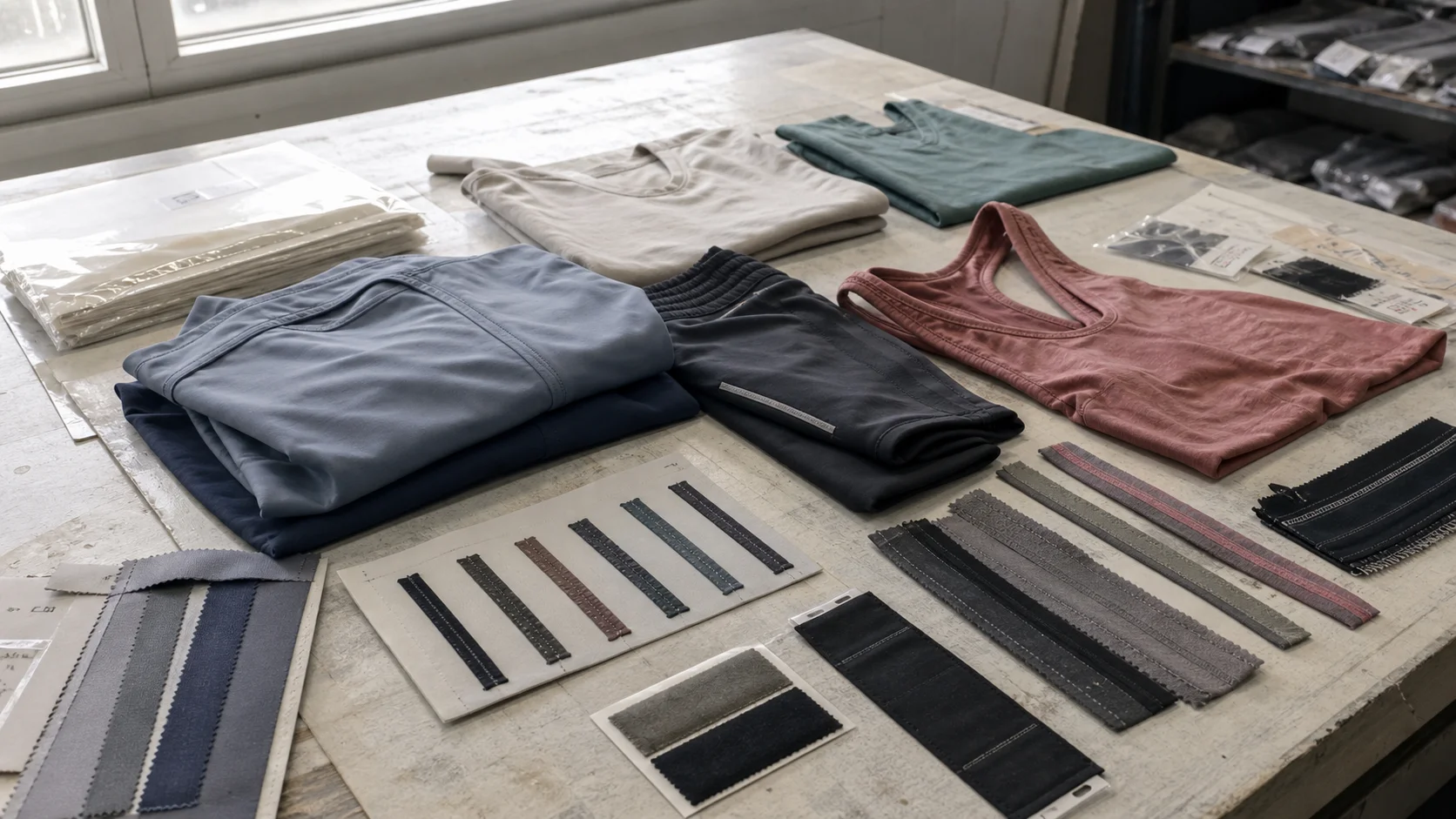
A practical SEO outline for gym program buyers evaluating contrast bartack placement, fabric testing, stitch durability, and decoration compatibility...
Contrast Bartack Map for Gym Program Buyers - Decoration & Printing manufacturing guide
Gym program buyers do not usually reject a garment because one bartack looks slightly brighter than expected. They reject it because a contrast bartack draws attention to weak sewing, poor placement, color bleeding, or inconsistent production control across a whole size run. In activewear, small construction details become visible fast because garments stretch, move, and sit close to the body.
This guide is written for buyers sourcing gym programs where contrast bartacks are part of the decoration and printing package. It explains how to build a contrast bartack map, how to test fabric and thread before bulk production, and what to inspect before shipment. The focus is practical: what to specify, what to approve, and where production commonly fails.
A contrast bartack map is a technical placement guide showing every bartack location, color, stitch length, density, and purpose on a garment. It is more than a sewing note. For gym program buyers, it works as a control document between design, merchandising, sampling, production, quality control, and inspection.
A bartack is a dense reinforcement stitch used at stress points. On gymwear, it is often placed at pocket openings, waistband joins, drawcord exits, side seam splits, gusset joins, zipper ends, label edges, and strap attachment points. When the bartack is made in a contrasting color, it becomes both a reinforcement feature and a visual detail.
That dual function creates risk. A tone-on-tone bartack can hide slight inconsistencies. A contrast bartack cannot. If placement drifts by a few millimeters or thread tension changes from operator to operator, the buyer can see it immediately. A contrast bartack map prevents vague production instructions such as “add red bartacks at stress points.” That type of note is not enough for bulk gym programs.
A useful contrast bartack map should include:
For broader apparel sourcing support, buyers can review the manufacturing and development services available through Fabrikn services. A bartack map becomes more effective when it is connected to the full tech pack, sample process, and quality checklist rather than treated as an isolated sewing instruction.
Contrast bartacks are popular in gym programs because they give a technical look without the cost of large embroidery, complex prints, or heavy hardware. They can highlight construction points and make a basic training short or hoodie feel more engineered.
Buyers typically use contrast bartacks for three reasons: reinforcement, branding, and assortment consistency.
Gymwear is pulled, stretched, washed often, and exposed to sweat. A bartack can strengthen openings and seam intersections that receive frequent tension. Examples include hand pocket corners on joggers, mesh panel joins on training shorts, zipper bases on gym jackets, and drawcord channels on waistbands.
Functional bartacks should not be treated as decoration only. If the garment relies on the bartack for strength, the construction must be tested after wash and stretch. A bright thread color is not valuable if the bartack cuts through the fabric or breaks during use.
A contrast bartack can create a recognizable program detail across multiple styles. For example, a buyer may use one color on all training bottoms, hoodies, and zip jackets to tie the range together. Compared with rubber patches, heat transfers, embroidery, or screen printing, bartacks are generally cheaper and faster to apply once machines are set correctly.
The tradeoff is visibility. A low-cost detail still needs strong control. Inconsistent bartacks make a program look careless, especially when placed near pockets, cuffs, or center-front areas.
Contrast bartacks can support a seasonal color story without changing base fabrics. Buyers sourcing black, navy, charcoal, and olive gymwear may use the same contrast thread as an accent. This can reduce fabric MOQ pressure while keeping the collection coordinated.
That strategy works best when the contrast thread is approved against every base fabric. A neon thread that looks clean on black may look cheap or too sharp on heather grey. A red thread may bleed or crock differently depending on dye chemistry and finishing.
The contrast bartack map should identify locations by garment category. Gym program buyers often source several styles at once, and each style has different stress points. Copying the same bartack placement from one garment to another is a common mistake.
Common bartack areas include side seam openings, pocket corners, waistband joins, drawcord eyelet edges, liner attachment points, and hem splits. On lightweight woven shorts, bartacks need careful density control. If the stitch is too dense, it may perforate the fabric and create tearing after repeated movement.
Joggers usually need bartacks at pocket openings, zipper ends, back pocket corners, waistband tunnel exits, crotch gusset intersections, and cuff joins. Fleece or French terry can handle heavier stitch density than fine jersey, but bulky seams may create uneven bartack formation.
Contrast bartacks may appear at kangaroo pocket corners, hood drawcord exits, rib panel joins, side seam vents, sleeve pocket corners, and zipper ends. On brushed fleece, loose fibers can reduce the clean appearance of a bright bartack. Buyers should review the finished look after garment wash or enzyme treatment if applicable.
These styles require more caution. Bartacks can reinforce straps, elastic joins, and keyhole openings, but dense stitching on stretch fabric can irritate skin or reduce elasticity. A contrast bartack on intimate activewear must be tested for comfort, stretch recovery, and abrasion.
Leggings often use coverstitch, flatlock, or bonded seams rather than visible bartacks. If contrast bartacks are used at pocket edges or waistband joins, placement should avoid high-rub zones. A bulky bartack at the hip pocket may cause discomfort during training or leave pressure marks.
Practical buyer rule: if a contrast bartack is functional, test it like construction. If it is decorative, inspect it like branding. If it is both, control it twice.
A gym program buyers contrast bartack map fabric testing guide should start before bulk fabric is cut. Contrast thread interacts with fabric, dye, stretch, finishing, and washing. Testing only the finished garment is late and expensive.
The following tests are commonly relevant for gymwear with contrast bartacks. Requirements vary by buyer, country, retail channel, and product type, so final standards should be set in the purchase order and quality manual.
Test Area Why It Matters Typical Risk With Contrast Bartacks Colorfastness to Washing Checks whether fabric and thread color changes after laundering. Contrast thread may fade faster than body fabric or stain light panels. Colorfastness to Perspiration Important for gymwear exposed to sweat. Bright threads may bleed onto adjacent fabric during use. Colorfastness to Rubbing/Crocking Checks dye transfer under dry and wet friction. Dark base fabrics can stain light contrast thread; bright thread can mark pale trims. Dimensional Stability Measures shrinkage after wash. Bartack placement may distort if fabric shrinks unevenly. Stretch and Recovery Critical for compression and performance fabrics. Dense bartacks can restrict stretch or cause fabric cracking. Seam Strength Assesses construction durability at stress points. Bartack may hold while surrounding fabric tears. Pilling and Abrasion Checks surface wear during training and washing. Raised bartacks can catch, fuzz, or look worn early. Needle Damage Assessment Evaluates whether sewing damages yarns. Fine knits may ladder or develop holes around dense stitching.The base fabric affects bartack performance. A 100% cotton French terry behaves differently from polyester-spandex interlock or nylon compression fabric. Buyers should state composition, weight, construction, finish, and stretch direction in the tech pack.
Common gymwear fabrics include:
Each fabric needs its own bartack trial. A buyer should not approve contrast bartacks on one black fleece hoodie and assume the same setup will work on a black nylon-spandex legging.
Thread testing is often overlooked because the fabric lab dips receive most attention. That is risky. Contrast thread may come from a different dye system than the fabric, and its behavior under sweat, heat, and wash may not match the base material.
At minimum, buyers should request sewn test swatches using actual bulk fabric, actual proposed thread, and actual bartack machine settings. The swatch should then be washed, rubbed, stretched, and reviewed under the same lighting conditions used for color approval.
For light-colored garments with dark contrast bartacks, staining risk is the main concern. For dark garments with bright bartacks, fading and visual inconsistency are more common concerns. Neon or fluorescent threads may have limited colorfastness compared with standard shades, so they need special caution.
The contrast bartack map must connect to a thread specification. A design file saying “electric blue bartack” is not a production spec. Buyers should define the color standard and allow a controlled tolerance.
A strong thread specification may include:
Polyester thread is common for gymwear because it offers good strength and colorfastness. Nylon thread may be used for certain stretch or performance applications, but it can behave differently with heat and dye. Cotton thread is less common for performance gymwear because it may shrink, weaken, or absorb moisture more than synthetic options.
Bartacks often sit near trims: zippers, drawcords, eyelets, elastic, labels, heat transfers, and pocket bags. The map should show these relationships. A contrast bartack placed too close to a zipper stop may become uneven because of seam bulk. A bartack near a rubber print may damage the print if stitched after decoration. A bartack over elastic can reduce stretch if density is too high.
For buyers developing full decoration and printing programs, the production order should define the operation sequence. Printing before sewing, sewing before heat transfer, garment dye after sewing, and garment wash after decoration all change the risk profile. If support is needed during development, buyers can contact the team through Fabrikn contact to discuss program requirements.
A good map is visual, measurable, and easy for the sewing floor to follow. It should not rely on long written descriptions only. The best format is usually a garment technical drawing with numbered callouts and a table listing specs for each bartack.
Callout Location Purpose Color Length Inspection Note BT-01 Left pocket opening top Functional reinforcement Contrast red 8 mm Must align with pocket edge, no fabric puckering. BT-02 Left pocket opening bottom Functional reinforcement Contrast red 8 mm Match BT-01 angle and density. BT-03 Back waistband center Decorative program detail Contrast red 6 mm Centered on seam; visible after waistband stretch. BT-04 Side seam vent Functional reinforcement Contrast red 10 mm No twisting; must not cross hem stitch unevenly.Every visible bartack should have a reference point. Examples include “5 mm from pocket edge,” “centered over seam intersection,” or “2 mm above zipper stop.” Avoid vague notes such as “near the pocket corner.” Production teams need repeatable measurements.
Placement must also consider size grading. On a size XS, a 10 mm bartack may look prominent. On a 3XL, it may look too small. Most buyers keep bartack dimensions consistent across sizes for production efficiency, but some highly visible decorative applications may need review across the size range.
Bartacks may be vertical, horizontal, diagonal, or parallel to a seam. The map should show orientation clearly. A diagonal bartack on one side and a vertical bartack on the other side looks like a defect, even if both are strong. Symmetry is especially important on front pockets and waistband areas.
Dense bartacks look solid and premium, but too much density can damage lightweight fabric. Lower density may be safer for delicate knits but can look weak or uneven in contrast color. Buyers should approve density by physical sample, not only by written spec.
The right setting depends on fabric, thread, machine, and purpose. For high-stress points, strength matters more than decoration. For decorative points, visual consistency matters more, but the bartack should still survive wear and wash.
Contrast bartacks should be approved through a staged sample process. Skipping stages may save a few days early but can create larger delays after bulk sewing begins.
The first sample checks the concept. At this stage, the buyer reviews whether contrast bartacks suit the style, whether the color supports the collection, and whether placement is visually balanced. Construction may not be final yet.
The fit sample confirms that bartacks do not interfere with garment movement or comfort. For activewear, the reviewer should assess stretch points, bending areas, pocket function, and skin contact. A bartack that looks fine on a flat table may feel uncomfortable during squats, running, or lifting.
The size set checks grading and placement across multiple sizes. Buyers should review whether bartacks remain proportional and properly aligned. This is important for gym programs with extended sizing, where pocket angles, waistband curves, and seam lengths change significantly.
The pre-production sample should use bulk fabric, bulk thread, approved trims, and intended production sewing settings. This is the key approval stage for the contrast bartack map. If the map changes after PP approval, the change should be documented and reapproved.
The top of production sample verifies that bulk output matches the approved PP sample. It is especially useful when multiple sewing lines or subcontracted units are involved. Contrast bartacks can vary by machine setup, operator handling, and line supervision.
Buyers should keep approved samples sealed, dated, and clearly labeled. One approved sample should remain with the factory, and one should remain with the buyer or nominated inspection team. Digital photos help, but they do not replace physical standards for color, stitch density, and hand feel.
Typical MOQ ranges depend on fabric sourcing, dyeing, trim availability, and factory capacity. Contrast bartacks alone rarely determine MOQ, but thread color and program complexity can affect planning.
General activewear MOQ ranges may look like this:
Program Type Typical MOQ Range Bartack Consideration Basic gym T-shirts or tanks 300-800 pieces per style/color Few bartacks; contrast stitching mostly decorative if used. Training shorts 500-1,000 pieces per style/color Pocket and vent bartacks require placement control. Joggers or hoodies 300-800 pieces per style/color More seam bulk; thread tension and consistency matter. Leggings or sports bras 500-1,200 pieces per style/color Stretch fabric testing is critical before approval. Multi-style gym program 1,000-5,000+ pieces total Shared contrast thread can improve consistency across the range.These ranges are not fixed. A supplier using stock fabric and available thread may accept a lower MOQ. Custom-dyed fabric, custom trims, private-label packaging, and special thread colors may raise the minimum. Buyers should ask whether MOQ is driven by fabric mill minimums, dye-lot size, cutting efficiency, or sewing line setup.
A contrast bartack program can be efficient if the same thread color is used across several styles. It becomes less efficient when each style has a different accent color, different bartack size, and different placement rule. That increases setup time and inspection risk.
Lead time for gymwear with contrast bartacks depends on more than sewing time. Buyers should consider fabric booking, lab dips, thread sourcing, sample rounds, print or decoration schedule, trim delivery, testing, and final inspection.
Typical development and production timing may include:
A realistic gym program timeline often runs 6-12 weeks after final approval, with longer timing for custom fabric, special trims, or multiple sample rounds. Buyers trying to compress the timeline should protect the PP approval and testing stages. Cutting those steps increases the chance of bulk defects.
Since this topic sits in the Decoration & Printing category, operation sequence deserves attention. Contrast bartacks may interact with screen prints, heat transfers, reflective details, silicone logos, embroidery, and wash treatments.
If a print crosses a seam or sits near a bartack, the factory must decide whether to print panels before sewing or print garments after assembly. If bartacks are sewn through a printed area, needle holes and thread tension may damage the design. If printing happens after bartacking, raised stitches may affect print pressure and surface smoothness.
Reflective prints and silicone transfers are especially sensitive to heat and pressure. Buyers should ask for a strike-off or placement trial when bartacks sit within the same visual zone as decoration. The artwork file, sewing map, and production route should agree before bulk starts.
Contrast bartacks create easy-to-see defects. That is useful for inspection, but it also means consumers will notice problems quickly. Buyers should define acceptable and unacceptable conditions before the final AQL inspection.
Defect classification should match the garment function and buyer standard. A missing bartack at a pocket corner may be a major defect because it affects durability. A slight shade variation on an inside bartack may be minor if not visible during wear. A wrong bright contrast color on the front waistband may be major because it changes the approved design.
Critical defects are less common but possible. For example, a bartack with sharp broken needle fragments, severe fabric cutting, or skin-irritating roughness on compression wear should not pass.
Inspectors should compare bulk garments against the approved PP sample and bartack map. They should check a balanced mix of sizes and colors. If the program includes several factories or production lines, samples from each line should be reviewed.
Useful inspection steps include:
The inspection checklist should be simple enough for consistent use. A complicated map with unclear tolerances can cause arguments at final inspection. Buyers should specify the most important callouts and tolerances early.
Contrast bartacks are useful, but they are not always the best choice. Buyers should decide whether they add value to the program or create unnecessary production risk.
If the goal is strong branding, a contrast bartack may be too subtle. Heat transfers, woven labels, silicone patches, embroidery, reflective prints, or screen prints may communicate the brand more clearly. Each option has its own testing needs. Heat transfers need adhesion and wash testing. Embroidery needs puckering control. Reflective prints need abrasion and reflectivity checks.
The best decision depends on the garment’s price point, use case, sales channel, and return risk. A budget gym short may benefit from two clean contrast bartacks at the pocket openings. A premium compression legging may look better with minimal stitching and a carefully tested reflective logo.
Buyers evaluating supplier capability should also consider company background, sourcing structure, and communication process. For general information, visit Fabrikn about us.
A buyer-ready tech pack should not leave bartacks open to interpretation. The following checklist is a practical minimum for gym programs:
Revision control matters. If a buyer changes from navy contrast thread to orange after the fit sample, the change must be reflected in the map, bill of materials, sample comments, and purchase order. Small mismatches between documents are a common reason bulk production goes wrong.
A contrast bartack is a small feature with large visibility. In gymwear, it sits at the intersection of construction, decoration, fabric performance, and quality control. Buyers should treat it as a planned design and engineering detail, not as an afterthought added during sewing.
The safest route is straightforward: approve real sewn swatches, test the actual fabric and thread combination, map every visible bartack, and lock the PP sample before bulk. Keep the number of accent colors controlled. Use contrast only where it improves the garment. Choose tone-on-tone where the risk outweighs the visual benefit.
For gym program buyers, a reliable contrast bartack map reduces confusion, protects durability, and makes inspection more objective. It also helps suppliers price and plan more accurately. That is where better buying decisions begin: clear specifications, realistic tolerances, and careful approval before production pressure takes over.
Get a free quote from Fabrikn — your trusted B2B clothing manufacturer with 10+ years of experience. MOQ as low as 200 pieces.
Get a Free Quote →A contrast bartack map is a technical guide showing each bartack location, color, size, density, and purpose on a garment. It helps buyers and factories control visible reinforcement stitching during sampling, bulk sewing, and inspection.
Gymwear faces stretch, sweat, washing, and repeated movement. Contrast bartacks can reinforce stress points and add a technical visual detail, but they also make sewing inconsistencies more visible. Buyers need clear specs to avoid bulk quality issues.
Key tests include colorfastness to washing, perspiration, rubbing, dimensional stability, stretch and recovery, seam strength, abrasion, and needle damage assessment. The exact test plan should match the fabric type and buyer standard.
Yes, but with caution. Dense stitching can reduce stretch, irritate skin, or damage fine performance fabrics. Buyers should test comfort, stretch recovery, and fabric damage before approving visible bartacks on compression garments.
Typical MOQs often range from 300 to 1,200 pieces per style/color, depending on fabric, trims, customization, and supplier setup. Contrast bartacks alone rarely drive MOQ, but special thread colors or multiple accent variations can affect efficiency.
After final approvals, many gymwear programs take around 6-12 weeks, depending on fabric sourcing, sample rounds, testing, decoration, trims, and order quantity. Custom fabric or special color development can extend the timeline.
Inspectors should check wrong color, missing bartacks, incorrect placement, uneven density, loose threads, puckering, needle damage, asymmetry, staining, and thread breakage after stretch. Functional bartacks at stress points should receive special attention.
Often, yes. Once sewing settings are established, contrast bartacks can be a cost-effective accent. The limitation is branding impact. A bartack is subtle compared with a logo print, patch, or embroidery, so it should be used where a small technical detail is enough.
Using one accent thread across several styles can improve consistency and reduce setup complexity. Buyers still need to test the thread against every base fabric color because colorfastness, visibility, and shade perception can change by material.
Buyers should approve the bartack map, bulk fabric, thread color, trim interaction, decoration sequence, sewn swatches, fit sample, size set if required, and pre-production sample. Bulk should not start until the PP sample matches the final specification.