
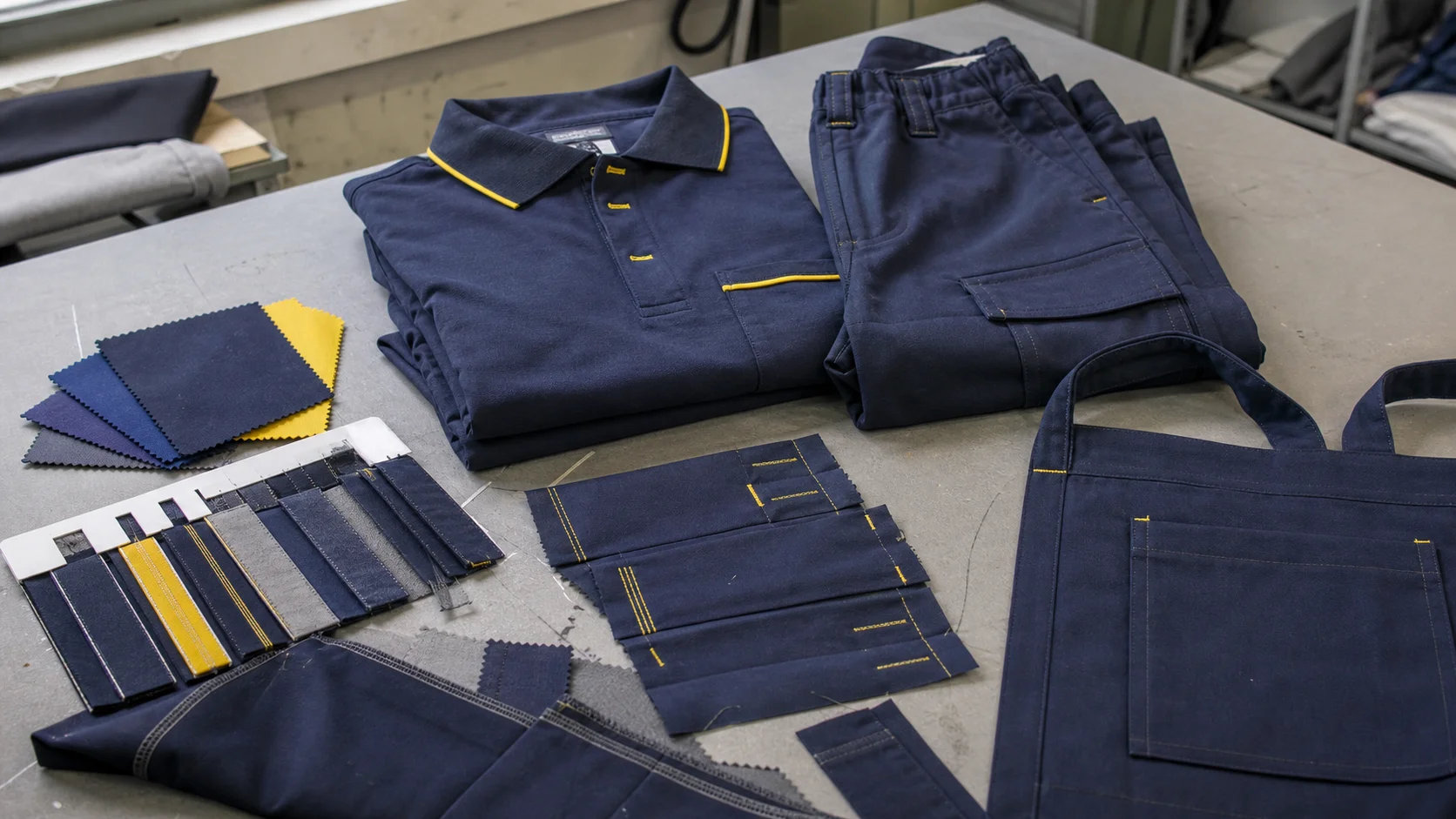
A 2500-word SEO outline for buyers reviewing contrast bartack maps, seam strength specs, and order approvals for cleaning crew uniforms that need visible...
Contrast Bartack Map Review for Cleaning Crew Orders - Fabrikn production reference
Contrast bartacks look like a small decoration decision, but for cleaning crew uniforms they are more than a color accent. A bartack map tells the factory exactly where reinforced stitches must go, what color thread should be used, how dense the reinforcement should be, and which stress points need extra holding power. For cleaning crews, those stress points are not theoretical. Pockets carry keys, cloths, gloves, pens, radios, and sometimes chemical-resistant accessories. Side seams are pulled during bending. Waistbands are stressed by repeated squatting. Sleeve openings and plackets are handled dozens of times per shift.
This review explains how buyers should evaluate a contrast bartack map order for cleaning crew apparel, with a focus on seam strength, production control, fabric and trim specifications, sample approval, inspection risks, and commercial tradeoffs. It is written for sourcing teams, uniform distributors, facility service brands, and procurement managers who need durable workwear without turning a basic uniform order into an over-engineered garment.
A contrast bartack map is a technical placement guide for short, dense reinforcement stitches made in a thread color that visibly contrasts with the garment body. The map usually appears in the tech pack, production worksheet, or artwork placement file. It should show the bartack position, length, thread color, stitch density, sewing direction, and the exact garment points that need reinforcement.
In basic terms, a bartack is a compact group of zigzag or lock stitches used to secure high-stress areas. It is common on pocket corners, belt loops, fly openings, sleeve plackets, side vents, and zipper ends. A contrast bartack uses a thread color that stands out, such as white bartacks on navy trousers, orange bartacks on charcoal jackets, or blue bartacks on grey tunics.
For cleaning crew orders, the map matters because the uniform is washed frequently, exposed to movement, and often worn for long shifts. A decorative bartack may look sharp during sampling, but if the placement is wrong or the stitch density is too light, it will not improve durability. A correct map combines branding visibility with mechanical reinforcement.
Good contrast bartacks should be easy to see, hard to pull loose, and positioned only where they help the garment or the brand identity. Too many visible bartacks can make a uniform look busy and add production risk without adding real strength.
Cleaning crew apparel is often purchased as a practical uniform: polos, work shirts, tunics, aprons, trousers, cargo pants, utility vests, and light jackets. The buying focus is usually color consistency, logo placement, wash performance, and cost. Seam reinforcement is sometimes treated as a factory default. That is a mistake when the garment is used daily in facilities, hospitality, healthcare, schools, transportation hubs, and commercial offices.
Cleaning staff move differently from office wearers. They reach overhead, kneel, bend, carry supplies, push carts, and use pockets repeatedly. A standard stitch construction may be acceptable for a casual garment, yet it can fail earlier under uniform service conditions. Bartacks help control failure at predictable stress points.
The main benefit of a bartack map is repeatability. Without a map, one production line may reinforce two pocket corners while another reinforces four. One operator may sew long bartacks; another may sew short ones. One batch may use body-color thread and the next may use contrast thread because the purchase order wording was vague. A map reduces interpretation.
Contrast bartacks add another layer of control because they are visible. This can help inspection teams quickly verify reinforcement placement. It also means mistakes are visible to the wearer and buyer. A crooked tone-on-tone bartack may go unnoticed. A crooked red bartack on a black apron will be obvious.
Contrast bartacks sit between construction and decoration. They are sewn reinforcements, but they also create a visual detail. For this reason, they belong in the Decoration & Printing discussion whenever a buyer is planning logo embroidery, heat transfer labels, screen printing, reflective trims, piping, color blocking, or other visible brand elements.
A cleaning service company may use contrast bartacks to match its logo color. A facility management provider may use them to differentiate departments. A hospitality cleaning team may choose subtle contrast for a premium look. In each case, the bartack is part of the garment’s appearance, not only its structure.
Buyers working with garment customization should treat bartacks like any other visible decoration component. They need a color standard, approved placement, tolerance rules, and production confirmation. If the order also includes embroidery or printing, the bartack thread should be reviewed together with the decoration palette. A close but mismatched thread color can cheapen the overall presentation.
For buyers comparing customization options, it is useful to review broader production capabilities before locking the bartack plan. Fabrikn’s apparel manufacturing services page is a suitable internal reference point for understanding how garment construction, decoration, and order execution connect in a sourcing program.
The best bartack map starts with garment use, not decoration preference. Cleaning crew uniforms should be reinforced where repeated pulling, loading, or opening occurs. Too few bartacks can leave weak points exposed. Too many can increase cost, slow production, and create puckering on lighter fabrics.
For a standard cleaning crew shirt with one chest pocket, a practical map may include two bartacks at the pocket corners and two at the side vents. For trousers, a typical map may include pocket openings, belt loops, fly base, and back pocket corners. Utility-heavy trousers may need more reinforcement, especially if workers carry keys, cards, radios, or small tools.
Placement must match the seam allowance and garment construction. A bartack that sits too close to the fabric edge may rip through the fabric. A bartack that is too far from the stress point may look decorative but fail to reinforce the seam. The map should use measurements from fixed garment points such as pocket edge, seam line, opening edge, or waistband seam.
Seam strength is not created by bartacks alone. The full system matters: fabric weight, yarn strength, seam type, stitch type, thread quality, stitch density, seam allowance, and operator control. Bartacks are local reinforcement. They help where force is concentrated, but they cannot compensate for weak base fabric or poor seam construction across the entire garment.
A buyer reviewing seam strength should separate three questions. First, is the base seam suitable for the garment use? Second, are the stress points correctly reinforced? Third, will the reinforcement survive laundering and daily movement?
For woven shirts, tunics, and aprons, common seam constructions include lockstitch seams, overlocked edges, flat-felled seams, and double-needle topstitched seams. For trousers and utility bottoms, higher-stress seams may require double-needle stitching or reinforced seams in the seat and inner leg. For knit polos or stretch tops, bartacks must be used carefully because dense stitching can distort flexible fabric.
Cleaning crew garments usually do not need heavy industrial construction unless the workers carry tools or work in demanding maintenance environments. A balanced specification is better: durable enough for frequent use, not so heavy that the garment feels stiff or costs too much.
Typical bartack length may range from 6 mm to 14 mm depending on garment type and location. Pocket corners on shirts may use shorter bartacks, while belt loops and cargo pocket points may need longer reinforcement. Stitch density should be firm but not excessive. Overly dense bartacks can cut into light fabric, create hard knots, or cause puckering.
For light woven shirts, a shorter and cleaner bartack is often better than a bulky one. For trousers, aprons, and utility vests, stronger bartacks with heavier thread may be justified. The specification should not copy denim reinforcement blindly unless the cleaning crew uniform is actually built like workwear.
Thread selection is a major part of seam strength. Polyester thread is widely used for uniforms because it generally performs well under repeated washing and offers good strength. Cotton thread is less common for cleaning crew uniforms because it may not hold up as well under frequent laundering. Nylon thread can be strong but may not always be preferred for heat exposure, pressing, or certain washing conditions.
Thread ticket size should match fabric weight. A heavy contrast thread on a lightweight poplin can look rough and cause puckering. A fine thread on a heavy twill may look weak and may not deliver enough reinforcement. The sample stage should confirm both appearance and pull resistance.
Garment Area Common Risk Practical Bartack Approach Buyer’s Review Point Chest pocket corners Pocket tearing from pens, cloths, or cards Short contrast bartacks at both top corners Check symmetry and avoid puckering Side vents Opening stress during bending and reaching Bartack across vent top at both sides Confirm bartack does not distort hem Belt loops Loop detachment during pulling Dense bartack at top and bottom of each loop Review strength and thread consistency Cargo pockets Loaded pockets pulling away Longer bartacks at pocket top corners and flap ends Check reinforcement after washing sample Apron ties Tie attachment tearing Bartack or box reinforcement depending on fabric weight Pull test attachment pointsContrast bartacks should be planned alongside fabric and trims. A bartack map that works on 240 gsm twill may not work on 150 gsm poplin. A bright contrast thread may look clean on a solid woven garment but uneven on a heather knit. The supplier needs a complete specification, not just a photo with arrows.
Fabric weight should be specified in gsm or oz/yd², and fiber content should be confirmed before sampling. Cleaning crew uniforms often fall in a middle range: light enough for indoor work, strong enough for repeated washing. For shirts, buyers commonly evaluate fabrics from roughly 120 gsm to 180 gsm. For trousers and aprons, typical ranges may sit around 200 gsm to 280 gsm, depending on comfort and durability requirements.
The purchase specification should list thread fiber, color reference, approximate ticket size, and acceptable substitute rules. If the order uses buttons, zippers, snaps, reflective tape, woven labels, or printed branding, those trims should be reviewed with the bartack color. A bright bartack thread that matches the logo may clash with reflective tape or zipper tape if the palette is not coordinated.
For contrast bartacks, a clear thread color standard is important. Use Pantone, brand color references, approved lab dips, or physical thread cards when possible. Screen colors are not reliable enough for production approval. Factories and trim suppliers may interpret “royal blue” or “safety orange” differently.
Contrast bartacks can make a uniform look designed rather than generic. They can also make a low-cost garment look inconsistent if the color is too bright, the placement is uneven, or the thread shade varies between batches. The purchasing decision should balance brand value against production control.
High-contrast thread is useful when the buyer wants visible reinforcement and a recognizable uniform detail. Examples include white on navy, red on black, lime on charcoal, or orange on dark grey. Mid-contrast thread is safer for large cleaning crews because it adds detail without highlighting every minor sewing variation. Tone-on-tone reinforcement is usually the lowest-risk option, but it does not deliver the same visual branding effect.
Cleaning crew uniforms are often worn by large teams across multiple sites. A contrast feature that looks attractive on a showroom sample can look too loud when multiplied across hundreds of workers. If the uniform already includes a logo, reflective tape, piping, color-block panels, or printed back branding, the bartack color should support the design rather than compete with it.
The safest buying path is to approve the bartack thread together with the main decoration package. If embroidery, printing, and bartacks are all reviewed separately, small shade differences can accumulate. Buyers can contact a manufacturing partner early through a page such as Fabrikn’s contact page to clarify whether the decoration and sewing teams can align thread and artwork standards before sampling.
Contrast bartacks should never be left for bulk production without a physical sample review. The sample process does not need to be complicated, but it should be disciplined. The buyer should approve appearance, position, stitch quality, and seam strength before cutting bulk fabric.
The pre-production sample is the key stage. It should use actual bulk fabric or approved production-equivalent fabric, actual thread, and final trims. If the bartack color is changed after pre-production approval, the buyer should request a new confirmation photo or physical swatch before bulk sewing.
For cleaning crew orders, wash testing is especially important. A bartack may look flat before washing but pucker after laundering. Contrast thread may bleed, fade, or become more prominent after the fabric shrinks. If the uniform will be industrially laundered, the buyer should communicate that early. Domestic wash assumptions are not always enough.
A simple table inside the tech pack can reduce confusion. Photos alone are not ideal because scale and exact positioning can be misread. Diagrams with measurements are more reliable, especially for repeat orders.
Minimum order quantity depends on garment type, fabric availability, trim sourcing, customization level, and factory setup. Contrast bartacks alone usually do not create a high MOQ, but they can affect efficiency if thread colors change often or if the map requires many reinforcement points.
For basic cleaning crew shirts or polos using available fabric, typical MOQ may start around 100 to 300 pieces per style and color in some sourcing programs. For custom woven shirts, trousers, aprons, or utility garments with specific fabric dyeing or custom trims, MOQ may more commonly sit around 300 to 1,000 pieces per style and color. Highly customized programs with special fabric, branded trims, multiple decoration processes, or strict color matching may require higher quantities.
These ranges are not guarantees. Buyers should confirm MOQ based on current material availability and production line capacity. A supplier may accept a smaller trial order with a higher unit price, or require a larger MOQ if the thread, fabric, or trim must be specially sourced.
For planning purposes, simple repeat orders may move faster once the sealed sample and bartack map are already approved. New custom orders often require several weeks for development and approval before bulk production begins. Bulk production timing then depends on order volume, material readiness, and factory capacity. Buyers should avoid promising delivery dates to end customers until the pre-production sample, materials, and production slot are confirmed.
Order Type Typical MOQ Range Lead-Time Sensitivity Purchasing Note Stock fabric polo with limited bartacks 100-300 pieces Low to medium Good for trial programs if decoration is simple Custom woven shirt or tunic 300-800 pieces Medium Needs clearer seam and bartack approval Utility trouser or cargo pant 500-1,000 pieces Medium to high Reinforcement map should be detailed Full cleaning crew uniform set Varies by style High Coordinate thread shade across garments Custom-dyed fabric with branded trims Often higher High Allow time for lab dips and trim approvalContrast bartacks are easy to inspect because they are visible, but that also makes defects harder to hide. A good inspection checklist should cover placement, color, stitch quality, seam strength, symmetry, and finishing. The inspection team should compare bulk goods against the sealed sample and the bartack map, not against memory or loose comments in email.
Inspection should include both visual review and practical stress checks. For example, pocket corners can be gently pulled to confirm reinforcement. Belt loops should be checked for secure attachment. Apron ties should be pulled because they are common failure points. The inspection should not use destructive force on every garment, but a reasonable sample check is useful.
Buyers should define acceptable quality limits before production where possible. If the order is small, the buyer may inspect a higher percentage. If the order is large, a standard sampling plan can be used. Contrast bartack defects may need stricter handling than hidden construction defects because they are visible and directly tied to the approved appearance.
Contrast bartacks add value when they improve durability, support brand identity, or help inspection. They add cost when they increase sewing time, require thread changes, complicate operator training, or cause rework. The right choice depends on the uniform program.
For a budget cleaning crew order where price is the main driver, use bartacks only at true stress points. Tone-on-tone thread may be more forgiving and efficient. For a branded cleaning service competing on presentation, contrast bartacks can justify their cost by making the uniform look intentional. For high-turnover roles, durability matters, but over-customization may make replenishment harder if staff sizes change frequently.
The best purchasing judgment is to separate functional bartacks from decorative bartacks. Functional bartacks are required to protect the garment. Decorative bartacks are optional and should be limited. A buyer can specify contrast thread only on visible pocket and vent points while keeping hidden reinforcements tone-on-tone. This gives a branded look without making every stress point visually loud.
Contrast bartacks are not a substitute for good garment engineering. They are a finishing and reinforcement tool. If the base seam is weak, the fabric is unsuitable, or the fit restricts movement, bartacks will only delay failure at selected points. A proper sourcing review should look at the complete garment.
Buyers can also evaluate supplier transparency. A supplier that can explain stitch density, thread choice, tolerance, and inspection method is usually better prepared than one that treats bartacks as decoration only. A sourcing partner’s background and operating model can matter, so reviewing company information on pages such as Fabrikn’s about page may help buyers understand whether the supplier is positioned for custom uniform development rather than only basic blank apparel.
A well-written purchase package reduces rework. Cleaning crew orders often move through several hands: buyer, merchandiser, pattern maker, sample room, production line, quality team, and logistics team. Each person needs the same instruction.
The checklist should be attached to the purchase order or tech pack, not scattered across messages. If changes are made after sampling, the revision date should be updated. Version control is not glamorous, but it prevents expensive arguments when bulk goods arrive with an older bartack layout.
Consider a cleaning crew program that includes a short-sleeve woven shirt, an apron, and a utility trouser. The brand color is blue, and the buyer wants blue contrast bartacks on dark grey garments. The idea is commercially reasonable, but it needs control.
For the shirt, contrast bartacks at the chest pocket corners and side vents may be enough. Adding them to every placket point could make the shirt look cluttered. For the apron, the neck strap and waist ties need strong reinforcement, but a box stitch may be better than a simple bartack depending on fabric weight and strap construction. For the trouser, pocket openings, belt loops, back pocket corners, and fly base are the main stress points. Cargo pocket reinforcement should be added only if the style includes cargo pockets.
The buyer should request one pre-production sample for each garment type using final fabric and final contrast thread. The inspection team should receive the bartack map and sealed sample. If the sample shows puckering on the shirt but looks clean on the trouser, the buyer may approve contrast bartacks for the trouser and apron while switching the shirt to a subtler thread or lower density. This is better than forcing one decorative decision across all garments.
For cleaning crew orders, a contrast bartack map is worth specifying when the uniform has visible stress points and the buyer wants a more intentional branded finish. It is especially useful on utility trousers, aprons, cargo pockets, side vents, and pocket corners. It is less useful when the fabric is very light, the order is extremely price-driven, or the supplier cannot control thread color and placement.
The strongest approach is practical: define the map, approve the thread, test the sample, review washed appearance, and inspect bulk production against a sealed standard. Use contrast bartacks where they earn their place. Keep the rest of the garment clean, durable, and easy to replenish.
A good cleaning crew uniform does not need excessive decoration. It needs the right decoration in the right places, supported by seam strength that survives real work.
Get a free quote from Fabrikn — your trusted B2B clothing manufacturer with 10+ years of experience. MOQ as low as 200 pieces.
Get a Free Quote →A contrast bartack map is a technical guide showing where visible reinforcement stitches should be placed on a garment. It usually includes placement points, thread color, bartack length, and construction notes.
They can be both. Bartacks reinforce stress points, while contrast thread adds a visible design detail. For cleaning crew uniforms, the functional purpose should come first.
Common positions include pocket corners, side vents, belt loops, cargo pockets, apron ties, sleeve plackets, zipper ends, and fly bases. Placement should match actual stress points, not just visual preference.
Simple stock-fabric orders may start around 100 to 300 pieces per style and color in some programs. Custom garments often range from about 300 to 1,000 pieces or more, depending on fabric, trims, and decoration requirements.
Yes, they can increase cost through extra sewing time, thread changes, quality control, and possible rework. The cost is usually easier to justify when bartacks improve both durability and brand presentation.
Polyester thread is commonly used because it offers good strength and wash performance. The thread size should match the fabric weight to avoid puckering, weak reinforcement, or a bulky appearance.
Yes. Buyers should approve a pre-production sample and ideally review washed samples. Testing helps catch puckering, color change, weak stitching, and placement problems before bulk sewing.
They can, but they should be used carefully. Knit fabrics may distort under dense bartack stitching, so placement, thread size, and machine tension need closer review.
The main risks are missing bartacks, wrong thread color, crooked placement, loose stitches, puckering, needle damage, and inconsistent symmetry. Contrast thread makes these issues more visible.
No. A balanced approach is often better. Use contrast thread on visible brand-relevant points and tone-on-tone reinforcement where visibility is unnecessary or where defects would be too noticeable.