
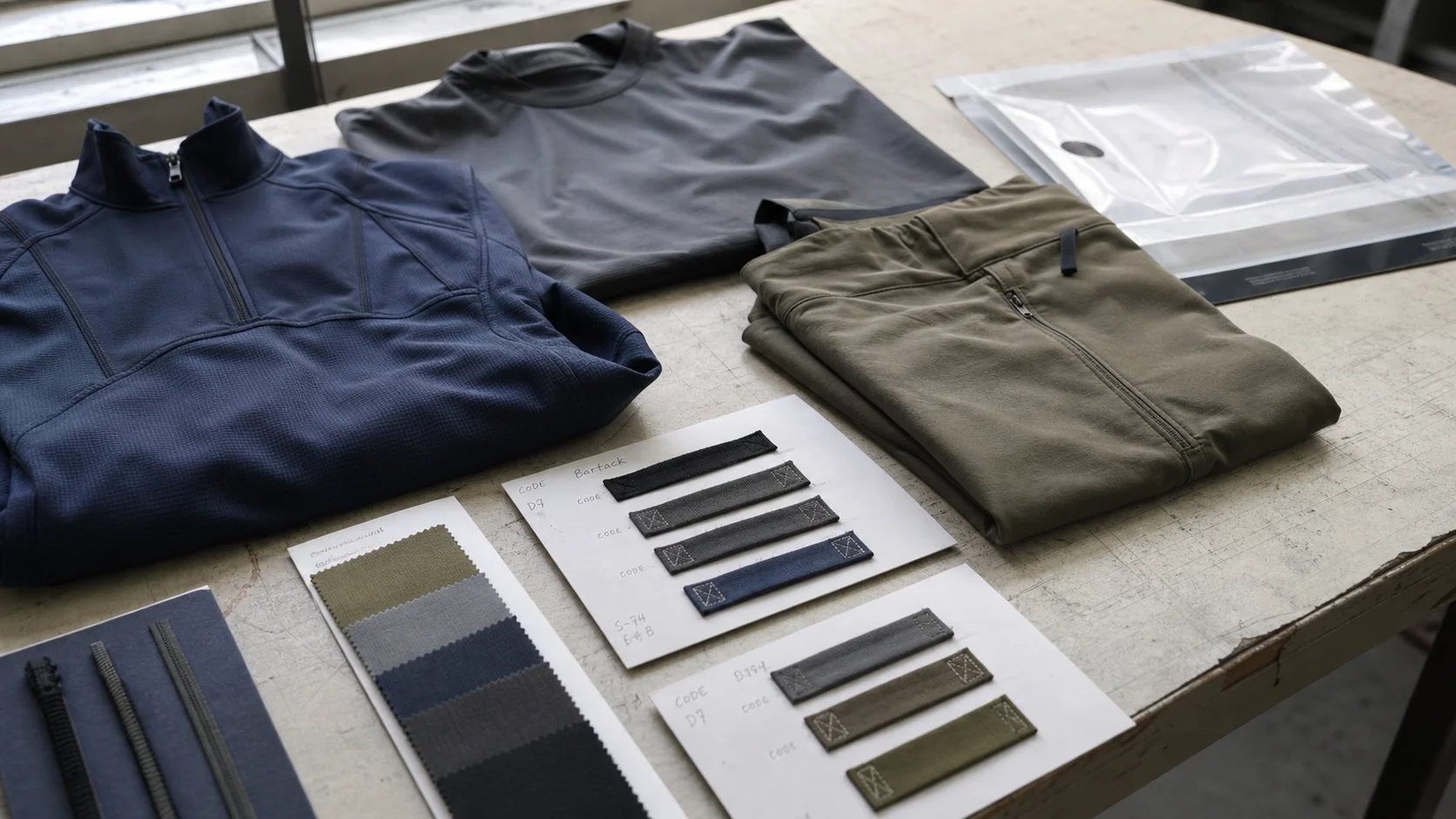
A production-focused review of contrast bartack maps for security contractor uniforms, covering seam-strength evidence, placement logic, inspection...
Contrast Bartack Map Review for Security Contractors - Fabrikn production reference
Security contractors buy uniforms for hard use, not just for presentation. Trousers, tactical shirts, duty jackets, carrier-compatible vests, and outerwear are repeatedly stressed by long shifts, kneeling, vehicle entry, radio movement, belt load, pocket use, and laundering. A contrast bartack map gives buyers a practical way to review where reinforcement is placed, whether the placement is consistent, and whether a manufacturer understands seam strength beyond a decorative stitch.
In the Decoration & Printing category, contrast bartacks sit in an unusual position. They are visible like a design detail, yet they perform like a construction feature. A red, yellow, black, gray, or reflective-look bartack may help identify reinforced stress zones, support brand color coding, and give a technical appearance. It should not be treated as decoration alone. If the thread, stitch density, location, and backing construction are wrong, the visible bartack becomes a weak point or a quality complaint.
This review looks at how security contractors and procurement teams should assess a contrast bartack map manufacturer for seam strength, production consistency, sample approval, and inspection risk. It is written for buyers sourcing contract uniforms, patrol apparel, event security garments, private protection team apparel, logistics security uniforms, and facility guard uniforms where durability and repeat order consistency matter.
A contrast bartack is only valuable when it reinforces the correct stress point. A bright stitch in the wrong position is decoration; a controlled stitch over the right seam intersection is manufacturing discipline.
Security contractor uniforms are often used in mixed conditions. A guard may spend part of the shift standing in a lobby, part of it outdoors, and part of it moving through vehicles, stairways, gates, or crowded venues. The garment has to look controlled while absorbing repeated movement. That combination creates a sourcing challenge: the uniform must be presentable, cost-controlled, and stronger than ordinary corporate apparel.
Contrast bartacks help buyers and wearers see where reinforcement has been added. This is useful on cargo pocket corners, belt loop ends, side pocket openings, fly base points, cuff vents, placket ends, shoulder tabs, radio loops, epaulets, tool pockets, and stress zones around hybrid tactical panels. For security contractors, the function is not only seam strength. It is also repeatability. A visual bartack map makes it easier to check production against an approved sample.
Uniform programs with multiple job roles can also use contrast bartacks as a subtle design language. Supervisors may have one color accent, general guards another, and event staff another. That approach can work, but it needs discipline. Too much contrast can make the uniform look promotional rather than professional. A restrained map, with reinforcement only where needed, usually gives the best result.
The tradeoff is that contrast bartacks expose mistakes. A tone-on-tone bartack can hide small placement variations. A bright contrast bartack cannot. If a manufacturer does not have good operators, machine setup, and line quality control, the style may look inconsistent across sizes or production batches.
A contrast bartack map is a technical layout showing each bartack position, thread color, stitch specification, length, width, and purpose. It should be part of the tech pack rather than a loose note on a design sheet. For security contractor apparel, the map should connect reinforcement points to actual use conditions.
For example, a cargo trouser may need bartacks at the top and bottom corners of cargo pockets, side pocket openings, fly base, belt loops, back pocket corners, knee panel edges, and hem vent openings. A tactical polo or woven shirt may need bartacks at side vents, shoulder epaulets, pen pockets, microphone loops, sleeve tabs, and placket base. A jacket may need them at pocket openings, zipper garage ends, adjustable cuff tabs, storm flap ends, and hanger loop anchors.
A weak map causes production arguments. The factory may interpret “contrast bartack at pockets” differently from the buyer. One operator may place the tack vertically; another may place it horizontally. One line may use shorter tacks to save time; another may use a denser tack that cuts into the fabric. These issues are avoidable when the map is measurable.
Map Element Recommended Detail Buyer Risk if Missing Location Numbered garment diagram with distance from seam or edge Misplaced reinforcement and inconsistent bulk production Thread Fiber type, ticket size, color standard, and finish Color mismatch, weak thread, or poor abrasion performance Stitch Program Length, width, stitch count, and machine setting Loose bartacks, fabric cutting, or uneven appearance Layering Fabric layers, seam allowance, reinforcement tape, or facing Strong stitch on a weak base fabric Inspection Tolerance Acceptable position variance and defect criteria Disputes during final inspectionA manufacturer seam strength review should start with equipment and continue into process control. Bartacking is not rare machinery, but consistent bartacking on workwear-grade products needs the right machines, operators, needles, thread tension, and quality checks. A basic apparel factory may produce acceptable casual shirts yet struggle with dense bartacks on heavier twill, ripstop, softshell, or multi-layer pocket assemblies.
Security contractors should ask whether the manufacturer uses programmable bartack machines, what range of bartack sizes they can produce, and whether machine settings are controlled by style. For larger uniform programs, the buyer should request a production-ready bartack chart with the approved program reference. This reduces the risk that a sample-room operator makes a good prototype while bulk production uses a different setting.
Needle selection matters. A needle that is too large can damage lighter fabric. A needle that is too small may deflect or break on heavy seam intersections. Thread tension also affects both appearance and strength. Over-tight tension can pucker the base fabric or cut into synthetic blends. Loose tension can create loops, snagging, and poor abrasion resistance.
The best purchasing decision is not always the lowest unit price. A supplier that quotes slightly higher but controls bartack settings, thread shade, and inspection standards may reduce after-delivery complaints. For contractor uniforms, replacement costs and field dissatisfaction can easily outweigh small savings on production.
Buyers building a new uniform program can review development options through a full-service manufacturing partner. A practical starting point is the service overview at fabrikn.com/services/, especially when garment development, decoration, and production planning need to be aligned before sampling.
Seam strength is affected by more than the bartack itself. Fabric strength, seam type, stitch type, thread quality, seam allowance, pocket construction, and finishing all contribute. A bartack can prevent a seam from opening, but it can also create a concentrated stress point if placed badly. For security apparel, the goal is not maximum stitch density at all costs. The goal is balanced reinforcement that supports the fabric and seam construction.
Buyers commonly request seam strength testing, seam slippage testing, or pull testing depending on garment type and fabric. Exact test standards depend on the market, buyer requirement, and laboratory arrangement. For practical sourcing, the buyer should define the stress points most likely to fail and ask the manufacturer to test those constructions on actual production fabric.
For security trousers, belt loops deserve special attention. Many wearers carry equipment belts, radio clips, keys, or small tools. Uniform trousers are not a substitute for certified load-bearing gear, but belt loops still receive more stress than casual pants. Bartacks at both loop ends are usually expected. The factory should confirm the loop fabric, fold construction, seam allowance, and bartack dimensions.
Pocket corners are another frequent failure point. A cargo pocket used for gloves, notebook, flashlight, or phone will see repeated pulling. If the pocket bag or outer pocket is made from weak fabric, the bartack may hold while the surrounding fabric tears. This is why reviewing the full construction is more useful than asking for “strong bartacks” as a generic requirement.
Garment Area Typical Bartack Purpose Inspection Concern Purchasing Judgment Belt Loops Secure loop ends against repeated pulling Short tack, loose thread, poor penetration through layers Do not reduce reinforcement here to save cost Cargo Pocket Corners Prevent corner seam opening Misaligned tack or fabric tearing beside tack Check pocket fabric strength as well as stitch strength Side Vents Stop vent seam from splitting Puckering on lightweight shirting Use moderate density and correct backing Radio Loop Anchor loop for repeated clipping Loop distortion or weak base panel Test with realistic pulling, not visual review only Placket Base Prevent opening under movement Skipped stitches and poor alignment Useful on shirts and polos with active wear requirementsThe contrast bartack map cannot be separated from the fabric and trim package. A heavy bonded polyester thread may be suitable for tactical trousers but too bulky for a lightweight woven shirt. A high-density bartack may work on cotton-rich twill but cut into some lightweight synthetics. A decorative color may look sharp on a sample yet bleed, fade, or appear inconsistent after industrial laundering if thread quality is not controlled.
Security contractor uniforms often use polyester-cotton twill, mechanical stretch twill, ripstop, softshell, polyester pique, woven poplin, or Oxford-type shirting. Each behaves differently under bartack stress. Twill can usually accept a firm bartack if the fabric weight is adequate. Stretch fabrics need more caution because rigid reinforcement can restrict movement and create stress beside the tack. Ripstop can be durable, but the grid structure may show puckering if stitch tension is too high.
Fabric weight should be selected around job role. A lobby security shirt may not need the same reinforcement package as a patrol trouser. A heavier garment may last longer, but it can be uncomfortable in warm climates. Buyers should avoid overbuilding every style. Use reinforcement where the garment is actually stressed.
Bonded polyester is common for durable uniforms because it offers abrasion resistance and strength. Corespun polyester thread can also perform well in many uniform applications. Nylon thread may be strong but can have heat and UV considerations depending on use conditions. The manufacturer should specify thread type, ticket size, color, and supplier consistency rather than simply writing “contrast thread.”
For visible bartacks, color matching deserves a formal approval step. Buyers should approve thread on the actual fabric under normal lighting. A contrast color that looks refined on dark navy may look too bright on black or too casual on gray. Security uniforms usually benefit from controlled contrast rather than novelty color.
Printing and embroidery can also affect the reinforcement plan. If a shirt includes chest printing, sleeve patches, heat transfers, or embroidered logos, the bartack thread color should not fight the branding. Buyers can explore decoration and production coordination through Fabrikn’s services page or contact the team through fabrikn.com/contact-us/ when a uniform program includes both functional sewing and visible branding.
Sampling is where many bartack problems should be caught. A clean prototype is not enough. The buyer needs to verify that reinforcement points are correctly mapped, visually acceptable, and strong enough for the intended use. The process should move from concept sample to fit sample to pre-production sample with increasingly strict control.
The pre-production sample is the most important control point. It should not be made with substitute fabric, substitute thread, or sample-room-only sewing settings unless the buyer clearly accepts that limitation. Security contractors placing repeat orders should keep one approved sample sealed or documented for future comparison.
Photos are useful, but they are not a substitute for measurement. The tech pack should include bartack distance from seam edges, tack length, tack width, thread color, and allowable tolerance. A common practical tolerance may be around a few millimeters depending on garment area, but the buyer and factory should agree before production. Tight tolerances increase inspection clarity but may increase cost or rejection risk on complex garments.
The best sample approval process treats contrast bartacks as both a visual feature and a structural component. Approving only the color leaves too much manufacturing risk on the table.
Minimum order quantity depends on garment complexity, fabric availability, trim customization, color requirements, and factory capacity. For security contractor uniforms with standard fabrics and simple contrast bartacks, a typical MOQ may start around 100 to 300 pieces per style or color in some sourcing setups. More customized garments, special dyed fabric, custom trims, multiple size ranges, or complex tactical construction may push MOQ toward 500 to 1,000 pieces or more per style.
Small runs are possible in some production models, but buyers should expect tradeoffs. Unit cost is usually higher. Thread shade control may be easier than custom fabric control, but line setup still takes time. If the bartack contrast color is unusual, the factory may need to source thread specifically for the order. That can create delay for a small detail that looks simple on paper.
Order Type Typical MOQ Range Best Use Case Main Tradeoff Sample or Pilot Run 20-100 pieces where available Wear trial, team approval, new contractor program High unit cost and limited fabric options Small Uniform Order 100-300 pieces per style/color Local security teams or controlled rollout Less leverage on custom trims and pricing Standard Bulk Order 300-800 pieces per style/color Regional contractor uniform supply Requires stronger forecasting by size Custom Program 800-1,500+ pieces per style/color Large security contractor or multi-site rollout Longer development and approval cycleLead time also varies. A basic repeat order using stocked fabric may move faster than a first production order requiring new fabric, lab dips, trims, decoration, and fit approval. As a cautious planning range, sampling may take two to six weeks depending on revisions and material availability. Bulk production may take four to ten weeks after final approval and deposit, with longer timelines possible during peak seasons or when fabric must be knitted, woven, dyed, or finished specifically for the order.
A practical sourcing editor’s view: do not compress development time for a new contrast bartack map unless the order is low risk. Rushing sample approval often moves problems into bulk production, where correction is slower and more expensive.
Contrast bartacks make quality problems easier to see, but only if the inspection plan is clear. The buyer should define what counts as a major defect, minor defect, or acceptable variation. Security uniforms often need a higher standard than promotional apparel because the garments represent authority, reliability, and contractor discipline.
Inspection should include both visual review and functional checks. AQL inspection can catch visible defects, but seam strength issues may require pull checks or lab testing. For high-stress garments, buyers should consider testing before shipment rather than waiting for field complaints.
Bulk production should be checked against the approved pre-production sample. The inspector should use the numbered bartack map, not personal judgment. If the map says there are 24 contrast bartacks on a trouser, the inspection checklist should count those locations. If a shirt has contrast tacks only at the placket and side vents, the inspector should not accept random additional tacks added by the line to hide a sewing issue.
Bartack placement can drift across sizes. A tack that looks balanced on a medium shirt may sit too close to an edge on a 3XL if the pattern grading was not reviewed. Security contractor programs often include broad size ranges, including tall or extended sizes. Size-set sampling helps catch reinforcement points that need adjusted placement across the range.
For trousers, pocket placement and belt loop spacing deserve attention on larger waist sizes. A uniform program can look inconsistent if contrast tacks create uneven visual spacing. That does not always reduce strength, but it affects professional appearance.
Finishing can change how bartacks look. Pressing may flatten or shine synthetic thread. Garment washing can create puckering or expose tension problems. Folding can place pressure on raised bartacks, especially on dark garments where lint or abrasion marks are visible. Buyers should confirm packaging standards for dark uniforms and high-contrast stitching.
Labels and care instructions should reflect the garment and decoration package. If the uniform includes prints, heat transfers, reflective components, embroidery, and contrast bartacks, the care label should not be copied from a generic shirt. Laundering instructions affect long-term appearance and contractor satisfaction.
Contrast bartacks are worth specifying when they improve both durability and product control. They are especially useful for tactical-inspired trousers, duty pants, cargo workwear, reinforced shirts, outerwear, and uniform pieces where stress zones are predictable. They also help when the buyer wants a visible technical detail without adding large logos or decorative panels.
They are less suitable when the garment is very formal, minimal, or intended to blend quietly into hospitality or corporate environments. A bright contrast bartack can make a uniform look too casual. Tone-on-tone reinforcement may be better for executive protection, concierge security, or reception roles where a clean appearance matters more than tactical styling.
Cost impact is usually moderate but not zero. More bartack points mean more machine time, more inspection time, and more risk of visible inconsistency. If the design includes 40 visible contrast tacks where 18 would do the job, the buyer is paying for complexity and creating more chances for defects. A lean map is usually stronger than an overloaded map.
From a sourcing perspective, contrast bartacks should be specified only where they earn their place. A clean stress-point map, controlled thread color, and tested seam construction are better than a design-heavy garment that is difficult to reproduce.
A supplier scorecard helps security contractors compare manufacturers on practical production capability rather than sales claims. The scorecard should cover technical development, sample reliability, seam strength understanding, decoration coordination, and communication. A supplier that can sew bartacks is not automatically a supplier that can manage a uniform program.
Review Area What to Check Strong Supplier Signal Warning Sign Tech Pack Handling Can they build or follow a numbered bartack map? Returns comments with measurements and construction notes Confirms vaguely without technical questions Sample Accuracy Do samples match the requested locations and thread? Uses bulk-like materials and documents deviations Substitutes thread or placement without approval Seam Strength Can they discuss stress points and testing? Suggests suitable stitch density and reinforcement Only promises “strong quality” with no details Decoration Coordination Can printing, embroidery, patches, and bartacks work together? Checks layout conflicts before sampling Handles decoration separately with no construction review Bulk QC Can they inspect placement, color, and defects? Uses checklist tied to approved sample Relies only on final visual packing checkSecurity contractors should also consider supplier responsiveness. If a manufacturer cannot clarify bartack length, thread size, or sample deviations during development, bulk production may be difficult. A reliable supplier should be comfortable discussing tolerances and tradeoffs.
For buyers evaluating a manufacturing partner, the company background and service structure matter. Reviewing fabrikn.com/about-us/ can help teams understand whether the supplier approach fits a contract uniform program. For specific RFQs, size runs, decoration requirements, and delivery planning, contacting Fabrikn directly is the more practical step.
A clear RFQ reduces misquoting. If the buyer sends only a reference photo, the manufacturer may quote a simplified construction. When the final tech pack arrives with more bartack points, heavier thread, special trim, and decoration requirements, the price and lead time may change. That creates friction before production even starts.
The RFQ should also ask the manufacturer to identify any risk areas. Good suppliers will point out if a tack is too close to a seam edge, if fabric needs reinforcement, or if thread contrast may look uneven after washing. That feedback is valuable. It is better to adjust the map before sampling than to defend a weak design later.
A contrast bartack map manufacturer seam strength review should focus on four practical questions. First, are the bartacks placed at real stress points? Second, is the thread and stitch program suitable for the fabric? Third, can the manufacturer reproduce the approved sample in bulk? Fourth, does the inspection plan catch both strength and appearance defects?
Security contractors should avoid treating contrast bartacks as a simple style add-on. They affect construction, visual identity, production time, and QC. Used properly, they help create a uniform that looks intentional and performs better in active conditions. Used carelessly, they create bright markers for poor manufacturing.
The best buying route is controlled and direct: build the map, sample it in real materials, test the high-stress points, approve the thread shade, and inspect bulk production against a numbered checklist. That process takes more effort at the front end, but it protects the contractor from inconsistent uniforms, avoidable repairs, and rushed reorder problems.
Get a free quote from Fabrikn — your trusted B2B clothing manufacturer with 10+ years of experience. MOQ as low as 200 pieces.
Get a Free Quote →A contrast bartack map is a technical garment diagram showing where visible reinforcement stitches should be placed. It usually includes location numbers, thread color, bartack size, stitch density, and construction notes.
They use contrast bartacks to reinforce stress points and make quality control easier. The visible thread also creates a technical uniform appearance, but the main value should be durability and consistent production.
A properly made bartack can strengthen a stress point, but it is not automatically stronger in every situation. Strength depends on fabric, thread, stitch density, seam construction, and placement.
Bonded polyester and corespun polyester are common choices for durable uniforms. The right thread depends on fabric weight, abrasion needs, wash conditions, and the required appearance.
Yes. If the stitch density is too high, the needle is wrong, or the thread tension is excessive, the bartack can pucker, cut, or weaken the surrounding fabric. Lightweight and stretch fabrics need extra caution.
Typical MOQs may range from 100 to 300 pieces per style for smaller programs when materials are available. More customized fabric, trims, colors, and tactical construction can move MOQ toward 500 to 1,000 pieces or more.
Sampling often takes two to six weeks depending on fabric availability, revisions, trim sourcing, decoration, and approval speed. First-time custom programs usually take longer than repeat orders.
Inspectors should check every mapped bartack location, thread color, stitch quality, placement tolerance, loose threads, skipped stitches, puckering, fabric damage, and consistency across sizes.
Not always. High-stress pocket corners usually benefit from bartacks, but unnecessary visible stitching can increase cost and defect risk. The map should reflect actual use, fabric strength, and garment style.
Buyers should prepare garment requirements, order quantity, size range, fabric preferences, decoration needs, and a preliminary bartack map. For development and quotation support, they can review Fabrikn’s services or send project details through the contact page.