
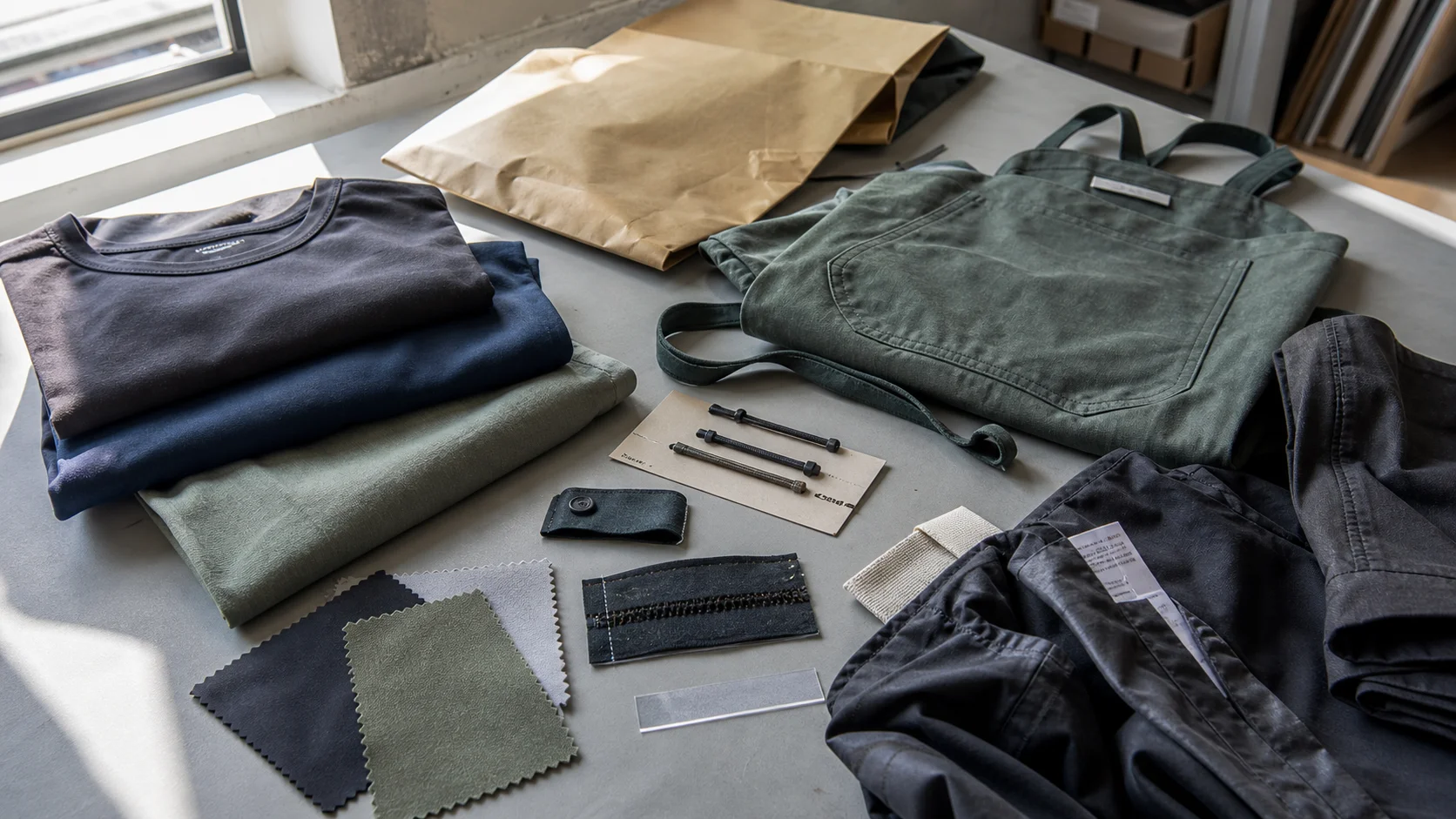
Practical breakdown of corporate uniform buyers mono material workwear uniform aql inspection checklist, covering MOQ, cost, timeline, quality checks, and...
Corporate Uniform Buyers Mono Material Workwear Uniform Aql - Fabrikn production reference
Corporate uniform buyers are under more pressure than ever to balance appearance, durability, compliance, and sustainability. Mono material workwear has become part of that conversation because it simplifies end-of-life sorting and can reduce the complexity of recycling compared with blended garments. In practice, that does not make a uniform sustainable by default. It only means the product is easier to design for recovery if the rest of the supply chain is disciplined.
For buyers, the appeal is straightforward. A single-fiber garment can be easier to spec, easier to communicate internally, and easier to position in a sustainability program. The challenge is equally clear: workwear still has to perform. A mono material shirt, trouser, jacket, or apron that tears, pills, shrinks, or loses shape quickly will not survive corporate use, no matter how strong the sustainability brief sounds.
That is why corporate uniform buyers need an inspection checklist that covers more than visual appearance. The order must be judged on fabric stability, trim compatibility, stitching quality, measurement tolerance, color fastness, wash performance, and packing accuracy. AQL inspection gives structure to that process, but it only works when the buyer knows what to inspect and what failures matter most.
Corporate workwear is rarely a simple bulk purchase. It often sits between brand presentation and operational use. A front-of-house shirt may need to look crisp all day. A warehouse uniform may need abrasion resistance and easy laundering. A hospitality apron may need stain performance and stable color under repeated washes. The buyer should define the use case before talking about fabric price.
Mono material construction narrows the options in useful ways, but it also creates tradeoffs. A 100% polyester uniform can be easier to recycle in theory, though heat comfort and static behavior may need attention. A 100% cotton program is comfortable and familiar, but shrinkage and crease recovery may complicate care. A mono-polyester or mono-cotton specification is only useful if the buyer accepts the operational consequences.
Internal stakeholders often want a simple answer: “What is the best sustainable uniform?” The sourcing answer is less convenient. The best option depends on laundering frequency, wearer comfort, climate, brand image, durability targets, and budget. If those inputs are not agreed early, suppliers will quote to a vague brief and the result is usually a compromise no one fully owns.
AQL inspection is the standard tool for controlling quality on apparel orders, but the checklist must be tailored to the garment type. For corporate uniform buyers, the inspection should capture both workmanship and performance. A garment may pass at first glance yet still fail after the first industrial wash cycle. That is why the checklist should combine measurement, visual, and functional checks.
For most corporate programs, the buyer should not rely on AQL alone. It is a sampling method, not a guarantee. AQL helps reduce risk when the inspection plan is built around meaningful defects. A broken stitch near a hidden seam may be acceptable if it does not affect performance. A collar shade mismatch on a customer-facing blouse is usually not acceptable even if the garment is technically wearable.
Inspection Area What To Check Typical Risk If Missed Fabric Content, weight, shade, surface defects Color variation, shrinkage, poor durability Measurements Critical points and grade consistency Fit complaints, returns, replacement cost Construction Seams, bartacks, stitching, trimming Premature failure, poor presentation Finishing Pressing, labels, folding, packing Retail-like quality issues in corporate use Function Closures, logos, wear comfort, mobility Operational complaints from employeesWorkwear programs are often lost in vague fabric descriptions. “Good quality polyester” is not enough. Corporate uniform buyers need a spec that can be measured, compared, and enforced. For mono material garments, the spec should state fiber content, yarn type if relevant, construction, grams per square meter, finish, shrinkage target, and colorfastness expectations.
Typical mono material options include 100% polyester, 100% cotton, or nylon-based utility garments. Each has its own strengths. Polyester usually offers easier drying, better crease recovery, and stable appearance. Cotton usually offers better comfort and breathability. Nylon may suit durable outerwear or technical workwear, depending on the program. The right choice is not always the most sustainable-sounding one. It is the one that survives the actual work environment.
Trim selection matters just as much. Buttons, zippers, labels, reflective tape, embroidery thread, and interfacing can all complicate mono material recycling goals if they introduce mixed-material content. Buyers who are serious about mono material strategy should ask suppliers what elements remain non-mono and why. Some trims are unavoidable, but the exceptions should be deliberate rather than accidental.
Useful specification items to include in the tech pack:
Uniform buying should never jump from sketch to bulk order. A structured sample approval process is the cheapest way to avoid expensive mistakes. The usual sequence is simple enough, but skipping steps creates false confidence.
The biggest mistake corporate buyers make is approving a sample that is not representative of bulk. A polished hand-made sample can hide issues that appear in production. The reverse also happens: a supplier may send an early sample in substitute fabric and the buyer assumes the bulk will behave the same. That is a weak basis for approval, especially in a uniform program where repeatability matters more than one-off appearance.
Best practice is to approve the exact fabric quality, exact trim set, and exact measurement table before bulk cutting starts. If any of those change later, the buyer should treat the order as re-approved, not simply updated.
MOQ for corporate uniforms can vary widely by supplier capability, decoration method, and fabric availability. A practical range for many made-to-order programs is roughly 300 to 1,000 pieces per style or color, though some factories will ask for more when custom fabric or special trims are involved. Basic repeat styles may be possible at lower quantities, but buyers should expect a higher unit cost.
Lead time usually depends on fabric booking, sample approval speed, logo complexity, and inspection schedule. A common timeline is 30 to 60 days after final approval for standard styles, while fully custom mono material workwear can take longer if fabric development or custom dyeing is required. The safest assumption is that every revision adds time. Delay in sample sign-off is one of the most common reasons a uniform launch slips.
Cost tradeoffs are often misunderstood. A slightly more expensive fabric may save money if it reduces shrinkage claims, replacement orders, or employee complaints. A cheaper trim package may look efficient on paper but can lead to closure failure or poor visual consistency. Buyers should compare landed cost, not only FOB price. Freight, duties, testing, labels, and rework risk all affect the real number.
If procurement is under pressure to move fast, it is usually better to simplify the style rather than weaken the quality standard. Fewer panels, fewer trims, and a cleaner construction approach can lower risk without sacrificing the sustainability story. Complex designs can be justified, but they need a stronger inspection plan and a more patient timeline.
Sustainable Fashion is not just about fiber content. Corporate buyers should ask for evidence that supports the environmental claim and the product claim. A supplier offering mono material workwear should be able to explain where the garment fits in a broader sustainability strategy.
Compliance expectations differ by market and use case. Uniforms for food service, healthcare-adjacent roles, industrial settings, or public-facing corporate teams may require different testing and labeling standards. Buyers should not assume one compliance template fits every program. The safest approach is to define testing requirements early and include them in the purchase order.
For buyers comparing suppliers, the most useful question is often the simplest one: can the factory produce consistent bulk quality in the material claimed? If the answer is vague, the sustainability discussion is premature. A greener spec that fails in use is not a good buy.
Useful internal references for buyers who want support on sourcing and project setup include services, about us, and contact us.
Inspection teams see the same issues again and again, and most are preventable. Corporate buyers should know the failure patterns before placing the order so they can write the spec accordingly.
Many of these problems come from poor pre-production control, not from random factory mistakes. If the approved sample was never tied to a bulk fabric roll, if the tolerance table was unclear, or if the inspection standard was too generic, the order becomes difficult to defend later. AQL can identify the issue, but it cannot compensate for weak product definition.
Corporate uniform buyers should make three decisions before they chase price: what the garment must do, how long it must last, and how sustainable the program needs to be in practical terms. Those answers shape everything else. Without them, sourcing becomes a negotiation over assumptions instead of a controlled buy.
The best purchasing judgment is usually conservative. Approve fewer styles, define fewer exceptions, and demand clearer quality standards. If the order is for a company-wide uniform rollout, consistency often matters more than fashion detail. A restrained design is easier to inspect, easier to replace, and easier to reorder later. That is usually the smarter commercial move.
Buyers should also resist the temptation to treat sustainable material claims as a substitute for process control. Mono material workwear can support a sustainability goal, but only if the sampling, inspection, and production checks are disciplined. A garment that looks responsible on paper but fails after a few washes adds cost and wastes resources. The more serious the sustainability claim, the more important the inspection checklist becomes.
For teams that need a supplier conversation starter, the strongest approach is to request the full spec sheet, an approval sample sequence, the AQL plan, and a wash-test requirement before comparing prices. That creates a more meaningful quote comparison and reduces the risk of false savings.
Get a free quote from Fabrikn — your trusted B2B clothing manufacturer with 10+ years of experience. MOQ as low as 200 pieces.
Get a Free Quote →AQL means Acceptable Quality Limit. In uniform sourcing, it is a sampling method used to judge whether a production lot meets the agreed quality standard. It helps buyers catch defects without checking every single garment.
No. Mono material can help with recyclability and material simplification, but sustainability also depends on durability, dyeing, trim choices, repairability, and how the garment is actually used. A weak garment is still a poor environmental outcome.
Many suppliers quote around 300 to 1,000 pieces per style or color, though this varies by fabric, decoration, and construction complexity. Custom trims or specialty fabrics usually increase MOQ.
At minimum, buyers should review development, fit, pre-production, and top-of-production samples when the program is complex. Simpler programs may use fewer checkpoints, but skipping the pre-production step is risky.
The most common risks are measurement drift, shade variation, seam failure, shrinkage, and logo defects. Packing mistakes are also common and can create immediate distribution problems for corporate rollouts.
Buyers can start with the factory or sourcing partner’s services page, then move to contact us for project details and about us for background on capability and approach.