
A practical review of trim choices, construction details, and sourcing checks for court warm jackets built for security contractors.
Court Warm Jacket Trim Sourcing for Security Buyers - Activewear & Teamwear manufacturing guide
Court warm jackets sit in a specific uniform category. They are not fashion outerwear, and they are not standard gym warmups. For security contractors working around courts, public buildings, screening areas, controlled entrances, transport points, and event perimeters, the jacket must look controlled, hold up under repeat wear, and support quick identification.
Fabric gets most of the attention during early sourcing conversations, but trims often decide whether the finished garment is actually usable. Zippers fail first. Pullers break. Snaps corrode. Hook-and-loop tabs lose grip. Reflective tape cracks after washing. Badge holders distort. Rib cuffs stretch out. Drawcords can create safety concerns depending on the operating environment. These details are not decorative extras; they are functional risk points.
A court warm jacket manufacturer trim sourcing review should test whether the supplier understands uniform reliability, not just garment assembly. Security contractors usually need repeatable bulk quality, controlled appearance across teams, and reorder consistency over multiple procurement cycles. A supplier that treats trims as a last-minute purchasing task can create mismatched batches, delayed shipments, and field complaints that are expensive to correct.
The practical buying question is simple: can the manufacturer source, test, document, and repeat the correct trims for a security-use warm jacket at the required quantity and price point? If the answer is unclear, the buyer should slow down before confirming bulk production.
For security uniform programs, trim sourcing should be reviewed before price approval, not after the sales sample looks acceptable.
Security contractors buy jackets differently from retail brands. The product has to support daily duty, shift handovers, team identification, and sometimes mixed indoor-outdoor use. The wearer may stand at an entrance, escort visitors, move between vehicles and buildings, or operate in a courthouse-adjacent environment where the jacket must look professional without appearing tactical in the wrong way.
A good court warm jacket manufacturer should understand these purchasing pressures:
Security buyers should also separate “activewear style” from “security uniform function.” A warm jacket may borrow construction from teamwear or track jackets, but the trim package often needs a firmer standard. Low-cost coil zippers, thin elastic, or generic pullers may be acceptable for promotional teamwear. They are often poor choices for jackets issued to guards, supervisors, and court support personnel who wear them repeatedly.
If your organization is building a broader uniform program, it is useful to discuss trim standards as part of development rather than treating each style separately. A manufacturing partner that handles product development, sampling, and bulk production can help align warm jackets with polos, trousers, vests, or other teamwear layers. Fabrikn’s broader apparel production support can be reviewed through its services page.
The trim bill for a court warm jacket can look short, but each component carries performance and sourcing implications. Buyers should request a complete trim sheet with supplier codes, material composition, color references, dimensions, placement notes, and approved sample references. A photo-only approval is not enough for a repeatable security uniform program.
The front zipper is usually the highest-risk trim on a warm jacket. It affects appearance, function, wearer comfort, and perceived quality. For security contractors, the zipper should be selected based on duty use rather than only cost.
For most court warm jackets, a mid-grade nylon coil or molded zipper from a reliable trim supplier is a practical choice. Buyers should ask for zipper tape color matching, slider finish, puller size, and replacement availability. A black jacket with black zipper tape sounds easy until the bulk batch arrives with a different black tone or a shiny slider that clashes with the uniform standard.
Pullers are small but important. Security staff may use the jacket while carrying radios, keys, gloves, or documents. A tiny fashion puller can be irritating. An oversized puller can look too casual or create snag risk.
Common options include standard metal pullers, rubberized pull tabs, woven pull tabs, and molded branded pullers. For security contractors, the best purchasing choice is usually a plain durable puller unless branding is required. Custom pullers can improve identification, but they increase tooling cost, MOQ, and lead time.
Some court warm jackets include snap plackets, cuff adjusters, pocket flaps, or detachable hood systems. Snaps should be reviewed for cap diameter, finish, pull strength, corrosion resistance, and compatibility with fabric reinforcement.
A weak snap on a thin knit or lightweight woven can tear the fabric around the attachment point. A strong snap without proper reinforcement can be worse than a weaker snap because repeated pulling damages the shell. Ask the manufacturer how snap areas are reinforced. Interlining, fabric patches, bartacks, or heavier facing may be needed.
Cuffs and hems affect comfort and durability. Rib cuffs are common in warm-up jackets, while elastic binding or adjustable hems may be used for lighter activewear. Security contractors should avoid ribs that lose recovery quickly, pill heavily, or fade differently from the body fabric.
Specify rib composition, width, stretch recovery, color, and hand feel. Polyester-spandex rib may hold shape better in some programs. Cotton-rich rib can feel comfortable but may fade, shrink, or absorb moisture differently. The correct choice depends on the shell fabric, laundering method, and desired appearance.
Drawcords need careful judgment in security-use garments. They can improve fit at the hood or hem, but they may introduce snag risk. In courthouse or screening environments, loose cords may be discouraged. Some buyers prefer internal elastic adjustment systems, hidden toggles, or no drawcords at all.
If drawcords are used, specify cord diameter, end finish, stopper material, pull strength, and placement. Metal tips can look premium but may scratch surfaces or create noise. Plastic tips are lighter and usually cheaper. Heat-sealed cord ends are low profile but may look less finished.
Pockets are often where trim decisions become operational. Security staff may carry IDs, notepads, pens, gloves, mobile devices, radios, access cards, or keys. Pocket zippers, welt trims, snap flaps, and internal mesh bags should be selected according to use.
A court warm jacket does not need to become a tactical vest, but it should not have flimsy fashion pockets. Buyers should review pocket opening size, zipper direction, pocket bag fabric, bartack placement, and whether items can fall out when the wearer sits, walks quickly, or enters a vehicle.
Some security contractors require reflective details, especially for parking, perimeter, event, or evening operations. In formal court environments, reflective tape may be limited or avoided because it changes the visual tone of the uniform.
Reflective trim should be reviewed for wash durability, cracking, brightness, width, placement, and certification claims where relevant. Do not accept vague “reflective style” wording if actual visibility performance matters. Request the trim supplier’s technical data and washing guidance.
Trim sourcing cannot be separated from fabric selection. A zipper that performs well on a medium-weight woven shell may ripple on a lightweight knit. A heavy rib cuff may pull down a soft jersey sleeve. Reflective tape may not bond well to certain stretch fabrics. Snap fasteners may distort thin laminated materials.
For court warm jackets in the activewear and teamwear category, common fabric directions include polyester interlock, polyester pique, bonded knit, softshell, polyester fleece-backed knit, stretch woven, and light woven shells with mesh or tricot lining. Each direction changes trim selection.
Fabric Direction Common Benefit Trim Sourcing Watch Point Polyester interlock knit Smooth teamwear appearance and moderate stretch Zipper waviness, pocket sagging, rib shade matching Bonded knit Warmer hand feel and cleaner structure Needle damage, seam bulk, zipper weight balance Softshell Weather resistance and professional outerwear look Snap reinforcement, seam sealing expectations, heavier zipper choice Polyester fleece-backed knit Comfort and warmth for indoor-outdoor shifts Pilling, lint attraction, elastic recovery, pocket bag durability Light woven shell Lower weight and wind resistance Static, lining compatibility, drawcord and stopper noiseSecurity contractors should request fabric and trim testing on the same construction that will be used in bulk. Testing trims separately from the garment is useful but incomplete. Zipper strength, seam puckering, snap pullout, and reflective tape adhesion must be judged on the actual fabric or a very close substitute.
Color matching deserves direct attention. Navy, black, charcoal, and dark green are common security uniform colors, but not all trim materials absorb or reflect color the same way. Zipper tape, rib, elastic, thread, plastic stoppers, rubber pullers, and printed patches may all read differently under fluorescent court lighting, outdoor daylight, and vehicle interior lighting.
Security contractors usually need clear identification. The challenge is balancing visibility, professionalism, legal naming requirements, and facility rules. Trim sourcing affects this because badges, patches, labels, reflective lettering, and detachable identifiers are all trim-related decisions.
Embroidered patches are durable and familiar in uniform programs. They work well for chest logos, sleeve identifiers, and department-style marks. Buyers should review backing type, border finish, stitch density, thread color, and attachment method.
Sew-on patches are secure but make replacement difficult. Hook-and-loop backed patches allow role changes and laundering flexibility, but they can look less formal and may curl over time if low-grade materials are used. For court settings, a clean sewn patch may look more controlled unless the role requires removable identification.
Heat transfers provide a clean look and can handle text or reflective detail. They are common in activewear and teamwear. The main risks are cracking, peeling, dye migration, and poor adhesion on textured or treated fabrics.
Buyers should request wash test results or at least pre-production wash checks before approving heat transfers for repeated security use. Low-cost transfers can look good on a sample and fail after a few wash cycles. If the garment is dark polyester, ask about dye-blocking layers and recommended temperature settings.
Woven neck labels, size tabs, care labels, and compliance labels are easy to overlook. They should be comfortable, readable, and consistent with the uniform program. Security contractors may need internal tracking labels, issue numbers, or reorder codes. Those details should be planned before bulk cutting.
Care labels should match the weakest component in the garment, not just the main fabric. If reflective tape, heat transfers, or special pullers require lower wash temperatures, the care label must reflect that. Wrong care instructions are a practical liability because field users will follow the label, not the buyer’s original tech pack.
Some jackets include transparent ID windows, badge loops, mic loops, or pen channels. These additions must be reviewed carefully. Clear PVC windows can yellow or crack. Badge loops can tear if not reinforced. Mic loops placed poorly can interfere with seatbelts, radio wires, or outer layers.
For court warm jackets, permanent ID windows may not always be the right choice. A clean chest patch and separate lanyard may be more flexible. If the buyer needs built-in ID display, the manufacturer should provide a sample that is tested with the actual ID card size and attachment method.
Minimum order quantity depends on fabric availability, trim customization, color matching, size range, and factory production setup. For court warm jackets, typical manufacturing MOQ ranges may fall around 300 to 1,000 pieces per style for standard fabrics and trims. Smaller runs may be possible if using stock materials, but unit cost rises and trim choice narrows.
Custom trims change the calculation. Custom zipper pullers, dyed-to-match rib, custom woven patches, special reflective layouts, branded snaps, and private-label packaging may each carry separate MOQs. A buyer may meet the garment MOQ but fall short of a trim supplier’s MOQ. That is a common sourcing trap.
Trim Type Typical MOQ Consideration Purchasing Tradeoff Stock zipper Often flexible if color is available Lower cost and faster lead time, but less branding control Dyed-to-match zipper tape May require several hundred to several thousand meters Better uniform appearance, but shade approval adds time Custom rubber puller Tooling and trim MOQ often apply Strong brand detail, but slower and harder to reorder in small lots Custom patch Usually manageable, but setup and color approval required Good identification value, but poor artwork control creates bulk inconsistency Reflective tape Depends on width, grade, and supplier stock Improves visibility, but can increase wash and compliance riskFor a first order, security buyers often get better value by using reliable stock trims and customizing only the identification elements that matter most. A fully custom trim package can make sense for large programs or long-term contracts. It is usually inefficient for a small pilot unless the buyer has confirmed repeat volume.
A cautious MOQ conversation should include replacement planning. If the first order is 500 jackets and the contractor expects to hire staff continuously, ask whether the manufacturer can support 100 to 300 piece replenishment runs using the same trims. If not, the initial savings may disappear when the second order produces mismatched jackets.
Sampling should prove more than fit. For court warm jackets, the approval process should verify trim function, placement, durability, and repeatability. A rushed sample approval can push unresolved trim issues into bulk production.
The development sample confirms general silhouette, fabric direction, pocket layout, closure type, and branding concept. At this stage, substitute trims may be acceptable if clearly marked. Buyers should not mistake a development sample for a production-ready approval sample.
Good review notes at this stage include zipper type, pocket depth, cuff comfort, collar height, logo position, and whether identification is visible from a practical distance. If the jacket is intended for court environments, avoid trim choices that look too sporty, too tactical, or too promotional unless that is the deliberate uniform direction.
The fit sample checks sizing, movement, sleeve length, shoulder comfort, and layering allowance. Security staff may wear the jacket over a polo, shirt, light sweater, or protective layer. Fit should be reviewed with the expected underlayer, not just on a display form.
Trim effects should be reviewed here too. Heavy front zippers can cause front drop. Tight rib cuffs can restrict movement. Pocket placement can interfere with belts or carried equipment. A clean jacket on a table may behave differently on a wearer during movement.
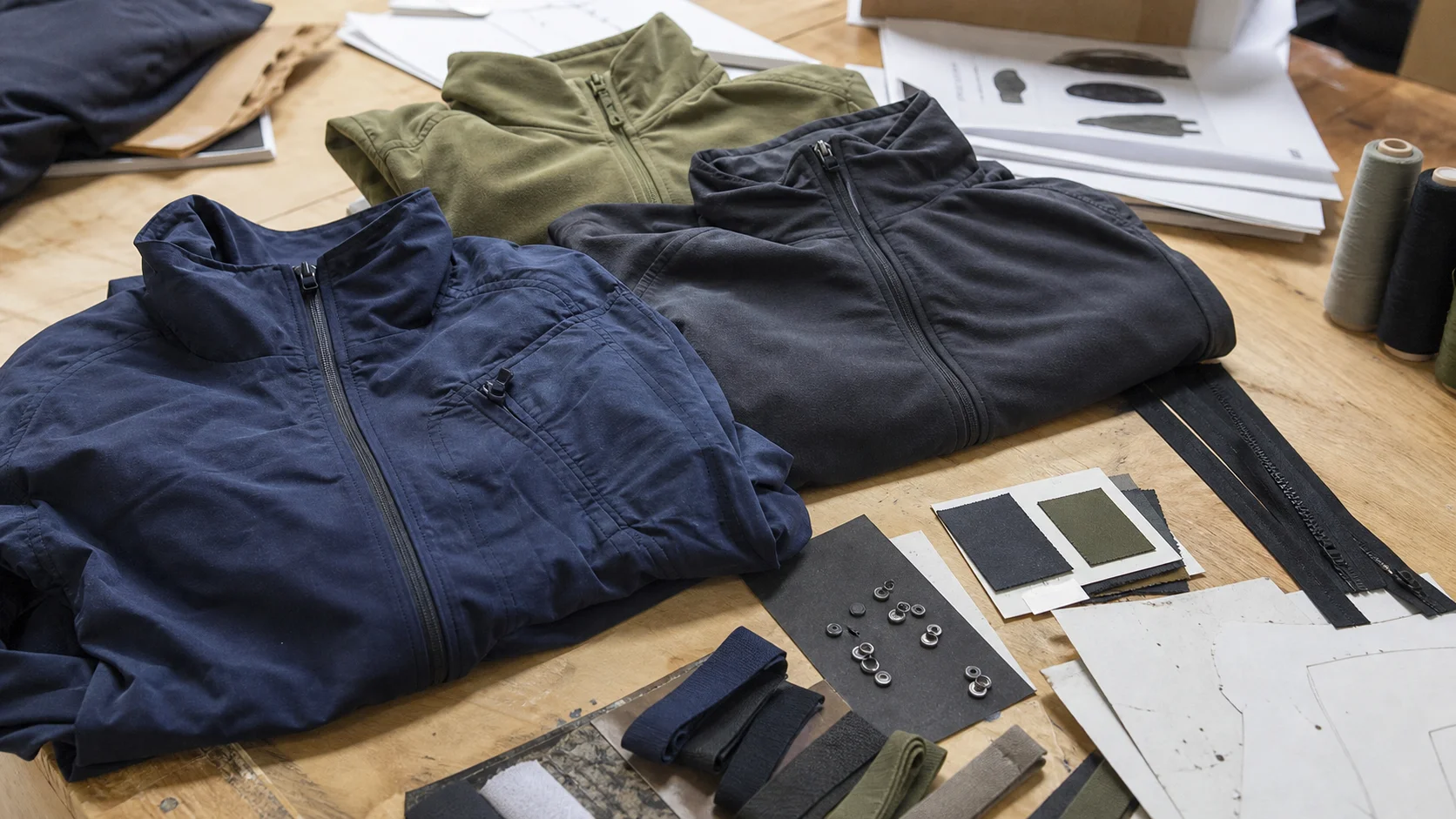
Before pre-production, ask for trim cards or trim boards. These should include actual zipper tape, sliders, pullers, rib, elastic, labels, patches, reflective material, snaps, drawcords, stoppers, and thread colors. The buyer should approve physical trims where possible, not only digital images.
Each trim should be labeled with supplier reference, color, size, material, and usage location. This helps prevent substitutions during bulk purchasing. If a manufacturer cannot provide organized trim records, that is a warning sign for repeat-order reliability.
The pre-production sample should use confirmed bulk fabric, confirmed trims, correct branding, correct labels, and final construction methods. This is the sample that should be signed off before bulk cutting.
Security buyers should examine the pre-production sample carefully: zip and unzip it repeatedly, pull pocket openings, stretch cuffs, inspect patch edges, check the care label, test the ID area, and review the jacket under different lighting. If possible, conduct a small wear trial before full production approval.
For teamwear and security programs, size consistency matters. A size set helps confirm grading across small, medium, large, extra-large, and extended sizes if required. Trims must scale correctly. A pocket that works on large may sit awkwardly on small. A logo that looks balanced on medium may look too high on 3XL if grading is poorly managed.
Extended sizes need special attention. Security contractors often require a practical size range, and trims should support that range. Zipper length, hem elastic, rib stretch, and logo placement should be confirmed across the approved size set.
Lead time for court warm jackets depends on fabric booking, trim sourcing, sample approvals, production capacity, embellishment, inspection, packing, and shipping. Standard programs using available fabric and trims may run faster. Custom trims, dyed components, or special branding can add meaningful time.
A typical production timeline may look like this:
Stage Typical Timing What Can Delay It Tech pack and quotation review Several days to 2 weeks Unclear trim specs, missing artwork, incomplete size range Development and fit samples 2 to 4 weeks or more Fabric substitutions, revised trims, pattern changes Trim approval 1 to 3 weeks Dyed-to-match components, custom patches, artwork corrections Pre-production sample 1 to 3 weeks after materials are ready Bulk trim delays, incorrect labeling, branding changes Bulk production 4 to 8 weeks depending on quantity and complexity Factory capacity, trim shortages, rework, inspection failures Final inspection and shipping Depends on destination and transport method Packing errors, documentation issues, late approvalsSecurity contractors working against contract start dates should build in margin. Uniform delivery often becomes urgent because staffing schedules, facility onboarding, and public-facing deployment dates are fixed. A low-cost jacket delivered late may cost more than a higher-priced jacket delivered correctly.
Trim sourcing is one of the most common reasons timelines slip. The shell fabric may be ready, but the zipper color is late. The patches may be approved, but the hook-and-loop backing has changed. The reflective tape may be in stock, but the selected width is unavailable. These are practical issues that should be covered during supplier review.
If a buyer has a fixed deployment date, the smarter approach is to lock stock trims early and avoid unnecessary customization. If the program is long-term and repeat volume is likely, custom trims may be worth the extra setup. The decision should be based on procurement reality, not only appearance.
Inspection for court warm jackets should include more than general sewing defects. Trim-related defects may not be obvious at first glance, yet they can cause high complaint rates in the field. Buyers should define inspection points before production, especially for bulk orders.
Zipper problems include slider jamming, uneven tape sewing, wavy front plackets, mismatched zipper lengths, missing top stops, sharp edges, weak pullers, and color inconsistency. Inspectors should operate zippers repeatedly, not only check visual placement.
For jackets with pocket zippers, check pocket orientation and puller direction. A reversed pocket zipper may not make the jacket unusable, but it looks careless and can frustrate wearers. On security uniforms, visible inconsistency weakens program discipline.
Snaps should be tested for attachment strength and alignment. Misaligned snaps create twisting or puckering. Weakly attached snaps may detach during use. Overly tight snaps may tear the surrounding fabric.
If snaps are used near pockets or cuffs, inspection should include repeated opening and closing. A single hand check is not enough. Ask whether the manufacturer performs pull tests or has an internal fastener standard.
Patches and logos must be straight, correctly positioned, color accurate, and securely attached. Security contractors should provide a tolerance for placement. For example, a chest patch may need to sit within a defined measurement from the shoulder seam, center front, or pocket edge.
Heat transfers should be checked for lifting edges, scorch marks, poor opacity, cracking, and dye migration. Embroidered patches should be checked for thread trimming, border cleanliness, backing irritation, and stitch density.
Reflective tape defects include uneven placement, bubbling, cracking, poor adhesion, inconsistent reflectivity, and edge lifting. If visibility is a safety requirement, visual inspection alone is weak. Buyers should specify performance expectations and washing guidance.
Wrong size labels, wrong care labels, missing contractor labels, and mixed carton assortments are common uniform program problems. They do not always look like garment defects, but they create distribution headaches. Security contractors issuing uniforms by site, role, or size should require clear carton markings and packing lists.
A court warm jacket manufacturer trim sourcing review should be structured. Do not rely only on a catalog image or general assurance that “all trims are good quality.” Ask direct questions and request documentation where it matters.
The bill of materials should list shell fabric, lining, rib, zipper, puller, pocket components, thread, labels, patches, interlining, reflective trims, drawcords, stoppers, and packing materials. Each item should include specification and color. If the manufacturer cannot provide this, repeat production will be difficult to control.
Stock trims are usually faster and less expensive. Custom trims give better control but increase risk. Buyers should know which components are stock and which require special purchase. This affects MOQ, replacement availability, and lead time.
Substitution is a major risk. A factory may replace a zipper, elastic, or patch backing if the original supplier is out of stock. Sometimes this is harmless. Sometimes it changes the garment’s appearance or durability.
Buyers should define which trims cannot be substituted without written approval. Zippers, patches, reflective tape, care labels, rib cuffs, and visible drawcords usually require control. For internal pocket bag fabric, limited substitutions may be acceptable if function is maintained.
Security uniforms are washed repeatedly. The manufacturer should provide care recommendations based on the final trim package. If the jacket includes heat transfers, reflective material, bonded fabric, or special pullers, wash temperature and drying method matter.
Reorders are where weak trim sourcing becomes visible. Ask how the manufacturer records approved trims and whether they can reproduce the same jacket six months or a year later. For long-term security contracts, trim record control is often more valuable than a small first-order discount.
Buyers evaluating a manufacturer’s ability to support ongoing production can also review company background and operating focus through an about page before moving into technical discussions.
The best trim package is not always the most expensive one. It is the package that matches use, budget, lead time, and reorder needs. A security contractor buying court warm jackets should make decisions with field reliability in mind.
If the jacket is for a short contract, event-based deployment, or limited pilot, stock trims and simple branding may be the right call. Use a dependable zipper, clean patch or transfer, standard labels, and controlled packaging. Avoid custom pullers, unusual reflective layouts, or special hardware unless they are necessary.
If the jacket is for a multi-year uniform program, it is worth investing in stronger trim documentation, better zipper standards, tested patches, and controlled color matching. The upfront development time can reduce complaints and simplify future replenishment.
If the jacket will be worn in formal court-facing settings, visual restraint matters. A clean navy or black jacket with a controlled logo, reliable zipper, and professional finish is usually better than an over-designed garment. Security uniforms should support authority and recognition without creating distraction.
If the jacket will be worn around parking areas, public entrances, or night operations, visibility may matter more. Reflective piping, sleeve tape, or back identification could be justified. The buyer should confirm whether visibility is a safety need, a branding preference, or a facility requirement.
The strongest procurement position is to define non-negotiable trims and flexible trims. Non-negotiable trims include visible identification, main zipper quality, care labels, and safety-related reflective details. Flexible trims may include internal pocket fabric, generic puller style, or carton packing format, depending on the program.
Before requesting final quotations from a court warm jacket manufacturer, security buyers should prepare a concise but complete trim specification. This reduces quote gaps and prevents suppliers from pricing different quality levels.
Specification Area Details to Confirm Main zipper Type, length, tape color, slider finish, puller style, brand level or quality grade Pocket closures Zipper, snap, flap, or open pocket; pocket bag fabric and reinforcement Cuffs and hem Rib, elastic, binding, drawcord, or adjustable system; width and recovery requirements Identification Patch, embroidery, heat transfer, reflective print, badge holder, or woven label Reflective trims Width, placement, grade, wash requirement, color, and safety expectation Labels Main label, size label, care label, compliance label, contractor tracking label Packaging Individual polybag, size stickers, carton assortment, site-specific packingThis checklist also helps compare quotations fairly. One supplier may quote a lower price because they assume generic zippers, cheap rib, and basic heat transfers. Another may quote higher because they include better trims and more controlled approvals. The lowest unit price is not meaningful unless the trim package is equivalent.
Documentation does not need to be excessive, but it should be enough to protect the buyer. A professional sourcing process for court warm jackets should include:
For buyers without a complete tech pack, a manufacturer may be able to help develop one from a reference garment, sketches, or functional requirements. The buyer should still insist that final trim specifications are written down before bulk production. Verbal approvals are a weak basis for uniform procurement.
Teams ready to discuss a specific court warm jacket or security activewear program can prepare the style requirements, expected quantity, size range, branding needs, and target delivery window before contacting a supplier. A direct enquiry can be sent through Fabrikn’s contact page.
Court warm jacket sourcing is not difficult because the garment is complicated. It is difficult because small trim choices affect function, appearance, delivery, and repeatability. Security contractors should treat trims as controlled components, especially when jackets are used as part of a public-facing uniform program.
A reliable manufacturer should be able to explain trim options, provide realistic MOQ guidance, prepare samples in stages, manage approval records, and warn buyers when a requested trim creates risk. The buyer should be equally disciplined: define the use case, avoid unnecessary customization, approve physical trims when possible, and inspect the final jackets for function as well as appearance.
For security contractors, the practical rule is clear. Spend money where failure would create field complaints, safety issues, or inconsistent identification. Save money where the trim is not visible, not safety-related, and not critical to long-term reorder consistency. That balance produces a court warm jacket that looks professional, performs reliably, and remains practical to source.
Get a free quote from Fabrikn — your trusted B2B clothing manufacturer with 10+ years of experience. MOQ as low as 200 pieces.
Get a Free Quote →The most important trims are the main zipper, pocket closures, cuffs, identification patches or transfers, labels, and any reflective elements. These parts affect daily function, appearance, and wearer complaints. Decorative trims should be secondary to reliability.
Typical MOQ ranges may be around 300 to 1,000 pieces per style when using standard fabrics and trims. Custom trims, special colors, branded pullers, or dyed-to-match components can raise the effective MOQ because trim suppliers may have their own minimums.
Stock trims are usually better for smaller runs, urgent orders, and pilot programs. Custom trims are more useful for long-term uniform programs with repeat volume. The buyer should customize only where it improves identification, durability, or program control.
Buyers should review zipper type, tape color, slider finish, puller strength, smooth operation, and sewing quality on the pre-production sample. The zipper should be opened and closed repeatedly. Pocket zippers should also be checked for direction, placement, and ease of use.
Reflective trims are useful for outdoor, parking, perimeter, and evening assignments. They may not be suitable for formal court-facing roles where a cleaner uniform appearance is preferred. If visibility is safety-related, buyers should request technical data and wash guidance.
A practical process includes a development sample, fit sample, trim approval card, pre-production sample, and size set. The pre-production sample should use the confirmed bulk fabric, confirmed trims, correct labels, and final branding before bulk cutting starts.
Inspection should check zipper operation, snap strength, patch placement, heat transfer adhesion, reflective trim condition, rib recovery, label accuracy, and carton packing. Functional checks are important because many trim defects are not visible in a quick visual inspection.
Buyers can reduce risk by preparing a clear bill of materials, approving physical trims, limiting unnecessary customization, defining substitution rules, and confirming reorder availability. A written trim record is especially important for multi-site or long-term uniform programs.