
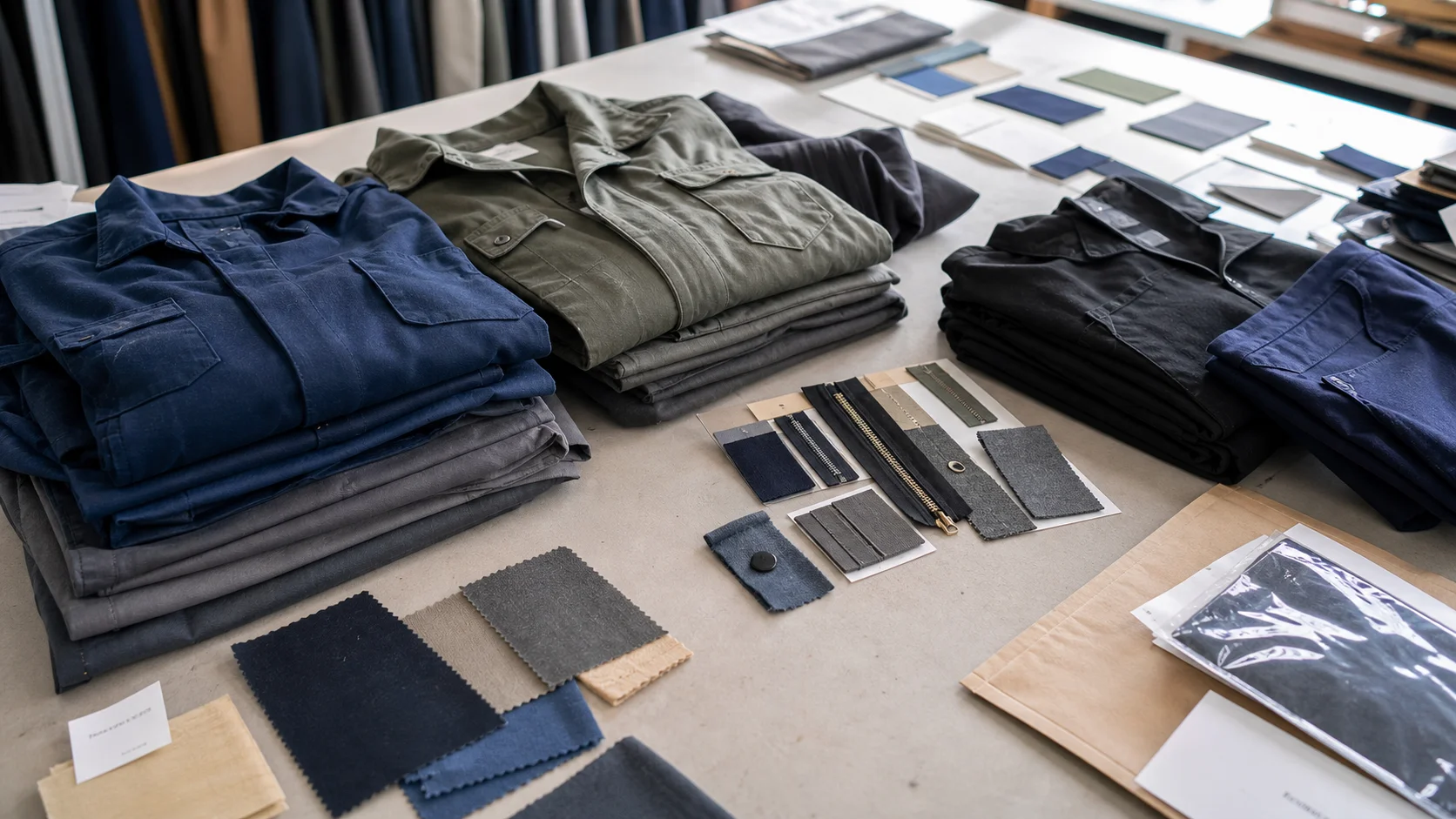
A quality inspection outline for event staffing buyers who need coveralls that resist dye transfer, laundering fade, perspiration staining, and brand-color...
Coverall Colorfastness Audit for Event Buyers - Quality & Inspection manufacturing guide
Event staffing teams buy coveralls for a simple reason: they need a uniform that looks consistent across a large workforce, photographs well under changing light, and survives a demanding event schedule. Colorfastness is often treated as a lab detail, but for event buyers it is a commercial risk. A red coverall that bleeds onto a white lanyard, a navy coverall that fades after one laundry cycle, or a black coverall that rubs dye onto branded furniture can create avoidable problems during a live activation.
This guide explains how to run a practical coverall colorfastness audit for event staffing teams. It is written for procurement managers, uniform buyers, production coordinators, and brand operations teams who need to brief suppliers clearly, approve samples with fewer surprises, and inspect bulk shipments before uniforms are issued to staff.
Coveralls are high-visibility garments. They cover the full body, sit close to accessories, and move constantly during event setup, guest management, backstage operations, warehouse handling, hospitality service, and cleanup. If the color is unstable, the failure is easy to see.
For event staffing teams, colorfastness affects more than garment appearance. It affects brand consistency, staff confidence, guest perception, and asset protection. A uniform that transfers dye onto hands, seating, signage, or equipment can become a reputational issue. A uniform that fades unevenly can make one team look like they were issued old stock, even if all garments were produced in the same order.
The audit priority depends on the event use case. For a one-day promotional event, crocking and shade consistency may matter more than long-term wash durability. For a touring event, festival crew, venue team, or recurring brand activation, wash fastness and perspiration fastness become more important. For luxury, automotive, technology, or hospitality events, tolerance for visible shade variation is usually lower.
Practical buying rule: if coveralls will be worn near light-colored furniture, vehicle interiors, equipment cases, guest-facing surfaces, or white accessories, colorfastness to rubbing should be treated as a critical test, not a nice-to-have.
A good audit is not just a laboratory report. It combines fabric specification, dye process review, sample approval, bulk shade control, trim compatibility, and final inspection. Event buyers do not need to become textile chemists, but they do need a sourcing checklist that catches the common failure points before garments reach the venue.
Buyers working with a manufacturing partner can also align this audit with broader production support. Fabrikn’s apparel manufacturing services can be used as a reference point when building a supplier brief that includes fabric, trims, sampling, quality control, and delivery requirements.
Colorfastness begins with the fabric. Coveralls are commonly made in cotton twill, poly-cotton twill, canvas, poplin, ripstop, stretch woven, or technical blends. Each fabric has different dye behavior, hand feel, durability, shrinkage, and price implications.
Black, navy, charcoal, bottle green, burgundy, and saturated red usually require closer control than pale or neutral shades. Deep shades often use heavier dye loads, which increases the risk of crocking if dye is not properly fixed, washed off, or finished. The risk rises when fabric is rushed, poorly rinsed, or processed without enough time for stabilization.
White and light-colored coveralls have different risks. They may not bleed, but they can show contamination from trims, contrast stitching, labels, packing materials, or dirty factory handling. They also reveal oil marks, rust spots from metal trims, and shade differences between shell fabric and pocketing.
Fabric-dyed coveralls are usually more predictable for event uniform programs. Fabric is dyed before cutting, which allows mills and garment makers to manage roll shade and cutting layout. Garment-dyed coveralls can create a softer, casual appearance, but shade variation, seam abrasion, trim reaction, and size-to-size color differences need tighter control.
Garment dyeing may work for fashion-led events where a slightly washed look is acceptable. It is usually a weaker choice for a strict brand color match. If the brand requires a precise blue, green, orange, or red, approve fabric-dyed material against a physical standard before production.
The biggest colorfastness disputes often start before testing. The buyer says the bulk shade is wrong. The supplier says it matches the approved sample. Both may be partly right if the approval standard was vague.
Do not approve color from a screen image. Digital color references are useful for direction, not production control. Use a physical standard whenever possible. This can be a Pantone textile reference, a brand master swatch, an approved lab dip, or a sealed pre-production sample.
Lighting matters. A navy coverall can look correct in office light and too purple under stage light. A charcoal coverall can shift green under LED lighting. Event buyers should review shade under the environment closest to actual use: daylight, cool white, warm white, backstage LED, showroom lighting, or camera flash if photography is important.
For larger orders, ask the supplier to create a shade band. This is a set of swatches showing the acceptable light, standard, and dark range. The shade band prevents arguments during inspection and helps factories segregate fabric rolls. For strict event branding, keep the shade band narrow. For utility crew coveralls, a slightly wider tolerance may be commercially acceptable if the difference is not visible when staff stand together.
Direct purchasing judgment: if all staff will be photographed as one group, shade variation becomes more important than if teams work in separated zones. Buy accordingly.
Colorfastness testing should match how the coveralls will be worn and cleaned. Requesting every test can add cost and time without improving the buying decision. A practical audit focuses on the likely failure modes.
Testing methods may be based on ISO, AATCC, or other recognized standards depending on market and buyer requirements. The exact method should be listed in the purchase order or quality manual. If the event buyer does not specify the method, the supplier may choose a method that is easier to pass or cheaper to conduct.
Coveralls often include zippers, snap buttons, hook-and-loop tape, elastic, webbing, reflective tape, contrast pocketing, printed logos, woven labels, embroidery thread, and drawcords. These components can create color problems even when the main fabric is stable.
If trims are visible or touch the shell fabric, include them in the sample wash and rubbing review. It is cheaper to change a zipper tape or label before production than to reject finished garments.
A structured sample process reduces risk. The goal is not to slow production. The goal is to catch the right problems early enough that the supplier can correct them without delaying the event.
The development sample checks silhouette, pocket placement, basic fabric hand feel, and construction direction. It may not use final bulk fabric or final color. Treat it as a fit and design review, not a colorfastness approval.
The lab dip is a small dyed fabric sample submitted for color approval. A strike-off may include print, wash, coating, or other surface treatment. Approve this against the physical color standard. Request multiple options if color matching is difficult.
For dark and saturated colors, ask whether the lab dip is made on the exact fabric composition and construction planned for bulk. A color can look correct on one cotton twill and shift on another blend.
The fit sample confirms size, movement, and comfort. Coveralls need specific attention because torso length, rise, sleeve movement, and shoulder mobility affect wearability. Staff may need to climb, carry boxes, manage guests, or work long shifts. A coverall that looks clean on a hanger can fail in use if the body length is short or the armhole restricts movement.
The pre-production sample should use bulk fabric, bulk trims, final color, final branding, final stitch type, and final wash or finishing method. This is the key approval stage for a colorfastness audit. Conduct rubbing checks, wash review, shade review, logo durability checks, and trim staining checks before authorizing production.
For event staffing teams, size range is a practical issue. Coveralls often require broader sizing than standard tops because they must fit height, chest, waist, hip, and torso length. A size set allows the buyer to confirm that graded sizes maintain proportion and that fabric shade remains consistent across sizes.
Once approved, keep a sealed sample as the production reference. The supplier should keep one, and the buyer or inspection team should keep one. Final inspection should compare bulk garments against this sample, not against memory or a digital file.
Bulk inspection should happen before shipment whenever possible. Once coveralls arrive close to the event date, the buyer has fewer options. Rework may be expensive or impossible, and replacement production may not fit the event schedule.
Many apparel inspections use AQL sampling, but the exact level should match order size, risk, and buyer tolerance. For event uniforms, common practice is to classify safety issues, severe staining, heavy dye transfer, and wrong color as critical or major defects. Minor shade variation may be acceptable only if it is not visible when garments are worn together.
Buyers should define what “visible” means. A practical standard is normal viewing distance under expected event lighting. A shade difference that is obvious on a lightbox may not matter backstage. A shade difference that shows in event photography may be unacceptable, even if a supplier considers it technically small.
Colorfastness control depends on time. Rushed dyeing, rushed testing, and skipped sample reviews are common reasons uniforms fail. Event buyers often work with fixed dates, so the production plan should be built backward from the event launch.
MOQ varies by fabric, color, supplier model, trim customization, and branding method. The following ranges are typical planning references, not fixed rules:
Lower MOQs may be possible, but there is usually a tradeoff: higher unit cost, fewer fabric choices, limited color control, or reduced willingness from the supplier to run multiple lab dips. For a brand-critical event, paying more for proper sampling and testing is usually cheaper than replacing failed uniforms.
Air freight can save calendar days, but it does not fix poor colorfastness. If the event date is close, buyers should simplify the product: use stock fabric, reduce custom dye requirements, avoid risky contrast trims, and approve a realistic color tolerance.
A supplier can only control what is specified. A strong brief should be concise, measurable, and tied to the event use case. Avoid vague wording such as “good quality” or “no fading.” Use test requirements, approved standards, and inspection criteria.
Buyers who need help translating a campaign uniform idea into a production-ready brief can start with the broader company information on Fabrikn’s about page or speak with the team through Fabrikn’s contact page.
Quality control is not about demanding the highest specification in every area. It is about choosing the right level of control for the event risk. A one-weekend indoor event does not always need the same test package as a six-month touring program. A luxury product launch has different expectations from a logistics crew uniform.
There is a clear tradeoff between exact brand color and production reliability. A custom-dyed coverall may look closer to the campaign palette, but it adds lab dip time, dye lot risk, testing requirements, and MOQ pressure. A stock fabric may not be a perfect match, but it can reduce cost, shorten lead time, and improve predictability if the fabric has already been used successfully.
Coveralls create inspection challenges because they use large fabric panels and many seams. A shade mismatch that might be hidden on a small shirt panel can become obvious across a full leg or sleeve. The garment also has stress points at the crotch, armhole, zipper placket, pocket corners, and waistband area. Colorfastness review should not replace normal garment inspection; both are needed.
Ask inspectors to pull garments from multiple cartons and sizes, not only the top of the nearest carton. If the supplier mixed fabric rolls during cutting, shade problems may appear in clusters. A proper carton spread increases the chance of finding them before shipment.
Not every failure has the same solution. The response depends on the test result, event date, order quantity, and severity of the issue. Buyers should avoid accepting vague promises such as “it will be better after washing” unless the supplier proves it with a controlled rewash and retest.
A discount is not a solution if the coveralls can damage event assets or embarrass the brand. For high-risk failures, especially dye transfer, rejection or replacement is usually the cleaner commercial decision.
Many event teams reorder uniforms after the first activation. The most common mistake is assuming the supplier can automatically reproduce the same shade. Dye lots vary, mills change availability, trims are substituted, and production conditions shift.
Keep a reorder file with the approved fabric swatch, test reports, bulk lot reference, trim cards, logo artwork, print method, thread colors, and packing details. Ask the supplier to confirm whether the same fabric lot is still available. If not, repeat lab dip approval and compare against the sealed standard.
For programs that will repeat across seasons, consider buying extra fabric or extra finished garments. This increases upfront cost but can reduce reorder mismatch. The decision depends on forecast confidence, storage capacity, and whether the uniform design is likely to change.
A coverall colorfastness audit does not need to be complicated, but it must be deliberate. Event buyers should focus on the real-world use case: sweat, rain, lighting, washing, props, guest-facing surfaces, and group photography. The best outcome is not just a garment that passes a report. It is a uniform that looks consistent, performs through the event schedule, and does not create last-minute operational problems.
Get a free quote from Fabrikn — your trusted B2B clothing manufacturer with 10+ years of experience. MOQ as low as 200 pieces.
Get a Free Quote →A coverall colorfastness audit is a quality control process that checks whether the fabric, trims, and branding on coveralls can retain color and resist dye transfer during rubbing, washing, perspiration, water exposure, and event use. For event staffing teams, it helps prevent fading, staining, shade mismatch, and dye transfer onto props or furniture.
Colorfastness to rubbing is usually the first priority, especially for dark coveralls. Dry rubbing checks normal contact, while wet rubbing checks risk from sweat, rain, spills, or damp conditions. Wash fastness becomes equally important when uniforms will be reused across multiple event days.
Typical MOQs may range from 100 to 300 pieces for custom coveralls using available fabric, and 300 to 1,000 pieces for custom-dyed fabric. Stock coveralls with logo application may start lower, often around 50 to 200 pieces. Exact MOQ depends on fabric, color, trims, supplier capacity, and branding method.
A supplier can often get close, but exact matching is not guaranteed across different fabrics and dye processes. Pantone references should be supported by a physical lab dip or approved fabric swatch. Paper Pantone references are less reliable for textiles than textile standards or actual fabric approvals.
Dark coveralls can stain other surfaces when excess or unfixed dye remains on the fabric surface. Poor rinsing, heavy dye loads, rushed dyeing, and inadequate finishing can increase the risk. Wet conditions, friction, and heat can make transfer more visible.
Yes. Zipper tape, pocketing, labels, embroidery thread, reflective tape, and printed logos can bleed, stain, fade, or discolor. Testing only the shell fabric may miss a major source of color problems in the finished garment.
For custom color coveralls, buyers should allow time for lab dips, revisions, pre-production samples, testing, and bulk inspection. Lab dips alone may take 5 to 14 working days, and retesting can add more time. Tight event deadlines are better served by stock or already-approved fabrics.
The buyer should hold shipment, review the severity, request a corrective action plan, and retest after any rewash or fixing process. If dye transfer remains high and garments will contact light surfaces or guest-facing assets, rejection or replacement is usually safer than accepting a discount.