
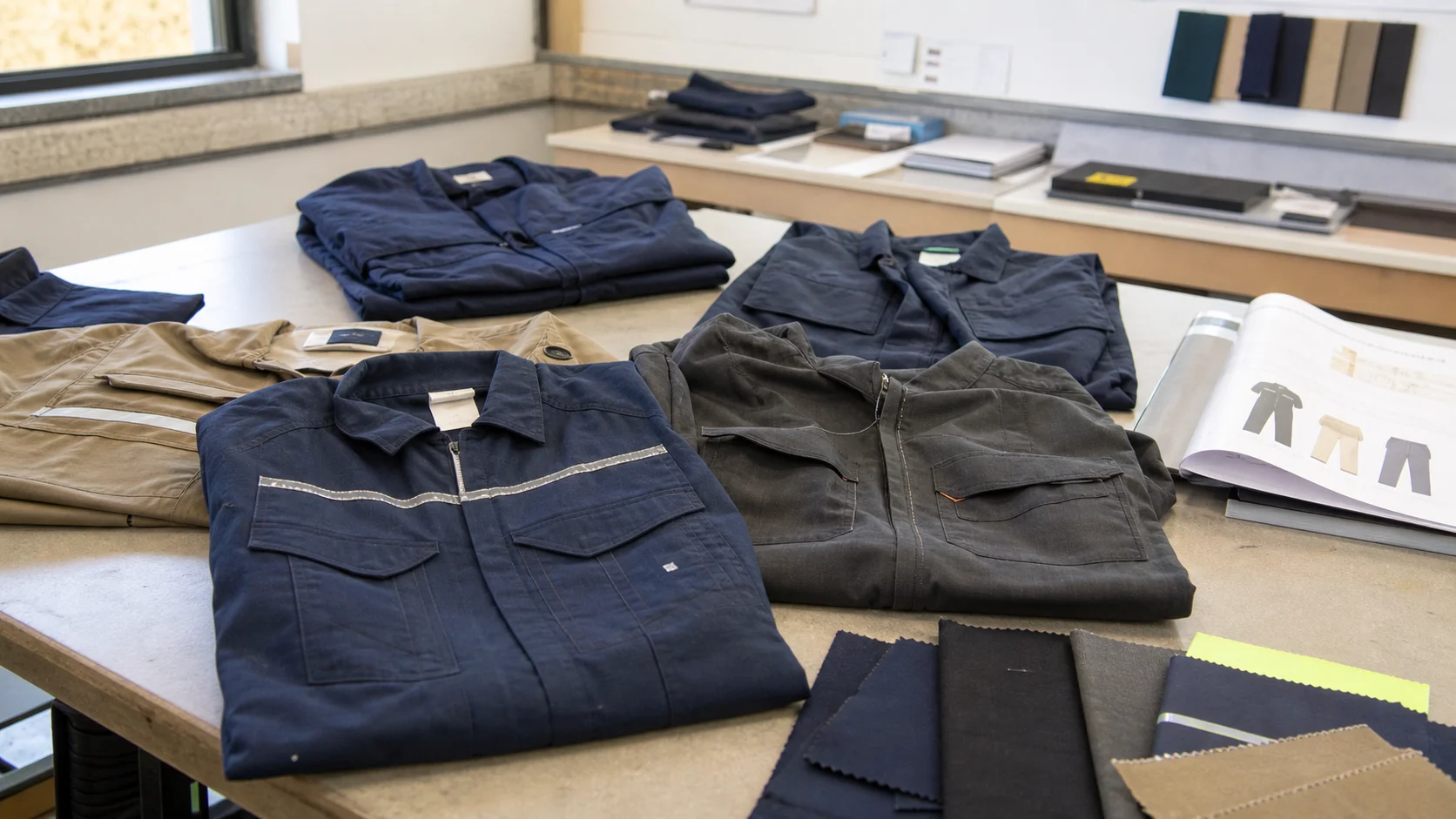
A practical inspection outline for corporate uniform buyers sorting coverall defects by severity, garment zone, construction risk, decoration quality, and...
Coverall Defect Sorting Guide for Uniform Buyers - Quality & Inspection manufacturing guide
Coveralls are not decorative garments. They are workwear products used in factories, workshops, logistics facilities, construction sites, maintenance teams, utilities, laboratories, and service departments. A loose seam, wrong zipper, poor sleeve length, or missing reflective tape can affect safety, brand image, staff comfort, and repeat ordering confidence.
For corporate uniform buyers, defect sorting is the bridge between “the goods are finished” and “the goods are acceptable for distribution.” It is not just a factory responsibility. Buyers need a practical defect sorting guide so they can align purchasing teams, suppliers, inspection agencies, and end-user departments before bulk production leaves the factory.
A coverall supplier defect sorting guide for corporate uniform buyers should answer four direct questions:
The best time to define these rules is before purchase order placement, not after cartons are sealed. Coverall programs often involve many sizes, multiple departments, embroidered logos, heat-transfer branding, reflective tape, fire-resistant fabric, antistatic requirements, or color-coded trims. Each extra specification creates another possible failure point.
Buyers sourcing from a coverall supplier should treat defect sorting as part of the commercial agreement. Price, lead time, and MOQ matter, but quality acceptance rules protect the buyer when production does not match the approved sample. A low unit price becomes expensive when rework, delayed rollout, replacement shipping, or staff complaints begin.
Purchasing judgment: if a supplier cannot explain how defects are classified, recorded, repaired, and prevented, the buyer should not rely on final inspection alone. The risk is too high for corporate uniform programs with fixed deployment dates.
A coverall defect is any deviation from the approved sample, technical specification, purchase order, safety requirement, or reasonable workmanship standard. Some defects are visual. Others relate to fit, function, durability, compliance, or packing accuracy.
Uniform buyers should avoid vague wording such as “good quality” or “same as sample” without measurable details. A factory can interpret these phrases differently from the buyer. A better approach is to define fabric weight, color tolerance, stitch type, seam strength expectation, zipper grade, pocket placement, label content, logo position, reflective tape width, packaging method, and acceptable measurement tolerance.
Sorting should not treat every defect equally. A small untrimmed thread inside a pocket is not the same as an open crotch seam or a reflective tape failure. The point of defect sorting is to rank defects by risk and decide what action follows.
Most apparel inspection systems classify defects into critical, major, and minor. This structure helps buyers and suppliers make consistent decisions. It also prevents arguments during final inspection because the acceptance rule is already known.
Defect Class Meaning Coverall Examples Typical Buyer Action Critical Defect may create safety, legal, or severe functional risk. Broken zipper on protective coverall, missing reflective tape, sharp metal trim, incorrect FR label, needle contamination, wrong compliance claim. Reject affected units; consider shipment hold and full sorting. Major Defect affects appearance, function, durability, or buyer acceptance. Open seam, wrong logo placement, major shade variation, incorrect size, twisted leg, weak bartack, visible stain. Reject or require rework depending on severity and rework feasibility. Minor Defect is noticeable but does not seriously affect use or appearance. Loose thread, slight stitch irregularity, minor crease, small internal chalk mark, slight label tilt. Accept within agreed AQL or require light repair if volume is high.Critical defects deserve special treatment. For corporate uniform buyers, critical defects are not limited to life-threatening hazards. A false certification label, missing care instruction, or incorrect flame-resistant marking can create compliance exposure. A wrong logo may also be commercially critical if the coveralls are used by contractors representing a corporate brand in public-facing environments.
Major defects are the most common source of disputes. A supplier may call a defect minor because the garment can still be worn. A buyer may call it major because the coverall looks unprofessional, fails fit expectations, or will trigger employee complaints. This is why an approved quality manual, sealed sample, and defect photo library are useful.
Minor defects should still be monitored. A few loose threads may be acceptable. Hundreds of loose threads across a shipment point to poor finishing discipline. Buyers should look at both defect severity and defect frequency.
Defect sorting becomes expensive when buyers rely on it too late. A strong coverall program starts with clear pre-production controls. These controls reduce the number of defects entering bulk production and make final inspection easier.
The technical package should include all construction and quality requirements. For coveralls, a basic tech pack is usually not enough. Corporate uniform buyers should include the following details:
When technical details are missing, suppliers make assumptions. Some assumptions are harmless. Others affect cost, durability, or safety. A buyer who does not define zipper quality may receive a cheaper zipper that passes initial appearance checks but fails after repeated use.
Sample approval should not be a single event. Coveralls have more construction points than basic shirts or trousers, so staged approval is safer.
Sample Stage Purpose Buyer Review Focus Proto sample Checks design interpretation and basic construction. Pattern, pocket layout, closure method, general fit, construction logic. Fit sample Confirms body shape, mobility, and size adjustments. Crotch comfort, arm reach, torso length, sleeve and leg length. Size set sample Reviews grading across ordered sizes. Size progression, measurement tolerance, consistency across small and large sizes. Pre-production sample Confirms final fabric, trims, branding, labels, and workmanship before bulk. Exact bulk standard. This should be sealed and used for inspection comparison.A practical buyer rule: do not approve bulk cutting until the pre-production sample uses actual bulk fabric and trims. Substitution at this stage is a common reason for shade mismatch, zipper issues, logo differences, and unexpected shrinkage.
MOQ varies by fabric, supplier setup, customization level, and trim availability. For standard cotton or polyester-cotton coveralls using available fabric, typical MOQ may range from 300 to 1,000 pieces per color. For custom-dyed fabric, special GSM, FR fabric, antistatic fabric, or branded trims, MOQ can rise to 1,000 to 3,000 pieces or more per color. Smaller trial orders may be possible, but the unit price usually increases.
Lead time also depends on material readiness. A common production window for regular coveralls may be 30 to 60 days after sample approval and deposit, while custom fabric, lab testing, complex branding, or large size assortments can push timelines to 75 to 120 days. Buyers should avoid promising rollout dates before confirming fabric booking, trim availability, sample approval status, and inspection schedule.
If a supplier quotes a very short lead time on a complex custom coverall order, the buyer should ask what is already in stock and what will be newly produced. Fast delivery can be legitimate when greige fabric, trims, and production capacity are available. It can also signal shortcuts in sampling, testing, or inspection.
For structured sourcing support, buyers can review uniform development and production options through Fabrikn’s services before locking a specification with a new supplier.
Many coverall defects begin before sewing. Fabric and trims must be inspected when they arrive at the factory. If problems are found after garments are finished, the cost of correction is much higher.
For fabric inspection, buyers should request roll inspection records, shade band grouping, and shrinkage test results where relevant. Not every corporate uniform program requires lab testing, but safety-related coveralls need stricter control. If the coverall is sold or issued with performance claims, the buyer should make sure test methods and certificates are agreed before ordering.
Trims are often underestimated in coverall sourcing. A durable fabric cannot compensate for a weak zipper or poorly attached snap. Buyers should define trim quality clearly, especially for workers who open, close, squat, climb, kneel, or carry tools throughout the day.
Incoming inspection should not only count defects. It should decide whether materials are approved for production, held for buyer review, or rejected. Once defective trims are sewn into garments, rework becomes slower and less reliable.
Coveralls have long seams, multiple panels, and stress points. Cutting accuracy and sewing discipline are both essential. A factory that produces acceptable shirts may still struggle with coveralls if pattern balance, rise length, sleeve mobility, and reinforcement points are not controlled.
Cutting defects are difficult to repair because the fabric panel itself is wrong. A miscut sleeve or leg panel may not be salvageable. Buyers should pay attention to pattern direction, ply control, size separation, and bundling accuracy.
Shade sorting is especially important for large coverall orders. A slight roll-to-roll shade difference may become a clear defect when one sleeve is darker than the body. Factories should group rolls before cutting and keep shade lots separated through bundling, sewing, finishing, and packing.
Sewing defects are often repairable, but not always without leaving marks. The buyer should decide when repair is acceptable and when the garment should be rejected.
Sewing Defect Likely Cause Sorting Decision Open seam Poor seam joining, missed operation, weak thread tension. Major defect; repair if no fabric damage remains. Skipped stitches Needle issue, machine timing, fabric thickness change. Major if visible or on stress point; minor if isolated and internal. Puckering Incorrect tension, shrinkage mismatch, poor feeding. Major if visible on front body or zipper area; minor if slight and internal. Loose bartack Poor machine setting or missed reinforcement. Major defect on pockets, crotch, belt loops, tool loops, or stress points. Needle hole after rework Unpicking and resewing on visible panels. Can remain major if visible after repair.The highest-risk areas are crotch seam, underarm seam, zipper attachment, pocket corners, knee sections, shoulder joins, sleeve opening, leg hem, and reflective tape attachment. These areas need focused inspection, not a quick general glance.
Purchasing judgment: rework is not automatically acceptable. If repair weakens the fabric, leaves visible needle holes, distorts the seam, or changes fit, replacement is safer than repair.
Coverall fit is more complex than standard tops or trousers because the garment connects shoulder, torso, crotch, sleeve, and leg in one piece. A small error in rise or torso length can make the coverall uncomfortable even when chest and waist measurements are correct.
Corporate uniform buyers should define measurement points clearly and use the approved size set as a reference. Common points of measure include chest, waist, hip, shoulder, sleeve length, inseam, outseam, front rise, back rise, collar, cuff, thigh, knee, leg opening, and total body length. Tolerances often range from plus or minus 0.5 cm to 1.5 cm for smaller points and plus or minus 1 cm to 2.5 cm for larger body measurements, depending on garment type and buyer standard.
Measurement tolerance should be realistic. Very tight tolerances can increase rejection rates and cost, especially on heavy fabric or washed garments. Loose tolerances can create inconsistent fit across the workforce. The right tolerance balances production reality with wearer acceptance.
Buyers should test fit on real wearers where possible, especially for operational teams. A coverall can measure correctly on a flat table and still perform poorly during movement. For safety or industrial workwear, mobility checks should include reaching, squatting, kneeling, climbing posture, sitting, and tool access.
If the coverall will be worn over regular clothing, this must be included in the fit brief. A supplier making the pattern as a standalone garment may produce a fit that is too tight for actual workplace use.
Corporate coveralls often carry company identity. Branding errors can make otherwise wearable garments unacceptable. Logo placement, thread color, badge type, and department identifiers should be approved before bulk application.
Branding should be inspected early in production, not only during final inspection. Once hundreds of coveralls are embroidered incorrectly, repair may be impossible without visible damage. For embroidered logos, buyers should approve a strike-off on actual bulk fabric. For heat transfers, wash and adhesion checks are useful before bulk application.
Labels carry legal, functional, and logistics information. Mistakes can delay customs clearance, confuse warehouse teams, or create compliance problems.
Safety-related labeling deserves particular caution. If a coverall is flame-resistant, antistatic, high-visibility, or chemical protective, labels should match verified standards and the buyer’s legal market. A supplier’s generic claim is not enough for a corporate buyer that needs documented compliance.
Packing defects are sometimes discovered after goods arrive at the buyer’s warehouse. By then, correction is slow and costly. The packing specification should define folding, polybag type, size sticker, carton quantity, size ratio, department grouping, carton marks, palletization, and moisture protection.
Common issues include mixed sizes in the wrong carton, missing carton labels, weak cartons, incorrect packing ratios, damp goods, poor folding that creates hard creases, and missing individual bags. If uniforms are distributed directly to branches or employees, packing accuracy becomes as important as garment workmanship.
Most bulk inspections use sampling rather than checking every unit. The common method is AQL, or Acceptable Quality Limit. AQL defines how many units are inspected and how many defects are allowed before the shipment fails inspection.
For apparel, many buyers use General Inspection Level II with AQL levels such as 2.5 for major defects and 4.0 for minor defects. Stricter programs may use AQL 1.5 for major defects, while lower-risk promotional uniforms may accept a looser standard. Critical defects are usually not accepted.
Inspection Approach Best For Tradeoff Random AQL inspection Standard bulk coverall shipments. Efficient, but may miss defects if production quality is uneven. 100% sorting High-risk orders, failed inspections, urgent rollout programs, or safety-related garments. More costly and slower, but reduces escape risk. Inline inspection New suppliers, complex designs, large programs, or tight deadlines. Catches defects earlier, but requires planning during production. Final random inspection Repeat suppliers with stable quality. Lower cost, but late discovery can delay shipment.Sampling is a risk management tool, not a guarantee that every defective unit is found. If an order has high safety risk, complex customization, or a history of supplier inconsistency, buyers should consider inline inspection or 100% sorting for specific defect categories.
Inspection timing matters. A final inspection should normally happen when at least 80% of goods are packed and the rest are completed. If inspection happens too early, the sample may not represent the full shipment. If it happens too late, rework may threaten the delivery date.
A clear workflow helps suppliers sort coverall defects consistently. It also gives buyers a document trail when discussing claims, discounts, rework, or replacement.
Before sorting begins, the supplier and buyer should confirm the approved sample, tech pack, PO, measurement chart, labeling standard, packaging instruction, and AQL level. If there are contradictions, the buyer should resolve them in writing. Sorting against unclear standards creates disputes.
Coveralls should be sorted by style number, color, size, production lot, and shade group. Mixing lots can hide defects or make root-cause analysis impossible. If only one size has a measurement issue, the buyer needs to know that. If one color has zipper failures, the buyer should not assume all colors are affected.
Inspectors should focus on functional and safety points before minor appearance checks. This includes zipper operation, crotch seam, underarm seam, pocket bartacks, reflective tape, snaps, logo placement, major stains, wrong size labels, and measurement accuracy.
Each defective unit should be tagged by defect type and severity. Factories should avoid placing all defective garments into one “repair” pile. Sorting categories may include repairable, not repairable, buyer review, replacement required, and accepted minor defect.
Good sorting records include order number, style, color, size, carton number, defect description, defect class, quantity affected, photo evidence, repair method, and final disposition. This data helps buyers identify whether the problem is isolated or systemic.
Reworked coveralls should be inspected again. A repaired seam may pass visually but fail measurement or leave needle marks. Re-inspection should also confirm that repaired garments are returned to the correct size and carton grouping.
After sorting and re-inspection, the buyer decides whether the order is approved, partially released, discounted, replaced, or rejected. This decision should be tied to agreed defect limits and commercial urgency. Shipping defective goods to meet a deadline may solve a logistics problem while creating an operational problem later.
Buyers needing help aligning garment specifications, inspection standards, and supplier communication can start a sourcing discussion through Fabrikn’s contact page.
Defect sorting should not end with counting bad units. The supplier should explain why defects occurred and how they will be prevented in the next order. Without corrective action, the buyer may face the same issue again.
Corrective action should be specific. “We will be more careful” is not a process improvement. Better responses include machine tension adjustment, new inline inspection checkpoint, revised logo placement template, shade lot segregation, operator retraining, trim supplier replacement, or revised measurement control after pressing.
Rework is reasonable when the defect can be corrected without damaging appearance, fit, performance, or durability. Examples include trimming loose threads, resewing a small internal seam, replacing a wrong size sticker on a polybag, or correcting carton labels before shipment.
Replacement is safer when rework leaves visible damage, weakens the garment, or does not fully restore the approved standard. Examples include heavy stains, wrong fabric shade, incorrect fabric composition, major miscut panels, wrong embroidery that cannot be removed cleanly, failed coating, or incorrect safety performance.
Discounts can be tempting when deadlines are tight, but they should be used carefully. A discounted defective coverall still reaches the worker. If the defect affects comfort, durability, or brand presentation, the future complaint may cost more than the discount saved.
The following checklist gives corporate uniform buyers a practical way to structure coverall defect sorting before production, during inspection, and before shipment release.
A supplier that handles this checklist transparently is easier to manage. A supplier that resists written standards, sample records, defect photos, or re-inspection may still produce acceptable goods, but the buyer carries more risk.
Quality control decisions are also purchasing decisions. A buyer may want low MOQ, fast delivery, custom fabric, full branding, strict measurement tolerance, and low unit cost. In practice, these targets compete with each other.
Buyer Priority Likely Tradeoff Practical Recommendation Low MOQ Higher unit price and fewer fabric options. Use available fabric and standard trims for trial orders. Fast delivery Less time for sampling, testing, and rework. Approve a repeat style or stock fabric; avoid complex changes. Strict quality Higher inspection cost and possible longer production time. Use clear AQL, inline checks, and realistic tolerances. Custom performance fabric Higher MOQ and longer material lead time. Confirm fabric testing and shrinkage before bulk cutting. Complex branding More approval stages and higher defect risk. Approve strike-offs and inspect early production branding.The best supplier is not always the cheapest supplier. For corporate coveralls, the better choice is often the supplier that can control fabric, trims, fit, branding, inspection, and packing with fewer surprises. A slightly higher unit price may be justified if it reduces rework, late delivery, rejected shipments, and employee dissatisfaction.
Buyers comparing sourcing partners can learn more about Fabrikn’s background through the About Us page.
A strong coverall defect sorting system protects both buyer and supplier. It gives the buyer a fair basis for accepting, rejecting, or reworking goods. It also gives the supplier a clear target and reduces subjective arguments.
Corporate uniform buyers should focus on the defects that matter most: safety, fit, durability, brand accuracy, labeling compliance, and packing accuracy. Minor cosmetic issues can be managed through AQL, but systemic defects need root-cause correction. Critical defects should not be negotiated casually.
The most practical approach is to build quality into the order from the start. Define the garment. Approve the right samples. Confirm fabric and trims. Set defect classes. Inspect during production. Sort carefully before shipment. Require corrective action when problems appear.
Coveralls are working garments, and workers quickly notice when they fail. A disciplined defect sorting guide helps buyers avoid those failures before the goods reach the field.
Get a free quote from Fabrikn — your trusted B2B clothing manufacturer with 10+ years of experience. MOQ as low as 200 pieces.
Get a Free Quote →Defect sorting is the process of identifying, classifying, separating, repairing, rejecting, or approving coveralls based on agreed quality standards. It helps buyers decide whether finished goods are suitable for shipment and distribution.
Common defects include open seams, skipped stitches, shade variation, wrong measurements, faulty zippers, loose bartacks, stains, incorrect logo placement, wrong size labels, and carton assortment errors.
A major defect affects appearance, function, fit, durability, or buyer acceptance. A minor defect is less serious and does not significantly affect use. Loose threads may be minor, while an open crotch seam or wrong logo placement is usually major.
AQL inspection is useful for many coverall orders because it provides a structured sampling method. Buyers should use stricter controls, inline inspection, or 100% sorting for high-risk safety garments, new suppliers, failed inspections, or complex customized programs.
Typical MOQ may range from 300 to 1,000 pieces per color for standard fabrics and available trims. Custom-dyed fabric, FR fabric, antistatic fabric, special GSM, or branded trims may require 1,000 to 3,000 pieces or more per color.
Regular coverall production often takes around 30 to 60 days after sample approval and deposit. Custom fabric, testing, complex branding, or large size ranges may extend lead time to 75 to 120 days depending on supplier capacity and material readiness.
Some defects can be repaired, such as loose threads, small seam issues, incorrect stickers, or carton labeling errors. Defects involving wrong fabric, severe stains, miscut panels, visible embroidery removal marks, or failed safety performance usually require replacement or rejection.
Buyers should approve the pre-production sample, size set, fabric quality, trims, logo application, labels, packaging standard, measurement tolerance, defect classification, and inspection plan before bulk cutting begins.