
A practical SEO outline for corporate uniform buyers auditing coverall factory colorfastness, from lab standards and wash testing to shade bands, crocking...
Coverall Colorfastness Audit for Uniform Buyers - Quality & Inspection manufacturing guide
Colorfastness is not a cosmetic detail in a coverall program. For corporate uniform buyers, it affects brand consistency, worker appearance, wash durability, complaint rates, and replacement cost. A coverall may pass size checks, stitching checks, and packing checks, yet still fail in the field if the navy shade fades after five industrial washes or transfers dye onto reflective tape, gloves, car seats, or lighter garments.
Coveralls are exposed to harder use than many other uniform items. They face sweat, abrasion, sunlight, repeated laundering, oil, mild chemicals, and sometimes industrial washing. Dark shades such as navy, black, charcoal, bottle green, and royal blue are common in corporate workwear, but they also carry higher colorfastness risk when dyeing, washing, and finishing are not controlled properly.
A coverall factory colorfastness audit gives buyers a structured way to check whether a supplier can repeatedly produce the approved shade and maintain performance across production lots. It is not enough to ask for a test report at the end of production. By then, the fabric is already cut, sewn, trimmed, packed, and often close to shipment. The better approach is to audit the color control system before bulk production and then verify it again during manufacturing.
For corporate uniform buyers managing multiple sites, departments, or yearly replenishment orders, the real risk is inconsistency over time. One delivery may look acceptable, while the next batch has a greener cast, lower rubbing fastness, or more visible fading after wash. A practical audit should therefore look at both laboratory test results and factory process discipline.
Purchasing judgment: treat colorfastness as a production control issue, not only a laboratory certificate issue. A clean test report is useful, but it does not replace shade band management, fabric lot control, and wash performance checks.
A useful audit starts with the buyer’s real use case. A mechanic’s coverall, utility worker’s coverall, warehouse coverall, flame-resistant coverall, and disposable-style light industrial coverall may all have different performance requirements. The same colorfastness standard should not be copied blindly across every program.
The audit should define the garment type, fabric composition, shade, washing method, expected service life, and exposure conditions. A corporate uniform buyer should also confirm whether garments will be home laundered, commercially laundered, dry cleaned, or industrially washed. Colorfastness expectations must be matched to that laundering reality.
The audit should not be limited to the sewing floor. Many coverall color problems begin before stitching: poor dye fixation, inadequate washing-off, uneven fabric finishing, unstable resin treatment, poor storage conditions, and mixed fabric lots. A factory that only assembles garments may depend on nominated mills or market fabric suppliers. In that case, the buyer should audit how the garment factory qualifies fabric suppliers and controls incoming fabric.
For buyers sourcing through a manufacturing partner, quality and inspection support should be discussed early. Fabrik’s apparel production support can be reviewed through Fabrik’s services page, especially when uniform programs require clearer control of materials, sampling, and inspection milestones.
Uniform buyers do not need to become textile chemists, but they should understand the main test categories. The goal is to set clear requirements in the purchase order and technical pack, then verify that the factory’s process can meet those requirements consistently.
Test Area What It Checks Why It Matters for Coveralls Typical Buyer Concern Colorfastness to Washing Shade change and staining after laundering Coveralls are washed often and may face hot wash cycles Fading, dull appearance, staining on contrast panels Colorfastness to Rubbing / Crocking Dye transfer under dry and wet rubbing Dark workwear rubs against skin, seats, equipment, and tools Blue or black dye transfer onto other surfaces Colorfastness to Perspiration Color change and staining from acidic or alkaline sweat Coveralls are worn during physical work Underarm discoloration, staining on inner garments Colorfastness to Light Resistance to fading under light exposure Outdoor workers may face sunlight for long shifts Navy turning purple, black turning brown or grey Colorfastness to Water Staining and color change when wet Rain, condensation, sweat, and wet work conditions are common Dye bleeding during use or storage Colorfastness to Chlorine / Bleach Resistance to chlorine exposure Relevant only if laundry uses chlorine-based chemicals Patchy fading, uneven shade lossCommon international references include ISO and AATCC test methods. Many buyers set a minimum grade of 3-4 or 4 for shade change and staining, depending on the end use. For wet rubbing on deep shades, some fabrics may realistically achieve a lower grade unless special dyeing and finishing processes are used. This is where purchasing judgment matters. A requirement that sounds strict on paper may increase cost, reduce fabric options, or lengthen lead time.
A buyer should ask whether the test report is for the exact fabric composition, color, finish, and weight being ordered. Reports from a similar fabric are not equal to reports from the production fabric. Reports older than one year may still provide background, but they should not be relied upon for a critical corporate uniform rollout without fresh confirmation.
Coveralls are commonly made from polyester-cotton twill, 100% cotton drill, cotton-rich blends, polyester-rich blends, ripstop, canvas, stretch woven fabrics, and flame-resistant materials. Each fabric type brings different colorfastness risks.
Polyester-cotton blends are popular because they balance durability, shrinkage control, and cost. Color matching can be more complex because polyester and cotton fibers require different dye chemistry. If the dyeing process is not well controlled, the garment may show shade change after wash, especially where cotton fades faster than polyester.
Cotton coveralls are breathable and comfortable, but dark cotton shades may fade more visibly after repeated laundering. Reactive dyes can perform well when properly selected and fixed, but poor washing-off can create rubbing and bleeding problems. For cotton-rich workwear, wet crocking should be checked carefully.
Many coveralls include reflective tape, fluorescent panels, contrast piping, or printed logos. These components should be checked for staining and migration. A dark navy shell fabric that bleeds into reflective tape can create both appearance and compliance concerns. Reflective tape should also be checked after wash, because aggressive laundering may reduce reflectivity or cause edge lifting.
Flame-resistant coveralls require extra caution. Colorfastness cannot be considered separately from safety performance. Dye, finish, and laundry processes may affect flame-resistant properties if materials are not engineered correctly. Buyers should require relevant safety performance documentation and should not approve substitutions casually.
Trims may look minor, but they can create visible shade problems. Sewing thread can appear lighter after wash if it is not color matched correctly. Zipper tapes may bleed or fade differently from the shell fabric. Heat transfer logos can pick up color migration from dark fabrics during storage or washing.
Purchasing judgment: do not approve a coverall based only on the shell fabric shade. Review the full garment after wash, including thread, zipper tape, pocket flaps, collar, cuffs, reflective tape, labels, and logo application.
A colorfastness audit should examine how the factory prevents problems, not only how it reacts after defects appear. The buyer should ask for written procedures and then check whether those procedures are followed on the floor.
Every fabric roll should be identified by supplier, color, batch, roll number, width, weight, and receiving date. The factory should inspect rolls for shade variation, edge-to-center difference, stains, bowing, skewing, and visible finishing marks. If multiple dye lots are used, they should be segregated and cut by shade band.
For coveralls, panel size is large. Front body, back body, sleeves, and legs can show shade variation more clearly than small garments. Mixing fabric rolls without shade control can produce a garment where one sleeve looks slightly redder or one leg looks duller. This kind of defect may pass a quick packing inspection but becomes obvious under store lighting or daylight.
The factory should maintain a clear chain from lab dip approval to bulk fabric approval. A lab dip is only a small dyed sample. Bulk fabric can vary due to machine loading, dye bath control, finishing temperature, resin application, washing-off, and fabric construction.
Buyers should approve lab dips under controlled light sources, such as D65 daylight and store or office lighting where relevant. A shade that matches under one light source can shift under another. This metamerism risk is especially important for corporate colors that must match jackets, trousers, shirts, or existing uniform stock.
The cutting department should receive clear instructions on roll sequence and shade band use. Layers from different dye lots should not be mixed casually. If shade variation exists, the factory may need to cut complete garments from the same roll or same shade band. This can increase fabric consumption and cutting time, but it reduces the risk of mismatched panels.
If garments are enzyme washed, soft washed, garment dyed, or pre-shrunk after sewing, the washing process becomes a major colorfastness control point. The factory should record wash formula, temperature, time, machine loading, chemical dosage, and drying conditions. Small changes can shift shade or create uneven fading.
Not every coverall needs garment washing. Pre-washed coveralls can feel softer and may show less shrinkage later, but they can also cost more and create shade variation if batch control is weak. Unwashed coveralls may look sharper at shipment, yet the first few customer washes become more important.
A disciplined approval process reduces colorfastness risk before bulk production starts. Buyers should avoid rushing from quotation to bulk order without confirming materials and wash performance. The sample path does not need to be complicated, but it should be documented.
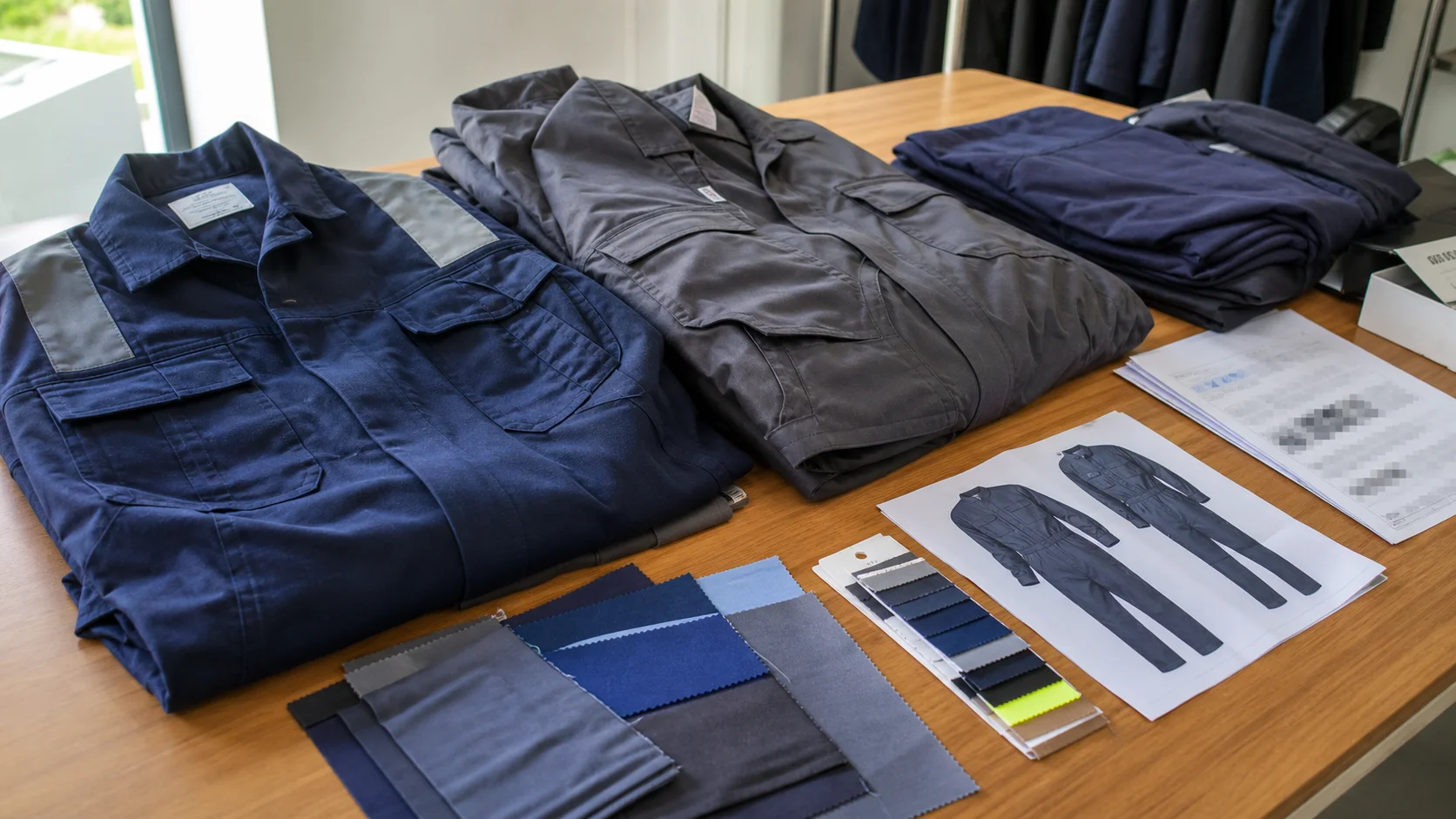
For corporate uniform buyers, the pre-production sample is the most important checkpoint. It should be made from actual or representative bulk fabric, not leftover sampling fabric. If reflective tape, embroidery, printing, or heat transfer branding is part of the design, it should be applied before wash testing. Testing only the plain fabric can miss garment-level risks.
Typical sample timelines vary by fabric availability and complexity. A lab dip may take about 5 to 10 days after color standard confirmation. A proto sample may take about 7 to 14 days if fabric is available. A pre-production sample using bulk fabric may take longer, often 2 to 4 weeks or more if custom dyeing is involved. These are practical ranges, not guarantees. Mill workload, trim sourcing, testing lab capacity, approval speed, and shipping time all affect the calendar.
Buyers who need help structuring a sourcing and inspection path can start a discussion through Fabrik’s contact page. The earlier the quality checkpoints are built into the order, the less pressure there is at final inspection.
Colorfastness risk should be checked during production, not only after packing. A final inspection can identify visible shade issues, but it cannot fully repair a poor dyeing decision. Inline checks give the buyer and factory time to isolate problems before the full order is completed.
At final inspection, the inspector should check color against the approved sealed sample, not only against memory or a digital image. Garments should be viewed under suitable lighting. Random pieces from different cartons and sizes should be compared side by side. For coveralls, front and back panels should be opened and reviewed because shade mismatch may appear between sleeves, legs, body panels, pocket panels, and collars.
Basic field checks may include dry rubbing with a white cloth, visual comparison after light steaming, and review of packaged garments for color migration. These checks do not replace laboratory testing, but they can catch obvious risks before shipment. If the order is high value or the color is difficult, production lots should be submitted for third-party testing before shipment release.
Inspection risks include testing the wrong lot, relying on a report from pre-production only, checking too few cartons, reviewing garments only under poor warehouse light, and ignoring packed storage conditions. Dark garments packed while damp or too warm may create staining, odor, mildew, or color transfer problems during transit.
Minimum order quantity affects colorfastness control because dyeing and fabric sourcing work best at practical batch sizes. For stock fabrics, coverall MOQs can sometimes start around 300 to 500 pieces per color, depending on size range and supplier policy. For custom-dyed fabric, a more common range may be 800 to 2,000 pieces per color, or a fabric MOQ based on meters rather than garments. Specialty fabrics, flame-resistant materials, high-visibility certified fabrics, or custom finishes may require higher commitments.
Lower MOQs are not always a bargain. A small order made from available market fabric may reduce upfront cost and lead time, but the buyer may lose control over repeat shade and test history. A custom dye lot costs more and takes longer, yet it gives better control over brand color and repeatability if the mill is disciplined.
Sourcing Option Typical MOQ Direction Colorfastness Control Buyer Tradeoff Stock Fabric Lower Depends on available lot and supplier records Faster, but repeat shade may be difficult Custom-Dyed Fabric Medium to Higher Better if lab dip and bulk controls are strong More cost and time, better brand consistency Garment-Dyed Coveralls Varies Can create unique appearance but needs wash control Soft hand feel, higher shade variation risk Certified FR or Hi-Vis Fabric Higher Must align with safety and performance standards Less flexibility, stronger compliance needsLead time depends on fabric availability, lab dip approval speed, bulk dyeing, testing, trim sourcing, sample approval, production capacity, inspection, and freight. A simple stock-fabric coverall may move faster, while a custom-dyed or certified program can take several weeks longer. Buyers should avoid approving unrealistic delivery dates that remove time for testing and corrective action.
Cost is also affected by testing frequency. A small order may not justify heavy laboratory testing on every variable, but a corporate rollout across multiple locations should have a stronger test plan. The cost of one failed colorfastness issue in the field can exceed the cost of proper pre-shipment verification.
The following checklist can be used during supplier qualification, pre-production review, or order follow-up. It is intentionally practical. A buyer does not need to inspect every chemical record personally, but the factory should be able to answer clearly and provide evidence where required.
A colorfastness audit should lead to a purchasing decision, not just a file of observations. Buyers should classify findings by commercial risk. A missing internal form may be a minor process gap. Poor wet rubbing on dark fabric, mixed dye lots without control, or color migration onto reflective tape are more serious because they can create field complaints and replacement claims.
Supplier approval should be conditional when color risk is manageable but not fully closed. For example, the factory may be acceptable if it agrees to fresh bulk testing, stricter roll segregation, a revised wash process, or a narrower shade band. A supplier should not be approved for a large corporate rollout if it cannot trace fabric lots, cannot provide relevant test reports, or treats color matching as a subjective visual decision only.
Buyers should also consider whether the factory is suited to repeat uniform programs. A supplier that performs well on one promotional order may not be the best option for annual replenishment. Repeat programs need record keeping, archived standards, stable fabric sourcing, and disciplined communication when mills or dye lots change.
One practical method is to create a color risk rating:
For high-risk orders, buyers should either strengthen controls or reconsider the supplier. The cheapest quote can become expensive if garments fade unevenly, stain other items, or fail customer acceptance after deployment. In uniform buying, consistency is often worth more than a small unit price saving.
Buyers evaluating long-term manufacturing partners can also review Fabrik’s background to understand the type of apparel sourcing and production coordination support that may be relevant for corporate uniform programs.
A coverall colorfastness audit is most valuable when it is done early, tied to the actual use case, and supported by clear approval samples. The buyer should define the standard, confirm the fabric route, test the right materials, and inspect production before shipment pressure takes over.
For most corporate uniform buyers, the strongest control points are simple: approve the lab dip properly, require a pre-production sample in correct fabric and trims, wash test the garment, verify bulk fabric lot control, and compare final goods against a sealed sample. These steps do not eliminate every risk, but they reduce the common failures that lead to field complaints.
The main tradeoff is between speed, cost, and control. Stock fabric can be fast. Custom dyeing can be more consistent. Higher testing adds cost but protects larger programs. Strict shade tolerance improves brand consistency but may increase rejections and lead time. The right decision depends on order value, brand requirements, worker exposure, and replenishment needs.
Best buyer position: set realistic requirements, verify them before bulk production, and refuse vague assurances when the order depends on repeat shade and wash durability.
Get a free quote from Fabrikn — your trusted B2B clothing manufacturer with 10+ years of experience. MOQ as low as 200 pieces.
Get a Free Quote →A coverall colorfastness audit is a review of how a factory controls fabric color, dye performance, shade consistency, wash durability, and dye transfer risk for coverall production. It usually includes document review, sample approval checks, fabric lot control, production inspection, and relevant laboratory testing.
The most common tests are colorfastness to washing, rubbing, perspiration, water, and light. For industrial laundry, buyers may also need tests related to higher temperature washing, detergents, chlorine exposure, or commercial laundering conditions.
Many buyers target grade 3-4 or 4 for shade change and staining, depending on the test method and end use. Wet rubbing on dark cotton or cotton-rich fabrics can be more difficult, so buyers should confirm realistic performance before locking the specification.
Both can be useful. Fabric testing confirms base material performance, while finished garment testing catches risks from trims, labels, reflective tape, embroidery, printing, heat transfers, and garment washing. For corporate uniforms, finished garment wash review is strongly recommended before bulk approval.
Deep shades require more dye and stronger process control. If dye fixation, washing-off, finishing, or fabric selection is weak, dark colors are more likely to show rubbing transfer, wash fading, staining, or shade variation between lots.
Yes, but it depends on the fabric source and factory controls. Low MOQ orders often use available stock fabric, which may be acceptable if test reports are relevant and the shade is stable. Custom-dyed low MOQ orders can be harder to manage and may carry higher cost.
A practical timeline may include 5 to 10 days for lab dips, 1 to 2 weeks for sampling if materials are available, and extra time for third-party testing. Custom dyeing, specialty trims, reflective components, or certified fabrics can extend the schedule.
The buyer should first identify whether the issue is panel-to-panel, garment-to-garment, carton-to-carton, or lot-to-lot. Affected goods should be segregated. Shipment approval should depend on severity, customer tolerance, replacement options, and whether the issue will worsen after washing.
An old report can provide background, but it is not enough for a critical order if the fabric, color, finish, mill, or dye lot has changed. Buyers should request current testing for the actual production material when colorfastness risk is meaningful.
Buyers can reduce complaints by setting clear specifications, approving lab dips and pre-production samples, wash testing finished garments, controlling fabric lots, inspecting production early, and giving users correct laundry instructions. Repeat orders should use archived standards and updated test checks.