
A product-specific outline for fitness club buyers evaluating reorder risks in custom coverall production, including fabric continuity, sizing drift,...
Fitness clubs do not usually buy coveralls in the same way a workwear distributor does, but the sourcing logic is similar: once a style is approved, the buyer needs repeatability, stable cost, and a factory that can reorder without drifting on fabric, sizing, or trim. That is where reorder risk becomes the real issue. A first order can look fine. A second or third order often reveals the weak points: fabric substitutions, color mismatch, lost pattern consistency, rising trim costs, and longer lead times when the factory reallocates capacity.
This review looks at coverall factory reorder risk from the perspective of fitness club buyers who need practical purchasing control. The goal is not just to get a quote. The goal is to keep a uniform program stable across seasons, branches, and replenishment cycles. That means checking MOQ behavior, sample approval discipline, cost structure, and the parts of production most likely to change on a reorder.
For buyers planning repeat programs, it also helps to review the factory’s broader sourcing support. A good starting point is the services page, the about us page, and the contact us page for communication flow and inquiry handling.
Coverall Reorder Risk Review for Fitness Club Buyers - Fabrikn production reference
Reorder risk is the chance that a factory cannot reproduce the approved coverall consistently when the buyer places a repeat order. In practical terms, the first order may establish a sample and a production standard, but the reorder can still change for reasons that matter to the end user: fit, seam strength, pocket placement, zipper quality, fabric hand feel, or color depth.
For fitness club buyers, that risk matters when coveralls are part of staff uniforms, maintenance wear, laundry rotation, or branded operational apparel. If a club is expanding to new locations, a uniform program usually needs continuity. A small mismatch may seem minor on a production sheet, yet in a multi-site operation it can affect brand presentation and replacement planning.
The strongest reorder programs are built on documented specifications rather than memory. A factory should not be relying on a sample hanging in the merchandising room. It should have a clear tech pack, approved lab dips, measured size specs, trim references, and a record of what was accepted on the first order.
Fitness clubs often balance brand image, frequent washing, movement comfort, and budget control. That combination can make coveralls more sensitive to factory variation than a standard bulk item. A coverall used in gym maintenance or operations may need to survive repeated laundering, contact with cleaning chemicals, and constant movement. If the fabric weight drops or the zipper quality changes, the garment fails faster.
Repeat buying is common in this category because uniforms wear out and staff counts change. The purchasing team may plan a small initial run, then reorder after internal feedback. If the factory does not track the original standard carefully, the buyer ends up approving another round of corrections, which adds cost and delays the replenishment cycle.
There is also a commercial tradeoff. A factory that offers a very low first-order price may be less disciplined on material continuity, while a more controlled supplier may quote slightly higher but protect the buyer from hidden reorder losses. The cheapest quote is rarely the lowest total cost when repeat production is expected.
MOQ is one of the first things to inspect in a reorder review. For coveralls, typical factory MOQs can vary widely depending on fabric, color, construction complexity, and whether the order includes custom labels or branded packaging. A basic solid-color coverall may be possible at a lower MOQ, while a highly customized style can require a higher minimum.
In sourcing practice, a buyer should ask two separate questions:
The answers are not always the same. Some factories accept lower reorders if the original fabric is still in stock or if production is slotted into an existing run. Others require the same MOQ again because cutting, dyeing, and trimming are set up as batch operations. Buyers should not assume that a reorder automatically gets better terms.
A practical reorder-friendly factory will explain where the minimum really comes from. If the MOQ is driven by dye lot minimums, that matters for color consistency. If it is driven by trim purchasing, that affects zipper or snap availability. If it is driven by the fabric mill, the buyer needs to know whether the fabric is open-stock or made-to-order.
Order Scenario Typical MOQ Pattern Buyer Risk Best Control Step Basic coverall, standard fabric Lower MOQ possible Spec drift if the style is not documented Lock measurements and trim codes Custom color or branded fabric Higher MOQ likely Color mismatch on reorder Approve lab dip and retain shade reference Complex construction with multiple trims Higher MOQ often required Component substitution risk List every trim and approved supplier Repeat order from same factory May be reduced if materials remain available Hidden cost increases if stock expired Confirm actual material availability before POCoverall reorder risk usually starts with fabric. A factory may present the same composition on paper, yet the hand feel, shrinkage, opacity, or durability may still shift because the mill changed yarn source, finishing method, or batch density. If the coverall is used around gym cleaning, storage, or heavy activity, this kind of variation is not just cosmetic.
Buyers should confirm fabric details in writing. That includes fiber composition, construction type, weight per square meter or ounce, finish, stretch content if any, and wash performance expectations. If the first order used a brushed poly-cotton blend, the reorder should not quietly move to a different blend or a lighter weight because “it looks similar.”
Trims deserve the same discipline. Zippers, snaps, elastic, drawcords, labels, and reflective tape can all change sourcing over time. A zipper from one supplier may pass on the first order and fail later under repeated laundering. Elastic can lose recovery. Thread quality can affect seam durability. Even a woven label can become itchy or fade sooner if the factory changes its supplier.
A reorder review should treat fabric and trims as controlled components, not flexible accessories. If the buyer cannot identify the exact material and trim references, the factory has too much room to substitute.
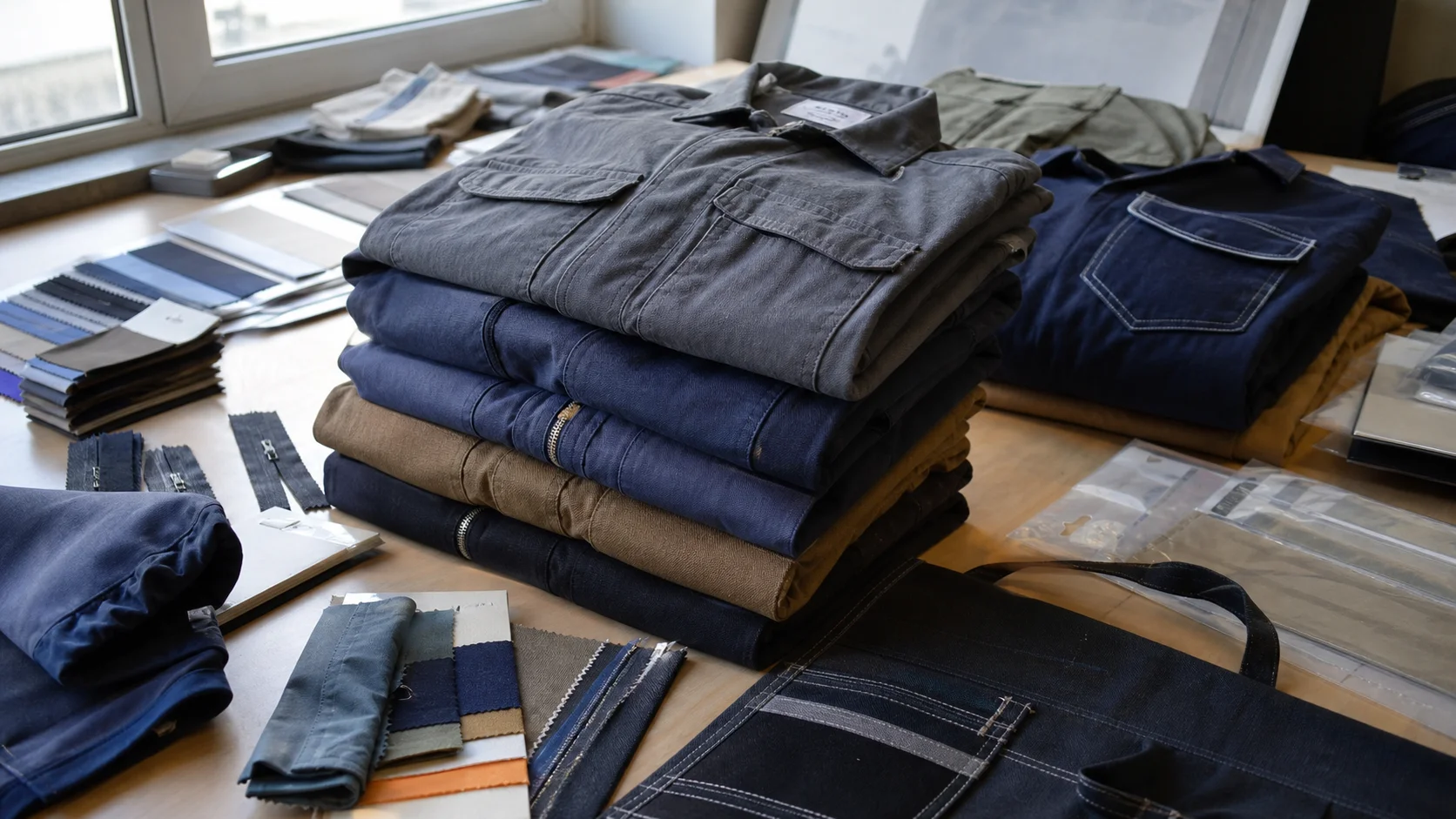
For fitness club buyers, one useful sourcing habit is to ask for a material approval pack before production. That pack should ideally include fabric swatches, trim cards, color references, and measured garment specs. If a factory resists this step, it is often a sign that repeatability may be weak.
The sample process is where many reorder problems can be prevented. A serious factory should distinguish between development samples, fit samples, pre-production samples, and shipment reference samples. If all of these stages are blurred together, the buyer has less evidence to rely on when a reorder is questioned.
For a coverall program, the buyer should keep at least one approved reference sample from the original order. Better still, the purchasing team should retain a photo record, a measurement sheet, and notes about any accepted tolerance. If the original team has moved on, those records become even more important.
The sample approval steps should normally include the following:
On reorder, the buyer should ask whether the factory will reference the original sample or recreate the style from the tech pack alone. If the factory says it will “make the same as last time” without showing any documentation, that is a warning sign. A tech pack plus physical reference is far safer than memory.
Lead time is not one number. It depends on whether the factory must re-source fabric, reserve dyeing capacity, secure trims, and schedule sewing lines. A reorder can actually take longer than the first order if any of those inputs are no longer on hand.
For fitness club buyers, this matters because uniform replacement often happens on a fixed cycle. Staff count changes, seasonal wear increases, or a new branch opens and the buyer needs replenishment fast. A factory that quotes an attractive production time without confirming material availability can miss the delivery window.
The biggest lead-time dependencies usually include:
Buyers should separate sampling time from bulk time. A reorder may need only minor approval, or it may require a fresh sample round if the factory changed materials. A realistic sourcing plan builds in a buffer. If the program is mission-critical, the reorder should be placed before the last stock is depleted.
Cost on reorder is often misunderstood. Buyers may expect the same or lower price because the style is already developed. That can happen, but it is not guaranteed. Fabric prices move. Labor rates change. Packaging costs rise. Small runs can become more expensive if the factory no longer has the original fabric lot or trim package.
There are also hidden cost shifts to watch for:
The right buying approach is to ask the factory for a reorder price structure, not just a spot quote. A useful quotation should show whether the price is valid only for the same quantity, the same fabric, and the same trim package. If a reorder price is tied to “subject to material availability,” the buyer should treat it as a provisional number, not a contract price.
In a competitive sourcing environment, a buyer may be tempted to split orders across two factories to chase lower pricing. That can reduce one factory’s MOQ burden, but it increases color and fit inconsistency. For branded fitness club apparel, consistency is often worth more than a small unit saving.
Inspection is where reorder drift is usually exposed. Even when the approved sample was strong, bulk production can still vary. Coveralls are especially sensitive because they have larger surface area, multiple seams, and hardware that can be misapplied or swapped.
Typical inspection risks on reorder include:
It is worth deciding early whether the reorder will be checked with a basic in-line inspection or a more formal pre-shipment inspection. For larger programs, a third-party inspection can be a sensible cost because it reduces acceptance risk. For smaller orders, at least require the factory to send measurement photos, bulk fabric references, and packing confirmation before shipment.
Buyers should also ask the factory how it handles nonconforming units. A real corrective process should include quarantine, rework, and sign-off before packing. If the factory cannot explain that process, the buyer is taking on more risk than the purchase order suggests.
A repeat order is safer when the buyer treats the first order as a long-term master reference. The following checklist is practical for fitness club procurement teams handling coveralls as recurring uniform stock.
One useful commercial rule is to test the factory’s memory. If the sales contact cannot quickly confirm the original fabric, size range, and trim package, the reorder process may already be fragile. Good suppliers do not rely on recollection. They rely on controlled documents.
Not every coverall factory is equally suited to reorder programs. Some are built for one-off promotional jobs. Others are organized for repeat production and more stable sourcing. Fitness club buyers should favor the second type, even if the quote is a little higher. The savings from fewer reworks, fewer delays, and fewer quality disputes often outweigh the initial difference.
When evaluating a factory, look for signs of process discipline rather than sales confidence alone. Useful indicators include clear spec handling, sample traceability, straightforward MOQ explanations, and a willingness to state what can and cannot be repeated exactly. A supplier that overpromises on reorder speed is not necessarily the safer option.
It can also help to check whether the factory supports broader sourcing services such as fabric development, trim sourcing, and packaging coordination. For buyers comparing suppliers or preparing a longer-term uniform program, the factory’s service structure can matter as much as its quote sheet. The services page is a good place to review scope before opening a pricing discussion.
When the buyer is ready to move from review to request, the best next step is a structured inquiry. A clean brief should include quantities, size range, fabric target, branding method, expected reorder cycle, and shipping target. That makes it easier for the supplier to judge feasibility. The contact us page can be used to start that conversation.
Coverall reorder risk is not only a production issue. It is a sourcing and continuity issue, especially for fitness club buyers who need uniforms to stay consistent across branches, seasons, and replenishment cycles. The first order can mask weak control. The reorder exposes it.
The safest buying strategy is to lock down the fabric, trims, measurements, sample approvals, and inspection plan before the first bulk order is placed. Buyers should also ask clear questions about MOQ, lead time, and reorder pricing rather than assuming those terms will improve with repetition. In workwear sourcing, repeatability is a commercial asset. Factories that can prove repeatability are usually worth closer attention than those that only quote aggressively.
For a broader look at supplier capabilities and the next step in inquiry planning, review the about us page as well. A factory that understands repeat programs will usually make its process easier to inspect from the start.
Get a free quote from Fabrikn — your trusted B2B clothing manufacturer with 10+ years of experience. MOQ as low as 200 pieces.
Get a Free Quote →The main risk is that the repeat order does not match the approved first order in fabric, fit, trim, or workmanship. That can happen if the factory changes suppliers, loses the original spec record, or treats the reorder as a fresh style instead of a controlled repeat.
There is no single standard MOQ. Basic styles may allow lower minimums, while custom fabrics, colors, and trims usually push the MOQ higher. Buyers should ask for both first-order MOQ and reorder MOQ because they are often different.
Keep the approved lab dip, fabric swatch, and production sample. Ask the factory whether the same dye lot can be repeated or whether a new lot is required. If color is brand-critical, include shade tolerance in the approval process.
Yes, at least in simplified form. A reorder should still be checked against the approved master sample and spec sheet. If any material or trim changes are proposed, the buyer should request updated approval before bulk production starts.
Fabric rebooking, dyeing queues, trim sourcing, pattern adjustments, and seasonal factory capacity are the most common reasons. A reorder can take longer than expected if the factory no longer has the original materials in stock.
Not usually. A low quote can be useful, but repeat orders depend on stable quality and material continuity. If the factory cannot explain how it will repeat the approved style, the total cost of rework and delay may be higher than the savings.