
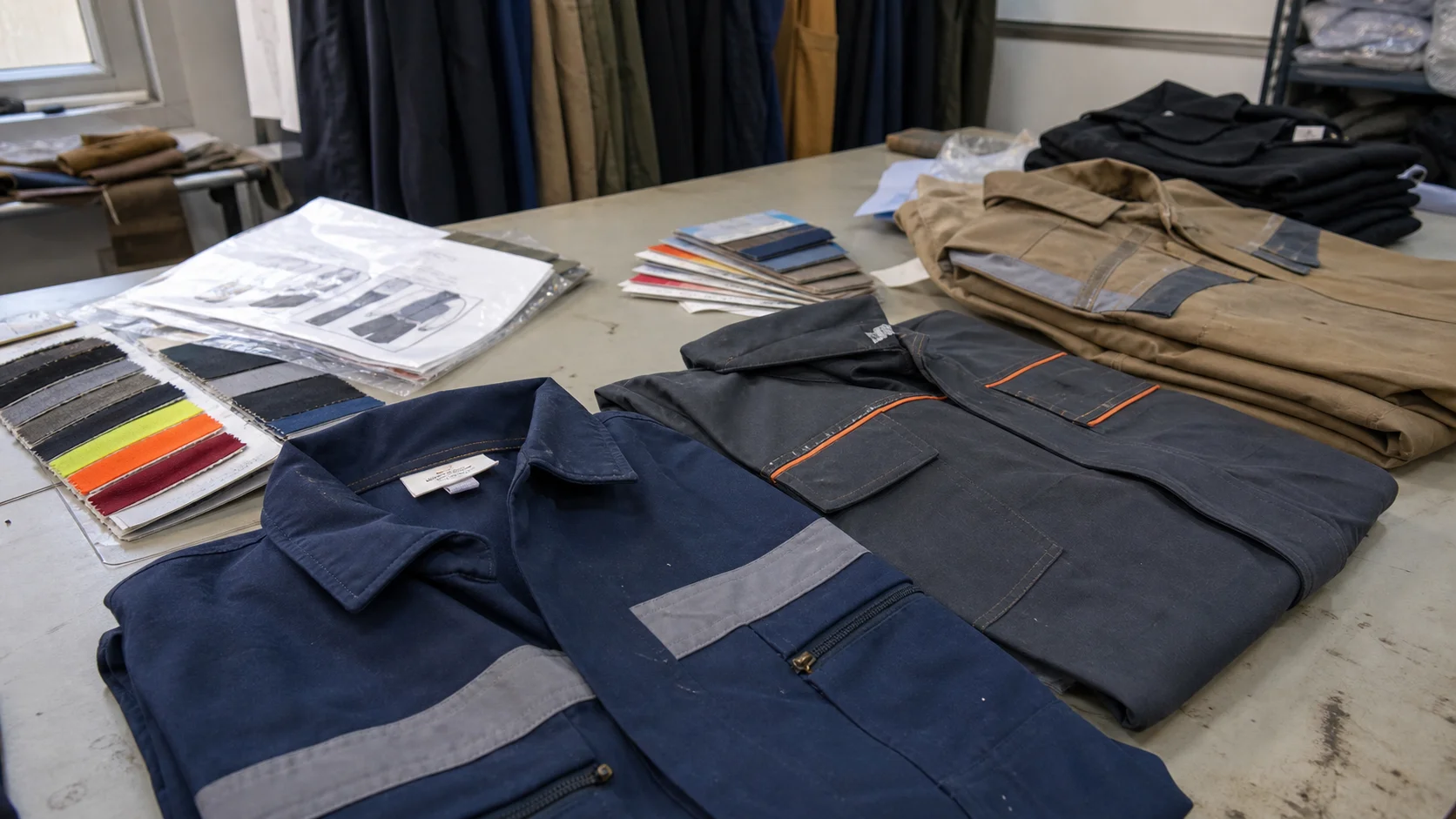
A practical SEO outline for corporate uniform buyers evaluating coverall fit blocks, size consistency, mobility, and production readiness before bulk approval.
Coverall Fit Block Review for Corporate Buyers - Quality & Inspection manufacturing guide
A coverall order fit block review is one of the most important quality checkpoints for corporate uniform buyers. Coveralls are not simple tops or trousers. They combine shoulder fit, torso length, sleeve mobility, seat ease, thigh room, and leg length in one garment. A small error in one area can make the entire uniform uncomfortable or unsafe for daily work.
For corporate buyers, the issue is not only appearance. Coveralls are worn by maintenance teams, engineers, warehouse crews, production operators, field technicians, cleaning teams, and service staff. These users bend, climb, kneel, reach overhead, drive vehicles, handle tools, and sometimes wear base layers or protective equipment underneath. The fit block must allow these movements without excess bulk that catches on machinery or looks unprofessional.
Fit problems also create commercial waste. If a company orders 2,000 units and the torso is too short, workers may reject the garment even when fabric, color, logo, and stitching are correct. If the thigh is too narrow, the user may size up, which then makes the shoulder and sleeve too large. Returns, rework, emergency replenishment, and employee complaints all become expensive.
A disciplined fit block review reduces these risks before bulk production. It gives the buyer, supplier, and quality team a shared reference for the approved shape of the garment. The goal is not to chase a fashion fit. The goal is a practical, repeatable coverall block that suits the job role, brand image, washing method, climate, and wearer population.
Purchasing judgment: do not approve a coverall fit block only because the sample looks neat on a hanger. The correct test is whether the garment supports real work movement across the intended size range.
A fit block is the base pattern shape used to build the coverall order. It controls the garment’s proportions before style details are added. Pockets, reflective tape, contrast panels, embroidery, zippers, snaps, and cuff finishes can change the look, but the fit block controls how the garment sits on the body.
In corporate uniform sourcing, the fit block is usually reviewed through a development sample, fit sample, and size set. The supplier may use an existing workwear block, adapt the buyer’s previous uniform, or develop a new block from a measurement chart. Each option has a different risk profile.
Corporate buyers should ask whether the proposed block is based on woven or knit assumptions, men’s or women’s proportions, regular or relaxed ease, and whether the block includes allowance for industrial laundry shrinkage. A coverall block for light office maintenance will not necessarily suit heavy-duty utility teams working in cold weather with layers underneath.
For buyers building a long-term uniform program, the fit block should be treated as an asset. Once approved, it should be documented in a technical pack, measurement chart, graded size chart, pattern reference, and sample archive. This helps maintain consistency across repeat orders and supplier transitions. Sourcing partners that support development, production coordination, and inspection services can help structure this process; buyers can review related support options through Fabrikn’s services.
The buyer’s objective is to approve a block that balances comfort, durability, safety, brand presentation, and production repeatability. These goals can conflict. A looser fit improves movement and layering, but too much excess fabric may look untidy or create snagging risk. A slimmer fit improves appearance, but may fail when workers bend or squat.
The first decision is the use case. A coverall for automotive workshop staff may need dark colors, abrasion-resistant fabric, action back panels, knee reinforcement, and easy sleeve movement. A coverall for facility management may need cleaner styling, moderate ease, concealed fasteners, and strong logo placement. A coverall for food production or clean-area work may prioritize minimal external pockets, controlled closures, and wash durability.
Corporate buyers should define these requirements before reviewing samples. If the buyer only says “make it fit well,” the supplier will follow its own assumptions. Those assumptions may be reasonable, but they may not match the buyer’s workforce.
The strongest fit block reviews involve both technical measurement and wearer trial feedback. A garment can meet the spec but still feel restrictive during real movement. A garment can feel comfortable but measure outside tolerance because the trial user selected the wrong size. Both inputs matter, but neither should be used alone.
Coverall measurement specs need more detail than many corporate buyers expect. Chest, waist, hip, and inseam are not enough. The body length and rise are especially important because the garment connects upper and lower body movement. If the vertical balance is wrong, users will feel pulling when lifting arms, sitting, or bending.
A good coverall measurement chart should include point-of-measure instructions, tolerances, size grading, and whether measurements are taken before wash or after wash. The buyer should also specify whether the garment is measured closed, laid flat, relaxed, and without stretching.
Measurement Point Why It Matters Typical Review Risk Chest width Controls upper body ease and layering allowance Too narrow causes pulling across front and armhole Waist width Affects comfort, belt fit, and seated posture Elastic or pleats may distort measurement consistency Hip or seat width Controls bending, squatting, and pocket access Too tight creates stress at seat seam and crotch Across shoulder Controls posture and sleeve hang Too wide looks oversized; too narrow restricts reach Sleeve length Controls wrist coverage and glove compatibility Wash shrinkage can make sleeves too short Armhole depth Affects movement and underarm comfort Low armhole can pull the whole garment when arms lift Back length or torso length Controls vertical comfort from neck to crotch Short torso is one of the highest rejection risks Front rise and back rise Affects seated comfort and crotch position Poor balance causes pulling or sagging Thigh width Controls squat and kneel movement Too narrow forces users to size up Inseam Controls leg length and footwear interface Too long creates dragging; too short exposes socks or boots Leg opening Controls fit over boots and appearance Too narrow may not pass over work bootsMeasurement tolerance should be realistic. A common tolerance range for woven coveralls might be about 1 cm for small components, 1.5 cm for medium body widths, and 2 cm for larger lengths, depending on fabric, wash process, and factory capability. Buyers should avoid over-tight tolerances that look good in a document but fail in normal production. At the same time, loose tolerances on torso length, thigh width, and sleeve length can create visible and functional inconsistency.
Grading is another common weak point. The sample size may be acceptable, but larger sizes may gain too much width and not enough length. Smaller sizes may become too short in the body. Corporate programs often cover a broad wearer population, so the buyer should check the grade rules rather than only approving the base size.
Fabric selection has a direct effect on fit. The same pattern will behave differently in a lightweight poly-cotton twill, heavy cotton drill, stretch canvas, flame-resistant fabric, or recycled polyester blend. Corporate buyers should not approve the fit block in one fabric and assume it will behave the same in another.
Typical coverall fabrics may range from about 150 gsm for lightweight indoor or warm-climate use to 300 gsm or more for heavy-duty workwear. Many corporate uniform programs use poly-cotton twill in the 180-245 gsm range because it balances durability, cost, color retention, and wash performance. Heavy cotton-rich fabrics may feel more breathable but can shrink more and crease more. Polyester-rich fabrics may dry quickly and hold color better, but they can feel warmer and may shine under abrasion.
Stretch fabric can improve movement, especially in shoulders, seat, and knees. It also adds sourcing complexity. Stretch recovery, shrinkage, seam strength, and shade consistency must be controlled. A poor stretch fabric may feel good in the sample and become baggy after repeated wear or industrial wash. The buyer should request fabric composition, yarn or construction details where relevant, gsm, shrinkage test results, colorfastness results, and care instructions.
Trim placement can also change fit. A heavy front zipper can stiffen the torso. Reflective tape around thighs or arms can reduce comfort if placed without movement allowance. Large cargo pockets can pull the side seam if loaded with tools. Knee patches may restrict bending if they are positioned too high or too low. These are not cosmetic details; they affect whether the uniform works in the field.
A structured sample approval process prevents confusion between design approval, fit approval, and production approval. Many order problems start when a buyer approves a nice-looking sample without confirming measurements, fabric behavior, and graded sizes. For coveralls, the approval route should be more disciplined.
The development sample confirms the general style, construction approach, pocket layout, trims, and first fit direction. It may be made in available fabric if the final fabric is not ready, but this must be clearly recorded. Buyers should not treat a development sample as bulk approval unless it is made in confirmed fabric and trims.
The fit sample should be made in the correct or very close fabric quality. The buyer reviews measurements against the spec and conducts a movement check. Trial wearers should test standing, sitting, arm lift, forward reach, squat, knee bend, and boot compatibility. Feedback should be specific: “tight across back when reaching forward” is useful; “feels wrong” is not.
If the first fit sample has significant issues, request a revised fit sample before moving to size set. Pattern changes should be documented clearly. Common corrections include adding back length, adjusting crotch depth, increasing thigh ease, raising armhole shape, changing sleeve pitch, or rebalancing front and back rise.
The size set checks whether the approved block grades correctly across sizes. For small programs, buyers may review core sizes only. For larger corporate orders, review the full size range or at least small, medium, large, and upper-end sizes. If women’s or short/tall sizes are included, these should not be assumed from the men’s regular block without review.
The pre-production sample should represent the exact approved fabric, color, trims, branding, labels, packaging, and workmanship standard. This is the sample the factory should follow for bulk production. Buyers should keep a sealed or clearly marked approved sample for inspection reference.
Approval comments should be written, dated, and linked to sample version numbers. Verbal comments are risky. A supplier may interpret “slightly longer body” differently from the buyer. Better instruction would state the exact measurement change, the size affected, and whether the grade rule should change across all sizes.
Size set review is where many coverall programs either become reliable or start to drift. The middle size can look acceptable, but the full range may reveal poor grading. Corporate uniform buyers should pay close attention to the largest and smallest sizes because these are often where employee dissatisfaction is highest.
A practical size set review starts with measurement. Each sample should be measured against the approved chart. Variances should be recorded by point of measure. The buyer should separate minor measurement variances from true pattern problems. One sleeve measuring 0.5 cm outside tolerance may be a sewing issue. A full size range with consistently short torso length is a grading issue.
Fit models or wearer trials should represent the intended workforce as closely as possible. If the buyer’s staff includes both office supervisors and field technicians, test the coverall on people who perform the actual tasks. A garment that passes a static office fitting may fail during climbing, kneeling, or overhead work.
Size Set Check What to Look For Buyer Decision Small sizes Body length, sleeve length, shoulder width, and crotch comfort Reject if grading simply shrinks all dimensions without preserving movement Middle sizes Base fit, style balance, pocket placement, and ease Use as the main comparison point for approved fit Large sizes Torso length, seat ease, thigh width, and stress points Check whether extra width is enough without making legs or sleeves excessive Tall or short options Vertical proportions rather than only inseam changes Approve only if body length and rise are adjusted sensibly Women’s fit Hip shape, waist position, rise balance, and bust ease Avoid relabeling a smaller men’s block as women’s fitCorporate buyers should also decide whether they need dual fit blocks. A unisex coverall can work for some industrial programs, especially where loose functional fit is acceptable. It may not satisfy a diverse workforce if the garment is worn daily and employee comfort is a priority. A separate women’s block increases development cost and inventory complexity, but it can reduce complaints and improve adoption.
Once the fit block is approved, production still needs control. A factory can follow the approved pattern and still deliver inconsistent fit if cutting, sewing, pressing, washing, or packing is poorly managed. Coveralls have long seams and many joined panels, so small handling differences can accumulate.
Inspection should include both workmanship and measurement checks. Buyers should define acceptable quality limits, inspection level, critical defects, major defects, and minor defects. For uniform programs, critical issues may include wrong size labels, unsafe sharp trims, insecure snaps, broken zippers, missing reflective tape, incorrect logo, open seams, or fabric defects in visible areas.
Inline inspection is useful for coveralls because it catches problems before the full batch is completed. If the first production lot has a short body length, the buyer wants that discovered before thousands of units are sewn. Final random inspection is still needed, but it should not be the only quality control step for a high-volume corporate program.
Buyers should also confirm whether inspection measurements are taken before or after finishing. If the garment is garment-washed, pressed, or tumble-dried, the final measurement point should be clearly defined. If the order uses industrial laundry testing, the buyer should define expected shrinkage after a set number of cycles.
Companies needing structured production support, supplier coordination, or inspection planning can review quality and sourcing service options before placing bulk coverall orders.
Minimum order quantity depends on fabric availability, dyeing requirements, trim customization, logo methods, and factory capacity. For basic stock fabric coveralls, typical MOQ may start around 300-500 pieces per color, though some suppliers may accept lower quantities at a higher unit cost. For custom-dyed fabric, special trims, flame-resistant materials, or certified reflective tape programs, MOQ can move to 800-1,500 pieces or more per color. Large corporate uniform programs often run into several thousand units when size ratios and replenishment stock are included.
MOQ should be reviewed by size and color, not only total units. A supplier may accept 1,000 pieces total but still require practical cutting quantities per size. If the buyer has too many sizes, colors, or logo variations, production efficiency drops. This can increase price, extend lead time, or create quality inconsistency.
Lead time also depends on the stage of development. A simple repeat order using approved fabric and block may take about 45-75 days after deposit and final approval, depending on capacity and logistics. A new custom coverall program with fabric development, lab dips, trims, fit samples, size set, pre-production sample, and bulk production may take 90-150 days or longer. Certified protective fabrics, complex testing, or delayed approvals can extend this timeline.
Order Scenario Typical MOQ Range Lead-Time Considerations Basic coverall in available fabric 300-500 pieces per color Faster sampling, fewer fabric risks, limited color flexibility Custom color corporate coverall 500-1,200 pieces per color Lab dip approval, bulk dyeing, shade band control Heavy-duty workwear coverall 800-1,500 pieces per color Fabric weight, seam strength, reinforcement, trim sourcing Reflective or safety coverall 800-2,000 pieces per style Tape certification, placement approval, wash testing Multi-site corporate rollout Varies by size ratio and replenishment plan Staggered deliveries, size forecasting, packaging by locationBuyers should build approval time into the calendar. Fit comments, revised samples, lab dip review, logo strike-off approval, and wearer trials all take time. Rushing these steps usually moves risk into bulk production. If the uniform launch date is fixed, it is better to reduce style complexity than compress fit review.
Before approving bulk production, corporate buyers should ask direct questions. The answers reveal whether the supplier understands fit control or is simply trying to move the order forward.
A capable supplier should answer these questions without treating them as unusual. If the supplier cannot explain the block, shrinkage, grade rules, or inspection method, the buyer should slow down. A low price is not a saving if the order fails at wearer acceptance.
For buyers comparing options or building a new coverall specification, it can be useful to discuss project requirements early through Fabrikn’s contact page. Clear information about use case, size range, target price, fabric preference, delivery date, and inspection expectations improves the sourcing conversation.
The best coverall fit block is not always the most tailored or the cheapest. It is the block that performs consistently for the wearer group and production reality. Corporate buyers should make decisions with tradeoffs in mind.
A relaxed fit is safer for movement and size flexibility. It is often the better choice for maintenance, utility, and field work. The downside is a less sharp appearance, especially on smaller wearers. A tailored fit improves brand presentation but increases the risk of complaints if workers are active or wear layers.
A unisex block reduces complexity and inventory burden. It can be suitable for short-term programs, visitor coveralls, or roles where the fit expectation is basic. The tradeoff is weaker satisfaction across diverse body shapes. Separate men’s and women’s blocks cost more to develop and stock, but they may be justified for daily uniforms in larger organizations.
Stock fabric reduces MOQ and lead time. It is practical for smaller orders and urgent launches. The tradeoff is limited control over shade, hand feel, and long-term continuity. Custom fabric supports better brand matching and performance requirements, but it increases MOQ, lead time, and approval work.
One buyer mistake is over-customization. Too many pocket types, contrast panels, special trims, and size variations make the order harder to manage. Each detail creates another inspection point. For corporate programs, simple and repeatable often beats complex and distinctive, especially when the garment is workwear rather than promotional apparel.
Direct purchasing view: approve the most reliable fit block that meets the job requirement. Do not pay for complexity that workers do not value, and do not cut fit review time to protect a launch date.
A clear checklist helps prevent missed decisions during sample approval. Buyers can adapt the following points for internal quality review, supplier communication, or third-party inspection briefing.
Good documentation protects the buyer during repeat orders. It also prevents disputes. If the approved sample and written spec disagree, production teams may follow the wrong reference. The buyer should keep the latest technical pack, measurement chart, approval comments, fabric test results, trim cards, logo approvals, size ratio, packaging instructions, and inspection criteria in one controlled file.
Photos are helpful, but they do not replace measurements. A front, back, side, inside construction, and close-up trim photo set can support communication. Each photo should match a sample version. If a revised sample changes the pocket position or sleeve length, older photos should be archived rather than left in circulation.
Repeat orders need special caution. Factories may change fabric lots, operators, subcontracted processes, or trim suppliers. Even when the style code is the same, buyers should request a new pre-production sample or at least a top-of-production sample for approval. A stable fit block still needs production control.
Buyers evaluating long-term manufacturing partners may also want to understand company structure, operating approach, and service scope. Background information is available through Fabrikn’s about page.
A coverall order fit block review for corporate uniform buyers is a practical risk-control step. It protects comfort, safety, appearance, and budget. The buyer should review the block through real measurements, real movement, correct fabric, proper size grading, and clear inspection criteria.
The most important areas are torso length, crotch balance, shoulder movement, seat and thigh ease, sleeve length, and leg opening. Fabric shrinkage, trim placement, reflective tape, pocket load, and laundry method can all change the final result. A sample that looks acceptable in a showroom can still fail on the job if these details are ignored.
Corporate buyers should treat the approved fit block as a controlled standard, not a casual sample. Document it, test it, inspect against it, and protect it during repeat orders. That discipline is what turns a coverall purchase from a one-time apparel order into a reliable uniform program.
Get a free quote from Fabrikn — your trusted B2B clothing manufacturer with 10+ years of experience. MOQ as low as 200 pieces.
Get a Free Quote →A coverall fit block review is the technical assessment of the base pattern used for a coverall order. It checks whether the garment shape, measurements, grading, and movement allowance are suitable for the intended corporate uniform users before bulk production begins.
A coverall combines upper and lower body fit in one garment. Shoulder movement, torso length, crotch depth, seat ease, thigh width, and inseam must work together. If one area is wrong, the wearer may feel pulling or restriction across the entire garment.
Torso length is one of the most critical measurements because it affects bending, sitting, reaching, and crotch comfort. Chest, shoulder, sleeve, seat, thigh, rise, and inseam measurements are also important and should be reviewed together.
For small repeat orders using an already proven block, a full size set may not always be necessary. For new programs, large rollouts, new fabrics, or broad size ranges, size set approval is strongly recommended before bulk cutting.
Typical MOQ may start around 300-500 pieces per color for basic coveralls using available fabric. Custom colors, heavy-duty fabrics, safety trims, or special certification requirements often push MOQ to 800-1,500 pieces or more per color or style.
A repeat order with approved materials may take about 45-75 days after final approval, depending on supplier capacity and logistics. A new development program with fabric approval, fit samples, size set, pre-production sample, and bulk production may take 90-150 days or longer.
A unisex block can work for some practical workwear programs, especially where a relaxed fit is acceptable. For daily uniforms across a diverse workforce, separate men’s and women’s blocks may improve comfort and adoption, though they increase development and inventory complexity.
Common risks include measurement drift, short torso length, weak crotch seams, twisted legs, uneven pocket placement, zipper waviness, shade variation, shrinkage after wash, wrong labels, and incorrect size ratios.
Yes, whenever possible. Fabric weight, stretch, shrinkage, and stiffness can change the fit. If a development sample is made in substitute fabric, the buyer should still request a fit or pre-production sample in confirmed bulk fabric before final approval.
Buyers should review the size chart, fit ease, and job movement needs before advising employees to size up or down. If many workers fall between sizes, the block or size grading may need adjustment. A wearer trial can reveal whether the issue is sizing communication or pattern balance.