
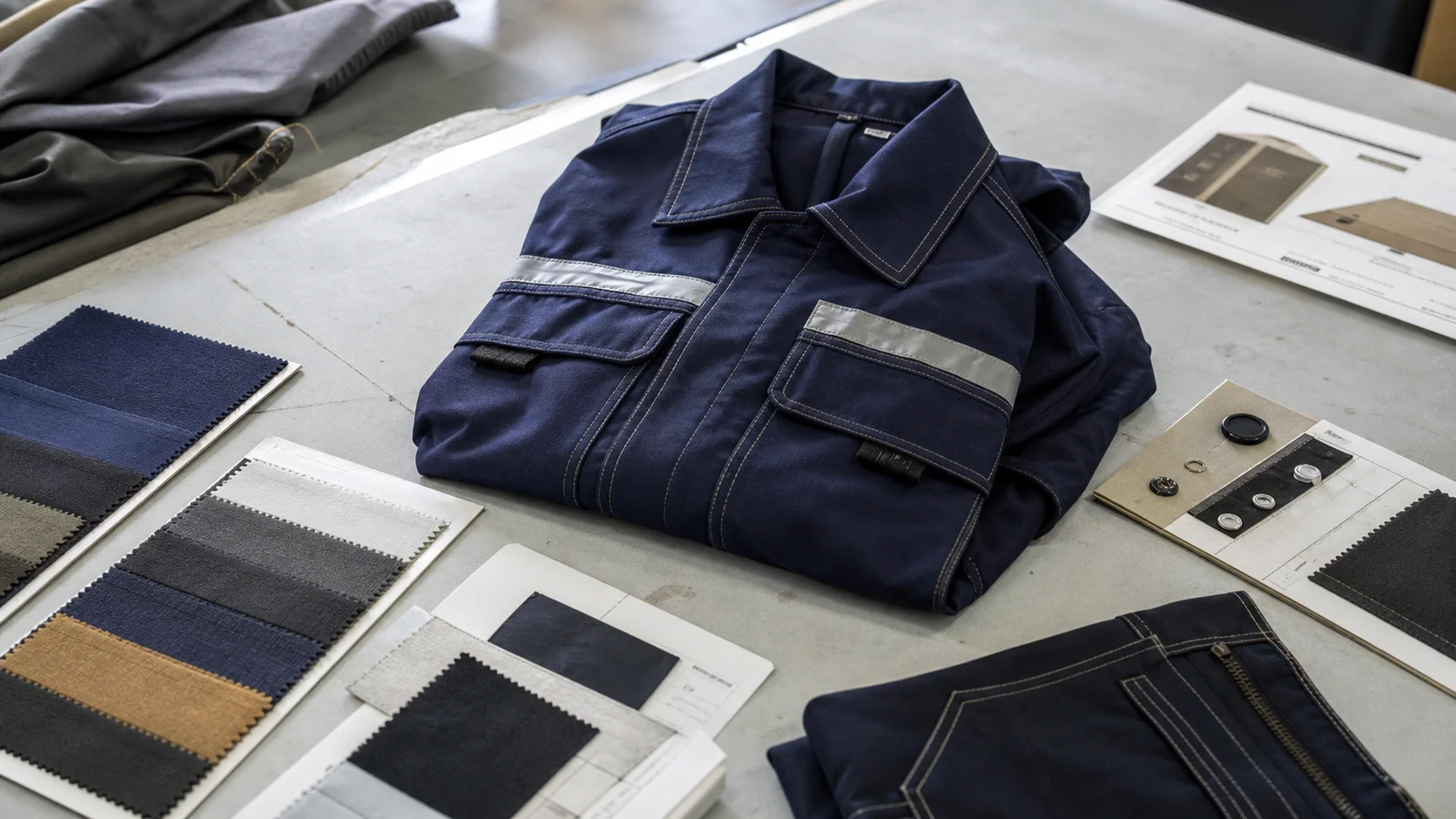
A product-specific landed cost outline for corporate uniform buyers ordering coveralls, covering fabric, decoration, packaging, inspection, freight,...
Coverall Order Landed Cost Guide for Buyers - Quality & Inspection manufacturing guide
A coverall order landed cost guide for corporate uniform buyers should do more than explain the factory price. The quoted garment price is only one part of the real cost of getting compliant, wearable, correctly branded coveralls into a company’s stores, warehouses, plants, or field teams.
For corporate uniform buyers, landed cost is the total cost of ownership for the order by the time it reaches the required delivery point. It includes the garment manufacturing cost, fabric and trims, branding, packaging, quality checks, freight, insurance, customs duty, taxes, documentation, local handling, and sometimes warehousing or distribution.
This matters because coveralls are not casual promotional apparel. They are often used in environments where fit, durability, washing performance, color consistency, and safety details affect daily operations. A low unit price can become expensive if the garment shrinks badly, zippers fail, reflective tape peels, pockets are incorrectly placed, or cartons arrive without clear size and department labeling.
The best coverall price is not the lowest FOB quote. It is the lowest reliable landed cost for garments that pass inspection, meet the buyer’s specification, and arrive in time for deployment.
Buyers comparing suppliers should treat landed cost as a purchasing control tool. It helps separate a genuinely competitive offer from a quote that hides costs in sampling, rework, air freight, inspection failures, customs delays, or replacement stock.
Corporate uniform programs also carry internal costs. If a procurement team has to manage repeated sample corrections, chase missing labels, or handle complaints from wearers, the order becomes more expensive even when the invoice price looks attractive. Strong specifications and inspection planning reduce those hidden costs.
A practical landed cost calculation starts with the commercial terms. Buyers should first confirm whether the price is EXW, FOB, CIF, DAP, or DDP. Each term shifts responsibility for freight, insurance, duty, taxes, and customs clearance. A quote that looks cheaper under EXW may cost more after inland transport, export documentation, and forwarder handling are added.
For most international corporate uniform programs, FOB is a common comparison point because it includes delivery to the port of export but leaves international freight and import costs visible to the buyer. DDP can be convenient for smaller or less experienced importers, but the buyer should still ask for a cost breakdown to understand duty assumptions, delivery scope, and who carries customs risk.
The following formula is a useful starting point:
Garment cost + sample and development cost + inspection cost + export packing + inland transport + international freight + insurance + customs duty + taxes + brokerage + destination handling + final delivery = landed cost.
For corporate buyers, the landed cost should then be divided by the number of accepted garments, not simply the number ordered. If 2% of garments are rejected or held for repair, the usable unit cost rises. This is why quality planning belongs inside the landed cost calculation, not outside it.
These questions sound basic, but they prevent most quote comparison errors. A buyer comparing a fully packed FOB price against a basic EXW sewing price is not comparing equivalent offers.
Coveralls have many specification variables that affect cost. The biggest mistake is asking suppliers to quote “standard coveralls” without a technical package. Every supplier may interpret that phrase differently. One may quote a light poly-cotton fabric with basic plastic snaps. Another may quote heavier cotton twill with branded YKK-style zippers, bar tacks, action back, and reinforced knees.
Fabric is usually the largest cost driver. Common corporate uniform coverall fabrics include poly-cotton twill, 100% cotton twill, cotton-rich blends, ripstop, stretch twill, and flame-resistant fabrics. For general industrial uniforms, many buyers specify poly-cotton blends in the approximate 180-260 gsm range. Heavy-duty workwear may require 260-320 gsm or more, depending on climate and durability expectations.
A lighter fabric lowers garment cost and freight weight, but it may reduce abrasion resistance and perceived quality. A heavier fabric can improve durability but may be uncomfortable in warm environments and increase shipping cost. The right choice depends on usage, laundry method, climate, and replacement cycle.
Finishes can add meaningful cost. Wrinkle resistance, oil repellency, water repellency, anti-static performance, flame resistance, and high-visibility compliance each require clearer testing expectations. Buyers should not accept vague terms such as “waterproof style” or “FR-like fabric.” If performance matters, the purchase order should name the required standard, test method, wash durability, and certificate expectations.
Flame-resistant coveralls require particular caution. The cost is higher because compliant fabrics, trims, thread, reflective tape, and labels must match the relevant safety requirement. Substituting a non-compliant zipper tape or embroidery thread can undermine the garment’s performance. Buyers should request fabric test reports, trim declarations, and care label accuracy before bulk production.
Construction affects both labor cost and inspection risk. More pockets, flaps, gussets, elastic inserts, reflective panels, knee patches, tool loops, and reinforced seams add sewing time. A simple two-chest-pocket coverall will not cost the same as a utility coverall with multiple cargo pockets, hidden snaps, action back pleats, elastic waist, reflective tape, and bartacked stress points.
Buyers should define seam type and reinforcement points. Common stress areas include crotch seams, pocket corners, sleeve openings, waist seams, zipper base, and side pocket access points. Bar tacks are inexpensive compared with field failures, but they still need to be specified.
Trim quality is a frequent source of failure in coverall orders. Zippers, snaps, hook-and-loop tape, elastic, sewing thread, reflective tape, buttons, woven labels, and care labels all influence durability and compliance. Zipper failure is especially costly because it often makes the garment unusable.
Buyers should specify zipper length, material, puller style, color, tape quality, and whether replacement or repair is acceptable. Reflective tape should be tested for wash performance and adhesion if heat applied. Woven labels should not bleed or irritate the wearer. Care labels should match actual fabric composition and washing limits.
Minimum order quantity is one of the first commercial constraints in coverall sourcing. Typical MOQ ranges vary by supplier, fabric availability, color, and branding complexity. As a cautious planning range, buyers may see MOQs from 300-500 pieces per style for basic stock fabrics and 800-1,500 pieces per style or color for custom-dyed fabrics or specialized materials. Flame-resistant or certified fabrics can require higher fabric MOQs depending on the mill.
Size breakdown also affects feasibility. An order of 500 pieces spread across ten sizes may be harder to manage than the same volume across five core sizes. Very small quantities in extreme sizes can increase cutting inefficiency or lead to shortages if the supplier applies fabric consumption averages too aggressively.
A disciplined sample process reduces landed cost risk. Buyers should expect several approval steps, especially for new suppliers or new coverall designs.
Sampling is not just a formality. It is where costly misunderstandings should be discovered. If a logo is 2 cm too low, pocket access is awkward, or the crotch seam restricts movement, fixing it during sampling is far cheaper than fixing it after bulk shipment.
Sample fees can feel high compared with bulk unit price because they include pattern work, single-garment cutting, special handling, and courier cost. A buyer should budget for paid samples, especially for customized coveralls. Some suppliers refund sample fees after bulk order confirmation, while others do not.
Skipping samples to save time is rarely a good purchasing decision for corporate uniform buyers. It may be acceptable for repeat orders using the same approved specification, but even repeat orders should confirm fabric shade, trims, and logo placement before production if any supplier, mill, or branding process has changed.
Lead time depends on fabric availability, sample approvals, production capacity, trims, testing, inspection, shipping mode, and destination clearance. A realistic coverall order timeline is not just sewing time. It starts when the technical package is clear and finishes when goods are delivered to the buyer’s required location.
For basic coveralls using available fabric and trims, a typical production lead time may sit around 30-60 days after pre-production sample approval and deposit. Custom fabric, custom-dyed colors, special finishes, or certified safety materials may push the timeline toward 60-100 days or more. Peak season, public holidays, raw material shortages, or late approvals can extend this further.
The highest landed cost often appears when the order runs late. Buyers may move from sea freight to air freight, accept partial shipments, or pay overtime charges. Air freight can be many times more expensive than sea freight, especially for heavy cotton coveralls. Late approvals are one of the most avoidable causes of this cost.
Corporate buyers should build a decision calendar. Each approval should have an owner and deadline: fabric, trims, fit, logo, care label, packaging, carton marks, and inspection booking. If internal stakeholders take three weeks to approve a logo placement, the supplier’s production promise may no longer be valid.
Quality and inspection sit at the center of landed cost control. A cheap order that fails inspection is not cheap. Coveralls are inspection-sensitive because they include functional construction, sizing, trims, branding, and sometimes safety-related components.
Buyers working with a manufacturing partner can review service scope and quality checkpoints through supplier capability pages such as Fabrikn services. The main point is to define who checks what, when, and against which written standard.
For a corporate coverall program, final inspection alone may not be enough. If fabric shrinkage or shade variation is found after cutting, the damage is already expensive. Inline checks are valuable when the design is new, the supplier is new, the order is large, or the garment has many functional details.
Inspection risk usually clusters around a few areas. Measurement deviation is common because coveralls must fit across chest, waist, hip, rise, sleeve, inseam, and torso length. A coverall can match chest width but still feel restrictive if the body rise or back length is wrong.
Shade variation is another concern. Buyers should approve a shade band, not just one perfect swatch, because bulk fabric can vary by dye lot. If departments or regions receive visibly different shades of the same uniform, the brand image suffers.
Workmanship problems include skipped stitches, open seams, puckering, uneven pocket placement, poor bar tacks, loose threads, zipper waviness, and incorrect snap setting. Functional failures include weak crotch seams, peeling reflective tape, poor heat transfer adhesion, and zippers that jam after washing.
Many buyers use AQL inspection for finished garments. Common general inspection levels and AQL limits should be agreed before production. For corporate uniforms, buyers often treat critical defects as unacceptable, major defects under a defined AQL, and minor defects at a slightly more tolerant level. The exact level depends on the brand, application, order size, and risk profile.
Critical defects may include exposed sharp objects, wrong safety labeling, non-compliant reflective tape, severe contamination, or incorrect flame-resistant claims. Major defects may include broken zippers, wrong logo placement, open seams, incorrect size labeling, or stains. Minor defects may include small loose threads or slight packaging inconsistency, depending on the agreed standard.
Inspection cost should be budgeted as insurance against larger losses. Re-inspection should also be addressed in the purchase agreement. If the first inspection fails due to supplier workmanship, many buyers expect the supplier to pay for rework and re-inspection. This must be agreed clearly, not assumed.
Freight can change the economics of a coverall order. Coveralls are bulkier and heavier than many light uniform items. Fabric weight, carton dimensions, packing method, and shipping mode all affect landed cost. A buyer should calculate cost by both gross weight and volumetric weight, especially for air freight and courier shipments.
Sea freight is usually the better choice for large coverall orders when timing allows. It lowers transport cost per garment but requires longer planning. Air freight is useful for urgent launch quantities, replacement stock, or delayed programs, but it can damage margin quickly.
A mixed shipping plan may work well. Buyers can ship a small launch quantity by air and the balance by sea. This should be planned before production rather than decided in panic after a delay. The factory must pack and label partial shipments correctly, or the receiving team may face confusion.
Customs duty depends on HS code, fabric composition, country of origin, trade agreements, and destination country rules. A cotton coverall, polyester-cotton coverall, and flame-resistant coverall may not always carry the same duty treatment. Buyers should verify classification with a customs broker rather than relying only on the supplier’s invoice description.
Incorrect product descriptions can create clearance delays or compliance risk. The commercial invoice should match the garment accurately: fiber content, gender or unisex classification if required, woven or knitted construction, intended use where relevant, quantity, unit price, total value, country of origin, and shipping terms.
Destination charges are easy to miss. These may include terminal handling, customs brokerage, duty, import VAT or GST, documentation, security fees, port storage, demurrage, local trucking, liftgate delivery, and warehouse receiving fees. DDP quotes may include some of these, but buyers should confirm the delivery point and whether inside delivery, appointment booking, or multi-site distribution is included.
For multi-location corporate rollouts, final distribution can be a major cost. Packing coveralls by employee, branch, department, or size ratio may add factory packing cost but reduce warehouse handling later. The best choice depends on the buyer’s receiving process.
The table below gives a practical landed cost framework. Actual costs vary by country, supplier, order size, fabric specification, shipping route, and compliance requirements, so buyers should use this as a budgeting structure rather than a universal price list.
Cost Component What It Includes Buyer Risk Purchasing Judgment Garment FOB price Cutting, sewing, standard trims, basic packing, export delivery to port under FOB terms Quote may exclude branded trims, special labels, or reinforced construction Compare only against the same technical package and trade term Fabric upgrade Heavier gsm, cotton-rich blend, ripstop, stretch, FR fabric, special finish Higher cost, longer lead time, higher MOQ Pay for performance that matches actual working conditions Trims and branding Zippers, snaps, reflective tape, labels, embroidery, patches, heat transfers Failures can make garments unusable or non-compliant Specify trim quality and approve physical samples before bulk Sampling Fit sample, size set, pre-production sample, courier charges Skipped approvals increase bulk rejection risk Budget sampling as a control cost, not a nuisance fee Testing Fabric composition, shrinkage, colorfastness, tear strength, FR or hi-vis testing Unsupported claims can create compliance exposure Test when performance claims affect safety, durability, or contract requirements Inspection Inline inspection, final inspection, re-inspection, loading check Late defect discovery leads to rework, delay, or air freight Use more inspection for new suppliers, new styles, or high-risk specifications International freight Sea freight, air freight, courier, insurance, freight forwarder fees Air freight can erase unit cost savings Plan approvals early enough to protect sea freight timelines Duty and taxes Customs duty, VAT, GST, tariff charges, broker fees Wrong HS code or origin data can delay clearance Confirm classification with a broker before order placement Destination handling Port charges, trucking, warehouse receiving, sorting, distribution Poor carton marking creates receiving errors Align packing method with the buyer’s internal distribution processA landed cost calculation is only as strong as the specification behind it. Before placing a coverall order, corporate uniform buyers should lock the key commercial, quality, and logistics points in writing.
Buyers can also review a supplier’s background and operating model before committing to a program. A page such as Fabrikn About Us can help buyers understand positioning, while direct project discussions can be started through Fabrikn contact.
Not every specification upgrade is worth paying for. A corporate buyer should match the coverall to the job, not to the most impressive sample in the showroom. Heavy fabric may be right for mechanical work but wrong for hot warehouse operations. Flame-resistant fabric is essential where required by risk assessment, but it should not be used as a vague quality signal for non-FR work.
Branded details also need discipline. Embroidery can look premium, but dense embroidery may irritate wearers or distort lightweight fabric. Heat transfers can be clean and flexible, but poor application may crack or peel after laundering. Woven patches can be durable, but they add sewing operations and may catch on equipment if placed poorly.
For large programs, standardization usually lowers landed cost. Reducing the number of fabric colors, logo versions, pocket configurations, and packaging formats helps suppliers buy materials efficiently and reduces inspection complexity. The tradeoff is less customization for individual departments. Buyers should ask whether customization improves function or simply adds administrative burden.
Size planning deserves serious attention. Under-ordering common sizes leads to emergency replenishment at higher freight cost. Over-ordering rare sizes ties up cash and storage space. Historic issue data, wearer measurements, and pilot fitting sessions can improve the size curve. A size set approval is especially useful when the workforce has diverse body types or when the coverall must be worn over base clothing.
Reorders should not be treated as automatic repeats unless the specification is controlled. Fabric mills change lots, trims get substituted, and patterns may drift if the supplier does not maintain a controlled production file. Buyers should reference the approved sample, last purchase order, color standard, and measurement chart for every reorder.
Quality planning reduces landed cost because it prevents expensive decisions late in the order. A buyer who discovers zipper defects before sewing can replace trims. A buyer who discovers zipper defects after shipment may face returns, repairs, downtime, and emergency replacement buying.
The strongest approach is to define quality checkpoints before the order starts. Incoming fabric inspection should check shade, defects, width, gsm, and shrinkage. Cutting inspection should confirm fabric relaxation and marker accuracy. Inline inspection should focus on measurements, seam strength, pocket placement, logo placement, and trim attachment. Final inspection should verify finished quality, packing, labeling, and carton count.
Corporate uniform buyers should also define acceptable tolerances. A sleeve length tolerance of plus or minus 1 cm may be reasonable for some sizes, while torso length may need tighter control for comfort and mobility. Logo placement should have a tolerance too. Without it, disputes become subjective.
Wash testing is worth considering for coveralls that will be laundered frequently. Shrinkage, colorfastness, seam puckering, reflective tape performance, and logo durability should be checked against the intended washing method. Industrial laundry conditions are harsher than home washing, so the test method should match the real use case where possible.
Packaging inspection should not be ignored. Wrong size stickers, mixed cartons, weak cartons, missing packing lists, or unclear carton marks increase receiving costs. If garments are distributed to different sites, packing accuracy can matter as much as sewing quality.
A clean supplier comparison should use a standard quote sheet. Each supplier should price the same fabric, same trims, same measurement chart, same packaging, same inspection expectations, same Incoterm, and same delivery schedule. If a supplier offers an alternative fabric or construction method, list it separately rather than mixing it into the main comparison.
Buyers should request fabric consumption assumptions for large orders. A supplier with an unusually low price may be using optimistic consumption, narrower seam allowances, lighter gsm, or different fabric width. This may be legitimate, but it should be understood before purchase order confirmation.
Payment terms also affect landed cost through cash flow and risk. A lower unit price with a very high deposit and weak remedy terms may not be better than a slightly higher price from a supplier with clearer approvals, inspection cooperation, and reliable documentation.
The best landed cost comparison includes scenario planning. Buyers should estimate the cost of sea freight, partial air freight, re-inspection, 2% repair, 3% shortage, and delayed delivery. These scenarios reveal which quote is more resilient. The cheapest base price often performs poorly once realistic risk is included.
Coverall landed cost is not a single number from a supplier quotation. It is the combined result of product specification, MOQ, sampling discipline, production planning, inspection control, freight mode, customs treatment, and final distribution. Corporate uniform buyers who manage these elements early usually reduce both visible and hidden costs.
The safest purchasing route is to define the garment clearly, approve samples in sequence, verify fabric and trims, inspect at the right stages, and compare suppliers on equal terms. A low factory price is useful only when the garments pass inspection, meet the wearer’s needs, and arrive without expensive recovery action.
For corporate coverall programs, the practical goal is not just saving cents on sewing cost. It is securing dependable uniforms at a predictable landed cost, with fewer surprises after the purchase order is signed.
Get a free quote from Fabrikn — your trusted B2B clothing manufacturer with 10+ years of experience. MOQ as low as 200 pieces.
Get a Free Quote →Landed cost is the total cost of getting the coveralls to the buyer’s required delivery point. It usually includes garment cost, sampling, inspection, packing, freight, insurance, customs duty, taxes, brokerage, destination handling, and final delivery.
Typical MOQ ranges may start around 300-500 pieces per style for basic coveralls using available fabrics. Custom colors, special finishes, certified fabrics, or flame-resistant materials may require 800-1,500 pieces or more per style or color, depending on fabric mill requirements.
Freight and quality failure costs are often underestimated. Heavy coveralls can be expensive to air freight, and failed inspections can trigger rework, re-inspection, late shipment, and emergency logistics.
Yes, for new styles or new suppliers, pre-production samples are usually worth the cost. They confirm the exact fabric, trims, construction, logo placement, care label, and packing approach before bulk production begins.
At minimum, buyers should consider final random inspection before shipment. For new, complex, or high-value orders, incoming material inspection and inline inspection are also useful because they catch problems before all garments are completed.
Fabric affects garment price, MOQ, lead time, durability, comfort, shrinkage, and freight weight. Heavier or certified fabrics usually cost more and may take longer to source, but they can be necessary for demanding work environments.
DDP pricing can be convenient because it includes delivery to the buyer’s location, but it may hide duty, tax, and logistics assumptions. FOB pricing is often better for transparent comparison if the buyer has a reliable freight forwarder or customs broker.
Buyers can reduce landed cost by standardizing designs, limiting unnecessary color variations, approving samples quickly, planning for sea freight, using clear inspection standards, and matching fabric performance to the actual work environment.