
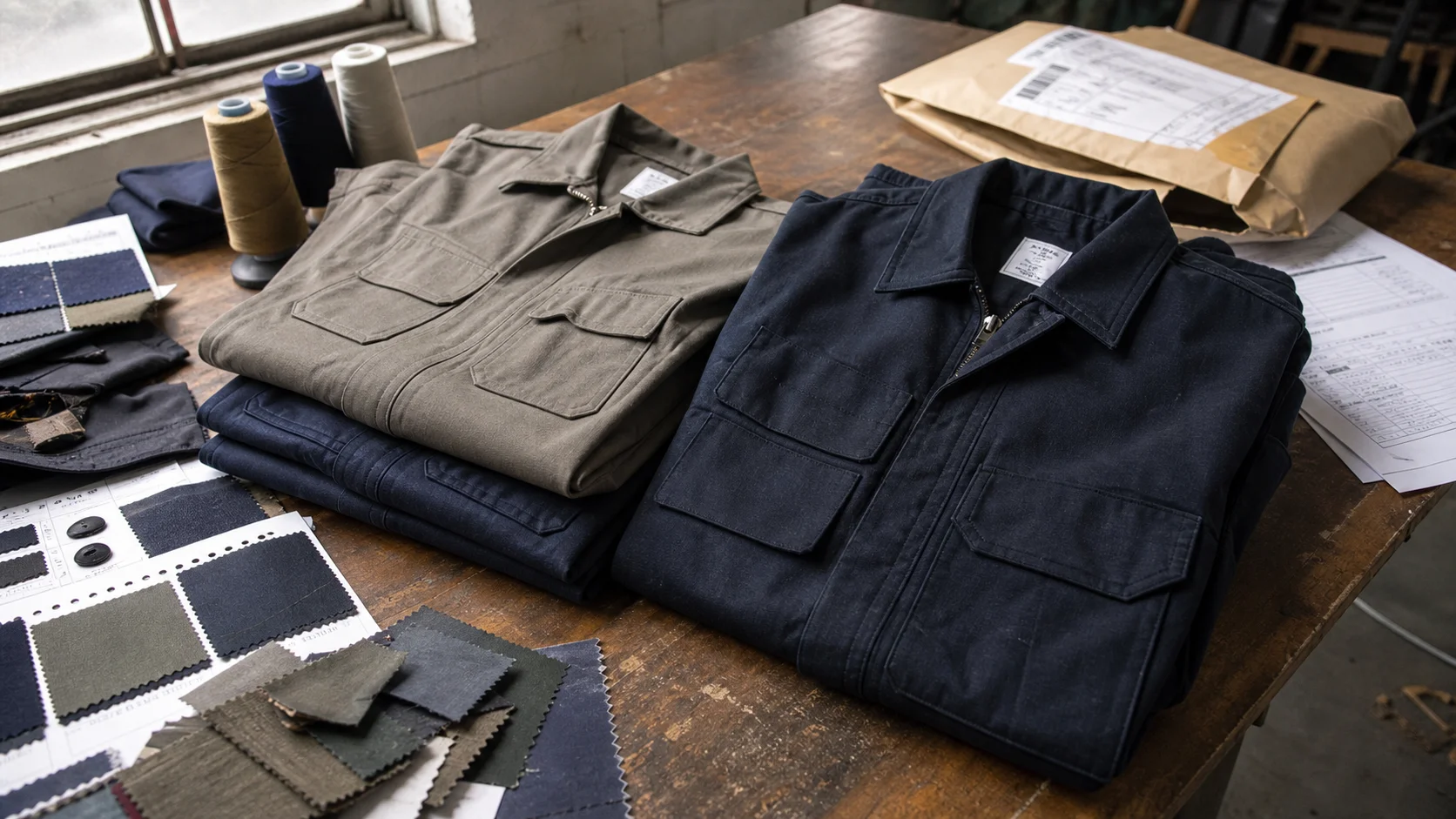
A practical SEO outline for event staffing buyers calculating landed cost on decorated coverall orders, including garment specs, embellishment variables,...
Coverall Landed Cost Guide for Event Staffing Buyers - Fabrikn production reference
For event staffing buyers, coveralls are not just uniform items. They are part of crowd management, brand presentation, staff identification, and sometimes basic jobsite protection. A low quoted unit price can look attractive during the first sourcing round, but it rarely tells the full story. The useful number is landed cost: the total cost of getting approved, wearable, event-ready coveralls into your warehouse, office, venue, or staff distribution point.
A coverall order landed cost guide for event staffing teams should help buyers compare suppliers on a realistic basis. It should also prevent last-minute budget surprises. The cheapest factory quote can become expensive once sampling rounds, logo application, size breakdowns, carton packing, inspection, duties, air freight, and rework are added. A slightly higher FOB price may be better if it gives you stronger fabric consistency, fewer defects, cleaner branding, and predictable delivery.
Event staffing has a particular risk profile. Orders are often deadline-driven, tied to a conference, festival, sports event, construction handover, product launch, or temporary operations program. If the coveralls arrive late, the order does not simply become inconvenient. It may lose much of its value. If sizing is poor, staff may look inconsistent or be unable to work comfortably. If logo placement is wrong, the garments may fail brand approval. If seams split during setup day, replacement costs land directly on the buyer.
That is why landed cost must include quality risk. A garment that costs less but produces 8% replacement or rework is not cheaper. A supplier that offers fast production but skips proper pre-shipment inspection may create more operational cost than the invoice shows. Buyers should treat coverall sourcing as a controlled procurement project, not a simple apparel purchase.
The best landed cost is not the lowest first quote. It is the lowest reliable cost for approved coveralls that arrive on time, fit the team, meet brand expectations, and pass inspection with manageable risk.
For teams comparing production partners, it is worth reviewing service scope early. A supplier or sourcing partner that can support development, production follow-up, inspection coordination, and shipment planning may reduce hidden cost. For reference, buyers can review apparel manufacturing support options at Fabrikn services when mapping what needs to be handled internally versus externally.
A clear formula keeps the buying team, finance team, and operations team aligned. For coveralls, landed cost should be calculated at both order level and unit level. Order-level cost shows the total budget impact. Unit-level cost helps compare supplier quotes, reorder pricing, and allocation by staff group.
The basic formula is:
Landed cost per coverall = garment cost + customization cost + packaging cost + quality control cost + inland freight + export charges + international freight + insurance + import duty and taxes + destination handling + local delivery + rework or contingency allowance.
Many buyers stop at garment cost and freight. That is too narrow. Coveralls are bulkier than T-shirts, more complex than aprons, and more sensitive to sizing than many promotional garments. They use more fabric, require longer sewing time, and often include zippers, snaps, elastic, reflective tape, tool pockets, ID patches, or embroidered branding. Each of those details affects cost and inspection risk.
For event staffing teams, the formula should also include the cost of time. If the shipment arrives one week late and must be couriered to several venues, the local distribution cost may exceed the original freight savings. If the first sample is approved without a fit check and the bulk is too tight across shoulders, the buyer may need emergency backup uniforms. These costs may sit outside the purchase order, but they are still part of the practical landed cost.
Supplier quotes may be EXW, FOB, CIF, DAP, or DDP. Buyers should not compare them as if they are equal. EXW usually means the buyer carries nearly all logistics responsibility from factory pickup onward. FOB usually includes delivery to the port and export clearance, but not ocean or air freight. CIF includes freight and insurance to the destination port, but destination charges, customs, duties, and final delivery may still apply. DAP includes delivery to a named destination but usually excludes import duties and taxes. DDP includes duties and delivery, but the buyer should confirm who acts as importer of record and whether tax compliance is handled properly.
Incoterm What It Usually Means Buyer Risk Purchasing Judgment EXW Buyer collects from supplier premises High logistics control needed Useful only if your forwarder is strong and local pickup is easy FOB Supplier delivers to export port Buyer manages main freight and import Often the cleanest basis for comparing factory quotes CIF Supplier covers freight to destination port Destination fees may surprise buyers Check local charges before accepting DAP Supplier arranges delivery to named place Duties and taxes still usually unpaid Good for simpler delivery if import handling is clear DDP Supplier quotes delivery with duties paid Compliance and tax visibility can be weak Convenient, but verify importer responsibility and paperworkFOB is often the most transparent starting point for B2B apparel comparisons because it separates production cost from freight and import variables. DDP can be useful for smaller event buyers without import infrastructure, but it should be reviewed carefully. A very low DDP quote may hide weak customs classification, under-declared values, or limited accountability if goods are delayed.
A proper cost sheet should list every component that affects the final invoice or operational budget. Coveralls have more moving parts than most simple uniforms. Buyers should request itemized pricing wherever possible, especially for customized event staffing programs.
The base garment cost includes fabric consumption, cutting, sewing, standard trims, factory overhead, and margin. Coveralls use more fabric than shirts and pants sold separately in many cases because the body panels, sleeves, legs, pockets, and allowances increase consumption. Tall sizes, relaxed fits, reinforced panels, and elasticated waists can all raise usage.
Typical bulk FOB pricing varies widely depending on fabric, construction, market, and quantity. Lightweight promotional coveralls may sit at a lower price point, while durable workwear-style coveralls with multiple pockets, heavier twill, branded trims, and reflective tape cost more. Buyers should avoid relying on generic price benchmarks without a tech pack. Two coveralls with the same photo can have very different cost structures.
Fabric is usually the largest cost driver. Cotton twill, polyester-cotton blends, ripstop, stretch woven, disposable nonwoven, and flame-resistant fabrics all price differently. For event staffing, the right choice depends on whether the garment is mainly for visual identity, light operational work, cleaning crews, technical crews, parking teams, security support, or brand ambassadors.
Poly-cotton blends are common because they balance cost, durability, colorfastness, and ease of care. Cotton-rich fabrics feel better in heat but may wrinkle more and can shrink if not controlled. Polyester-heavy blends can reduce cost and dry quickly, but they may feel less breathable. Stretch fabrics improve movement, especially for staff who bend, lift, or install equipment, but they add cost and require closer testing for recovery and seam strength.
Zippers, snaps, buttons, elastic, thread, pocket bags, labels, hook-and-loop patches, reflective tape, drawcords, and ID badge loops should all be specified. A cheap zipper can damage the entire order if failure rates are high. Reflective tape must be reviewed for wash performance, adhesion, and placement. Elastic should be checked for recovery, especially at waist or cuffs.
For event staffing buyers, trims should support fast dressing, clear identification, and repeated wear. If staff will wear coveralls for only one short activation, the trim standard can be simpler. If the program involves repeated events or seasonal staffing, weak trims become a false saving.
Logo application can include embroidery, screen printing, heat transfer, woven patches, silicone patches, reflective logos, or removable ID panels. Each method has tradeoffs. Embroidery is durable and professional but can pucker on lightweight fabric and costs more for large stitch counts. Screen print is efficient for larger runs and bold graphics, but it requires testing for wash and abrasion. Heat transfer can look clean but may crack or peel if the wrong transfer type is used.
Logo placement also affects labor. A chest logo is usually straightforward. Sleeve logos, back prints, pocket embroidery, or reflective branding may require extra handling. If branding is applied after sewing, access can be limited in some areas. If branding is applied before sewing, the supplier must control panel matching and placement tolerance.
Packaging is often underestimated. Standard individual polybags may be enough for warehouse distribution, but event teams often need size stickers, staff name labels, department sorting, carton-level allocation, or venue-specific packing. These services add cost but can reduce chaos during deployment.
Carton dimensions affect freight cost, especially air freight and courier shipments. Coveralls are bulkier than flat promotional apparel. If each garment is individually folded with inserts, the cubic volume rises. Vacuum packing may reduce volume, but it can create deep creases and may not suit premium presentation.
Freight is usually the most volatile component. Ocean freight lowers unit cost for larger orders but needs longer planning. Air freight is fast but can distort landed cost, particularly for heavy cotton coveralls. Courier can work for samples, small urgent replenishments, or split shipments, but it is rarely economical for full bulk orders.
Buyers should ask for gross weight, net weight, carton quantity, carton dimensions, and packing method before confirming logistics. A freight estimate without carton data is only a rough guess. For event programs, logistics should be confirmed after the pre-production sample and packing method are approved.
Specifications drive cost more than negotiation does. A buyer who asks for “blue coveralls with logo” will receive inconsistent quotes. One supplier may quote a 160 gsm polyester fabric with basic zipper. Another may quote a 240 gsm poly-cotton twill with reinforced seams and branded labels. The lower price may not be a better offer; it may simply be a different product.
A useful coverall specification should include fabric composition, fabric weight, weave, color standard, shrinkage tolerance, seam type, pocket count, zipper type, closure method, reflective elements, label requirements, logo method, size range, packing method, and inspection standard.
Specification Area Lower-Cost Option Higher-Cost Option Buyer Tradeoff Fabric weight Lightweight 150-180 gsm Midweight 220-260 gsm Lower cost and cooler wear versus better durability and structure Composition Polyester-rich blend Cotton-rich or stretch blend Cost and easy care versus comfort and mobility Closure Basic zipper or snaps Quality zipper with storm flap Lower trim cost versus stronger use experience Pockets Two to four simple pockets Multiple utility pockets Cleaner look and lower labor versus practical storage Branding Single chest print Embroidery plus back print Budget control versus stronger visual identity Visibility No reflective tape Reflective tape at arms, legs, or torso Lower price versus staff visibility and safety expectationsEvent staffing teams often work long shifts. Comfort matters, especially in warm venues, outdoor festivals, kitchens, logistics zones, and temporary structures. A heavy fabric may look durable but become uncomfortable after several hours. A very light fabric may breathe better but look flimsy, wrinkle heavily, or tear at stress points.
For general event staffing coveralls, many buyers evaluate fabric in the 180-240 gsm range for woven styles, depending on climate and intended use. Disposable or limited-use coveralls follow a different logic and are usually specified by material type and barrier performance rather than traditional woven garment weight. If the garment is expected to protect against specific hazards, buyers should consult the relevant safety standard rather than treating it as a generic uniform.
Brand color is a common issue. Black, navy, red, orange, and custom brand colors can vary between fabric lots. Lab dips should be approved before bulk dyeing when color matters. For urgent event orders, buyers may accept available stock fabric, but that limits color control. This is a reasonable tradeoff only if the event timeline is more important than exact shade matching.
Colorfastness should be tested or at least checked against the garment’s intended use. Staff may sweat, work in rain, brush against equipment, or wash uniforms repeatedly. Poor dye performance can transfer color onto other garments or fade after one wash. That creates replacement cost and brand damage.
Coveralls fail at predictable areas: crotch seams, underarms, pocket corners, zipper base, sleeve openings, and seat seams. Reinforced stitching, bar tacks, and suitable seam allowance reduce failure risk. They also add labor cost. For a one-day brand activation, a lighter construction may be acceptable. For multi-day operations or repeated event use, stronger seams are worth paying for.
Buyers should specify stitch density and reinforcement points where possible. At minimum, the sample should be pulled, stretched, and worn during fit review. A coverall that looks good on a hanger can restrict movement badly when staff squat, reach, or carry items.
MOQ is one of the first constraints in coverall sourcing. Typical MOQ ranges depend on whether the order uses stock fabric, custom dyed fabric, special trims, or fully custom development. For simple customized coveralls using available fabric, buyers may see MOQs from about 100 to 300 pieces per style or color. For custom dyed fabric or special trims, MOQs can rise to 500 to 1,000 pieces or more. For premium or certified fabrics, the MOQ may be driven by the fabric mill rather than the sewing factory.
Small event teams sometimes need only 50 or 80 coveralls. That is possible in some cases, but the landed unit cost will be higher. Sampling, pattern setup, logo setup, trim sourcing, and production management do not shrink neatly with the order size. A small batch may also require stock blanks or semi-custom production rather than full custom manufacturing.
For urgent event orders, teams may be tempted to skip steps. That may be necessary in some cases, but every skipped approval increases risk. A practical compromise is to approve a stock fabric quickly, run a digital logo placement proof, and produce one physical pre-production sample before bulk. If there is no time for a full sample shipment, the buyer should at least request detailed photos and measurements before cutting. This is not as strong as physical approval, but it is better than blind production.
Sample fees are normal. A custom coverall sample may cost more than the bulk unit price because it requires one-off cutting, sewing, trim handling, and sometimes separate logo setup. Buyers should ask whether sample fees are refundable after bulk order placement, but should not assume they will be. Freight for samples can also be high if courier service is used.
From a purchasing standpoint, paying for a proper sample is usually cheaper than discovering a bulk problem late. The key is to control the number of sample rounds. Clear comments, marked-up photos, measurement notes, and confirmed artwork reduce repeated sampling cost.
Lead time is not just factory sewing time. It includes product confirmation, sample development, fabric sourcing, trim ordering, lab dip approval, bulk cutting, sewing, finishing, quality inspection, packing, export handling, freight, customs clearance, local delivery, and internal distribution. Event staffing teams should map the full calendar backward from the staff issue date, not the event date.
Typical timelines vary, but a straightforward coverall order using available fabric may need 4 to 8 weeks from final approval to delivery by air or mixed freight. Ocean freight can extend the total timeline significantly. Custom fabric, special sizing, complex branding, reflective tape, or multiple delivery locations can add time. Peak production seasons and holidays also matter.
Stage Typical Time Range What Can Delay It Requirement confirmation 2-7 days Unclear size range, missing artwork, changing quantities Sample development 7-21 days Custom pattern, unavailable trims, repeated fit changes Fabric and trim sourcing 7-30 days Custom dyeing, mill MOQ, lab dip rejection Bulk production 20-45 days Order size, sewing complexity, factory capacity Inspection and packing 2-7 days Failed inspection, repacking, carton label errors International freight 3-10 days by air, longer by sea Flight space, customs checks, port congestion Local delivery and allocation 1-7 days Split venues, staff sorting, incomplete packing listsThere is a direct tradeoff between lead time and landed cost. Air freight can rescue a late order, but it may double or triple the logistics portion of cost. Splitting shipment can help: send a minimum launch quantity by air and the balance by sea or deferred air. This only works if the event schedule allows phased distribution.
Buyers should build in a buffer for inspection failure. A failed inspection does not always mean the entire order is unusable, but sorting, repair, replacement, and re-inspection take time. If the event date is fixed, inspection should happen early enough to leave room for corrective action.
Quality control is not a formality for coveralls. It is a direct landed cost control tool. Defects become expensive when they are discovered at the venue, during staff check-in, or after the first shift. A practical inspection plan should cover measurements, workmanship, branding, fabric defects, trims, packing, labeling, and quantity accuracy.
Inspection should not only count defects. It should judge whether the order is usable for the event. For example, a small loose thread may be minor. A tight torso measurement across many units may be critical because staff cannot move properly. A slightly uneven inside label may not matter. A back logo printed 5 cm too low may be unacceptable for a branded activation.
Many apparel inspections use AQL sampling standards. Common settings include general inspection level II with critical, major, and minor defect classifications. The exact AQL limits should be agreed before production. For event staffing coveralls, major defects usually include open seams, broken closures, wrong size, visible stains, incorrect branding, and serious measurement variance.
For smaller orders, buyers may choose a tighter practical review because the cost of checking more units is manageable. For urgent events, a 100% check of branding and size labels may be worthwhile even if full garment inspection follows a sampling plan. The goal is not to create paperwork. The goal is to prevent unusable uniforms from reaching staff.
Quality expectations should be written into the purchase order or production confirmation. The approved sample, size chart, artwork placement, packing plan, and defect classification should all be treated as control documents. If expectations are discussed only in emails, disputes become harder to resolve.
Pre-shipment inspection is the minimum standard for most custom orders. It should happen when production is complete and at least 80% packed, depending on the inspection arrangement. During-production inspection can be useful for larger or high-risk orders because problems are caught before all units are finished. Fabric inspection before cutting is also valuable when the order uses custom dyed or expensive fabric.
For deadline-driven event orders, the inspection schedule must be booked early. Waiting until production is complete to arrange inspection can create delays. If the order fails, the buyer needs time for repairs and re-inspection. A supplier who resists inspection should be treated cautiously, especially for first-time orders.
To calculate landed cost, buyers need a structured worksheet. The worksheet should include fixed costs and variable costs. Fixed costs, such as sample development and logo setup, become less expensive per unit as quantity increases. Variable costs, such as fabric, sewing, trims, and freight by weight or volume, scale more directly with the order.
Cost Item Example Question to Ask Cost Type Garment FOB cost Does the quote include all trims and labels? Variable Logo setup Is embroidery digitizing or screen setup included? Fixed Sample cost Is the sample fee refundable after bulk order? Fixed Packing Are size stickers, polybags, and carton labels included? Variable Inspection Who pays for inspection and re-inspection if the order fails? Fixed or semi-fixed Freight Is the quote based on confirmed carton dimensions? Variable Duties and taxes What HS code and duty rate are being used? Variable Local distribution Will cartons ship to one point or multiple venues? VariableA simple example shows why this matters. If a supplier quotes 1,000 coveralls at a low FOB price but the order requires expensive air freight due to delayed approval, the final landed cost may exceed a higher-priced supplier with faster readiness. If another supplier includes inspection support, better packing, and confirmed carton data, the buyer may save time and local handling cost.
Buyers should also calculate wastage and replacement. Event staffing programs usually need extra units for late hires, size exchanges, damage, and lost garments. A practical overage might be 3% to 10%, depending on staff turnover, size uncertainty, and event complexity. If the staff list is unstable, ordering exactly the headcount is risky. The cost of emergency replacements is usually higher than planned overage.
Coveralls are more size-sensitive than many tops because torso length, shoulder width, rise, inseam, and sleeve length all interact. Extended sizes may increase cost due to higher fabric consumption. Very uneven size curves can reduce cutting efficiency. Buyers should provide a realistic size breakdown rather than ordering a generic curve from the supplier.
If the team has no historical sizing data, a fitting set can reduce risk. This adds upfront cost and time, but it may prevent bulk sizing errors. For one-off events, buyers may use adjustable features such as elastic waist, snap cuffs, or relaxed fit to cover more body types. The tradeoff is a less tailored appearance.
Cost control should start with specification discipline. Buyers often increase cost by changing requirements late, adding logo placements after sampling, or approving fabric without checking availability. A stable brief saves money.
Stock fabric can reduce lead time and MOQ. It may also reduce color control. If the event does not require an exact brand shade, stock navy, black, grey, or white may be a sensible choice. For high-visibility brand programs, custom color may be worth the added time and MOQ.
One strong logo placement may be better than three weak ones. Large back prints, sleeve logos, and embroidery combinations increase cost and inspection points. If staff must be identifiable from a distance, a high-contrast back print may deliver more value than small premium details.
Different departments may request different coveralls, colors, or pocket layouts. Standardization improves MOQ efficiency and reduces sorting complexity. Role identification can sometimes be handled with patches, badges, armbands, or color-coded accessories instead of separate garment styles.
Good packing saves operational cost. If coveralls are shipped by size and venue, staff issue becomes easier. If all sizes are mixed randomly across cartons, the event team may spend hours sorting. Buyers should specify carton marks, size ratios, and packing list format before production is packed.
Inspection is an easy line item to remove, but it is usually the wrong saving. If the order is small and simple, a limited inspection may be enough. If it is custom branded, deadline-driven, or a first order with a supplier, inspection should stay in the budget. The cost of one failed event deployment is usually higher than the inspection fee.
Better negotiation comes from understanding cost drivers. Ask whether price changes if fabric is adjusted, pocket count is reduced, branding is simplified, or packing is standardized. Pushing only for a lower price may lead the supplier to downgrade trims or rush workmanship. A transparent cost reduction is safer than an invisible one.
Buyers who need help refining specifications, production planning, or supplier communication can review Fabrikn’s company background at Fabrikn about us or start a sourcing discussion through Fabrikn contact us. The main point is to define responsibility early: who owns the tech pack, who checks samples, who approves bulk, who books inspection, and who manages shipment documents.
A good coverall order landed cost guide for event staffing teams is not only a costing exercise. It is a risk control tool. The buyer’s job is to make sure the event team receives coveralls that are wearable, correctly branded, properly packed, and delivered with enough time to solve problems.
The strongest purchasing approach is to compare suppliers on equal specifications and equal Incoterms, then add realistic logistics, inspection, duty, and distribution costs. Buyers should not reward vague quotes. They should reward clear assumptions, sample discipline, confirmed trims, practical packing, and willingness to pass inspection.
For one-day events with limited budgets, a simpler coverall using stock fabric and one logo placement may be the right answer. For multi-day events, technical crews, or repeated staffing programs, better fabric, stronger seams, reliable trims, and tighter inspection are usually worth the higher upfront cost. The landed cost may be higher on paper, but the operational risk is lower.
The practical target is not perfection. It is controlled reliability. If the order arrives on time, matches the approved sample, fits the staff range, and passes inspection without major corrective work, the buying team has protected both budget and event execution.
Get a free quote from Fabrikn — your trusted B2B clothing manufacturer with 10+ years of experience. MOQ as low as 200 pieces.
Get a Free Quote →Landed cost is the total cost of getting finished coveralls from the supplier to the final delivery point. It includes garment cost, customization, packing, inspection, freight, insurance, duties, taxes, destination charges, local delivery, and any realistic contingency for rework or replacements.
Typical MOQs may range from about 100 to 300 pieces for simple customization using available fabric. Custom dyed fabric, special trims, or more complex development can push MOQs to 500 to 1,000 pieces or more. The fabric mill may set the real MOQ, not only the sewing factory.
FOB is often better for transparent supplier comparison because production and logistics costs are separated. DDP can be convenient for buyers without import handling, but the buyer should verify customs responsibility, duty treatment, delivery terms, and paperwork quality before relying on it.
A practical overage is often 3% to 10%, depending on staff turnover, size uncertainty, event length, and replacement risk. Ordering exactly to headcount can be risky because late hires, size exchanges, and damaged garments may require urgent replacements.
Common defects include poor fit, weak crotch or underarm seams, zipper failure, incorrect logo placement, fabric stains, shade variation, wrong size labels, and packing errors. For event teams, branding and size accuracy are especially important because defects are visible and operationally disruptive.
Sampling can be compressed, but skipping it entirely increases risk. At minimum, buyers should request detailed photos, measurements, fabric confirmation, and logo placement proof before bulk production. A physical pre-production sample is safer when the order is custom branded or the supplier is new.
There is no single best fabric. Poly-cotton twill is common because it balances durability, cost, and care. Cotton-rich fabrics can feel more comfortable but may wrinkle or shrink more. Polyester-rich fabrics can lower cost and dry faster but may feel less breathable. The right choice depends on climate, shift length, brand expectations, and reuse plans.
Inspection helps catch defects before shipment, when repair or sorting is still possible. Without inspection, defective coveralls may reach the event site and create emergency replacement, rework, courier, or staff issue costs. Inspection is a cost line, but it often protects the total landed cost.