
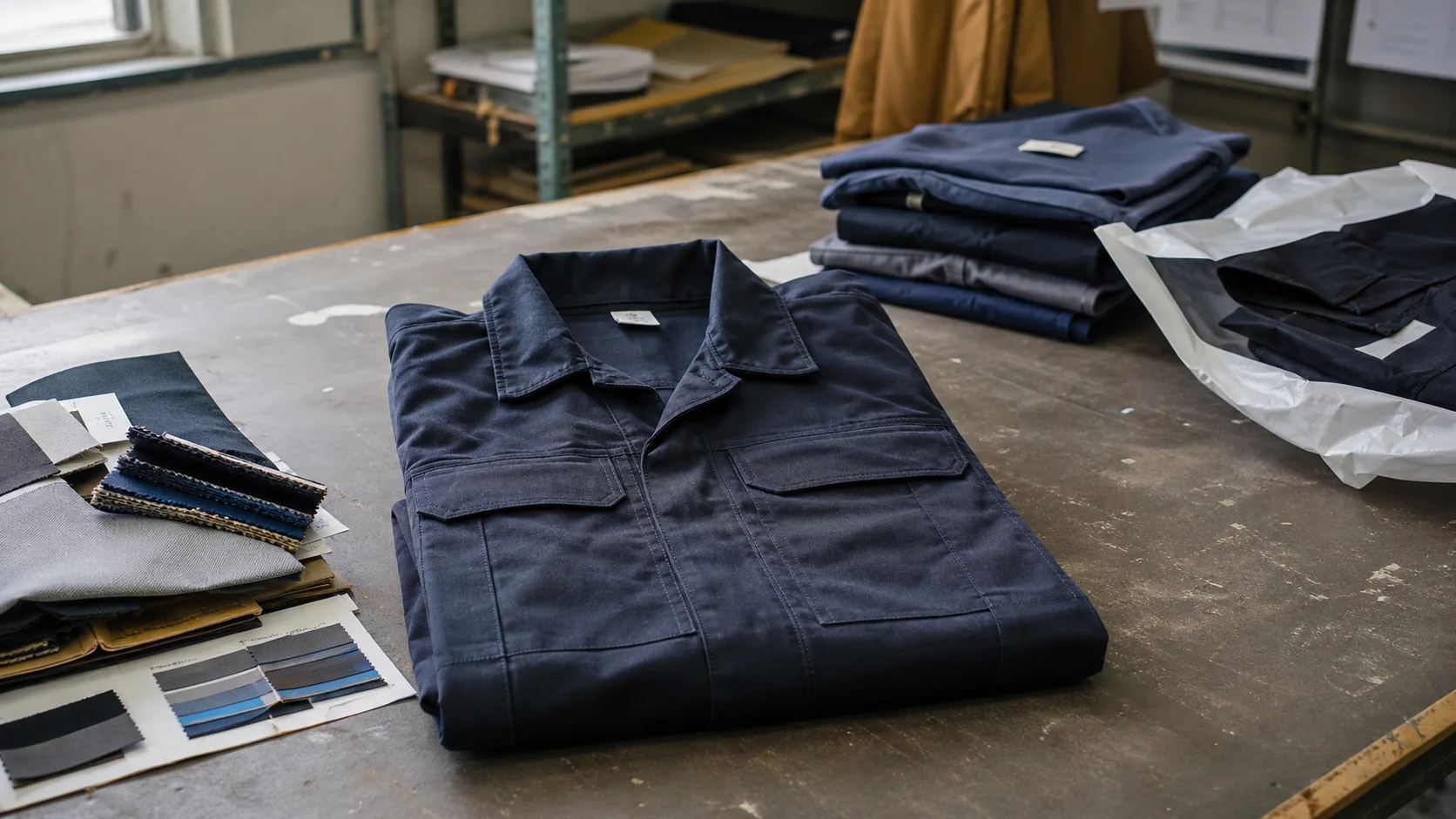
A sourcing-focused outline for restaurant groups evaluating coverall orders through wash test reviews, shrinkage checks, colorfastness, seam durability,...
Coverall Wash Test Review Before Restaurant Orders - Fabrikn production reference
Restaurant groups should not approve a coverall order on fit sample appearance alone. Coveralls used in kitchens, commissaries, maintenance rooms, dishwashing areas, cold storage, and back-of-house cleaning tasks are exposed to heat, moisture, grease, detergent, sanitizer, friction, and repeated laundering. A coverall that looks acceptable in a pre-production sample can shrink, twist, fade, pucker, lose snap strength, or become uncomfortable after only a few wash cycles.
A coverall order wash test review is the practical checkpoint that sits between sample approval and bulk production. It helps buyers confirm whether the garment can survive the actual laundry conditions used by the restaurant group or its contracted laundry provider. For multi-location restaurant groups, this review is especially important because one weak fabric or trim decision can become a chain-wide replacement cost.
This guide explains how sourcing teams should review wash tests before placing restaurant coverall orders, what to measure, what to reject, and where the commercial tradeoffs sit across MOQ, cost, lead time, and supplier risk.
Restaurant coveralls are not fashion garments. They are workwear products that need to hold size, color, strength, and function after repeated washing. The wash test is not a formality. It is a purchasing control that protects the buyer from preventable bulk defects.
Restaurant groups often order coveralls for several user types: kitchen production staff, facilities teams, sanitation crews, warehouse handlers, catering operations, or central commissary teams. Each group may wash garments differently. Some workers take uniforms home. Some operators use an industrial laundry. Some sites wash in-house using hot water and strong detergent. These differences can change the test result.
The main purpose of a wash test review is to answer five commercial questions:
For restaurant groups, the cost of a failed coverall order is not limited to the unit price. It includes reordering delays, staff complaints, brand inconsistency across locations, emergency replacements, and possible disputes with the supplier. If the group has embroidered logos or location-specific branding, the financial risk increases because decorated garments are harder to return or rework.
Direct purchasing judgment: do not place a large branded coverall order until the wash-tested sample has been measured, photographed, reviewed for trim failure, and compared against the original approved sample.
A useful wash test starts with realistic conditions. Testing a coverall in mild domestic laundry may not reveal the problems that appear in restaurant use. Buyers should define the expected wash environment before approving the test method.
Back-of-house garments often face high heat from cooking lines, steam cleaning, dish areas, and production kitchens. The coverall may be worn over base layers, which means fit tolerance matters. If the garment shrinks too much across chest, sleeve length, inseam, or rise, workers may find it restrictive after laundering.
Moisture also matters. Cotton-rich fabrics may feel comfortable but can shrink more than polyester-rich blends if not properly preshrunk or stabilized. Polyester-rich fabrics usually control shrinkage better but may feel less breathable in hot kitchen zones. The correct choice depends on the work area, comfort expectation, and laundry process.
Restaurant garments are exposed to cooking oil, animal fat, sauces, cleaning agents, and sanitizer residue. Strong wash formulas can accelerate color loss and weaken poor-quality trims. A wash test should consider whether the coverall will be washed with standard detergent only or with heavier soil-removal chemistry.
Dark colors such as black, navy, charcoal, and deep green can show fading and seam abrasion. Lighter colors may reveal staining more easily. White coveralls are common in food production environments, but they require careful review for yellowing, optical brightener reaction, and trim discoloration.
Coveralls are pulled, stretched, and rubbed during a shift. Crotch seams, underarms, knees, elbows, pocket corners, and front closures are frequent stress points. A wash test should not only check shrinkage. It should also check seam puckering, fabric distortion, zipper waviness, pocket lifting, and thread breakage.
One wash cycle rarely gives enough information. For restaurant group sourcing, a more useful review usually includes three to five wash cycles for initial approval. For high-volume or industrial laundry programs, buyers may request ten or more cycles, but this adds time and cost.
The coverall wash test review should be structured. A casual “looks fine after wash” comment is not enough for a restaurant group order. The buyer should request measurable results from the supplier or arrange independent checking where needed.
Dimensional stability means how much the garment changes in size after washing and drying. The most important measurements usually include chest, waist, hip, shoulder width, sleeve length, body length, inseam, front rise, back rise, leg opening, and cuff opening.
Common acceptable shrinkage ranges depend on fabric and buyer tolerance. As a practical guide, many workwear buyers prefer shrinkage within 3% for key length and width measurements after standard laundering. Cotton-rich fabrics may need a wider tolerance if the price point is low, but wider tolerance creates fit complaints across a restaurant group. If the supplier proposes 5% or more shrinkage tolerance, the buyer should review whether the size spec has been adjusted to compensate.
Measurement Area Why It Matters Common Risk After Washing Chest and waist Affects movement and layering Tight fit, pulling at front closure Sleeve length Affects arm coverage and comfort Sleeves become too short after shrinkage Inseam and body length Affects bending, reaching, and walking Crotch tension and restricted movement Shoulder width Affects mobility during kitchen tasks Pulling across upper back Leg opening and cuffs Affects safety and appearance Twisting, tight cuffs, uneven hemsColorfastness is critical for branded restaurant uniforms. A faded black coverall can look older than it is. A navy coverall that shifts toward purple or grey may not match the restaurant’s uniform standard. Colorfastness to washing, rubbing, perspiration, and sometimes chlorine or non-chlorine bleach should be reviewed depending on the cleaning process.
Buyers should ask for lab dips or bulk fabric swatches before garment sampling, especially for custom colors. The wash test should compare the washed garment to the unwashed approved sample under consistent lighting. Photographs help, but physical review is better because camera settings can distort color.
Coveralls need stronger seam construction than many general uniform items. At minimum, buyers should inspect seam security after washing at the armhole, side seam, inseam, crotch, back rise, pocket attachment, front placket, collar, and cuffs.
Common stitch issues include skipped stitches, loose thread tails, seam grin, puckering, thread shrinkage, and seam twisting. Thread choice matters. Polyester thread is common because it resists shrinkage and has good strength. Cotton thread may not perform as well in repeated laundering unless there is a specific reason to use it.
Trim failure is one of the most frustrating problems in coverall orders because the garment fabric may be acceptable while the closure system fails. Zippers can ripple, jam, lose pullers, or corrode. Snaps can loosen or crack. Buttons can chip. Elastic can relax. Hook-and-loop closures can collect lint and lose grip.
Restaurant buyers should confirm the exact trim type, color, material, size, and supplier reference where possible. If the supplier changes trim between sample and bulk, the wash test result may no longer be reliable.
Care labels, size labels, woven brand labels, heat transfers, embroidery, and screen prints should be checked after washing. For restaurant groups, employee identification and size sorting often depend on readable labels. A label that curls, frays, bleeds, or becomes unreadable creates operational waste.
Decorated coveralls deserve extra caution. Embroidery can pucker after washing if the backing, stitch density, or fabric stabilization is wrong. Heat transfers may crack or peel depending on wash temperature and dryer heat. Screen prints may fade if ink chemistry and curing are not suitable for the fabric.
A disciplined sample process reduces misunderstandings. Restaurant groups should treat wash testing as a formal approval gate, not a side note.
Before sampling, the buyer should define who will wear the coverall, where it will be used, how often it will be washed, and whether it needs decoration. A sanitation team coverall may require different fabric and closures than a facilities maintenance coverall. A commissary garment may need stricter color, lint, or food-safety considerations than a general back-of-house garment.
The supplier should provide fabric details before cutting the fit sample. Important details include fiber content, fabric weight, weave or knit structure, finish, color standard, shrinkage expectation, and care instructions. Trim details should include zipper type, snap material, button type, elastic width, thread type, label method, and any reflective or contrast elements.
If sourcing support is needed at this stage, buyers can review production options through Fabrikn’s apparel manufacturing services to clarify how fabric choice, sampling, and order structure affect the final program.
The first garment sample should be reviewed unwashed. Check fit on the intended size model or fit form, confirm measurements against the spec sheet, and review construction details. This sample becomes the baseline for wash comparison.
Buyers should avoid approving a fit sample that is already out of tolerance. Washing will not fix poor pattern balance, tight rise, short sleeves, or weak pocket placement. It usually makes those problems more visible.
The sample should be washed according to the expected care method. If the restaurant group uses industrial laundry, domestic washing may not be enough. If the garment will be tumble dried at high heat, line drying the sample gives misleading results.
At a minimum, the test record should state water temperature, detergent type, drying method, number of cycles, garment load conditions, and whether bleach or sanitizer chemistry was used. The more specific the record, the easier it is to resolve disputes later.
After washing and drying, the sample should rest before measurement so moisture and heat distortion do not skew results. Measurements should be taken in the same way as the original sample. Compare each key point against the pre-wash measurement and the garment spec tolerance.
Photographs should show front, back, side, close-ups of closures, seams, pockets, labels, and any defects. Buyers should keep both the washed and unwashed samples for reference until bulk production is approved.
The result should lead to a clear decision. Approve only if the sample meets fit, appearance, and durability expectations. Revise if the issues are correctable through spec changes, fabric adjustment, trim substitution, or wash-care updates. Reject if the fabric or construction cannot meet the restaurant group’s use case without unacceptable cost or lead-time impact.
Practical rule: if a supplier cannot explain why the sample failed after washing, do not assume bulk production will improve. Ask for a corrected sample and repeat the wash review.
Coverall performance depends heavily on material selection. The cheapest acceptable-looking fabric may not be the lowest-cost choice after shrinkage, replacements, and staff complaints are considered.
Restaurant coveralls are often made from cotton, polyester-cotton blends, polyester-rich twill, canvas, ripstop, or specialty performance fabrics. Each option has tradeoffs.
Fabric Type Advantages Tradeoffs 100% cotton twill Comfortable, breathable, familiar hand feel Higher shrinkage risk, more wrinkling, possible color fading Poly-cotton twill Balanced durability, better shrinkage control, common for uniforms Less breathable than cotton-rich options, quality varies by blend Polyester-rich fabric Good dimensional stability, faster drying, lower wrinkle level Can feel warmer, may retain odors if finish is poor Canvas or heavier twill Durable for maintenance and facilities roles Heavier, slower drying, may be too hot for kitchens Ripstop blend Better tear resistance at moderate weight More technical appearance, may cost moreFabric weight is also important. Lightweight coveralls may feel better in hot environments but can tear faster and show wear sooner. Heavyweight coveralls can last longer but may be uncomfortable in kitchens. Many restaurant workwear programs sit in a middle range, often around 160 to 240 gsm depending on fabric type and role. This is not a universal rule; buyers should match fabric weight to the work environment and laundry method.
Front closure selection affects wash durability and workplace function. Zippers are fast and clean-looking, but low-grade zippers are a common failure point. Snaps are practical for workwear and can be easier to replace, but poor snap attachment can pull through fabric. Buttons are simple but slower to use and may not suit all operational settings.
Metal trims should be reviewed for corrosion risk if the garment is exposed to frequent washing, sanitizer, or high humidity. Plastic trims avoid corrosion but may crack under heat or stress if quality is poor. For food-service environments, loose trim is also an operational concern because detached parts can create contamination risk.
Restaurant groups should be cautious with too many pockets. Pockets are useful for maintenance teams, but they can collect debris in food areas. If pockets are required, reinforce stress points and check them after washing. Pocket bags should not twist or shrink more than the outer garment.
Pen pockets, tool loops, chest pockets, and back pockets should be specified clearly. If the coverall is for food production, the buyer may prefer fewer external catch points and secure closures. The wash review should check whether pocket flaps curl, pocket openings distort, or bartacks pull after laundering.
The care label must match the tested wash method. If the sample survives only under cool wash and low tumble dry, but the restaurant group uses hot wash and high drying, the label is not solving the problem. It is documenting a mismatch.
Size labels should be durable and readable. For multi-location rollouts, poor size labeling slows distribution and returns. Buyers should specify label placement so it does not irritate the wearer or disappear after repeated laundering.
Wash testing adds time and sometimes cost, but skipping it is usually a false economy for restaurant group orders. The sourcing decision should account for MOQ, customization level, fabric availability, decoration, and approval rounds.
MOQ varies by supplier, fabric, color, and customization. For standard fabric and existing coverall patterns, a practical MOQ may start around 100 to 300 pieces per style or color. For custom fabric dyeing, special trims, unusual sizes, or private-label production, MOQ may move into the 500 to 1,000 piece range or higher. If fabric must be specially woven or dyed, MOQ can be driven by the fabric mill rather than the garment factory.
Restaurant groups should separate pilot quantities from rollout quantities. A smaller pilot order can confirm field performance before committing to a full chain-wide order. The unit cost will usually be higher, but the risk is lower.
Order Type Typical MOQ Range Best Use Stock style with minor branding 50 to 200 pieces Small teams, trial programs, urgent needs Existing pattern with selected fabric 100 to 300 pieces Regional restaurant groups, controlled rollout Custom color or trim package 300 to 800 pieces Brand-specific uniform programs Custom fabric or fully private-label coverall 500 to 1,000+ pieces Large restaurant groups with repeat demandThese ranges are typical sourcing references, not fixed rules. A supplier with available fabric may accept less. A mill-driven program may require more. The buyer should ask what part of the MOQ is caused by cutting efficiency, fabric minimums, dyeing minimums, trim minimums, or decoration setup.
Wash testing may affect cost in several ways. The buyer may pay for extra samples, lab testing, courier charges, and revised sample rounds. If the first fabric fails, the corrected fabric may cost more. Better zippers, stronger snaps, preshrunk fabric, reinforced seams, or improved labels can raise unit cost.
That cost increase is not automatically bad. A slightly higher unit price may be the better purchase if it reduces shrinkage complaints and replacement orders. The wrong saving is choosing a cheaper coverall that fails after several washes.
Buyers should compare cost by expected usable life, not only by first purchase price. A coverall that costs less but needs frequent replacement may be more expensive across a restaurant group’s annual uniform budget.
Lead time depends on material availability, sampling rounds, wash testing cycles, decoration approval, production capacity, inspection scheduling, and shipping method. A basic stock-based program can move quickly. A custom coverall program with wash testing should allow more time.
Typical sample development may take 1 to 3 weeks for an existing pattern, longer if custom pattern work is required. Wash testing can add several days to two weeks depending on number of cycles and whether third-party lab testing is used. Bulk production may take 4 to 8 weeks after final approval for many made-to-order programs, with shipping time added separately. Peak season, fabric dyeing, trim delays, and holiday closures can extend the schedule.
Restaurant groups planning new location openings should build wash test review into the uniform calendar early. Waiting until the final purchasing window often forces buyers to choose stock garments or accept higher risk.
A pilot order is useful when the coverall is new to the organization, the laundry process is uncertain, or staff comfort is a major concern. A pilot may include several sizes and roles across a limited number of locations. After several weeks of use and washing, the buyer can review fit retention, defects, and employee feedback.
The tradeoff is speed. A pilot delays full rollout, and the first quantity may have a higher unit cost. For large restaurant groups, this delay can still be cheaper than replacing thousands of garments that fail in the field.
Buyers who need help weighing pilot production against full rollout can contact a sourcing partner through Fabrikn’s contact page to discuss order structure, sampling expectations, and practical production constraints.
Passing the wash test does not guarantee bulk production will match the approved sample. Inspection remains necessary because factories may use different fabric lots, trims, operators, machines, or finishing conditions during bulk production.
Bulk fabric should match the tested sample in fiber content, weight, color, hand feel, finish, and shrinkage performance. If the sample was made from available stock fabric but bulk is cut from a new lot, the buyer should request confirmation testing. Fabric lot variation can cause unexpected shade differences or shrinkage changes.
Wash testing one size does not always prove all sizes will perform well. Larger sizes may show different stress points. Smaller sizes may become too tight after shrinkage. Grading should be checked across the size range, especially if the restaurant group has inclusive sizing needs.
A size set review before bulk production is useful. The buyer should inspect at least core sizes and any extended sizes. If only one medium sample is wash-tested, the purchasing team is accepting some risk in the rest of the size range.
Bulk sewing quality can differ from sample quality. The inspection should check stitch density, seam allowance, bartack placement, pocket symmetry, zipper alignment, snap strength, thread trimming, and label placement. A factory can produce a strong sample and still deliver inconsistent bulk if quality control is weak.
Embroidery and print quality should be checked before and after washing. Common risks include puckering, thread color mismatch, rough backing, logo placement drift, heat-transfer peeling, and print cracking. For restaurant groups, logo consistency matters because staff uniforms are part of brand presentation.
Coveralls are bulky compared with shirts or aprons. Incorrect folding, mixed sizes, missing labels, or weak cartons can create distribution headaches. For multi-location programs, buyers should specify carton markings, size breakdowns, polybag requirements if used, and location allocation instructions.
Packaging choices also affect cost and sustainability. Individual polybags improve size control and cleanliness but add material use. Bulk packing reduces packaging but can slow sorting. The better option depends on the restaurant group’s distribution process.
Before approving a restaurant coverall order, buyers should ask direct questions. Good suppliers can answer clearly. Weak answers often signal future disputes.
The answers should be documented in the purchase order, tech pack, or production agreement. Verbal approval is not enough when a restaurant group is buying for multiple locations.
Buyers can also review supplier background, sourcing approach, and production support expectations through Fabrikn’s about page before deciding how much external support is needed.
The best coverall program is not always the cheapest or the most technical. It is the one that fits the restaurant group’s real use, laundry process, budget, and rollout schedule.
A lower-cost stock coverall can be reasonable for short-term use, small teams, seasonal roles, or non-branded internal work. If the garment is not central to brand presentation and replacement cost is manageable, a buyer may accept more limited testing.
That said, even low-cost coveralls should be washed before purchase if the quantity is meaningful. A simple three-cycle in-house wash test can reveal obvious shrinkage, zipper, or color issues before the order is placed.
Pay more when the coverall is branded, used daily, distributed across many locations, exposed to harsh laundry, or expected to last through many wash cycles. Better fabric stabilization, stronger seams, higher-grade closures, and reliable colorfastness are worth considering when replacement disruption is costly.
Restaurant groups should also pay attention to staff comfort. A durable garment that workers avoid wearing creates a compliance problem. Fabric weight, breathability, rise length, sleeve mobility, and closure comfort should be reviewed alongside wash performance.
Restart the sourcing process if the sample has major shrinkage, severe twisting, color bleeding, closure failure, decoration damage, or fabric surface breakdown after a small number of washes. Small adjustments can solve minor issues. Major wash failure usually points to the wrong fabric, trim, pattern, or factory process.
Rejecting a poor sample may feel slow, but it is faster than arguing over failed bulk goods. A restaurant group should not let urgency turn an avoidable sample defect into a chain-wide purchasing mistake.
The approval standard should be written before the test. It should include measurement tolerance, number of wash cycles, wash method, visual acceptance rules, trim requirements, decoration performance, and inspection criteria. If the restaurant group has a contracted laundry provider, include that provider’s wash method in the test planning.
A clear standard also helps suppliers price correctly. If the buyer asks for industrial-laundry durability after the price is already negotiated, the supplier may need to change fabric or construction. That can reset cost and lead time.
The following checklist is a practical starting point for restaurant group buyers reviewing coverall samples before bulk orders.
Review Area What to Check Buying Decision Fit before wash Measurements, mobility, layering comfort Do not wash-test a poor fit unless pattern revision is planned Wash method Temperature, detergent, drying, cycle count Match expected restaurant laundry conditions Shrinkage Chest, sleeve, inseam, body length, rise Reject or revise if key dimensions exceed tolerance Color Fading, bleeding, shade change, staining Compare to unwashed sample and color standard Seams Puckering, twisting, thread breakage, seam grin Require correction before bulk approval Closures Zipper function, snap strength, button security Confirm exact trims for production Decoration Embroidery pucker, print cracking, transfer peeling Repeat test if decoration changes Labels Readability, curling, bleeding, attachment Specify durable labels for size controlA coverall order wash test review is one of the most useful controls a restaurant group can apply before committing to production. It protects fit, appearance, durability, and budget. It also gives the buyer a factual basis for approving, revising, or rejecting the garment before decoration and bulk cutting make problems expensive.
The strongest purchasing approach is simple: define the laundry method, approve fabric and trim details, wash-test the sample, measure the result, inspect the construction, document the approval, and require bulk production to match the tested standard. This process takes time, but it reduces the likelihood of costly uniform failures across multiple restaurant locations.
For restaurant groups balancing MOQ, cost, and sourcing risk, wash testing is not an extra step. It is part of responsible order approval.
Get a free quote from Fabrikn — your trusted B2B clothing manufacturer with 10+ years of experience. MOQ as low as 200 pieces.
Get a Free Quote →For initial approval, three to five wash cycles is a practical minimum for many restaurant coverall programs. If the garments will go through industrial laundry or harsh cleaning chemistry, more cycles may be justified. The test should match the expected wash and drying conditions as closely as possible.
Many buyers prefer key measurements to stay within about 3% shrinkage after standard laundering, especially for chest, sleeve length, body length, and inseam. Cotton-rich fabrics may need careful review because shrinkage can be higher. The acceptable tolerance should be written into the spec before testing.
Both stages can matter. First, test the blank garment to confirm fabric, fit, seams, and trims. Then test a decorated sample if embroidery, heat transfer, or print will be used. Decoration can pucker, crack, peel, or distort after washing even when the blank garment performs well.
A small pilot order can be useful, but it should still include basic wash review. If the coverall is branded or custom-made, testing before the pilot is safer. A pilot is best used to confirm field comfort and durability before a larger rollout.
Stock coveralls with minor branding may start around 50 to 200 pieces. Made-to-order coveralls often start around 100 to 300 pieces. Custom colors, trims, or private-label requirements may push MOQ to 300 to 1,000 pieces or more, depending on fabric and trim minimums.
The biggest risks are excessive shrinkage, color fading, seam twisting, zipper or snap failure, and decoration damage. For restaurant groups, fit failure after washing is especially costly because it affects staff comfort, size distribution, and replacement planning across locations.
The sourcing or uniform buyer should review it with input from operations, laundry stakeholders, and wearer representatives where practical. If the program is large or technical, third-party testing or inspection may be useful. The final approval should be documented with measurements and photos.
No. Bulk production can still vary because of fabric lot changes, trim substitutions, sewing inconsistency, or finishing differences. Buyers should require a pre-production sample from actual bulk materials and inspect production against the approved wash-tested standard.