
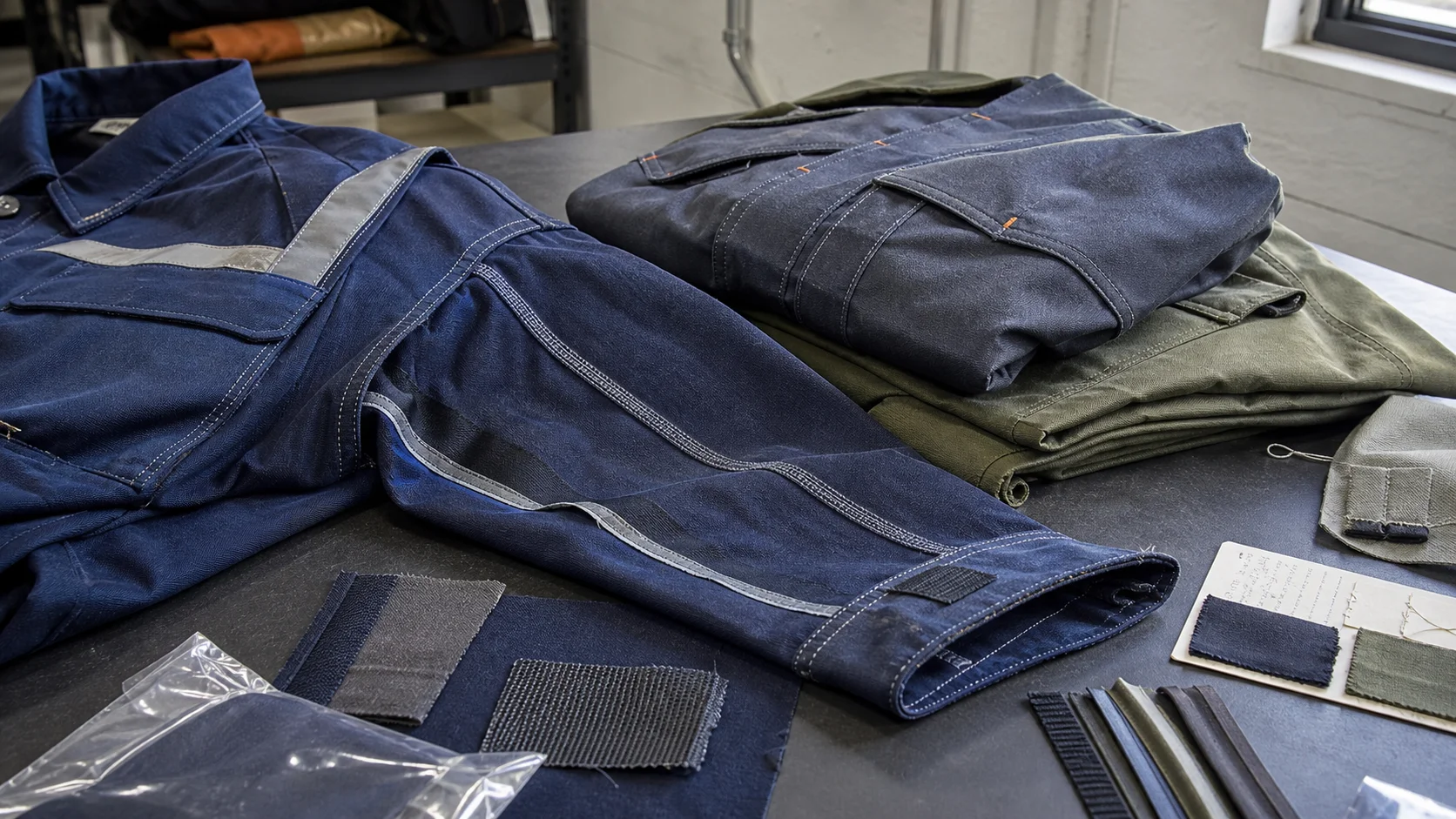
A practical review of how coverall manufacturers validate seam strength, compare stitch construction, and document durability for corporate uniform programs.
Coveralls fail in predictable places. Seams open at the crotch, shoulder, inseam, pocket edge, or knee reinforcement because the construction was not matched to the fabric, the stress point, or the end use. For corporate uniform buyers, seam strength is not a technical footnote. It affects worker safety, replacement cost, image consistency, and how much confidence a buyer can place in the supplier’s quality control.
This review is written for buyers sourcing coveralls at scale, especially procurement teams, uniform managers, and private-label apparel programs that need a practical way to judge whether a coverall manufacturer is building durable garments or only meeting a basic visual spec. The focus is on what to ask, what to inspect, and where seam failures usually start. Strong seam performance depends on fabric weight, thread type, stitch density, seam construction, reinforcement placement, and the discipline of sample approval. A buyer that checks only style and color is taking avoidable risk.
Coverall Seam Strength Review for Corporate Buyers - Quality & Inspection manufacturing guide
Seam strength determines how well a coverall holds together under repeated bending, lifting, kneeling, sitting, crawling, and laundering. That sounds obvious, but the real issue is that a garment can look well-made on the hanger and still fail quickly in use. Corporate buyers often discover this after the first wash cycle or after workers begin using the garment in a real shift environment.
For uniform programs, seam failures create several problems at once. A weak seam can expose the wearer to dirt, sparks, sharp edges, or process contamination. It can also trigger complaint handling, rushed replacements, and style inconsistency across a contract cycle. When a buyer evaluates a supplier, seam construction should be treated as part of the product’s risk profile, not just its craftsmanship.
Coveralls for maintenance staff, industrial cleaning, logistics, automotive service, warehouse operations, and light manufacturing do not all need the same seam spec. A general-purpose office utility coverall can tolerate a simpler build than a garment used around abrasive surfaces, frequent squatting, or tool belts. That is why the useful question is not whether the seam is “strong,” but whether the seam is strong enough for the intended duty cycle and fabric weight.
A coverall can pass visual inspection and still be weak in the field if seam allowance, thread, and reinforcement are not aligned with the end use.
Before approving a coverall program, a buyer should request construction details in writing. The key items are seam type, stitch count, thread specification, seam allowance, reinforcement points, and wash-performance expectations. A supplier that cannot state these clearly is unlikely to control them reliably in bulk production.
Seam allowance is one of the simplest indicators of whether a garment was designed for stress or just stitched quickly. In many utility coveralls, a practical seam allowance is commonly in the 0.5 to 1.0 inch range depending on location and seam type. Stress areas may benefit from wider allowances or a reinforced seam finish. Stitch density usually sits in a moderate range that balances strength and fabric puckering. Too few stitches can reduce holding power. Too many can perforate the fabric and weaken the seam line, especially on lighter materials.
Thread choice matters more than many buyers expect. Polyester core-spun thread is often favored for its balance of strength and laundering resistance. All-polyester thread can also perform well, particularly where wash durability and abrasion resistance matter. Cotton thread is generally less suitable for hard-wearing industrial coveralls because it can shrink or lose strength under repeated laundering. If flame resistance is part of the spec, the thread must match the garment’s protection requirements rather than be chosen only for cost.
The highest-risk areas are usually the crotch, armhole, side seam, knee zone, pocket openings, and zipper placket. These points see repeated load transfer and movement. Buyers should ask where reinforcement is added, whether bartacks are used, and whether the supplier has a plan for seam slippage at high-stress joins. Reinforcement that looks good on a sample but is not repeated consistently in production offers little value.
A seam that holds in a fit sample may still fail after multiple industrial laundry cycles. Buyers should ask how the garment performs after repeated wash-and-dry exposure, especially if the uniform program uses aggressive cleaning chemicals or high-temperature laundering. If shrinkage pulls at the seams, seam strength is only part of the problem. Fabric stability, thread shrinkage, and construction balance all need to work together.
Not every seam type is appropriate for every coverall. The right choice depends on fabric thickness, expected wear, and whether the garment needs a clean interior finish or maximum durability. The table below gives a practical buying view rather than a sewing textbook definition.
Seam Type Strength Profile Typical Use Buyer Note Plain seam with overlock finish Moderate General utility coveralls, lighter fabrics Cost-effective, but not ideal for high-stress zones unless reinforced Flat-felled seam High Workwear requiring durability and a clean enclosed edge Strong choice for inseams and side seams when fabric bulk is manageable Double-needle topstitch seam Moderate to high Visible reinforcement and construction stability Depends heavily on stitch balance and thread quality Bound seam Moderate Garments needing abrasion control on the inside Cleaner inside finish, but more labor and usually higher cost Bartacked reinforcement Very high at stress points Pocket corners, belt loops, crotch reinforcement, zipper ends Essential on high-wear coveralls even when the main seam is strongThe better question for buyers is not which seam type is “best” in the abstract. It is whether the chosen construction matches the fabric weight and work environment. A heavy seam on a light fabric can cause puckering and discomfort. A light seam on a heavy-duty garment can fail under load. Cost should be judged against garment life, not just unit price.
Seam strength is only as good as the materials around it. A weak fabric will split near a strong seam. A strong fabric can still fail if the thread is mismatched or the trim pulls against the seam line. Corporate buyers should ask for the full bill of materials, not just the shell fabric.
Typical coverall fabrics fall into ranges such as mid-weight cotton, polyester-cotton blends, or heavier canvas-like constructions depending on the program. A buyer should care less about broad labels and more about the actual GSM, weave density, and shrinkage tolerance. Heavier fabric often supports stronger seam performance, but only if the sewing method is appropriate. Dense fabric can also increase needle heat, seam distortion, and line skipping if the machine setup is poor.
Cotton-rich fabrics are comfortable and familiar, yet they can shrink and wrinkle more than synthetic blends. Polyester blends often improve wash stability and wear life, though they may feel less breathable in hot environments. For seam durability, the practical advantage of a blend is usually dimensional stability. Less shrinkage means less seam stress after washing. Buyers should weigh this against comfort and the working climate.
Trim failures can damage seam performance even when the sewing line itself is acceptable. A zipper placket that is too narrow, snap placements that are under-reinforced, or hook-and-loop tape that is attached to weak fabric can all create stress concentrations. Ask where trim ends are bar-tacked, how zipper tops and bottoms are secured, and whether pocket openings are reinforced to avoid ripping during use. Plastic components may reduce weight, but not every plastic trim is suited to industrial laundering or heat exposure.
Decoration is not a trivial issue on coveralls. Heavy embroidery can stiffen an area and alter how the seam moves. Heat transfer can affect fabric hand feel and may create localized stiffness near stitched sections. Buyers should check whether branding will be applied before or after final seam approval. A decoration sample that looks fine on a flat garment can still distort a seam line after repeated laundering.
Corporate buyers often underestimate how much seam quality depends on the sampling stage. The first sample is not the final answer. It is a checkpoint that shows whether the factory understands the construction brief and can repeat it consistently.
A practical approval process usually includes a development sample, a fit sample, a pre-production sample, and then a size-set or production reference where needed. Each step should confirm seam type, stitch density, reinforcement placement, pocket alignment, and any wash performance concerns. If the sample passes visually but the technical notes are vague, approval should be held until the details are clarified.
Typical MOQ ranges for custom coveralls often start around 200 to 500 pieces per style or color for standard programs, with lower thresholds possible for stock fabrics or simplified construction. Custom dyeing, special trims, reflective tape, or flame-resistant specifications can increase the minimum. Complex seam reinforcement also adds time and can push the minimum higher because setup and QA effort are greater.
Lead time depends on fabric sourcing, trim availability, pattern complexity, sample approval cycles, and production queue. A standard program may move in four to eight weeks after approval, while a custom industrial build can take longer. Buyers should not compress sample approval just to meet a shipment date. Rushed approval is a common cause of seam-related claims later.
For buyers comparing supplier capabilities, the most useful partner pages are services for capability review, contact us for direct RFQ discussion, and about us for background on production scope and working methods.
Seam review should include both lab-style tests and real-world inspection points. A garment can look acceptable in a showroom and still fail a seam stress test. The goal is to reduce the gap between sample appearance and field performance.
Not every program needs the same test depth. A low-risk promotional workwear style may only need a basic construction review, while a high-use industrial coverall needs stronger evidence. Buyers should define which tests are mandatory before production begins. If the supplier cannot produce test results or does not have an internal QC method, the buyer will bear the risk later.
Inline inspection should focus on seam alignment, stitch consistency, thread tension, and placement accuracy. Final inspection should check whether seams have been distorted by pressing, washing, or packaging. It is also worth checking seam allowance consistency across different size runs, since grading errors often show up as weak or uneven joints in larger sizes.
Inspection teams should look for puckering near curved seams, skipped stitches on thick layers, broken thread at pocket openings, and loose ends that suggest poor finishing. Small defects can be signs of broader control issues. A few loose threads are not the real problem. The concern is whether the factory has a repeatable process to prevent them.
Bulk production introduces risks that are easy to miss in a single sample. Thread tension can drift. Operators may follow slightly different sewing methods. Fabric lots can vary in coating, shrinkage, or thickness. Trim deliveries may change late in the cycle. Each of these can weaken the seam outcome even if the approved sample was acceptable.
These problems are often preventable. The cost of prevention is usually lower than the cost of corrective shipment handling, returns, or emergency replacement. Buyers should be skeptical of any supplier that treats seam failures as isolated accidents rather than process issues.
In coveralls, the cheapest unit price can become the most expensive purchase if seam failures force repeat orders or replacement labor.
Not every seam deserves the same level of spend. Strong sourcing judgment means putting money into the points that control lifespan, while keeping lower-risk areas economical. That is the difference between a well-structured uniform program and an overbuilt garment that is expensive without being meaningfully better.
Spend more on stress zones, thread quality, and repeatable stitching controls. Save by avoiding unnecessary decorative complexity, excessive seam layering, or trims that do not add function. If a coverall is intended for daily industrial wear, flat-felled seams or reinforced critical points are usually better value than a purely cost-driven construction. If the garment is for light-duty facility use, a simpler seam package can be acceptable provided the thread, wash performance, and size consistency are controlled.
The right balance also depends on compliance demands. Flame-resistant, anti-static, or high-visibility coveralls have construction limits that change the cost equation. In those cases, seam choice cannot be separated from the protection requirement. A buyer should not let the factory downgrade construction simply to keep the quote low. The garment must serve the job first.
These are practical questions that separate a capable manufacturer from a generic cut-and-sew operation:
A supplier that answers these questions clearly is easier to manage. A supplier that answers in general terms only may still be workable, but the buyer should then increase inspection depth and clarify every technical expectation in the purchase order.
For corporate buyers building a long-term uniform program, seam strength review should be part of the sourcing workflow from the beginning. The request for quotation should include the intended use, expected wash cycles, fabric weight target, closure type, and any special protection requirements. That information lets a manufacturer propose a seam package that fits the job instead of guessing at a generic build.
It is also useful to ask for a production-ready communication path early. Clear technical alignment reduces back-and-forth during sample development and helps the factory keep the construction consistent once the order moves into bulk. If a supplier presents capability information only at the end of the process, the buyer has already lost leverage.
Where a team needs manufacturing support, line-level construction review, or a clearer RFQ structure, the most direct next step is to review the available services and use the contact form to request a technical discussion. Buyers who need background on the supplier’s operating model can also check the about page before shortlisting.
Get a free quote from Fabrikn — your trusted B2B clothing manufacturer with 10+ years of experience. MOQ as low as 200 pieces.
Get a Free Quote →Flat-felled seams are often a strong option for durable work coveralls because they enclose raw edges and handle stress well. The right choice still depends on fabric weight, garment design, and the duty cycle.
Typical MOQ ranges often start around 200 to 500 pieces per style or color for standard programs. Custom fabrics, special trims, and technical requirements can push the MOQ higher.
A realistic process often includes a development sample, fit sample, and pre-production sample. More rounds may be needed if the garment has complex reinforcement, sizing issues, or compliance requirements.
Crotch seams, pocket corners, shoulder joins, and zipper areas usually see the highest stress and are common failure points. Poor thread choice, weak bartacks, and bad pattern shaping make those areas more vulnerable.
A practical check should cover seam type, stitch density, seam allowance, thread specification, reinforcement placement, wash performance, and visual signs of puckering or skipped stitches. Bulk inspection should confirm that the approved sample was actually repeated.
Yes, if the design is simple, the fabric is stable, and the supplier controls stitching and reinforcement carefully. Low cost becomes a problem when it comes from reduced seam allowance, weak thread, or missing stress-point reinforcement.
For corporate buyers, seam strength is one of the clearest indicators of whether a coverall program will stay reliable after repeated wear and washing. Good sourcing practice starts with a clear construction brief, disciplined sample approval, and a supplier that can explain how the seams are built, not just how the garment looks.