
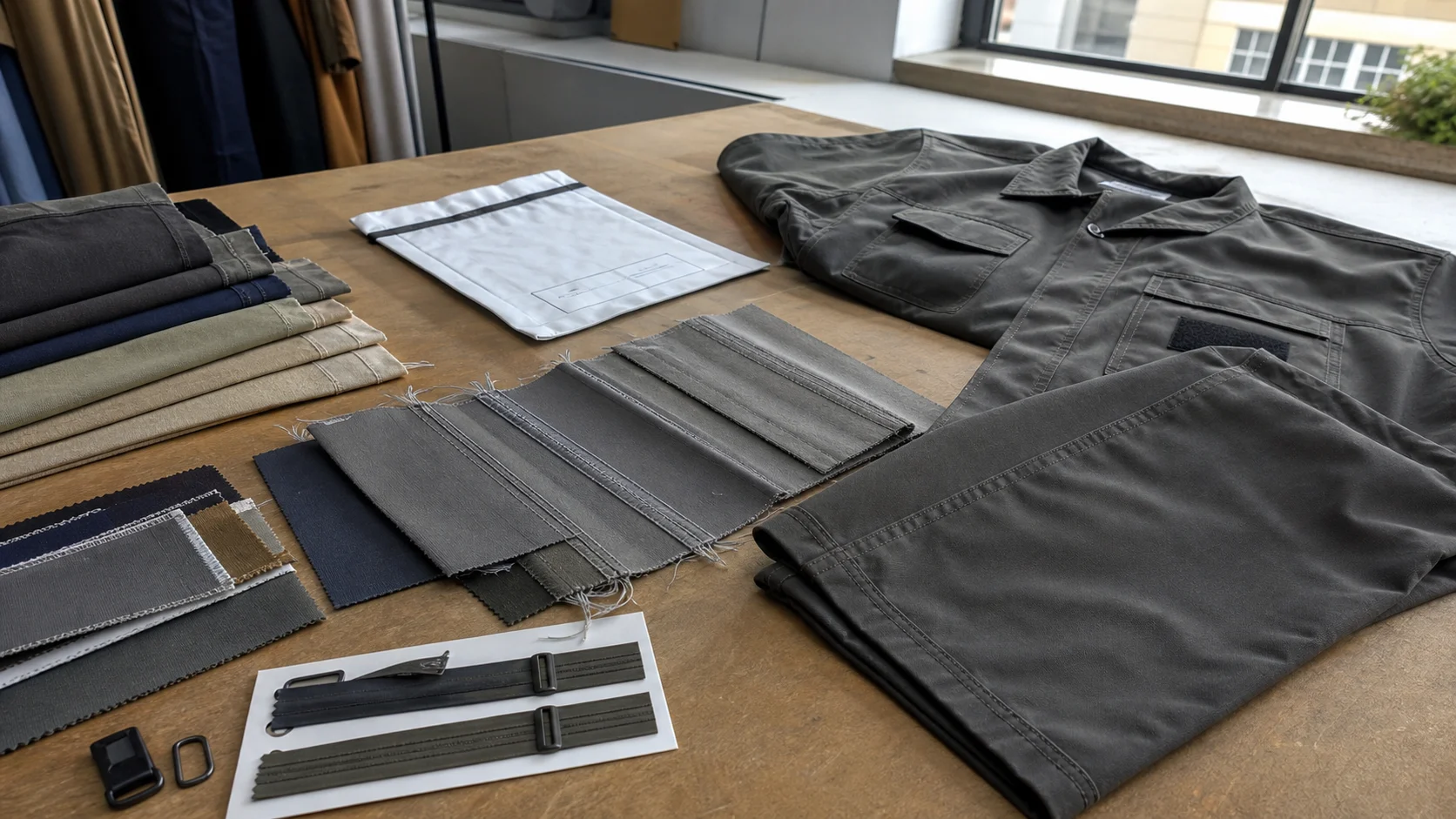
A sourcing-focused review of coverall seam strength for fitness clubs, covering failure points, test methods, cost tradeoffs, MOQ implications, and the...
Fitness club buyers usually focus on appearance, size run, logo placement, and price. Seam strength deserves the same attention because coveralls take abuse at the shoulders, crotch, side seams, knees, and pocket openings. A weak seam fails early, and when it fails, the garment stops being usable even if the fabric still looks acceptable. For a gym, that can mean faster replacement cycles, more complaints from staff, and more cost per wear than the initial quote suggests.
This review is written for sourcing teams that need to judge coverall seam strength before placing volume orders. The practical question is not whether a supplier can sew a sample that looks clean. The question is whether that construction will survive repeated use, repeated laundering, and the movement pattern of staff or members who wear the garment during operations, maintenance, training support, or promotional activities. If you are still comparing vendors, the services pages at fabrikn.com/services/, fabrikn.com/contact-us/, and fabrikn.com/about-us/ are useful starting points for understanding the production and communication side of the process.
Seam strength is the ability of a stitched join to resist pulling, stretching, abrasion, and laundering without opening, distorting, or breaking thread. In practical buying terms, it is the difference between a coverall that stays intact through a season and one that returns to the warehouse with popped stitches after a few weeks.
Fitness club coveralls are not all used the same way. Some are promotional uniforms worn a few hours a week. Some are utility garments worn by cleaning teams, equipment staff, or event crews. Some are fashion-forward pieces sold as branded merchandise. Seam requirements change with that use case. A lightweight, low-stress promotional coverall can tolerate simpler construction. A work-oriented version needs reinforcement at high-load areas and more disciplined quality control.
Buyers should separate visual quality from structural quality. Neat topstitching is useful, but it does not prove durability. Dense, even stitches matter. Correct seam allowance matters. Compatible thread and needle selection matter. Reinforcement at stress points matters even more. A garment can look premium and still fail at the first hard pull if the construction plan was weak from the start.
Most seam failures are predictable. That is helpful, because predictable failures are easier to prevent in the tech pack and sample stage than after bulk production begins.
The better way to review seam strength is to ask where the garment is expected to move, drag, bend, and carry load. A fitness club coverall worn while lifting, cleaning, transporting equipment, or coaching class setup will experience much more stress than a display sample on a hanger. That is why buyers should review the garment as a use-case item, not just a product sheet.
Not every seam type is equally suited to a coverall. The right choice depends on fabric weight, stretch content, expected abuse, and target price.
Seam or stitch type Typical use Buying judgment Single-needle lockstitch General joining on stable fabrics Clean and low cost, but can be too weak alone for high-stress zones. Double-needle stitching Visible reinforcement on seams and hems Useful for durability and appearance, though it must be supported by good seam allowance and thread choice. Chain stitch Flexible areas and some industrial garments Has stretch tolerance, but buyers should confirm the supplier controls shrinkage and seam stability after washing. Flat-felled seam Heavy-duty side seams, inseams, workwear One of the most reliable choices for longevity, though it adds labor and cost. Overlock plus topstitch Common mid-cost construction Acceptable for many fitness club coveralls if the seam is not over-stressed and the thread quality is solid. Bartacks Pocket corners, stress points, zipper ends Should be mandatory in critical spots if the garment is expected to see real use.Flat-felled construction is often the safest structural choice for high-stress coveralls, but it is not always the best commercial choice. It adds operations, which raises labor cost and can affect lead time. For some buyers, a reinforced overlock seam with bartacks at pressure points is the better balance. The right answer depends on the end use and the target landed cost.
Stitch density also matters. Very loose stitching can reduce sewing time, but it usually weakens the seam and makes skipped stitches more likely. Overly tight stitching can pucker the fabric and reduce comfort, especially on blends with elastane. Buyers should ask for a construction standard, not just a “strong seam” claim.
Seam strength is not only about stitching. The fabric, thread, stabilizers, zippers, and trims all affect performance. A strong seam in weak fabric still fails. A strong fabric with poor thread selection can also fail. The package has to work together.
For fitness club coveralls, common fabric choices include cotton-poly blends, poly-cotton twills, stretch twills, and some performance knits. Each behaves differently under seam stress.
Fabric weight changes the cost profile. A heavier fabric can improve durability, but it also increases raw material cost, sewing difficulty, and shipping weight. For many club programs, midweight fabric is the practical sweet spot. It offers enough strength without pushing the garment into a stiff, workwear-only feel.
Thread specification should not be left vague. Buyers should ask for thread type, ticket size, and color match requirements. Polyester thread is common because it resists abrasion and has better strength retention than many lower-cost alternatives. Some stretch garments need a thread with enough elongation to move with the fabric. Thread that is too weak, too thick, or poorly matched to the needle can create seam puckering or breakage.
Needle choice also affects seam quality. An incorrect needle can damage fibers, create skipped stitches, or produce weak penetration. Sewing machine settings, feed balance, and operator skill all influence whether the seam survives bulk production. That is why a sample that passes visual inspection should still be tested mechanically.
Zippers, snaps, hook-and-loop, elastic, drawcords, and labels can all affect seam load. If a zipper is installed into a weak placket, the zipper may work fine while the fabric tears around it. If elastic is inserted without stabilization, the seam may wave or break down after laundering. Reinforcement tape, facing, interlining, and bartacks are not optional details on a serious product spec.
A good purchasing rule is simple: if a coverall will be pulled, sat on, loaded, or washed repeatedly, assume the seam near that point needs reinforcement, not just clean stitching.
Testing does not have to be complicated to be useful. The problem is not the absence of tests. The problem is that buyers often approve samples based on look and fit alone. That leaves seam failure to show up later in bulk or in the field.
When possible, buyers should specify an acceptance approach in the purchase order or quality agreement. Even a simple in-house standard is better than relying on a vague factory promise. If the product is low-risk promotional wear, the standard may be lighter. If the product is intended for operational staff, the standard should be stricter and documented.
Sample approval should include more than one garment. One sample can hide process instability. Buyers should request at least a pre-production sample or size set, then check whether the construction matches the approved spec. Look closely at seam allowance consistency, stitch density, thread tension, pocket reinforcement, and line symmetry. If the sample already shows puckering, loose ends, or uneven bartacks, bulk quality will likely be worse, not better.
Fit testing matters because seam strength and fit are linked. A tight garment puts more stress on the seams during wear. A loose garment may feel safe but can create movement at unexpected points. For coveralls, the seat, crotch, shoulder width, and sleeve mobility deserve particular attention.
MOQ affects seam strength decisions more than many buyers expect. Small runs usually carry a higher unit price because setup cost, pattern work, and sewing changeovers are spread across fewer units. Large runs lower unit cost, but only if the design is already stable and the factory can run it efficiently.
Typical MOQ ranges vary by factory and garment complexity. A simple coverall might start around 300 to 500 pieces per color or style. More complex styles, custom fabrics, special trims, or multiple logo placements can push MOQ higher. Buyers should treat these figures as typical market behavior, not a guarantee.
Seam reinforcement increases cost in three ways. It adds labor time, it may require stronger or more specialized materials, and it can slow production if the process is not optimized. Flat-felled seams, bartacks, reinforced plackets, and heavy topstitching all add value, but they also raise sewing cost. That is a direct tradeoff, not a minor detail.
Cost driver Effect on seam quality Effect on sourcing Heavier fabric Usually stronger and more durable Raises material and shipping cost Flat-felled seams Strong and stable Raises labor cost and sewing time Bartacks at stress points Improves durability where it matters most Modest cost increase, usually worth it Elastic or stretch fabric Improves mobility, can complicate seam behavior Needs tighter sample control Lower MOQ Does not improve quality by itself Higher unit cost, less process efficiencyFor fitness club buyers, the lowest quote is often not the lowest-cost outcome. A cheaper coverall that fails seam testing, shrinks too much, or comes back with broken bartacks creates hidden costs through returns, replacements, and brand damage. The smarter approach is to compare total lifecycle cost, not only ex-factory price.
A disciplined approval flow is one of the strongest tools a buyer has. It reduces disputes later and gives the factory a clear target.
Lead time depends on fabric availability, sample iteration count, and factory capacity. If the buyer changes seam construction after sample approval, production delays are common. If the buyer waits to finalize logo placement or zipper choice, the critical path can slip by days or weeks. Seam strength reviews work best when they are built into the process from the start, not added after costing is complete.
For organized sourcing workflows, it helps to use a vendor that can support development, communication, and production control under one process. That is where a structured sourcing page such as fabrikn.com/services/ can be useful during vendor comparison, especially when buyers need a clear view of service scope before sampling begins.
Inspection should focus on the defects that matter most for seam performance. Cosmetic defects matter, but they should not distract from the structural issues that shorten garment life.
Inspection risk rises when the factory switches subcontractors, fabric lots, or thread suppliers without telling the buyer. That is why communication and change control matter as much as the inspection checklist. A clean approved sample does not protect the buyer if the bulk line uses different inputs. Buyers should request pre-shipment checks and retain an open channel for production updates. The contact page at fabrikn.com/contact-us/ is a practical reference point for teams comparing response speed and production support expectations.
Before placing an order, review the garment against a simple commercial and technical checklist. If the answer is unclear on any point, the buyer should not treat the quote as production-ready.
A supplier with a clear process usually looks more expensive at the quote stage and cheaper by the time the order closes. That is not a theory. It is a common sourcing pattern in apparel. Buyers who focus only on unit price often pay later through remakes, downgraded quality, or faster replacement cycles.
For companies still defining their supplier shortlist, it is worth checking who the supplier is, how they position their production support, and whether they present a stable operating model. A basic reference such as fabrikn.com/about-us/ can help buyers judge whether the relationship is likely to be managed in a structured way.
For fitness club buyers, seam strength should be treated as a core purchasing criterion, not a technical footnote. The right construction depends on the garment’s role. Promotional coveralls can use moderate reinforcement if the brand budget is tight. Operational uniforms need stronger seam engineering, tighter sample control, and more explicit inspection rules. Heavy-duty use almost always justifies better construction because replacement cost and service disruption are more expensive than the incremental sewing cost.
The most common mistake is buying a stylish coverall and assuming it is durable because the fabric feels substantial. Fabric handfeel is not a seam test. The second most common mistake is over-specifying every seam and then pricing the garment out of the market. The better approach is targeted reinforcement: protect the zones that fail first, choose a fabric that fits the actual use case, and keep the construction consistent with the order volume and budget.
If the order is small, keep the design simple and prioritize the highest-risk seams. If the order is large, spend more time on pre-production validation because a small defect rate becomes expensive at scale. That is the practical sourcing position. Strong seams are not a luxury feature. They are part of the product definition.
A solid coverall seam strength review helps fitness club buyers avoid early failure, reduce replacement cost, and make more disciplined MOQ decisions. The right seam construction depends on fabric, use case, budget, and lead-time tolerance. Buyers should insist on clear seam specifications, realistic sample approval, and a quality process that checks the actual stress points instead of relying on visual inspection alone. When sourcing is handled this way, the garment is more likely to survive real club use and stay within the planned cost structure.
Get a free quote from Fabrikn — your trusted B2B clothing manufacturer with 10+ years of experience. MOQ as low as 200 pieces.
Get a Free Quote →The crotch seam is usually the most critical because it sees the highest movement and tension. Side seams, shoulder seams, pocket openings, and zipper areas also deserve close review.
Flat-felled seams are often the strongest option for high-stress areas. Reinforced overlock seams with bartacks can also work well when the garment needs a lower-cost balance.
Typical MOQ ranges often start around 300 to 500 pieces per style or color, though complex construction, custom trims, or special fabrics can push the minimum higher.
Use a combination of seam pull checks, wash testing, wear simulation, and visual inspection after stress. A sample that only looks good on a hanger is not enough.
Usually yes. Stronger construction often adds labor, materials, or machine time. The tradeoff is better durability and lower replacement risk, which can improve total cost of ownership.
Common causes include weak thread, wrong needle selection, inconsistent seam allowance, poor tension settings, skipped reinforcement, and unapproved material substitutions.
Yes. Pre-production samples made with bulk fabrics and trims are the safest way to confirm that seam strength, fit, and appearance hold up before the order is released.