
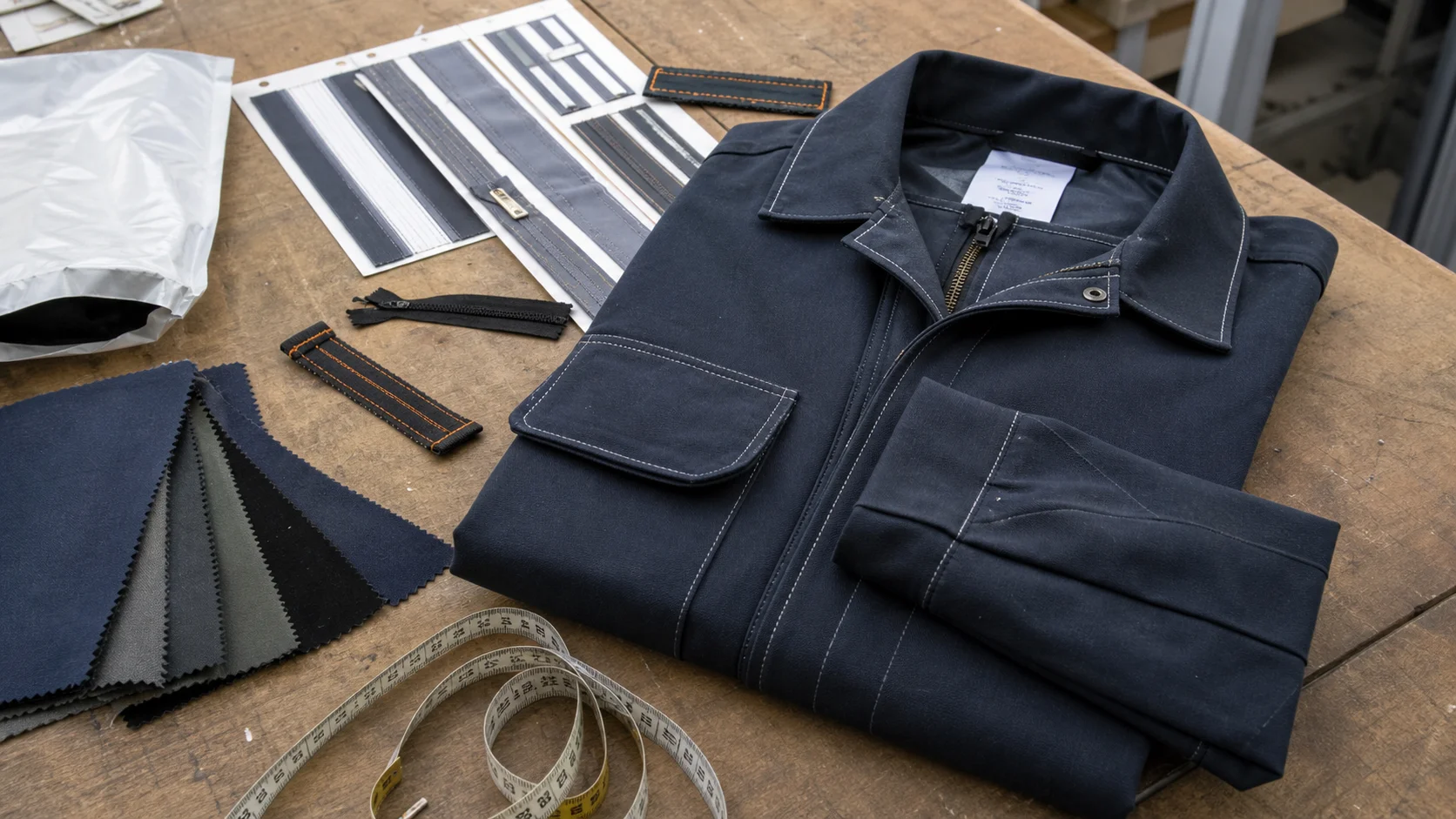
A product-specific compliance outline for event staffing teams sourcing coveralls, covering fabric safety, decoration durability, sizing, labeling,...
Coverall Compliance Checklist for Event Staffing Buyers - Quality & Inspection manufacturing guide
Event staffing teams buy coveralls for a different operating environment than factories, warehouses, or maintenance departments. The garment still needs to protect clothing, present a consistent brand image, and survive long shifts, but the buying risks are often more visible. A poor fit shows up immediately in guest-facing roles. A weak zipper fails during an event. A fabric that traps heat can reduce staff comfort across a long outdoor shift. A late shipment can leave a staffing agency trying to source emergency uniforms at retail pricing.
This coverall supplier compliance checklist is written for buyers, staffing managers, procurement teams, and quality teams sourcing coveralls for events, exhibitions, festivals, hospitality programs, security support, cleaning crews, technical teams, and promotional staff. It focuses on practical purchasing controls: supplier qualification, fabric and trim specifications, sample approval, MOQ planning, production lead times, inspection points, and final delivery checks.
The goal is not to over-engineer a simple uniform order. The goal is to prevent the most common failures before purchase orders are placed. Coveralls can look straightforward in a product photo, but details such as seam strength, shrinkage, colorfastness, zipper durability, size grading, pocket placement, and labeling requirements can create real problems when hundreds or thousands of event staff need to look consistent on the same day.
Event uniforms are judged in real time. Staff are photographed, filmed, and seen by guests, sponsors, venue operators, and brand partners. That makes coverall compliance both a quality issue and a brand control issue. A technically acceptable garment can still fail the buyer if the color is inconsistent across batches, the embroidered logo puckers, or the fit makes staff look unprofessional.
Coveralls also carry operational risk. Event staffing teams often assign garments quickly, sometimes across mixed temporary workforces. If sizing is poorly planned, supervisors lose time swapping garments. If care labels are unclear, returns and reuse become harder. If pockets are positioned badly, radios, scanners, badges, gloves, or event tools may not sit securely.
Compliance does not always mean heavy certification. For most event staffing coveralls, the critical requirement is controlled consistency. Buyers need a supplier that can make the agreed garment repeatedly, document the materials, check production before shipment, and respond clearly when issues occur.
A good coverall supplier for event staffing is not simply the cheapest cut-and-sew option. The better supplier is the one that can translate an event uniform brief into a controlled specification, sample it correctly, and hold production to that approved standard.
Before issuing a request for quote, buyers should define the actual use case. Coveralls used by backstage technical crews are not always the same as coveralls used by promotional staff at a product launch. A cleaning crew may need darker colors and stronger stain resistance. A VIP hospitality team may need a sharper silhouette and better logo execution. Outdoor festival teams may need breathable fabric, practical pockets, and reflective details depending on the role.
The main risks for event staffing buyers usually fall into five areas:
Buyers should treat these as commercial issues, not only technical issues. A failed shipment can create replacement costs, express freight charges, overtime sorting, and reputational damage with the event owner. That is why the checklist should be built into the sourcing process before price negotiation is finalized.
Supplier qualification should come before sampling. Many buyers ask for a sample first, then discover later that the supplier cannot support the actual order quantity, lead time, documentation, or decoration method. A better sequence is to qualify the supplier’s capability, then sample against a written specification.
For event staffing buyers, production flexibility often matters more than theoretical capacity. A supplier may claim high monthly output, but if the order requires several sizes, two colorways, printed logos, barcode labels, and carton sorting by event location, the practical capacity may be lower.
Buyers should be cautious with suppliers that only promise “good quality” but cannot explain how quality is checked. The supplier does not need a complicated system for every event order, but there should be a visible process for controlling fabric, cutting, sewing, finishing, and packing.
Lead-time language needs special attention. “30 days production” may not include sample development, fabric dyeing, logo setup, label approval, quality inspection, export documentation, or transit. For fixed-date events, buyers should build a calendar from the event date backward, not from the purchase order date forward.
A coverall specification should be clear enough that two suppliers would quote the same garment. If the brief only says “black polycotton coverall with logo,” each supplier may interpret the fabric weight, zipper type, pocket layout, stitching, cuff finish, and fit differently. That creates misleading price comparisons.
The specification should state whether coveralls are intended for single event use, seasonal reuse, laundry circulation, or resale as branded merchandise. A single-use promotional garment may justify lighter fabric and simpler trims. A reusable staffing coverall needs stronger seams, more stable fabric, and clearer care labeling.
Fabric selection drives most coverall performance decisions. Event buyers commonly compare cotton, polyester/cotton blends, polyester, twill, canvas, ripstop, and stretch woven fabrics. No fabric is best for every event. The practical choice depends on climate, shift length, desired appearance, washing plan, durability expectations, and budget.
Buyers should not request unnecessary testing just to look thorough. Testing adds cost and time. For small event orders, a physical fabric swatch, supplier test report, and sample wash test may be enough. For larger programs or repeated uniform contracts, laboratory testing becomes easier to justify.
Zippers deserve special attention. A low-quality zipper can fail even when the fabric is acceptable. For coveralls, buyers should specify whether they need a nylon coil zipper, metal zipper, plastic molded zipper, two-way zipper, or concealed front zipper. The zipper should move smoothly, sit flat, and withstand repeated opening. Puller size also matters when staff wear gloves.
Snaps, buttons, hook-and-loop tape, elastic, and drawcords should be checked during sampling. Elastic should recover after stretching. Hook-and-loop tape should not scratch the wearer or damage nearby fabric. Reflective tape, if used, should be positioned consistently and should not be described as safety certified unless the relevant standard is actually met and documented.
Fit problems are common in event coverall programs because staffing teams often order broad size ranges under time pressure. Coveralls are less forgiving than separate tops and trousers. Torso length, shoulder width, chest, waist, hip, thigh, sleeve length, and inseam all affect comfort. A garment can look right on a hanger and still restrict movement when staff bend, reach, or sit.
Typical event staffing orders use sizes from XS to 3XL, with some programs extending to 4XL or 5XL. The wider the range, the more important grading becomes. Simply scaling a medium sample up and down can create poor proportions in larger and smaller sizes. Buyers should ask the supplier to provide a graded size chart before bulk production.
Buyers often underestimate size distribution. A balanced ratio such as S to XL may be suitable for a small team, but larger staffing pools need more careful planning. Agencies should review past uniform issue data where available. If there is no history, it is safer to order a modest buffer in common sizes rather than relying on exact headcount.
A practical buffer for event staffing coveralls is often 3% to 8% of total quantity, depending on order size and whether late staff changes are expected. For very tight budgets, buyers may keep the buffer in undecorated garments or in the most common sizes. That saves cost but can create appearance inconsistency if decorated garments run short.
Branding should be approved as part of the garment, not treated as an afterthought. A logo that works on a flat digital mockup may not work over a chest pocket, seam, zipper guard, or curved body panel. Buyers should define logo placement in centimeters from fixed garment points, such as center front, shoulder seam, pocket edge, or neckline.
Labeling requirements depend on destination market and buyer needs. At minimum, buyers should define brand label, size label, care label, country of origin label where required, fiber composition, and any internal SKU or barcode. Claims such as flame-resistant, high-visibility, waterproof, antibacterial, or recycled content should be supported with relevant documentation. If documentation is not available, the claim should not appear on the label or product page.
Event teams should not leave packing instructions vague. Sorting hundreds of coveralls by size the day before deployment is avoidable work. If garments need to be issued by team, venue zone, or staff name, the packing plan should be agreed before production finishes.
Sample approval is the buyer’s strongest control point. A good sample process turns a concept into a measurable standard. A weak sample process produces a nice-looking garment that may not represent bulk production.
Not every event order needs every sample stage. A simple stock coverall with a small logo may only need a blank sample and decorated pre-production sample. A custom-designed coverall for a national event program should go through a fuller process. Skipping samples saves days early but can cost weeks if bulk production fails.
Buyers should record sample comments in writing, not only by phone or chat. Each revision should state what changed and whether the next sample is required. The final pre-production sample should be signed off digitally or physically before bulk materials are cut.
Minimum order quantity depends on fabric availability, color, decoration, size range, and whether the garment is stock or fully custom. For event staffing coveralls, typical MOQ ranges can vary widely:
These are practical ranges, not fixed rules. Some suppliers can support lower quantities with a surcharge. Others will quote a low MOQ but use stock fabric or substitute trims without making the tradeoff clear. Buyers should ask what changes at different quantity levels: unit price, fabric options, color accuracy, decoration method, and lead time.
A realistic lead time for a custom coverall program is commonly 6 to 10 weeks before international transit, especially when samples and fabric approval are required. Rush orders are possible, but the buyer usually gives up something: lower customization, fewer sample rounds, limited fabric choices, higher freight cost, or reduced inspection time.
Teams planning multiple event uniforms can reduce risk by building a standard supplier process. For buyers comparing broader manufacturing support, Fabrik’s apparel manufacturing services page is a useful place to review how sourcing, production, and quality control support can fit into a structured program.
Final inspection should happen before the shipment leaves the supplier. Once coveralls are in transit, fixing quality issues becomes slow and expensive. For event deadlines, replacement production may not be possible. Inspection should cover workmanship, measurements, branding, quantity, packing, and documentation.
Many apparel inspections use AQL sampling. The acceptable quality limit should be agreed before production. Common apparel inspections classify defects as critical, major, and minor. Buyers may use stricter levels for guest-facing uniforms and more standard levels for backstage teams. The important point is that the supplier and buyer agree what counts as a failure.
Critical defects may include sharp objects, broken needles, dangerous trims, severe contamination, incorrect branding, or a safety claim that is not supported. Major defects may include open seams, broken zippers, wrong measurements outside tolerance, stains, shade variation, logo placement errors, missing labels, or incorrect sizes. Minor defects may include small loose threads, light creasing, or slight stitching irregularity that does not affect use or appearance.
Measurements should be checked across sizes, not only one sample size. The inspector should use the approved size chart and measure garments on a flat surface using agreed methods. A common mistake is measuring different points than the supplier used during sample approval. That creates disputes. The measurement guide should be part of the tech pack.
High-risk points for coveralls include chest, waist, hip, across shoulder, sleeve length, body length, inseam, thigh, and crotch depth. Torso length is especially important because it affects whether staff can bend or raise arms comfortably. If only one measurement is slightly off, the garment may still pass. If several measurements trend small, the whole size may fit poorly even if each point is just within tolerance.
Inspection should include photos. Useful photo records include full garment front and back, inside construction, labels, zipper, pockets, logo close-up, measurement photos, defect examples, carton markings, and packed carton condition. Photos reduce ambiguity and help the buyer make a shipment decision quickly.
Documentation requirements should match order risk. A small local event order may not need a deep compliance file, but larger staffing programs should maintain records. Documentation supports internal approval, customs clearance, quality follow-up, and repeat production.
Buyers should avoid making unsupported product claims in event tenders. If a coverall is described as flame-resistant, high-visibility, waterproof, recycled, organic, or antimicrobial, the buyer should have documents that support the claim for the actual fabric and production lot. Generic supplier brochures are not enough for higher-risk claims.
Price pressure is normal in event staffing. The risk comes when low price is achieved by removing controls the buyer still assumes are included. A supplier may reduce cost by using lighter fabric, cheaper zippers, fewer bartacks, simplified pockets, substituted labels, or looser inspection. Those changes may not be obvious until the garments arrive.
None of these points automatically means the supplier is unusable. They do mean the buyer should slow down and clarify. In many cases, a supplier that is clear about limitations is safer than one that agrees to everything.
The strongest purchasing process is simple, written, and followed consistently. Event teams do not need a 60-page quality manual for every coverall order. They do need a checklist that prevents basic mistakes under deadline pressure.
Buyers that want help translating a uniform concept into production-ready specifications can review Fabrik’s company background on the about us page or send project details through the contact page. A clear brief, realistic timing, and defined inspection standard make supplier discussions more productive from the start.
For event staffing buyers, the best coverall supplier is not always the one with the lowest unit cost. The better commercial decision is usually the supplier that offers a controlled fabric choice, stable fit, clear MOQ, realistic lead time, documented sample approval, and inspection access before shipment. Low price has value only when the garment still performs on event day.
If the order is urgent and the design is simple, stock coveralls with approved decoration can be the safest route. If brand presentation matters and the event is high visibility, a custom style is worth considering, but only with enough time for sampling and fit approval. If the garments will be reused across multiple events, spend more attention on fabric strength, wash stability, zipper quality, and size grading.
The practical rule is straightforward: lock the specification before negotiating too aggressively. A supplier cannot protect quality if the buyer has not defined what quality means. A written checklist gives both sides the same target and reduces the chance of expensive surprises close to the event date.
Get a free quote from Fabrikn — your trusted B2B clothing manufacturer with 10+ years of experience. MOQ as low as 200 pieces.
Get a Free Quote →A practical checklist should include supplier qualification, MOQ confirmation, fabric and trim specifications, size chart approval, sample approval, branding controls, labeling requirements, packing instructions, inspection standards, and shipment documentation. It should also define who approves each stage and when production can begin.
Typical MOQs vary by supplier and specification. Stock coveralls may start around 50 to 200 pieces. Stock styles with logo decoration often start around 100 to 300 pieces. Custom coveralls commonly start around 300 to 800 pieces per color, while custom-dyed fabrics or special trims may require 500 to 1,500 pieces or more.
A realistic timeline for custom coveralls is often 6 to 10 weeks before transit when sampling, fabric approval, decoration approval, and bulk production are included. Simpler stock-based orders can be faster. Lead time depends on fabric availability, order quantity, size range, logo method, factory capacity, inspection requirements, and shipping mode.
Polyester/cotton blends are usually practical for general event staffing because they balance durability, price, and care performance. Cotton can feel more breathable and premium, but it may shrink and wrinkle more. The right choice depends on climate, shift length, wash plan, appearance requirements, and budget.
Common issues include open seams, skipped stitches, weak bartacks, broken zippers, poor snap attachment, stains, shade variation, incorrect measurements, uneven sleeve or leg lengths, logo placement errors, missing labels, and incorrect carton assortments. Torso length and crotch construction deserve special attention because they affect movement and comfort.
A pre-production sample is strongly recommended for custom coveralls or any order with branded decoration. It confirms the final fabric, trims, fit, logo placement, labels, and workmanship before bulk production. For simple stock coveralls, buyers may approve a blank sample and a separate decoration sample instead.
Buyers can reduce late delivery risk by confirming all specifications early, approving samples quickly, avoiding unnecessary custom materials, using available fabrics where possible, setting a backward calendar from the event date, and leaving time for inspection and freight delays. Rush orders should use simpler designs and fewer variables.
Buyers should request a final inspection report, measurement report, packing list, commercial invoice, carton details, and photos of packed goods. For claims such as high-visibility, flame resistance, recycled content, or special performance finishes, buyers should request relevant test reports or compliance documents tied to the actual order.
A unisex fit can simplify ordering and reduce development cost, but it may not fit all staff well. Coveralls are sensitive to torso length, hip, thigh, shoulder, and sleeve proportions. For guest-facing teams or long shifts, buyers should consider size set samples, broader size ranges, or separate fits where the budget allows.
The biggest mistake is comparing supplier prices without a fixed specification. If fabric weight, trims, size chart, logo method, packing, and inspection requirements are not defined, each quote may represent a different garment. A cheaper price can hide weaker materials, looser quality control, or missing services.