
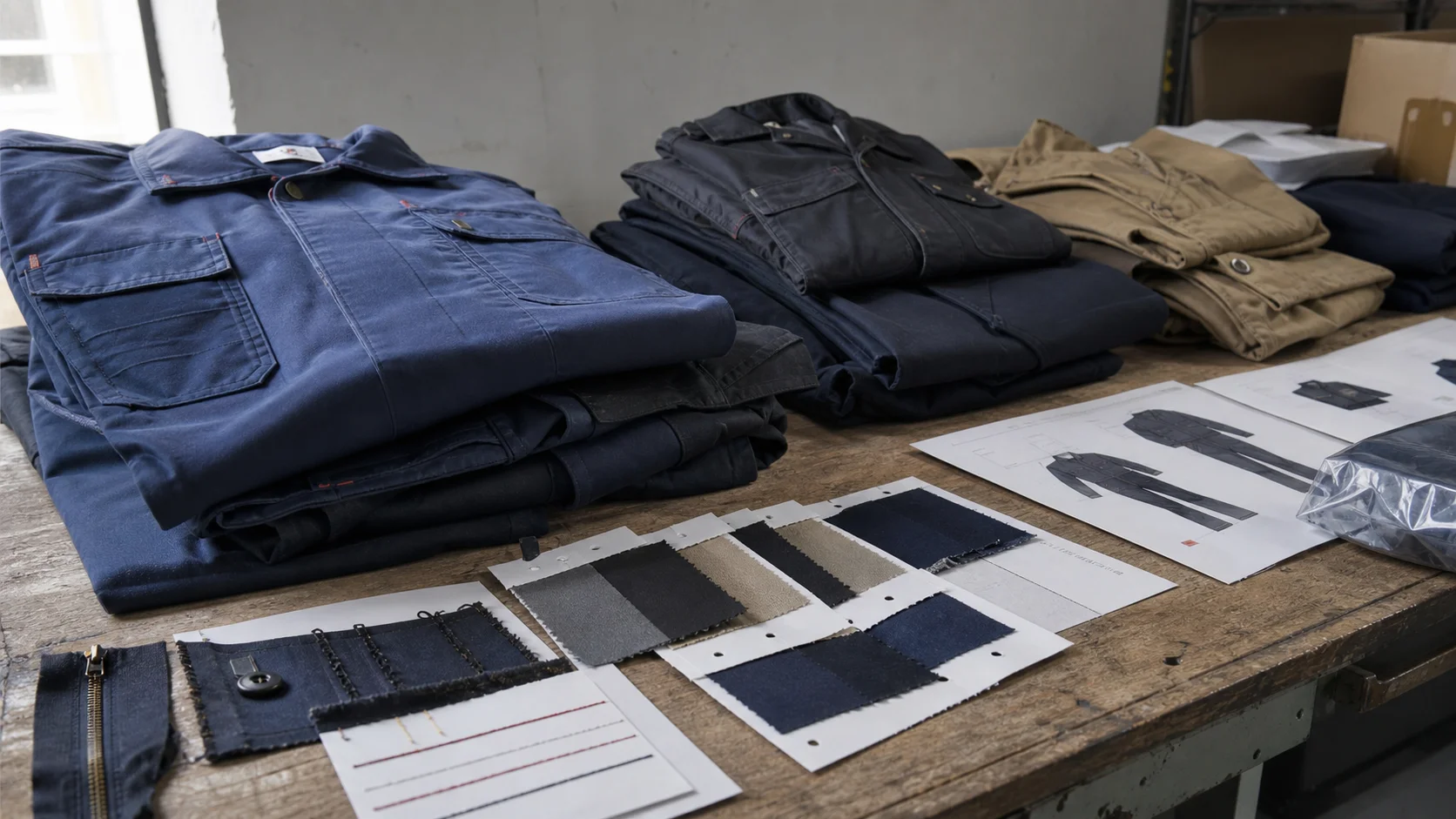
A sourcing-focused outline for restaurant procurement teams auditing coverall suppliers, with emphasis on garment specs, compliance evidence, cost drivers,...
Coverall Vendor Audit Brief for Restaurant Buyers - MOQ, Cost & Sourcing manufacturing guide
Restaurant groups do not buy coveralls the same way industrial plants buy coveralls. A food service uniform program has to balance hygiene, staff comfort, brand consistency, reorder speed, and cost control across multiple locations. The wrong coverall supplier can create problems that show up at store level: mismatched shades, shrinking garments, late replenishment, weak zippers, poor embroidery, and size curves that do not fit real teams.
This vendor audit brief is written for restaurant buyers, procurement managers, operations teams, and uniform program owners sourcing coveralls for kitchen, commissary, maintenance, facilities, cleaning, cold storage, delivery support, or back-of-house teams. It focuses on practical sourcing questions: minimum order quantities, costing, fabric specifications, sampling, lead times, compliance documents, production risks, and inspection points.
Use this as a structured checklist before approving a coverall supplier, especially when buying for multi-unit restaurant groups where a small garment issue can multiply quickly across dozens or hundreds of employees.
A coverall supplier vendor audit is not only about checking whether a factory can sew garments. For restaurant groups, the audit should confirm whether the vendor can support a controlled uniform program over time. Coveralls are often worn by staff who move between food prep, dish areas, receiving zones, storage rooms, cleaning tasks, and exterior waste handling. A garment failure can affect hygiene perception, staff safety, and brand presentation.
Restaurant buyers should audit suppliers before placing bulk orders because coveralls have more points of failure than basic T-shirts or aprons. There are zippers, snaps, pockets, waist seams, sleeve openings, gussets, elastic, bartacks, and sometimes reflective tape or protective finishes. Each component adds cost and creates another inspection risk.
A proper audit also helps prevent short-term price decisions from becoming long-term operational problems. A low unit price may look attractive on a spreadsheet, but if the fabric shrinks heavily after industrial laundering or the zipper fails after several weeks, the actual cost per wear becomes much higher.
Purchasing judgment: do not approve a coverall supplier based only on a clean sample and a low quote. Approve the vendor only after checking production consistency, fabric source, trim durability, size control, washing performance, and reorder capability.
Before reviewing price, restaurant buyers should define the supplier model. The right vendor depends on program size, customization level, delivery schedule, and whether the restaurant group needs ongoing replenishment.
A restaurant buyer should be careful when a vendor claims to do everything. Stock service, custom manufacturing, small-batch embroidery, garment washing, packaging, and rapid replenishment require different capabilities. A vendor may be strong in one area and weak in another.
If your organization is building a broader uniform sourcing program, review supplier support beyond coveralls. Categories like kitchen shirts, aprons, chef coats, maintenance uniforms, and branded outerwear may need similar standards. For a broader production capability review, buyers can compare service scope through a manufacturing partner’s apparel production services page before requesting a technical quotation.
Minimum order quantity is one of the first commercial points to clarify. Coveralls use more fabric and trims than simpler garments, so suppliers often set higher MOQs, especially for custom fabrics, dyed colors, and branded trims.
These ranges are typical planning references, not fixed rules. MOQ can change based on fabric mill requirements, trim sourcing, factory line efficiency, decoration method, and size breakdown. A supplier may accept a lower MOQ if the buyer pays a surcharge or uses available fabric. That can be useful for pilots, but it may not be ideal for a long-term national program.
Restaurant groups should ask whether MOQ applies per style, per color, per fabric, per size, or per purchase order. This distinction matters. A quote for 500 pieces may become difficult if the buyer needs three colors and twelve sizes. The supplier may price the order differently once the size and color split is clear.
Coverall cost is driven by fabric consumption, labor time, trims, finishing, decoration, packaging, testing, logistics, and order quantity. A restaurant buyer should not compare quotes unless all suppliers are pricing the same technical specification.
A basic polyester-cotton coverall with standard zipper and minimal branding will cost far less than a stretch twill coverall with reinforced knees, covered snaps, multiple utility pockets, embroidery, barcoded packaging, and wash testing. The difference is not only material cost. Construction complexity increases sewing time and quality-control workload.
Buyers should ask for a detailed quotation rather than a single unit price. At minimum, request unit cost by quantity tier, sample cost, tooling or logo setup cost, fabric description, trim assumptions, packaging method, payment terms, lead time, and freight terms.
A very low quote should trigger questions. It may exclude decoration, use a lighter fabric, assume a narrow size range, or omit testing and inspection. For restaurant groups, the cheapest coverall is rarely the best buy if it creates high return rates or inconsistent presentation across stores.
Fabric selection should reflect the work environment. Restaurant coveralls may be used in hot kitchens, commissaries, dishwashing areas, walk-in storage zones, food production spaces, and maintenance settings. The buyer should define the intended use before approving fabric.
For restaurant use, fabric should usually be durable but not overly heavy. A 240 gsm fabric may perform well for maintenance staff but feel uncomfortable for staff working near heat. Lighter fabric improves comfort but may show wear faster at knees, elbows, and pocket corners.
Fabric and trim specifications should be written into the purchase order or technical pack. Verbal agreements are not enough. If the approved sample uses one zipper and bulk production uses another, the buyer needs documentation to support rejection or corrective action.
Fit is one of the most common weak points in coverall programs. Coveralls must fit the torso, shoulders, seat, rise, sleeve length, and inseam at the same time. A pattern that looks acceptable on one sample size can fail badly at larger sizes if grading is not controlled.
Restaurant groups also need inclusive size planning. Staff size curves vary by region, job role, and workforce demographics. A vendor audit should check whether the supplier can produce extended sizes consistently and whether surcharges apply above certain sizes.
One practical audit question is whether the supplier has a tested size chart or only develops sizes from a single base pattern. For restaurant groups, request a full graded spec chart with tolerances. Standard garment tolerances might range from plus or minus 0.5 inch on smaller measurements to plus or minus 1 inch on longer body measurements, depending on the point of measure. Tolerances should be agreed before production.
Fit testing should include movement, not just standing measurements. Staff wearing coveralls may lift boxes, bend into low storage areas, climb steps, reach shelves, and clean equipment. Tight shoulders or short torso length will create complaints even if the garment technically matches the measurement chart.
A clean sample process reduces risk before bulk production. Restaurant buyers should avoid jumping from a photo or catalogue sample directly to a large purchase order, especially for custom coveralls.
For stock coveralls with decoration, buyers may only need a decorated approval sample before bulk branding. For custom programs, a pre-production sample is essential. It should include final fabric, final zipper, final snaps, final thread, final labels, final logo placement, and final packaging.
Approval should be written and specific. Instead of saying “sample approved,” note what is approved: fabric quality, color, construction, measurements, logo size, logo position, label content, packaging, and care instructions. If changes are required, list them clearly and ask for confirmation before cutting bulk fabric.
A restaurant buyer sourcing a new coverall program can also use early supplier discussions to evaluate responsiveness. If a vendor cannot answer sample questions clearly, that is a warning sign for bulk production. Buyers needing technical production support can start a discussion through Fabrikn’s contact page and provide style references, target quantity, fabric requirements, and delivery expectations.
Coverall lead time depends on whether the program uses stock garments or custom production. Restaurant groups should separate sample lead time, bulk production lead time, decoration time, inspection time, and freight time.
These ranges can shift during peak seasons, holiday periods, fabric shortages, or when a supplier is waiting for buyer approvals. The audit should check how the vendor manages production schedules and what information is required before they reserve capacity.
Restaurant groups rolling out new uniforms should build in a buffer. Store opening dates, menu launches, and operations training schedules often cannot wait for late garments. A rush order may be possible, but it usually increases cost and narrows quality-control time.
Restaurant coveralls may be worn in visible or semi-visible areas. Even if used mostly back of house, the garment should still support a consistent brand standard. Branding does not have to be loud. It should be durable, clean, and placed where it does not interfere with work.
Color control deserves special attention. Black, navy, charcoal, khaki, and white are common for restaurant workwear, but even these colors vary between dye lots and suppliers. If the restaurant group uses a brand-specific color, request lab dips and define acceptable shade variation under standard lighting.
White coveralls may look hygienic but show stains quickly. Dark coveralls hide stains better but can fade after repeated commercial laundering. Mid-tone colors can be practical for maintenance or facilities teams, while kitchen teams may prefer lighter colors for heat comfort and visible cleanliness.
Logo placement should avoid areas that crease heavily, rub against equipment, or interfere with pockets. For food-handling environments, buyers should also consider whether loose patches, poor embroidery backing, or peeling transfers create unacceptable appearance or contamination concerns.
Coveralls should be inspected more carefully than simple tops because construction defects affect wearability. A small measurement issue in torso length, zipper alignment, or crotch seam strength can make the garment uncomfortable or unusable.
Restaurant buyers should define an inspection standard before production. This can include AQL sampling, measurement checks, visual defect classification, packaging review, and wash testing. For smaller orders, a full internal check may be more practical than formal third-party inspection. For larger programs, pre-shipment inspection is usually worth the cost.
Ask the supplier to provide a measurement report during production and before shipment. The report should include key points of measure such as chest, waist, hip, shoulder, sleeve length, back length, front rise, inseam, thigh, cuff opening, and total body length. The buyer should compare these against approved specs and tolerances.
Restaurant uniforms often face frequent laundering. Wash testing should review shrinkage, colorfastness, seam puckering, trim damage, and logo durability. If garments will be industrially laundered, domestic wash testing may not be enough. Ask for care instructions that reflect the intended cleaning method.
Common acceptable shrinkage targets depend on fabric and buyer requirements, but many uniform programs aim to keep shrinkage controlled within a few percentage points. The key is not the exact number alone. The supplier should state expected shrinkage, test it, and build the pattern accordingly if needed.
Restaurant coveralls are not always regulated as protective garments, but compliance still matters. Buyers should not assume that a workwear supplier automatically meets the restaurant group’s corporate standards.
If the coveralls are marketed as flame-resistant, chemical-resistant, high-visibility, antimicrobial, or food-safe, buyers should require formal documentation and applicable test standards. Do not accept performance claims based only on sales language. A supplier that cannot document a claim should not be allowed to use it in the approved specification.
For standard restaurant workwear, the most practical testing priorities are usually fiber content, shrinkage, colorfastness to washing, colorfastness to rubbing, seam strength, and logo durability. Testing scope should match order size and risk. A small pilot may not justify a full lab package, but a national rollout usually does.
A restaurant uniform program does not end at the first delivery. New hires, damaged garments, store openings, seasonal staffing, and size exchanges all create reorder demand. Vendor audits should check whether the supplier can support the program after launch.
Core sizes should be forecasted carefully. Many buyers underorder larger sizes or short sizes, then discover that replenishment takes too long. A practical approach is to use employee size data where available, add new-hire buffers, and review actual issue rates after the first rollout.
For multi-location restaurant groups, packaging can be as important as garment quality. Store-level sorting reduces work for operations teams. The supplier should confirm whether they can pack by size ratio, store number, department, or individual wearer. This service adds cost but can reduce internal handling errors.
The audit should be direct. Restaurant buyers do not need overly complex paperwork for every supplier, but they do need clear answers before committing to bulk production.
A scorecard helps restaurant buyers compare suppliers in a consistent way. Weight the categories based on risk. For example, a small stock order may prioritize speed and price, while a custom national rollout should prioritize quality control, fabric continuity, and replenishment capability.
Audit Category Suggested Weight What to Check Product capability 20% Coverall construction experience, size range, customization ability Fabric and trim control 15% Fabric sourcing, zipper quality, trim continuity, color control Cost transparency 15% Clear quotation, price breaks, setup costs, packaging costs MOQ and reorder flexibility 15% Initial MOQ, replenishment MOQ, safety stock options Quality assurance 20% Inspection process, measurement reports, wash testing, defect handling Lead-time reliability 10% Sample timeline, production timeline, communication process Documentation and compliance 5% Care labels, test reports, origin, restricted substances supportA supplier with a slightly higher unit cost may be the better choice if they provide stable fabric, accurate sizing, lower defect rates, and reliable replenishment. A supplier with a low MOQ may be useful for pilots but unsuitable for full rollout if they cannot control repeat production.
Buyers evaluating manufacturing partners should also review the company’s background, category focus, and sourcing model. A general overview such as Fabrikn’s about page can help procurement teams understand whether a supplier’s positioning matches the needs of a restaurant uniform program.
Restaurant buyers usually face tradeoffs between cost, comfort, durability, and speed. There is no single best coverall specification for every group. The right choice depends on job role and operating model.
A cheaper coverall can be acceptable for short-term use, temporary staff, or low-abrasion tasks. For daily maintenance, commissary, receiving, or cleaning roles, stronger fabric and better trims are often worth the added cost. The buying question should be cost per wear, not just cost per unit.
Heavy fabric improves durability but can be uncomfortable in warm environments. Staff may avoid wearing the garment correctly if it feels too hot or restrictive. For kitchen-adjacent work, a medium-weight poly-cotton or breathable blend may be a better balance than a heavy industrial fabric.
Custom coveralls provide better brand control and functional details, but they take longer to sample and replenish. Stock coveralls are faster, but the buyer accepts limitations in color, fit, fabric, and future availability. A hybrid model can work: custom coveralls for core teams and stock backup garments for emergency replenishment.
Low MOQ is attractive for pilot orders. It can also mean the supplier is using available fabric that may not be available later. If consistency matters, confirm repeat fabric access before rollout. For a restaurant group, a pilot should test not only garment acceptance but also the vendor’s ability to scale.
Heat transfers can be fast and clean for logos, but poor transfers may crack or peel. Embroidery is durable but can pucker lightweight fabric and may not suit detailed artwork. Buyers should test decoration after washing before final approval.
Final purchasing judgment: approve the coverall supplier that can prove repeatable quality, not the one that only presents the best first sample. The strongest vendor for restaurant groups is usually the one with clear MOQ terms, documented specifications, realistic lead times, stable fabric access, and a practical defect-resolution process.
A coverall supplier vendor audit brief for restaurant groups should be practical, specific, and tied to operational risk. Buyers need to know whether the supplier can deliver the right garment, in the right sizes, with consistent branding, at a cost that holds up after washing, wearing, and reordering.
The strongest audit process starts with clear specifications: fabric content, weight, trims, construction details, size chart, tolerances, decoration method, care requirements, packaging, and delivery terms. From there, buyers should verify samples, test laundering performance, confirm MOQ and replenishment terms, and inspect bulk production before accepting shipment.
Coveralls are not the simplest restaurant uniform item, but a disciplined sourcing process makes them manageable. Treat the vendor audit as a risk-control tool. It protects the budget, the brand, and the operations team that has to live with the product after procurement signs the purchase order.
Get a free quote from Fabrikn — your trusted B2B clothing manufacturer with 10+ years of experience. MOQ as low as 200 pieces.
Get a Free Quote →A coverall vendor audit is a structured review of a supplier’s ability to produce, decorate, inspect, and replenish coveralls for restaurant teams. It usually covers MOQ, pricing, fabric, trims, fit, sampling, lead time, quality control, compliance documents, and reorder support.
Typical custom coverall MOQs range from 300 to 1,000 pieces per style or color. Semi-custom programs may start around 100 to 300 pieces if available fabric is used. Stock coveralls with logo decoration may be available from 24 to 100 pieces, depending on the supplier.
Custom coverall sampling often takes 2 to 6 weeks. Bulk production commonly takes 6 to 12 weeks after final approval. Custom dyed fabric, special trims, testing, and international freight can extend the timeline.
Polyester-cotton twill is a common practical choice because it balances durability, cost, and wash stability. Cotton-rich fabrics can feel more breathable but may shrink or wrinkle more. Stretch twill improves comfort but costs more and should be wash tested carefully.
Common issues include zipper failure, weak crotch or underarm seams, inconsistent sizing, fabric shade variation, shrinkage, poor logo placement, snap failure, loose threads, and incorrect packing by size or location.
Stock coveralls are better for speed, low quantities, and simple programs. Custom coveralls are better for brand control, specific fit requirements, functional pocket layouts, and long-term uniform consistency. Many buyers use stock garments for pilots and custom production for full rollout.
A coverall specification should include fabric content, fabric weight, color, trim details, zipper type, pocket layout, seam construction, bartack points, logo method, logo placement, labels, size chart, measurement tolerances, care instructions, packaging, and inspection requirements.
Buyers can reduce risk by approving a pre-production sample, checking a size set, conducting wash testing, confirming fabric and trim sources, agreeing on tolerances, documenting all specifications, and arranging pre-shipment inspection for larger orders.
Restaurant groups need ongoing coverall supply for new hires, replacements, store openings, and size exchanges. Reorder planning helps prevent mismatched garments, unavailable sizes, long replenishment delays, and operational shortages.
The most important factor is repeatable reliability. A strong supplier should provide consistent fabric, accurate sizing, durable construction, clear communication, realistic lead times, and a workable solution when defects or replenishment needs arise.