
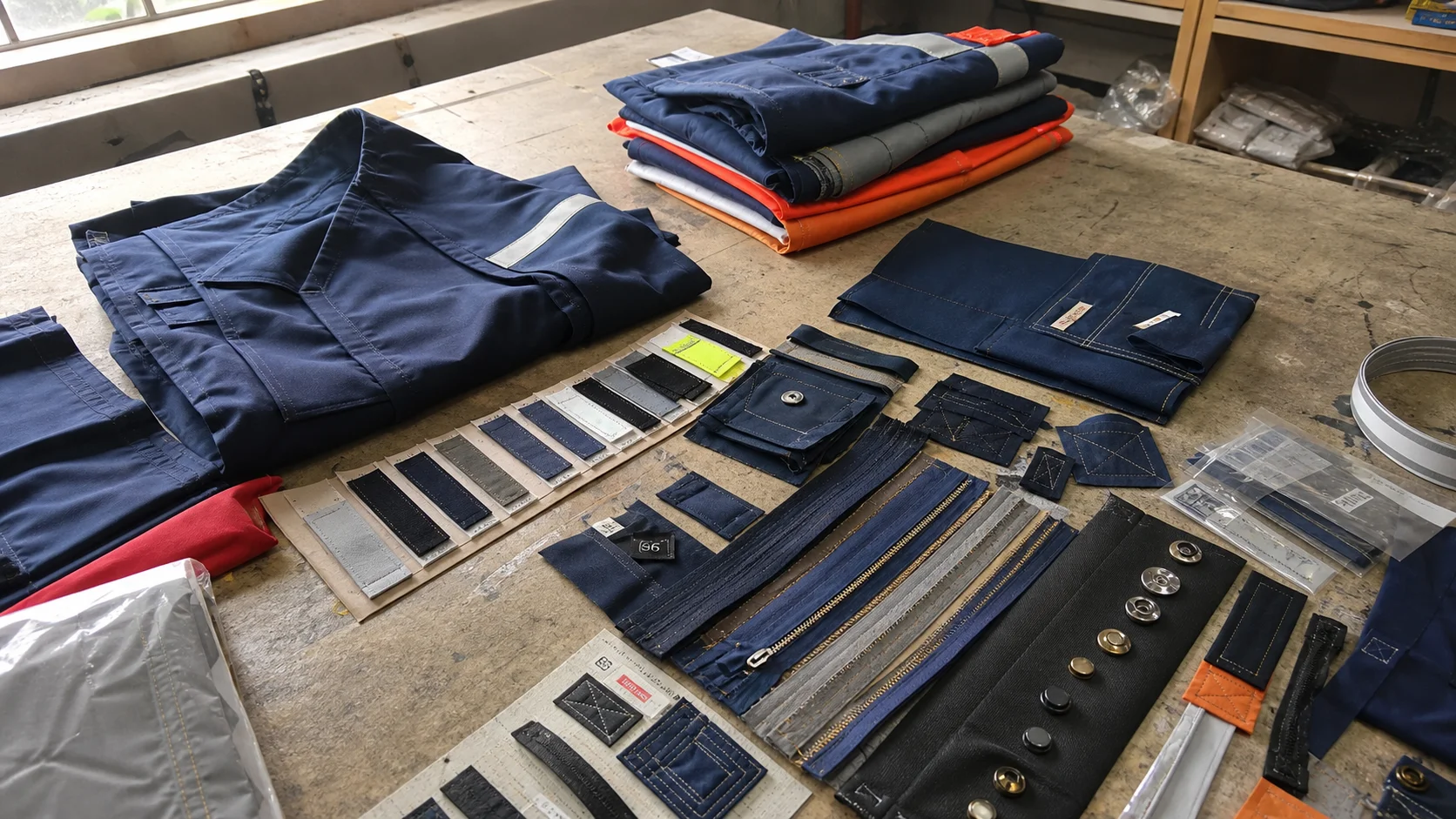
A quality-focused outline for corporate uniform buyers reviewing coverall trims, including zippers, snaps, reflective tape, labels, thread, pocket...
Coverall Trim Sourcing Review for Uniform Buyers - Quality & Inspection manufacturing guide
Corporate uniform buyers often spend most of their development time on coverall fabric, color, fit, and branding. That is understandable, because these items are visible and easy to compare across quotations. Trim sourcing deserves the same attention. Zippers, snaps, hook-and-loop tape, reflective tape, elastic, labels, pocketing, thread, and reinforcement materials can decide whether a coverall survives industrial use or becomes a recurring complaint.
This coverall trim sourcing review is written for corporate uniform buyers who need practical control over quality, cost, and supplier risk. It focuses on how to review trims before bulk production, what to specify in a tech pack, where inspection failures usually appear, and which tradeoffs matter when buying workwear at scale.
Coveralls are not fashion items with light wear expectations. They are bending, washing, rubbing, and snagging all day. A cheap zipper can stop a delivery program. Weak reflective tape can create safety and compliance exposure. Poor snaps can damage fabric. Incorrect labels can delay customs clearance or cause rework. Trim sourcing is not a side detail; it is part of the uniform’s functional specification.
A coverall program usually has multiple stakeholders. Procurement wants stable pricing. Operations wants durable garments. Safety teams may need flame-resistant, high-visibility, or chemical-resistant performance. HR or brand teams care about appearance. The final wearer expects the garment to close properly, fit comfortably, and last through repeated laundering.
Trims connect these priorities. A zipper must match the wearer’s movement and laundering conditions. Reflective tape must meet visibility expectations after washing. Thread must be suitable for the fabric and safety rating. Labels must carry the right care, size, fiber, origin, and compliance information. Even a drawcord, badge loop, or pocket flap tape can create failure points if it is not reviewed properly.
For corporate uniform buyers, the risk is rarely one single defective coverall. The problem is repeat failure across a rollout. If 5,000 units are issued and 8% have zipper problems within a few months, the cost is not just replacement garments. It includes complaints, operational disruption, internal credibility, and possibly safety exposure.
Trim sourcing should be treated as a controlled purchasing category, not as a factory-selected accessory list. The more functional the coverall, the less room there is for vague trim specifications.
Many factories can produce acceptable sewing when the inputs are controlled. Variation appears when trims are substituted, sourced late, or approved only by appearance. A sample may look correct but use a zipper grade that cannot handle industrial laundering. Reflective tape may pass a quick visual review but crack after wash testing. Hook-and-loop tape may look strong at first but lose grip when contaminated with lint or dust.
Uniform buyers should ask one basic question early: which trims are critical to safety, durability, brand consistency, or wearer comfort? Those items need named specifications, approved samples, and inspection checkpoints.
Coverall trim lists vary by design, industry, and performance requirements. A simple warehouse coverall may use basic zippers, snaps, labels, pocketing, and thread. A utility, oil and gas, maintenance, construction, or emergency-response coverall may require FR thread, reflective tape, concealed closures, radio loops, knee pad pockets, bartack reinforcement, and special labels.
Zippers are among the most common failure points in coveralls. Buyers should define zipper type, material, tooth size, tape width, puller style, slider finish, top and bottom stops, and whether the zipper must be concealed or two-way.
Typical options include metal zippers, molded plastic zippers, and coil zippers. Metal zippers are strong and familiar for heavy workwear, but they can corrode if finishing is poor or laundering is harsh. Molded plastic zippers are lighter and corrosion-resistant, but tooth damage can be difficult to repair. Coil zippers are flexible and smooth, though they may not be the best choice for heavy abrasive environments unless properly specified.
For coveralls, buyers often review zipper size around #5 or #8 depending on garment weight and use case. Heavy industrial coveralls may justify larger or stronger zipper systems. Lightweight facility uniforms may not need the same grade. Paying for a premium zipper is sensible when garment replacement is expensive or when the wearer relies on the closure throughout the day.
Snaps are used on cuffs, chest pockets, plackets, storm flaps, and sometimes leg openings. They should be checked for pull strength, cap finish, corrosion resistance, and compatibility with the fabric weight. A snap that is too aggressive can tear lighter fabric. A weak snap may open during work or laundering.
Buyers should specify snap diameter, material, finish, color, prong or ring type, and application location. Nickel-free or low-nickel requirements may apply in some markets. For industrial laundering, plated snaps need careful review because poor plating can stain fabric or rust.
Hook-and-loop tape is useful for adjustable cuffs, pocket closures, and patches. It is not always ideal for dusty, oily, or lint-heavy workplaces. It may also attach to other garments during washing if not covered or closed.
Specify width, color, cycle life expectation, sew-in type, and heat resistance if relevant. Buyers should approve both hook and loop sides, not just the visible side. A common mistake is accepting tape that looks correct but loses closure strength after repeated washing.
Reflective tape is a critical trim when coveralls are used for visibility. Buyers should confirm whether the requirement is decorative visibility, enhanced visibility, or compliance with a recognized high-visibility standard. The difference matters.
Specifications should include tape width, color, backing type, wash durability, placement, number of wash cycles, and applicable standard if required. Heat-transfer reflective tape and sew-on reflective tape behave differently. Sew-on tape may be more robust in some workwear applications, while heat-transfer tape can offer cleaner appearance and less stitching penetration. The right choice depends on fabric, wash method, safety standard, and expected garment life.
Thread is easy to overlook because it is less visible than zippers or reflective tape. It can be the difference between a coverall that holds its seams and one that fails at stress points.
Polyester thread is common for general workwear because it has good strength and wash resistance. Cotton-wrapped or special aramid thread may be required for flame-resistant garments. Thread ticket size should match fabric weight, seam type, and machine setup. Heavy thread on lightweight fabric can cause puckering. Weak thread on heavy fabric can snap under stress.
Labels include brand labels, size labels, care labels, fiber composition labels, origin labels, warning labels, compliance labels, and wearer identification labels. In uniform programs, labeling errors are common and costly because they may affect distribution, customs, compliance, and internal tracking.
Buyers should approve label content, language, layout, dimensions, material, print durability, and attachment position. For global programs, care and fiber labeling requirements may vary by destination. A factory should not be left to “use standard labels” unless the buyer has already approved those standards.
Elastic may be used at waistbands, cuffs, or action-back areas. Webbing may be used for tool loops, radio loops, badge holders, or hanger loops. Reinforcement tape may appear inside seams, pockets, or stress areas.
Specify width, stretch recovery, color, material, and wash performance. Elastic can degrade with heat, chemicals, and repeated laundering. Webbing must be strong enough for the intended use. Reinforcement tape should not create discomfort or stiffness in the wrong area.
A coverall trim specification should be precise enough that two factories can quote and produce comparable products. If one supplier quotes with branded zippers and another uses an unverified local alternative, the price comparison is not clean.
At minimum, a trim specification should include item name, material, size, color, supplier grade or reference, placement, performance requirement, and approval sample status. For safety-related garments, the specification should include applicable standards and test requirements.
Trim Item Specification Points Buyer Risk if Vague Zipper Type, size, tape color, slider, puller, finish, one-way or two-way, concealed or exposed Breakage, poor sliding, color mismatch, corrosion, uncomfortable closure Snaps Diameter, material, finish, color, pull strength, placement Fabric tearing, rust, weak closure, inconsistent appearance Reflective tape Width, backing, color, standard, wash cycles, placement Non-compliance, cracking, poor reflectivity, delamination Thread Fiber type, ticket size, color, strength, FR requirement if applicable Seam failure, puckering, non-compliant FR construction Labels Content, language, size, material, print durability, placement Compliance errors, distribution confusion, relabeling cost Hook-and-loop Width, color, closure strength, wash durability, sew-in or heat-applied Poor fastening, lint contamination, wash damageUniform buyers should keep a trim card for every approved coverall style. The trim card should include physical swatches or clear references, supplier names if locked, color standards, and approval signatures or approval dates. A digital tech pack is helpful, but physical trim approvals still reduce ambiguity for colors, hand feel, tape stiffness, and hardware finish.
For corporate uniform programs, a sensible control point is to classify trims into three groups:
Critical trims should not be substituted without written approval. Brand trims should match approved artwork and color standards. Standard trims can have more flexibility, but buyers should still define acceptable quality and appearance.
MOQ is one of the first practical barriers in trim sourcing. Many trims have different MOQ rules from garment production. A garment factory may accept 300 coveralls per color, but a zipper supplier may require 1,000 to 3,000 pieces per color and length. Reflective tape may be sold by rolls with minimum roll quantities. Custom labels may have MOQs from 500 to 5,000 pieces depending on material, printing method, and supplier setup.
Typical MOQ ranges vary by supplier and market, but uniform buyers can use the following planning ranges:
Trim Category Typical MOQ Range Notes for Buyers Standard zippers 500 to 3,000 pieces Lower MOQ is possible for stocked colors and common lengths. Custom zipper color or puller 1,000 to 5,000 pieces Custom pullers may require mold charges and longer development. Snaps and rivets 1,000 to 10,000 sets Stock finishes are easier; custom plating raises MOQ and risk. Reflective tape 100 to 1,000 meters Certified tape may have stricter sourcing and documentation controls. Woven labels 500 to 5,000 pieces Small orders often pay a higher unit cost or setup charge. Printed care labels 500 to 10,000 pieces Multi-language labels need careful artwork control. Hook-and-loop tape 100 to 1,000 meters Stock width and color reduce cost and lead time.These are not fixed rules. They are realistic planning ranges for discussion. MOQ depends on whether the trim is stocked, custom dyed, branded, certified, imported, or locally sourced.
Low MOQ sounds attractive when testing a new uniform program. The tradeoff is that factories may use available trims that are close but not exact. Higher MOQ can improve consistency and pricing, but it may create leftover inventory if the program changes. Corporate buyers should decide whether the coverall is a short pilot, an annual reorder item, or a long-term standard uniform. That decision affects how aggressively to lock trims.
For repeat uniform programs, it is usually better to standardize trim specifications across styles where possible. The same zipper tape color, same snap finish, same label format, and same reflective tape width can reduce purchasing complexity. Standardization also helps replacement orders match earlier production.
A useful sourcing question is simple: “Which trims can be common across the program without compromising function?” Common trims reduce cost and delay. They should not be forced where the work environment requires a stronger or compliant alternative.
Trim approval should not wait until the pre-production sample if the trims are critical. Buyers should review trims in stages, especially for larger corporate uniform orders.
At the design or quotation stage, request a preliminary trim list from the manufacturer. This should show the proposed zipper, snaps, tape, thread, labels, and any special components. Ask the factory to identify which trims are stock items, which are custom, and which require third-party certificates or special testing.
This stage is useful for cost comparison. If a factory quotes a low price but uses weak trims, the buyer should know before approving the supplier. A clean quotation should separate garment assumptions from trim assumptions.
Trim colors should be checked against fabric colors and brand standards. Zipper tape, thread, reflective tape backing, hook-and-loop tape, labels, and elastic can all create visible mismatch. For corporate uniforms, small color differences become more obvious when garments are issued across teams.
Color matching is especially important for navy, black, grey, khaki, orange, and high-visibility yellow shades. Different materials absorb dye differently. A zipper tape may not match the garment fabric exactly, but the buyer should decide what tolerance is acceptable.
The proto sample shows whether trim placement and function work on the actual garment. Check zipper length, placket coverage, pocket access, snap positions, cuff adjustment, reflective tape layout, and label readability. Wearer movement matters. A trim that looks fine on a flat sample can rub, pull, or restrict movement during bending and reaching.
If the coverall will be worn by different body types or in active jobs, collect structured wearer feedback. Do not ask only whether the sample “looks good.” Ask whether the zipper is easy to operate, whether snaps hold, whether cuffs adjust properly, whether labels irritate skin, and whether pockets can be accessed while working.
The pre-production sample should use actual bulk trims, not substitutes. This is the buyer’s best chance to catch risk before cutting bulk fabric. Confirm trim card, bill of materials, label content, thread color, zipper operation, reflective placement, and reinforcement points.
If a trim is still pending at pre-production sample stage, treat that as a schedule risk. Buyers can approve with conditions, but conditions must be documented clearly. “Approved except zipper puller” is better than a verbal discussion that becomes a dispute during inspection.
A sealed sample should be retained by both buyer and factory if possible. It becomes the reference for production and inspection. For larger programs, keep a sealed trim card as well. The inspector should compare bulk output against the approved sample and trim card, not against memory or email descriptions.
Buyers who need sourcing support, supplier review, or production coordination can review broader manufacturing support options through Fabrikn services. For trim-heavy workwear projects, the value is not only finding a supplier. It is keeping specifications controlled from sample to shipment.
Coverall lead time is often discussed as if fabric and sewing are the only drivers. Trims can be just as important. A missing zipper color, delayed reflective tape certificate, or incorrect care label can hold a shipment even when fabric is ready.
Typical lead-time dependencies include:
For standard coveralls using available trims, sampling may take 7 to 20 days after fabric and trim details are confirmed. Bulk production may take 30 to 60 days depending on order size, fabric availability, factory capacity, and inspection requirements. More complex workwear, FR garments, or high-visibility coveralls can take longer, especially when certified trims or test reports are required.
Buyers should be cautious when a supplier gives a short lead time without asking detailed trim questions. Fast lead time may be realistic for stocked programs. It may also indicate that the supplier plans to use whatever trims are available.
A practical purchasing approach is to create a trim readiness checklist before bulk production:
Trim shortages are not always dramatic. A factory may proceed with partial production, then wait for the final labels or reflective tape. This creates mixed production batches and increases the chance of inconsistency. For corporate buyers with rollout dates, trim readiness should be reviewed before cutting bulk fabric.
Inspection should include more than general workmanship. Coverall trims need functional checks. An inspector should open and close zippers, pull snaps, review reflective tape placement, check label content, inspect thread color, and confirm reinforcement stitching.
Many trim defects are easy to miss if inspection is only visual. A zipper may look aligned but jam when operated. A snap may be attached but too loose. Reflective tape may be positioned incorrectly around a seam. A label may have the wrong fiber content or care symbol. Hook-and-loop tape may be sewn upside down or placed too close to an edge.
Inspection risk increases when trims are supplied late, when multiple subcontractors are involved, or when the factory changes trim suppliers after sample approval. Buyers should require notice before substitution. A substitute trim should be reviewed for appearance, function, and compliance before production continues.
For coveralls, AQL inspection should be supported by specific measurement and function checks. General AQL sampling can identify visible defect rates, but buyers should define major and minor defects properly. A missing safety label or failed reflective tape placement may be a major or critical issue, not a cosmetic defect.
Inspection Check What to Verify Risk Level Zipper operation Smooth opening and closing, correct length, secure stops High Snap attachment Alignment, holding strength, fabric damage High Reflective tape Placement, width, adhesion or stitching, surface condition High for safety garments Labels Content, language, placement, print clarity Medium to high Thread and bartacks Correct thread, stress-point reinforcement, stitch quality High Elastic and tape Recovery, alignment, comfort, twisting MediumCorporate buyers should define pass and fail conditions before inspection. If the standard is unclear, the factory and inspector may treat functional issues as acceptable variation. Clear defect classification saves time during shipment decisions.
Testing requirements depend on the coverall’s intended use. Not every coverall needs a full laboratory testing program, but every corporate uniform buyer should understand the risk level.
General workwear may need checks for colorfastness, dimensional stability, seam strength, zipper strength, snap pull strength, and label durability. High-visibility coveralls may need reflective performance and wash durability. Flame-resistant coveralls need careful control of fabric, thread, reflective tape, labels, and all other components that could affect compliance.
For FR coveralls, trims must be considered part of the garment system. Non-FR thread, unsuitable labels, or incompatible reflective tape can undermine the garment’s intended protection. Buyers should not approve FR coveralls based only on fabric certification. The construction and components matter.
Useful trim-related tests may include:
Testing adds cost and time, so buyers should be selective. A small internal facility coverall may not justify extensive third-party testing if the risk is low. A safety-rated coverall should not be treated casually. The cost of testing is usually lower than the cost of recalling or replacing non-compliant garments.
Documentation should match the claim. If a supplier claims reflective tape meets a specific standard, ask for the relevant report and confirm it applies to the exact tape being used. If the report is for a different tape, different backing, or different wash condition, it may not support the garment being purchased.
Corporate buyers often work through the garment factory rather than directly with trim suppliers. That can be efficient, but it reduces visibility. For standard garments, factory-managed trim sourcing may be acceptable. For high-risk programs, buyers should ask more questions.
A practical supplier review should cover the following points:
Incoming trim inspection is particularly important. Factories should check quantity, color, appearance, function, and compatibility before sewing. If defective zippers are discovered after they are sewn into coveralls, repair becomes slow and expensive. If incorrect labels are discovered after packing, the shipment may require unpacking and relabeling.
Buyers do not always need to nominate trim suppliers. Nominating suppliers can improve control but may increase cost, MOQ, and coordination work. Allowing the factory to source trims can reduce workload and improve speed, but the buyer must define the required performance and approval process.
The best choice depends on the program. For a long-running corporate coverall with strict brand and safety requirements, nominated critical trims may be worth the extra management. For a short, low-risk order, factory-standard trims may be acceptable if samples are approved and inspection is clear.
Companies evaluating a new sourcing setup can also review supplier capability and communication approach through Fabrikn’s company background. The important point is to treat trim control as part of supplier qualification, not as a late production detail.
Uniform purchasing is full of tradeoffs. The lowest trim cost is not always the best value. The most expensive trim is not always necessary. Buyers should judge trim choices against garment life, wearer risk, replacement cost, brand visibility, and compliance needs.
Upgrade trims when the component affects garment function or safety. Zippers on heavy-duty coveralls are worth improving if failure would make the garment unusable. Reflective tape should be upgraded when visibility performance is required. Thread should be upgraded when seam strength or FR performance is critical. Snaps should be upgraded when they are placed on stress areas or exposed to industrial laundering.
Upgrades are also sensible for long-term programs. If the same coverall will be reordered for several years, better trims can reduce complaints and stabilize quality. The cost difference may be small when spread across the garment’s service life.
Standard trims can be acceptable for low-risk garments, pilot runs, and budget-sensitive programs where the use case is light. A warehouse coverall used occasionally does not need the same trim package as a high-visibility utility coverall. Buyers should still approve the sample and define minimum quality.
The danger is not using standard trims. The danger is not knowing what standard means. “Factory standard” should be supported by an approved sample, not a vague promise.
Custom trims can improve branding but may create MOQ, lead-time, and replacement problems. Custom zipper pullers, special snap colors, unique patch materials, and unusual label formats can look attractive during development. They may become a burden when a reorder is urgent or volume changes.
Use custom trims where they create real brand or functional value. Avoid them where they only add complexity. A corporate logo patch may be important. A custom snap finish may not be worth the delay unless it is central to the uniform identity.
When comparing coverall quotations, buyers should request the trim bill of materials and sample trims behind the quoted price. Two quotes are not equivalent if one uses certified reflective tape and the other uses generic tape. They are not equivalent if one uses a stronger zipper and the other uses a light-duty closure.
A fair comparison should include:
If the quote is unusually low, ask which trims have been downgraded. If the quote is high, ask whether the trims are over-specified for the actual work environment. Good sourcing is not about accepting the cheapest or most premium option. It is about matching component quality to operational risk.
The following checklist is suitable for corporate uniform buyers reviewing coverall trim sourcing before order placement:
This checklist should be part of the purchasing file, not just the product development file. Procurement teams need visibility because trim decisions affect price, lead time, compliance, and reorder reliability.
Coverall trim sourcing is a practical quality-control issue. It does not need to be overcomplicated, but it does need structure. Corporate uniform buyers should know which trims are critical, what standards apply, how MOQ affects cost, and when supplier substitution is unacceptable.
The best programs usually combine clear specifications with sensible flexibility. Lock the trims that affect safety, durability, compliance, and brand identity. Allow controlled alternatives where the risk is low and the sample is approved. Build inspection criteria around function, not just appearance.
For buyers preparing a new coverall program or reviewing supplier options, early trim review can prevent expensive production problems. If a project requires support with specifications, production coordination, or supplier communication, buyers can start a discussion through Fabrikn’s contact page.
A coverall is only as reliable as its weakest component. Fabric may define the garment category, but trims often decide whether the uniform performs in daily use.
Get a free quote from Fabrikn — your trusted B2B clothing manufacturer with 10+ years of experience. MOQ as low as 200 pieces.
Get a Free Quote →The most important trims are usually zippers, snaps, reflective tape, thread, labels, hook-and-loop tape, elastic, and reinforcement materials. The priority depends on the coverall’s use. For safety garments, reflective tape, FR thread, compliant labels, and closure systems need tighter control.
Typical MOQs vary by trim type. Standard zippers may start around 500 to 3,000 pieces, custom zippers around 1,000 to 5,000 pieces, reflective tape around 100 to 1,000 meters, and labels around 500 to 5,000 pieces. Stock trims can often support lower quantities, while custom colors and certified materials usually require higher MOQ.
Nominated suppliers are useful for long-term programs, safety-rated garments, or strict brand requirements. Factory-sourced trims can be acceptable for lower-risk orders if the buyer approves samples and defines performance requirements. The decision should balance control, cost, lead time, and reorder needs.
Buyers should approve a trim card, proto sample, fit sample if needed, and pre-production sample using actual bulk trims. The approval should include zipper function, snap strength, tape placement, thread color and type, label content, and any safety-related documentation.
Common defects include jamming zippers, loose snaps, incorrect labels, reflective tape peeling or placed incorrectly, weak hook-and-loop tape, mismatched thread, missing bartacks, and elastic with poor recovery. Functional checks are necessary because many trim defects are not obvious from appearance alone.
Reflective tape should be tested or supported by valid documentation when the coverall is sold or issued for visibility protection. Buyers should confirm the applicable standard, tape width, placement, wash durability, and whether the report applies to the exact tape used in production.
Factories should not substitute critical trims without written buyer approval. Substitutions may affect durability, appearance, compliance, and wearer safety. If a substitute is proposed, buyers should review a sample, updated specification, and any required test documentation before accepting it.
Trims affect lead time when they are custom dyed, branded, certified, imported, or delayed by supplier MOQ. Labels, reflective tape, and special zippers are common causes of production delay. Buyers should confirm trim readiness before bulk cutting begins.
A trim bill of materials should include item name, material, size, color, quantity per garment, placement, supplier reference if available, performance requirement, and approval status. It should match the tech pack and sealed sample.
The cheapest trim package may be acceptable for light-use, low-risk coveralls, but it is risky for industrial, safety, or long-term uniform programs. Buyers should judge trim cost against garment life, wearer complaints, replacement cost, and compliance exposure.