
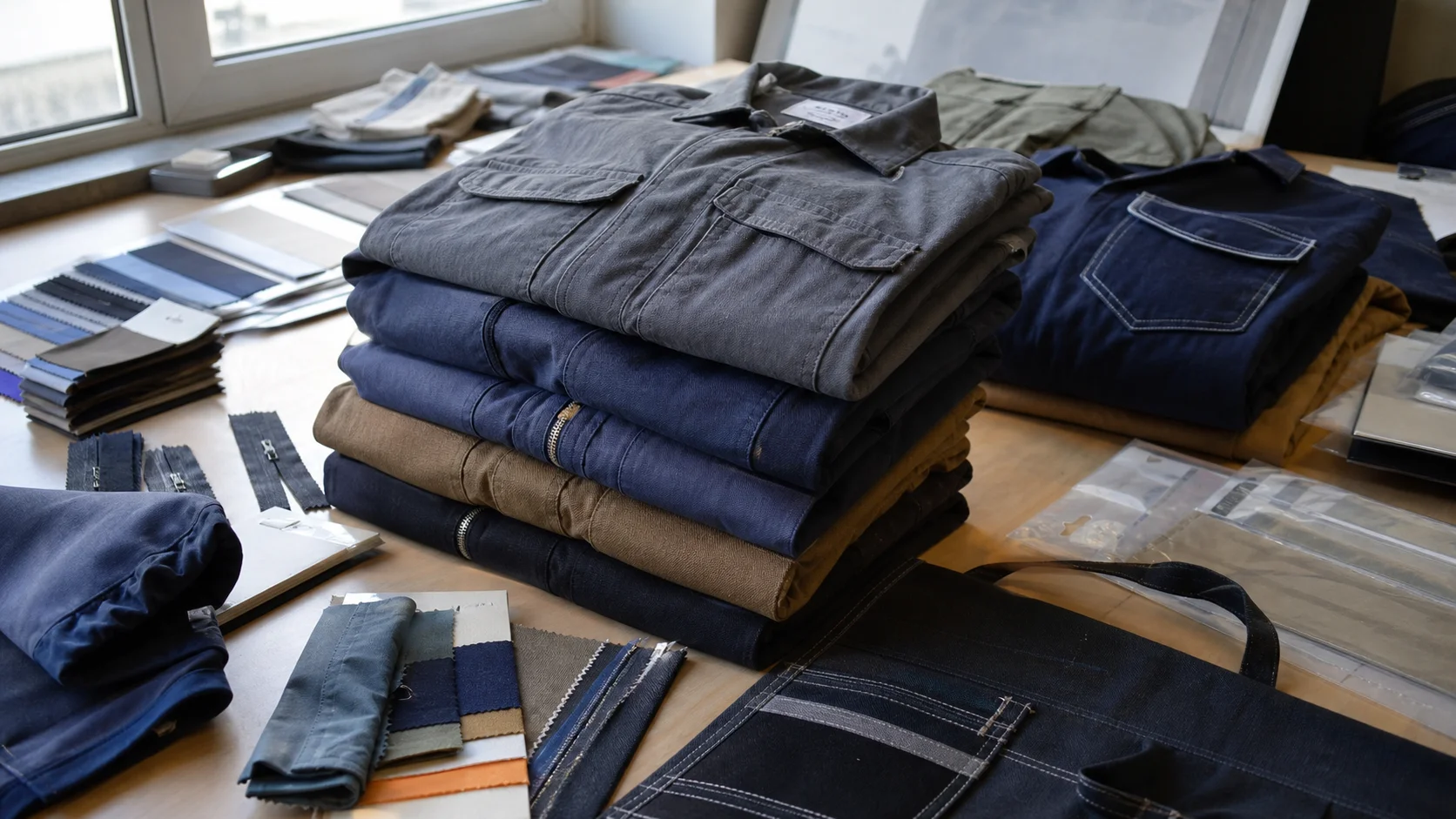
A practical outline for fitness club buyers evaluating coveralls through wash test results, durability checks, and cost implications before placing bulk orders.
Fitness clubs buy coveralls for a practical reason: they need durable workwear that can stand up to repeated laundering, daily handling, cleaning chemicals, and constant movement. A coverall may look straightforward at the buying stage, but wash performance is where many sourcing mistakes show up. Shrinkage, color loss, seam twisting, broken zippers, and print failure can turn a low-cost order into a costly replacement problem.
This review focuses on the coverall wash test from a fitness club buyer’s point of view. It covers what to check before placing an order, how wash testing affects MOQ and price, what fabric and trim choices matter, and where inspection risk tends to appear. If you are sourcing uniforms, maintenance wear, or staff coveralls for gyms, studios, wellness centers, or sports facilities, the wash test should be treated as part of the commercial decision, not as a final paperwork step.
Coverall Wash Test Review for Fitness Club Buyers - Fabrikn production reference
Fitness club coveralls are usually issued to maintenance staff, cleaning teams, technical crews, or back-of-house personnel. Their use case is tougher than it sounds. They are worn during active work, exposed to sweat, disinfectants, machine oils, floor cleaners, and frequent laundering. In some clubs, the garment is washed daily or several times a week. That makes wash stability one of the most important quality checks in the order.
A wash test is not only about whether the garment “looks fine” after one wash. Buyers should care about whether the coverall remains within tolerance after repeated cycles. A garment can pass the first wash and still fail after 5 to 10 cycles through shrinkage, puckering, seam distortion, or fading. For staff uniforms, these issues matter because the garment must keep a professional appearance and continue fitting correctly.
For fitness club buyers, wash performance is a cost-control issue as much as a quality issue. A cheaper coverall that fails early often costs more than a better-made garment with stable fabric, trim, and construction.
The practical question is not “Can the supplier wash test it?” The better question is “Was it tested against the way the club will actually launder and use it?” That means defining wash temperature, detergent type, drying method, and required appearance after wash before the order is confirmed.
A proper wash test review should look at both garment construction and visual appearance after washing. The goal is to understand whether the coverall remains usable and acceptable under normal laundering conditions.
Shrinkage is one of the first failure points. For woven cotton or cotton-rich coveralls, shrinkage can affect chest width, sleeve length, inseam, and overall ease of movement. For fitness club staff, a tight or shortened coverall can limit bending, lifting, and cleaning tasks. Buyers should ask for dimensional change data after wash, not just a verbal confirmation that the fabric is “pre-shrunk.”
Typical acceptance depends on the garment spec, but many buyers target low single-digit shrinkage. That target can vary by fabric composition, finish, and wash method. Knitted panels, if included, may behave differently from woven main fabric, so both areas should be checked separately.
Color loss shows up quickly on dark coveralls, especially black, navy, charcoal, and deep green shades often chosen by fitness facilities. Color transfer is also a concern if the garment is worn near lighter equipment covers or towel stock. Buyers should confirm colorfastness to laundering, rubbing, and perspiration if the staff will be active or working in warm spaces.
Dark shades can look acceptable on day one and then turn patchy after repeated washing if the dye system is weak. This is a common problem in low-cost sourcing, where the garment may pass a visual sample check but not hold color after real use.
Seams should be checked after wash for puckering, breakage, seam slippage, and distortion around stress points. Shoulders, crotch seams, side seams, and pocket openings are the most likely failure areas. For coveralls with heavy use, bartacks at pocket corners and reinforced stress zones are worth the extra cost.
Thread choice matters. Polyester core-spun thread usually holds up better in repeated laundering than weaker alternatives. If the coverall includes heat-sensitive prints or reflective elements, the sewing and attachment method should also be reviewed for wash durability.
Zippers, snaps, hook-and-loop tape, and elastic components should be tested after wash cycles. A zipper that warps, catches, or loses alignment after laundering creates immediate field complaints. If the garment has a front zipper with a protective placket, buyers should check whether the placket stays flat after drying and whether the zipper tape shrinks at a different rate from the garment body.
Plastic hardware may reduce cost, but it does not always age well under hot wash conditions. Metal hardware can be stronger, though it may increase weight and corrosion risk if the finish is not suitable.
A coverall should not come out of the wash feeling overly stiff, rough, or distorted. This matters for staff comfort, but it also affects appearance. Over-stiff fabric can crease badly and look worn even when it is structurally intact. A soft finish is useful only if it does not wash out too quickly. Buyers should define the desired hand feel after wash, not only at delivery.
If the fitness club requires a logo, staff name, or size label, these elements need wash testing too. Screen print, heat transfer, embroidery, woven labels, and care labels all behave differently. A logo that cracks after repeated washing will weaken brand presentation fast. Embroidery is often more durable than transfer printing, though it adds cost and can affect comfort if placed in high-friction areas.
Fabric selection has a direct impact on wash test outcomes. Fitness club buyers often compare price first, but the fiber blend and construction decide much of the garment’s long-term cost. A low initial price can hide a higher replacement rate later.
Fabric weight also matters. Light fabric can dry faster, which helps operations, but may wear out sooner at elbows, knees, and seat areas. Heavier fabric can improve durability, though it raises cost and can feel less comfortable in warmer club environments.
Some buyers ask for anti-wrinkle, water-repellent, soil-release, or antimicrobial finishes. These can help a fitness club manage appearance and cleaning efficiency, but each finish adds complexity. The supplier should confirm whether the finish is durable through washing, and how many cycles it is expected to last. A finish that works in the first few washes but breaks down early may not justify the cost.
Soil-release finishes are useful if staff work around cleaning products or equipment grease. Antimicrobial claims should be handled carefully and supported by the supplier’s documentation. Buyers should request clear claims, not broad marketing language.
Trims often fail before the base fabric does. Buyers should review:
Good sourcing practice is to specify the trim standard in the tech pack. If the supplier is free to substitute cheaper zipper tape or thread, the wash test result may not match the approved sample.
A wash test review should begin before bulk production, not after the shipment arrives. Buyers need a clear sample approval sequence so the supplier cannot move to production on a garment that only looks right on the hanger.
For fitness club programs, it is wise to test at least one full wash cycle using the planned care instructions. If the garment will be frequently laundered in hot water, the sample should be tested under that condition, not under a gentler lab assumption. If the club plans to outsource laundry, ask about the laundry provider’s actual process. The garment should match that process as closely as possible.
When possible, ask the supplier for before-and-after measurement reports on key points: chest, body length, sleeve length, inseam, waist, and leg opening if applicable. A visual approval alone is not enough.
If you are still shaping the buying program, the services page can be a useful starting point for understanding what a sourcing partner can support in sampling, production coordination, and quality checks. For direct project discussion, use the contact page.
MOQ for coveralls depends on fabric availability, color, pattern complexity, logo application, and whether the supplier is building custom trims. Wash testing itself does not always change MOQ directly, but it can affect how the order is quoted and staged.
These ranges are only indicative. A supplier may quote lower or higher depending on fabric availability and production line planning. For fitness club buyers, the real issue is whether the MOQ is tied to a risk reduction benefit. A higher MOQ can sometimes improve unit cost if it allows the factory to source better fabric or keep the same dye lot for the full order. A low MOQ may be easier to approve, but it can create cost pressure that pushes the factory toward weaker trims or lighter fabric.
A buyer should be careful with quotes that are significantly below the market average. The savings may come from reduced fabric GSM, weaker zipper specs, or a less rigorous wash test standard. In apparel sourcing, the cheapest quote is often the one that assumes the fewest quality requirements.
Wash test review affects lead time because it can trigger extra sampling rounds. If the first sample fails shrinkage or appearance criteria, the supplier may need to revise the pattern, change the fabric finish, or switch trims. That can add one to three weeks, sometimes more if fabric has to be re-sourced.
Fitness clubs often work to opening dates, seasonal promotions, or staff rollout schedules. That means a delayed wash test can affect operations. If the coveralls are needed for a launch, opening event, or replacement program, build enough time for sample correction. Rushing approval is one of the most expensive mistakes in sourcing.
A practical buying plan is to leave room for at least one sample revision. If the project is simple and the supplier is organized, the process may move quickly. If the fabric is custom or the wash specification is strict, do not assume the first sample will be production-ready.
Inspection should not stop at visual appearance before washing. The wash test can reveal hidden quality issues that are easy to miss on a fresh sample.
The best way to manage these risks is to define measurable acceptance criteria before bulk production starts. That may include tolerance limits for shrinkage, acceptable visual change after wash, and a minimum number of cycles the garment should survive without serious appearance loss.
Inspection teams should also check consistency across sizes. A coverall that washes well in medium size may behave differently in larger sizes because of pattern scaling and fabric distribution. Size set testing helps reduce this problem.
For fitness club buyers, a coverall program should be judged by total value, not by unit price alone. The garment needs to hold up to laundering, stay presentable, and remain comfortable enough for staff to wear consistently. If it fails in one of those areas, the club pays again through replacement, complaints, or staff reluctance to wear the uniform.
Good places to protect budget include decorative extras that do not add value in back-of-house workwear. Overly complex fashion details, unnecessary contrast paneling, and premium branding methods may not be worth it unless the coverall is customer-facing.
Places not to cut corners include fabric quality, thread strength, zipper performance, and wash testing. These are the areas that determine whether the garment survives real life. If the budget is tight, a simpler design with stronger materials is usually a better choice than a stylish design built on weak components.
In most coverall programs, the smartest savings come from reducing design complexity, not from lowering the fabric or trim standard.
Buyers should also consider the laundering method when selecting materials. If the club uses industrial laundering, a more stable polyester-blend construction may outperform a softer but less stable natural-fiber option. If staff wash garments at lower temperatures, there may be more flexibility on fabric feel, but the spec still needs to be clear.
When the buying team is ready to move from review to sourcing, it helps to work with a supplier who can manage sampling, specification control, and production communication cleanly. Learn more on the about page.
A coverall wash test review is a small part of the order process on paper, but it has a large effect on cost, durability, and buyer satisfaction. For fitness club buyers, the priority is simple: the coverall must survive repeated laundering, preserve fit, and maintain a clean professional look. That requires controlled fabric selection, dependable trims, clear sample approval, and realistic wash standards.
Do not treat wash testing as a formality. Treat it as part of the sourcing decision. The supplier’s ability to hold dimensions, color, and construction after washing is often the difference between a short-term purchase and a reliable uniform program.
Get a free quote from Fabrikn — your trusted B2B clothing manufacturer with 10+ years of experience. MOQ as low as 200 pieces.
Get a Free Quote →It is a check of how the coverall performs after washing. Buyers review shrinkage, colorfastness, seam strength, zipper function, and overall appearance after one or more wash cycles.
Typical MOQs often start around 300–500 pieces for simple styles and can rise to 500–1,500 pieces for custom fabrics, special trims, or more complex construction. The exact number depends on material sourcing and factory setup.
There is no single best option for every club. Poly-cotton blends are often a practical balance of durability, wash stability, and cost. Higher polyester content usually improves dimensional stability, while cotton-rich fabrics may feel better but need more control for shrinkage.
That depends on the buyer’s use case. At minimum, one wash test should match the intended care method. For heavier-use programs, buyers often ask for several cycles to see whether shrinkage, fading, or hardware issues appear over time.
Common failures include shrinkage, fading, seam puckering, zipper distortion, and print cracking. Trims and labels can also fail before the base fabric does.
Yes. Buyers should ask for measurements before and after wash, the wash method used, and any pass/fail criteria agreed in advance. Written records reduce disputes later.
It can, but only if the supplier uses the right fabric, thread, trim, and finishing. A low price alone is not a problem. The risk is when cost cuts reduce material quality or the factory skips proper testing.