
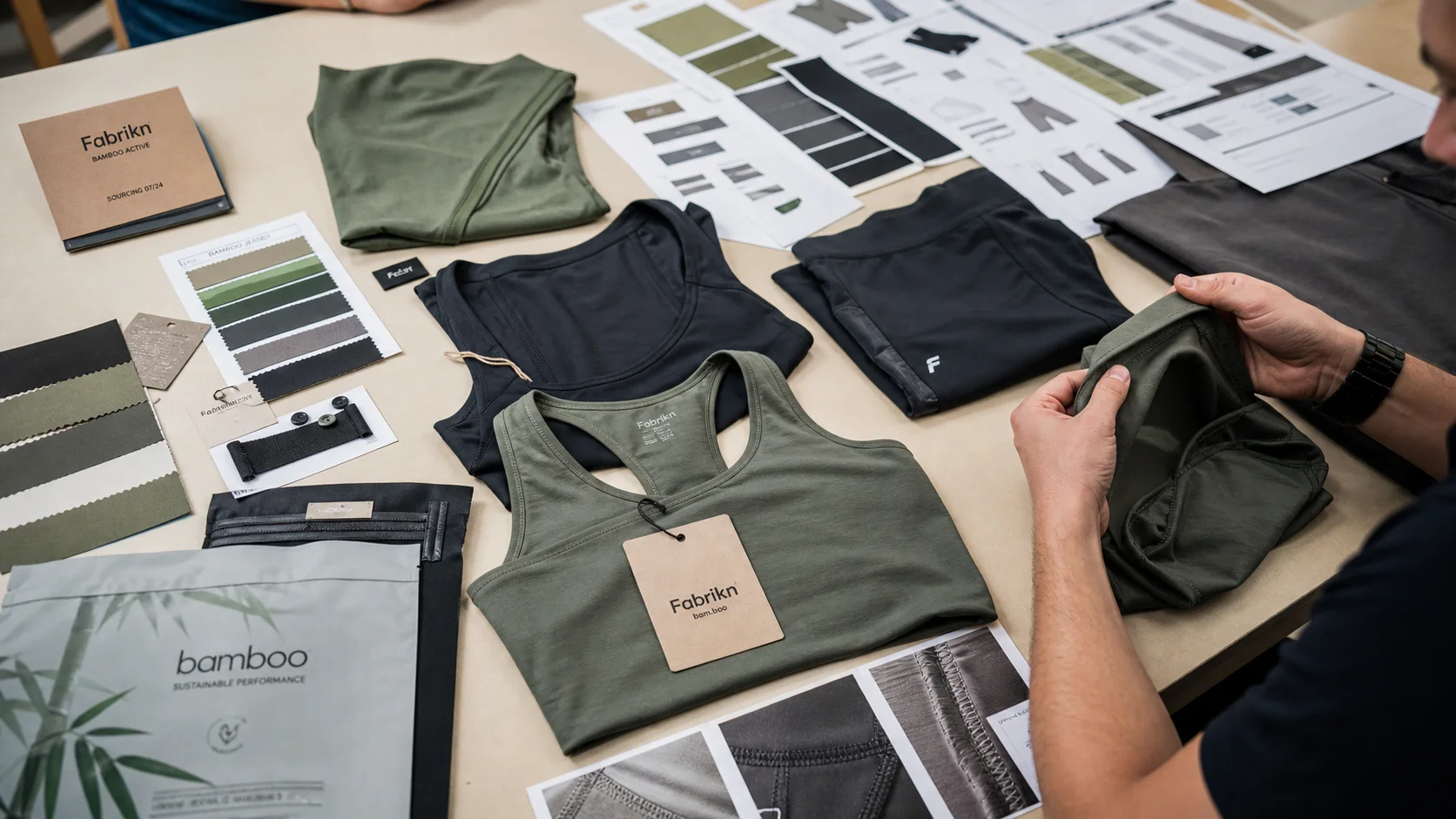
A focused outline for boutique fitness startups evaluating custom activewear set MOQs, including how decoration choices, fabric pairing, and production artifacts affect minimums, pricing, and launch planning.
Custom Activewear Set MOQ for Startup Buyers - Fabrikn production reference
For boutique fitness startup brands, MOQ is rarely just a number printed on a supplier quote. In activewear manufacturing, minimum order quantity reflects how a factory balances fabric sourcing, dyeing, cutting efficiency, trim purchasing, decoration setup, and line scheduling. When buyers search for answers about custom activewear sets MOQ for boutique fitness startup brands, the real issue is usually not whether a factory can make a small order. The issue is whether the order can be made at a commercially workable cost, with stable quality, and without creating avoidable production risk.
A custom activewear set typically includes at least two coordinated pieces, often leggings and a sports bra, or shorts and a crop top. Once matching colors, technical fabrics, branding applications, and size runs are added, the factory has to manage more variables than it would for a basic blank garment. That is why MOQ in this category tends to sit higher than many startup buyers expect.
Buyers should also separate three different MOQ discussions. The first is factory MOQ, meaning the minimum quantity a manufacturer needs to run a style. The second is fabric MOQ, which is often tied to dye houses or mills rather than the sewing factory. The third is decoration MOQ, which can come from printing, heat transfer, embroidery, silicone branding, or private-label trim suppliers. A startup brand that only asks for “the MOQ” can miss where the real limit sits.
That distinction matters when reviewing sourcing options through a manufacturing partner’s services page or while building an inquiry package for production. A low sewing MOQ does not help much if the selected nylon-spandex fabric must be dyed in quantities far above the brand’s launch plan.
Boutique fitness startups often launch with a focused product vision and a limited cash position. They want a signature activewear set, custom fit, branded look, and enough inventory to support a strong first drop. At the same time, they need to avoid tying too much capital into untested size curves and colorways.
That creates a direct conflict with how activewear production usually works. Factories prefer larger runs because technical sportswear uses specialized fabrics, stretch-sensitive sewing operations, and more detailed quality control than many basic apparel categories. A supplier may be able to produce 100 sets, but the unit cost can rise sharply once quantities fall below the efficient cutting and sewing threshold.
There is also the issue of assortment creep. Startup brands frequently want one legging, one bra, three colors, extended sizes, custom inside labels, printed care labels, branded elastic, and premium packaging. On paper, the total quantity may sound acceptable. In practice, every split across color and size reduces the usable quantity per SKU. A 300-set order divided across three colors and six sizes can become operationally thin very quickly.
For startup buyers, the wrong MOQ decision is not always ordering too much. It can also mean ordering too little to secure stable fabric quality, consistent decoration results, or a workable repeat-order path.
This is why many small fitness brands benefit from simplifying the first launch. Fewer colors, fewer trim variations, and cleaner logo application methods often do more for margin protection than negotiating aggressively on the headline MOQ alone.
MOQ ranges vary by product complexity and supply chain setup, but startup buyers can use some practical benchmarks when planning custom activewear sets.
These are working ranges, not fixed rules. Some suppliers quote by pieces rather than full sets, which changes the math. A manufacturer may state a 300-piece MOQ, but if the set includes both bra and leggings, the buyer needs to confirm whether that means 300 tops and 300 bottoms, or 300 completed sets.
Startups should also ask whether the quoted MOQ applies to one style, one color, or one purchase order. Confusion here is common. A supplier may advertise a low MOQ online, but the quote can shift once custom color, woven labels, or performance prints are added.
If a startup is still refining brand positioning, there is usually less risk in starting with a narrower SKU plan and confirming reorder capability upfront. A factory that can support a moderate initial MOQ and repeat the same fabric later is often more valuable than one offering a very low first run with uncertain continuity. Buyers that need help evaluating those tradeoffs often start the discussion through the contact page with a clear tech pack and target quantity range.
MOQ in activewear is shaped by the least flexible part of the supply chain. In many cases, that is not sewing capacity. It is fabric, color, or decoration setup.
Common activewear set fabrics include nylon-spandex blends such as 75/25 or 78/22, polyester-spandex options like 80/20 or 85/15, and brushed interlock or compression knits in weight ranges roughly from 220 gsm to 320 gsm. If the supplier already stocks the fabric in standard shades, MOQ can be lower. Once buyers request custom Pantone-matched dyeing, the minimum rises because dye houses and mills need enough volume to run efficiently.
A clean legging and sports bra set with standard seam construction is more manageable than a style with contour panels, mesh inserts, bonded hems, removable pads, hidden pockets, or contrast flatlock stitching. Complexity does not always change the official MOQ, but it often changes whether a factory is willing to accept a small order at a competitive price.
Custom jacquard elastic, branded zipper pulls, silicon end caps, molded cup pads, woven size tabs, and specialty packaging can all carry their own minimums. Startup buyers sometimes approve a workable garment MOQ and then discover the trim package forces excess purchasing.
One color is almost always more efficient than three. Activewear startups often underestimate how heavily color proliferation affects inventory exposure. If demand is uncertain, adding colors before validating fit can be an expensive way to learn basic sizing lessons.
Printing and branding choices are a major MOQ lever, especially in the Decoration & Printing category. Some methods are forgiving on small runs. Others require setup costs that make low-volume orders unattractive.
For custom activewear sets, decoration is not just an aesthetic layer. It affects cost, hand feel, stretch performance, wash durability, and reject rates in production. Startup buyers should choose branding methods based on both appearance and manufacturing reality.
Heat transfers are a common entry point for startup activewear brands because they allow relatively low setup complexity and clean logo placement. They can work well on leggings waistbands, bra fronts, or back yokes. MOQ can be comparatively manageable if the transfer supplier supports smaller runs.
The tradeoff is performance consistency. Transfer adhesion depends on correct heat, pressure, dwell time, fabric surface, and stretch behavior. On high-elastane fabrics, poor transfer selection can lead to edge lifting or cracking after wash and wear testing.
Screen printing can be cost-effective at scale, especially for bold graphics, but setup costs push it toward larger order quantities. It is less common for heavily compressive, slick activewear knits unless the artwork and ink system are properly selected for stretch. Buyers should ask whether stretch ink testing is included.
Sublimation is useful for polyester-based activewear where all-over prints, gradients, or engineered graphics are central to the design. It usually suits performance tops or printed panels better than nylon-rich compression sets. MOQ can be moderate, but the fabric base must be compatible. Buyers should confirm color migration risk, print alignment tolerance, and white crease exposure on stretch zones.
Silicone logos and reflective transfers can elevate brand appearance, particularly in premium fitness positioning. They also introduce more approval points. Thickness, placement accuracy, and stretch recovery all matter. A small logo looks simple, but if it distorts on the hip or chest after wear, the product can lose its premium impression fast.
The safest path for a first-order startup launch is often one restrained decoration method, one or two logo placements, and clear wash-test expectations before bulk production begins.
Startup buyers usually want the lowest MOQ available. That instinct is understandable, but lower MOQ does not always equal lower risk. It can mean higher unit pricing, weaker material leverage, and less room for factory-side quality buffering.
There are three basic sourcing models to compare:
Model Best For Common MOQ Impact Main Tradeoff Stock fabric + standard trims Fast launches and lower inventory risk Lower MOQ Less exclusivity Custom dye + simple branding Brands needing stronger identity Mid-range MOQ Longer lead time and higher cash commitment Fully custom set + premium decoration Established positioning from day one Higher MOQ Most expensive development pathFor most boutique fitness startups, the sensible middle ground is to protect the product’s core identity without overbuilding the first collection. Good fit, squat-proof fabric, secure seams, and a durable logo usually matter more than a fully customized trim package on day one.
A practical buying approach is to spend money where customer perception is strongest. In activewear, that usually means fabric opacity, recovery, stitching comfort, and fit balance. Packaging upgrades and non-essential branding details can often wait for later drops.
Sampling is where startup buyers either control MOQ risk or amplify it. A rushed sample approval can lead to bulk issues that are expensive to fix and even harder to resell.
A typical custom activewear set development path includes these stages:
Buyers should request clarity on which sample stages are charged, which are refundable against bulk, and how many revision rounds are realistically included. One common startup mistake is treating the proto as a near-final sales sample. That assumption can cause frustration and delay.
Approval should cover more than appearance. For activewear sets, buyers should review:
Factories with a clear development process often explain this upfront on their about page or during early project conversations. Buyers should still request the exact approval flow for their own program, rather than relying on general website language.
Lead time for custom activewear sets depends on more than sewing days. Startup buyers should think in phases rather than asking for one all-in number.
Sampling can take several weeks depending on how complete the tech pack is, whether fabrics are stocked, and how many revisions are needed. If sizing and support function are still being adjusted, development may take longer than the buyers initially budgeted.
Custom dyeing, custom jacquard elastic, woven labels, and branded packaging can all extend the schedule. A supplier cannot cut bulk garments until the full approved material package is on hand or at least firmly scheduled.
Bulk production timing depends on order size, line capacity, construction complexity, and inspection arrangements. During peak seasons, even moderate orders can wait for line allocation.
Air shipment protects launch dates but increases landed cost. Sea freight is cheaper but less forgiving. Startups should not commit to a hard launch date before confirming production completion windows and shipment mode.
A reasonable planning habit is to build buffer time between sample approval and campaign launch. Tight schedules often push factories and decorators into avoidable mistakes, especially when stretch fabrics, logo applications, and size-set consistency all need close attention.
Activewear has inspection risks that startup buyers should not treat casually. The category looks simple from a distance, but stretch garments can hide technical problems until they are worn.
Buyers should ask what in-line and final inspection points are used, and whether sets are checked as paired units or as separate garments. That sounds minor, but matching a bra and legging visually matters for a coordinated set product. If components are inspected independently without set matching logic, shade inconsistency can slip through.
For startup orders, the commercial damage from quality problems is often disproportionate. A larger brand may absorb returns and move on. A small fitness startup can lose momentum quickly if the first launch suffers from transparency complaints, peeling logos, or inconsistent fit reviews.
MOQ negotiation works best when buyers understand where flexibility exists. Pressuring a factory for an unrealistically small run without adjusting the product spec usually gets poor results. Smarter buyers negotiate structure, not just quantity.
If a factory offers stocked performance fabrics in proven colors, that can reduce fabric minimum exposure significantly. This is often the easiest way to lower MOQ without sacrificing the garment’s overall quality level.
One strong color and one core neutral often beat a broad but shallow launch. Concentrated quantities create cleaner production and better reorder intelligence.
Choose one logo method with a proven application record on stretch fabric. This reduces both MOQ pressure and production risk.
Some startup brands assume sets will sell evenly across all sizes. Reality can differ. If the factory allows separate top and bottom size ratios while maintaining the set concept, buyers may protect sell-through more effectively.
The first order and repeat order may not have the same minimums. Once patterns, labels, and approved fabrics are established, reorder conditions can improve. Buyers should get this in writing before placing the launch order.
A detailed request for quotation improves supplier confidence. Include style sketches, fabric targets, gsm, compression expectations, color count, logo placements, label requirements, quantity by color, and target ex-factory timing. Factories respond more constructively when they are pricing a defined project rather than a vague concept.
The easiest MOQ to negotiate is the one supported by a disciplined product brief. Factories are usually more flexible when the buyer reduces uncertainty.
For buyers researching custom activewear sets MOQ for boutique fitness startup brands, the central decision is not simply how low the minimum can go. The better question is which MOQ structure supports a credible launch without creating quality or cash-flow strain.
In most cases, startup-friendly activewear sourcing comes down to a few practical choices: use proven fabrics where possible, reduce color complexity, keep decoration clean and functional, and follow a disciplined sample approval process before bulk production starts. A slightly higher MOQ on the right fabric with the right logo application can be less risky than a very low MOQ built on unstable materials or rushed decoration methods.
That is the tradeoff startup buyers should keep in view. Activewear customers are quick to notice opacity issues, poor recovery, uncomfortable seams, and failing logos. If the product does not perform, a low opening MOQ will not protect the brand. A controlled first run, clear specifications, and realistic production planning usually offer a better path to repeat business and stronger margins.
Get a free quote from Fabrikn — your trusted B2B clothing manufacturer with 10+ years of experience. MOQ as low as 200 pieces.
Get a Free Quote →A typical starting range is often around 100 to 200 sets for simpler programs using stock fabric, and around 200 to 500 sets for more customized programs. Fully custom developments with special trims or complex decoration can move higher.
Yes, often that is the most practical route. Stock fabric removes some dyeing and sourcing minimums, which can make smaller production runs more workable.
It can. Heat transfer logos are usually more startup-friendly than large-scale screen print programs, while premium applications like silicone or reflective branding can add setup and approval complexity.
For most startups, a tighter color range is the safer move. Protecting size coverage in core shades usually gives better early sales data than spreading inventory thinly across many colors.
It depends on sampling, fabric availability, decoration approvals, and production capacity. Buyers should plan for development time, material lead time, bulk production time, and shipping time as separate stages.
Common issues include see-through fabric under stretch, seam popping, color mismatch between set pieces, logo cracking or peeling, and inconsistent fit across sizes. Those risks are easier to control when sample approvals and inspections are handled carefully.