
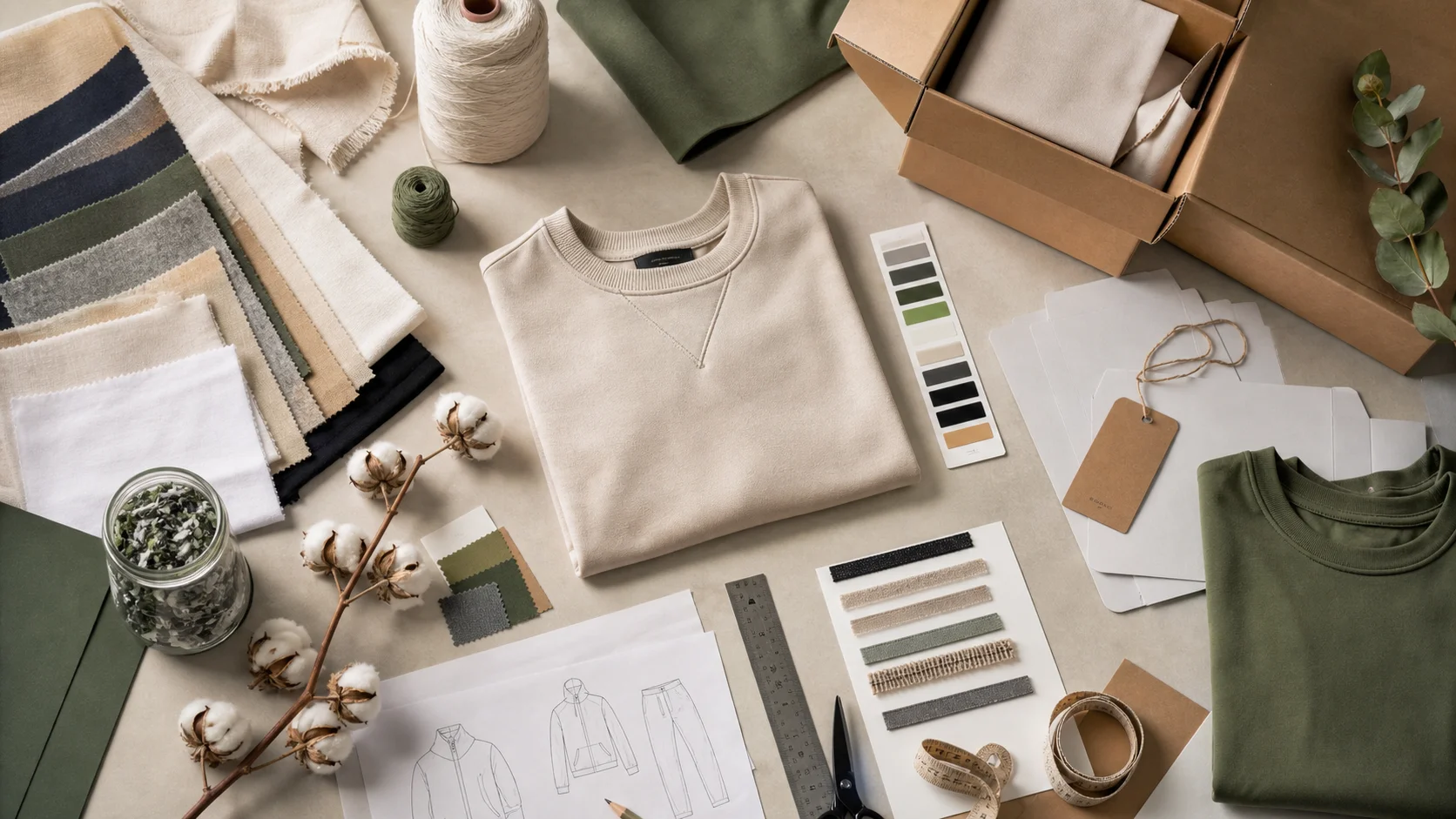
Garment MOQ Review Part 2 with checks for samples, fit, MOQ, QC evidence, pricing terms, and delivery risk.
Fast answer: Garment MOQ Review Part 2: Size Runs, Color Limits, and Phased Orders should be judged by production evidence, not by a generic sourcing promise. The buyer needs sample proof, cost breakdowns, QC checkpoints, and delivery buffers in writing.
Ask for recent sample photos, measurement tolerances, fabric or print test assumptions, decoration test notes, packing examples, and a named inspection checkpoint. These details show whether the team can repeat an approved sample at bulk volume.
Separate garment cost, decoration, labels, packaging, sampling, testing, freight, and rush charges. When every cost line is visible, it becomes easier to reduce colorways, adjust size depth, or reserve more time for sampling.
For any brand entering the custom clothing market, minimum order quantity, or MOQ, is one of the first real business hurdles. MOQ can determine whether a new product launch is profitable, whether a small brand can afford to test a design, and whether a scaling label can maintain healthy inventory levels. In custom apparel, MOQ is not just a production detail. It is a strategic lever that affects pricing, lead times, quality consistency, and supplier relationships.
A smarter custom apparel supplier MOQ strategy helps brands balance flexibility with manufacturing efficiency. The goal is not always to push MOQ to the lowest possible number. Instead, the goal is to negotiate the right MOQ for your business model, product type, sales forecast, and stage of growth. Brands that understand how suppliers think can often secure better terms, reduce risk, and build stronger long-term partnerships.
If you are sourcing custom garments for retail, corporate uniforms, promotions, or private label apparel, learning how MOQ works can save time and money. It can also help you avoid overcommitting to inventory that may not sell. For brands looking for support across product development, manufacturing, and order planning, explore our services to see how a structured production partner can improve your sourcing process.
MOQ stands for minimum order quantity. It is the smallest number of units a supplier is willing to produce in a single order. In custom apparel, MOQ may apply to an entire style, a colorway, a print design, a fabric type, or even a size run. For example, a supplier may require 300 pieces per style, 100 pieces per color, or 50 pieces per size assortment.
MOQ exists because manufacturing has fixed setup costs. Before production begins, suppliers must prepare materials, patterns, cutting schedules, sewing lines, printing screens, embroidery files, quality control processes, and packaging workflows. When the order volume is too low, those fixed costs are spread across too few units, which reduces profitability for the supplier.
Not all MOQs are the same. A low MOQ for a simple T-shirt may be very different from a high MOQ for a complex jacket or technical garment. Fabric dyeing, custom trims, wash treatments, and specialty decoration methods can all increase the minimum order quantity. In some cases, the MOQ is less about the product itself and more about the supplier’s production structure and sourcing network.
Many brands assume MOQ is simply a supplier’s way of saying no to smaller orders. In reality, MOQ is often tied to operational efficiency and cost control. Understanding this helps brands negotiate from a more informed position.
Setup costs: Every production run requires preparation. Even small runs need design review, pattern making, material sourcing, and line setup.
Material sourcing minimums: Mills and trim vendors often have their own minimums, which are passed down through the supply chain.
Labor efficiency: Sewing lines and finishing teams work more efficiently when they can produce consistent volumes.
Quality consistency: Larger runs often make it easier to maintain color, fit, and finishing consistency across production.
Waste reduction: Suppliers manage fabric yield and cutting loss more effectively when order volumes are predictable.
Profit protection: MOQ helps suppliers maintain margins on custom projects that require extra time and coordination.
When you understand these drivers, you can negotiate smarter. Instead of asking for a lower MOQ with no context, you can propose solutions that reduce supplier risk while meeting your own needs. That is where effective MOQ strategy begins.
MOQ has a direct impact on how a clothing brand grows. A high MOQ can create scale advantages if demand is strong, but it can also create financial strain if sales are uncertain. A lower MOQ can preserve cash and reduce inventory risk, but it may come with a higher per-unit cost.
For startups, MOQ often determines whether a product can be launched at all. New brands usually want to test concepts before committing to large inventory buys. If the MOQ is too high, cash flow can be tied up in stock that may take months to sell. This creates pressure on marketing, fulfillment, and working capital.
For established brands, MOQ affects assortment planning and replenishment. A high MOQ may be acceptable for proven bestsellers but problematic for seasonal colors or limited-edition drops. Brands that sell through wholesale and direct-to-consumer channels often need different MOQ strategies for each channel.
MOQ also influences pricing strategy. Lower quantities usually mean higher unit costs, which can affect margins and retail pricing. That is why brands need to calculate total landed cost, not just production cost. Freight, duties, sampling, warehousing, and unsold inventory all matter. A smart MOQ approach considers the full financial picture rather than focusing only on sticker price.
Negotiating MOQ is not about pushing suppliers to give away margin. It is about building a commercial structure that works for both sides. The best negotiations are specific, data-driven, and relationship-oriented.
Suppliers respond better when you can show realistic sales projections, customer interest, pre-orders, or historical sell-through data. If you are a startup, use market research, audience size, test ads, or waitlist numbers to demonstrate demand. Clear evidence reduces supplier uncertainty and makes lower MOQ requests more credible.
If your full collection has multiple styles, colors, and sizes, ask whether you can start with a single hero product or a focused color palette. Narrowing the scope makes production easier and may reduce the MOQ. Many suppliers are willing to support a simpler first run if it helps establish the relationship.
In some cases, the supplier can reduce MOQ if you accept a higher unit cost. This can be a smart trade-off when you need to test the market or launch a new design. The key is to compare the extra cost against the risk of overstock. Sometimes paying slightly more per unit is cheaper than carrying unsold inventory.
Suppliers are more flexible when orders can be consolidated. If you can use the same base fabric, trim package, or print technique across multiple styles, the supplier may be able to lower MOQ because material sourcing and setup become more efficient.
Instead of asking for a very small MOQ outright, propose a first production run followed by a replenishment order if sales hit agreed targets. This gives the supplier confidence that future volume is possible. It also helps you limit risk while keeping the partnership open for growth.
Suppliers may be more open to lower MOQ if you can accept longer lead times. This allows them to fit your order into existing production cycles, source materials more efficiently, or batch your run with similar jobs. Flexibility is often a valuable negotiation tool.
Suppliers often reserve their best terms for brands they trust. If you communicate clearly, pay on time, approve samples efficiently, and provide accurate forecasts, you become a lower-risk customer. That can lead to better MOQ terms over time. For brands seeking a long-term manufacturing relationship, it helps to understand the partner behind the production process. Learn more about our team on the about us page.
The best MOQ strategy depends on where your brand is in its lifecycle. A startup, a growing DTC label, and a wholesale business do not have the same production needs.
Startups should focus on validation. The ideal MOQ strategy is often a small test run with limited colors and sizes. The objective is to learn what sells, gather feedback, and refine fit and design before scaling. If your supplier offers sample-to-production workflows, use them to minimize risk. Keep the first order simple and direct.
Emerging brands should use MOQ to support repeatable growth. This usually means building a forecast based on actual sales data, then negotiating for a production structure that supports restocks. A slightly higher MOQ may be worth it if it reduces unit cost and improves consistency. At this stage, strong supplier communication is essential.
Established brands can use MOQ strategically across different product tiers. Bestselling core items can justify larger orders and lower unit costs, while seasonal or experimental products should be produced in smaller quantities. This segmentation lets brands protect margins while still innovating.
MOQ strategy for drops should prioritize scarcity, speed, and brand positioning. Limited runs often work better with a supplier who can accommodate smaller quantities and quick turnaround. If the product is meant to create buzz rather than ongoing inventory, it may be worth paying more per unit to keep the order size lean.
Corporate apparel often benefits from repeatable sizing and standardized decoration methods. This can allow for negotiated MOQs across multiple departments or rollouts. If the buyer expects recurring orders, suppliers may be more willing to reduce the initial MOQ as part of a longer-term agreement.
Not every supplier is a good fit for low MOQ or flexible production. Some factories are designed for high-volume efficiency and may not be able to support small, customized runs without sacrificing cost or lead time. Choosing the right supplier is just as important as negotiating the right terms.
Look for suppliers that clearly understand your product category, have experience with your decoration method, and are transparent about pricing structures. Ask how MOQ is calculated. Is it based on fabric minimums, setup time, color count, or pattern complexity? A good supplier should explain the real reason behind the number.
You should also assess communication quality. Fast response times, detailed quoting, and clear sample feedback are signs of a partner that can support a smoother MOQ negotiation process. If a supplier is vague during the quoting stage, that may become a bigger issue during production.
Another important factor is production versatility. Suppliers with broad capabilities may be able to combine multiple services, such as pattern development, sampling, cut-and-sew production, printing, embroidery, and packaging. That can improve efficiency and make lower MOQ structures more practical. If you are evaluating sourcing options, compare capabilities carefully and ask specific questions before committing.
For brands ready to discuss their production needs, a direct conversation can often reveal more flexibility than a price sheet. Reach out through our contact us page to start a manufacturing discussion tailored to your goals.
Even experienced brands can make costly mistakes when negotiating MOQ. Avoiding these missteps can improve your chances of getting better terms.
Asking for a lower MOQ without context: Suppliers need to understand why your order is smaller and what future potential exists.
Ignoring total cost: A lower MOQ with a much higher unit cost may not be the best option financially.
Overcomplicating the first order: Too many colors, styles, and trims can make MOQ harder to reduce.
Failing to forecast correctly: Inaccurate demand estimates can lead to either under-ordering or excess inventory.
Choosing the wrong supplier: A factory built for mass production may not be the right partner for a small-batch strategy.
Negotiating only on price: Sometimes lead time, payment terms, or phased orders create more value than a small discount.
MOQ negotiation should be part of a broader sourcing strategy. The best deal is not always the lowest unit price or the smallest quantity. The best deal is the one that supports product quality, brand growth, and healthy cash flow.
If you want to negotiate smarter minimum order quantities, use a simple framework:
Define your goal: Are you testing a product, launching a collection, or scaling replenishment?
Estimate realistic demand: Use past sales, pre-orders, or market data to support your request.
Reduce complexity: Simplify colors, fabrics, or decoration methods where possible.
Identify trade-offs: Decide whether you can accept a higher price, longer lead time, or phased production.
Build supplier confidence: Communicate professionally, pay promptly, and show long-term potential.
Review the full economics: Compare landed cost, inventory risk, and expected sell-through.
This framework helps brands move beyond emotional negotiations and toward commercially sound decisions. It also creates a repeatable sourcing process that becomes easier with each season or product launch.
MOQ is one of the most important variables in custom apparel sourcing. When handled poorly, it can create excess inventory, cash flow problems, and missed opportunities. When handled well, it can support efficient production, stronger supplier relationships, and more confident product launches.
The smartest custom apparel supplier MOQ strategy is not simply about asking for smaller quantities. It is about aligning order size with demand, simplifying production, and presenting yourself as a reliable partner. Brands that understand the supplier’s perspective can negotiate more effectively and create terms that support both growth and profitability.
If you are planning your next custom apparel project and want a production partner that understands balance between flexibility and scale, Fabrikn can help you evaluate your options and structure your order more strategically. Learn more about what we do on our services page.
Get a free quote from Fabrikn — your trusted B2B clothing manufacturer with 10+ years of experience. MOQ as low as 200 pieces.
Get a Free Quote →MOQ means minimum order quantity. It is the smallest number of units a supplier will produce for a specific custom apparel order.
Yes. MOQ can often be negotiated, especially if you have demand data, are willing to simplify the product, or can accept trade-offs such as higher unit pricing or longer lead times.
Custom apparel MOQs are often high because of setup costs, material sourcing minimums, labor efficiency, and quality control requirements.
Sometimes yes. If you are testing demand or trying to reduce inventory risk, a slightly higher unit cost may be worth the flexibility of a lower order quantity.
Startups can manage MOQ challenges by launching fewer styles, reducing color options, using pre-orders, and working with suppliers that support small-batch production.
The best approach is to explain your business stage, share realistic demand data, simplify the order, and offer flexibility on price or lead time.
No. Low MOQ is important, but you should also consider quality, communication, lead times, pricing, production capability, and long-term reliability.