
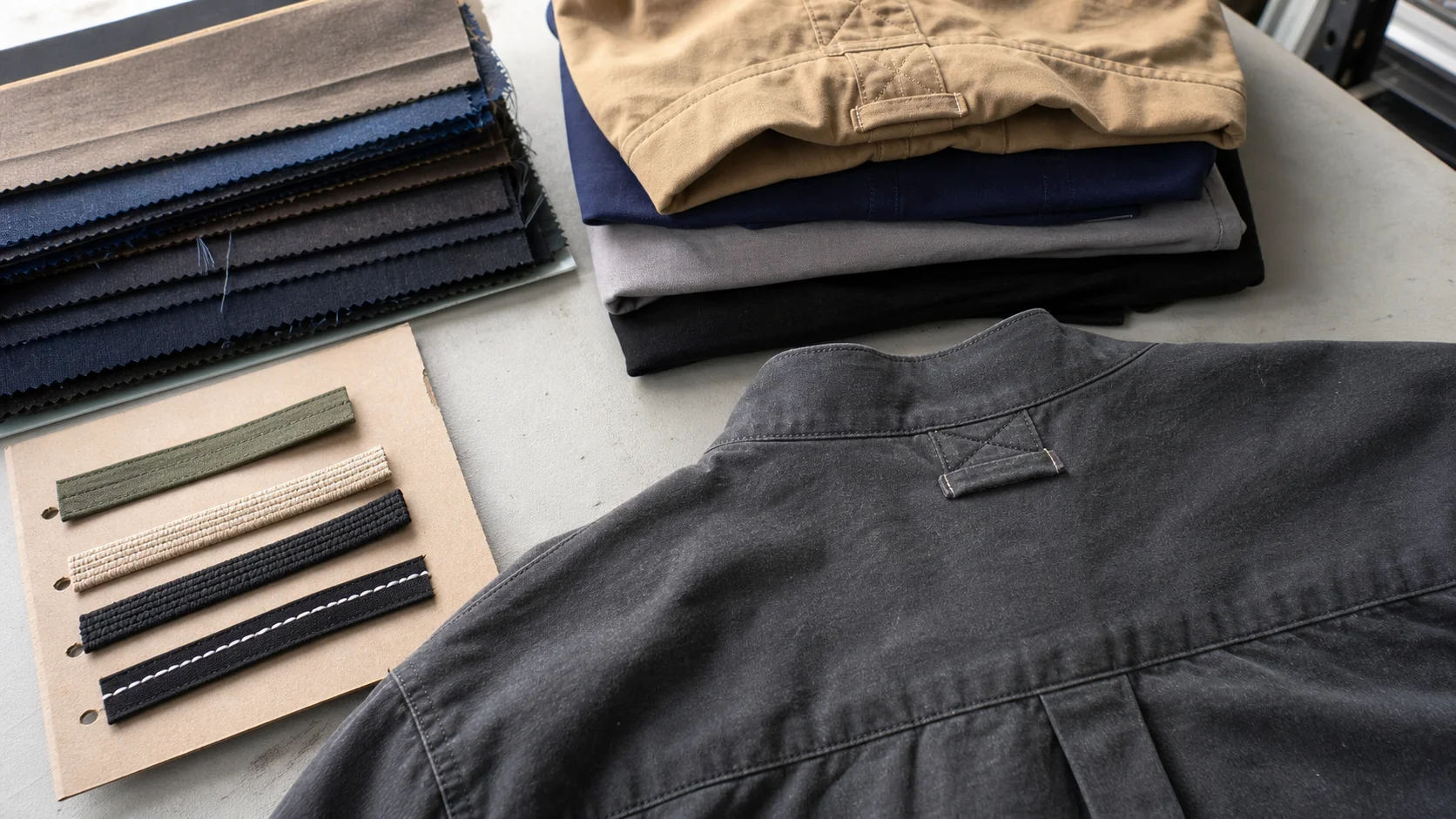
A production-focused quality control outline for restaurant groups ordering custom back neck tabs, covering artwork, materials, placement, durability,...
Back Neck Tab QC Checklist for Restaurant Buyers - Decoration & Printing manufacturing guide
A custom back neck tab is a small detail, but it carries more quality risk than many restaurant buyers expect. It sits at a high-friction point, it is visible when a shirt is hung, folded, or worn under an apron, and it often carries brand information, size data, care guidance, or staff program identification. For restaurant groups buying uniforms across multiple locations, the back neck tab needs to look clean, feel comfortable, survive laundering, and stay consistent across repeat orders.
In the Decoration & Printing category, back neck tabs are usually handled as printed neck labels, woven labels, heat transfer labels, satin labels, or small branded tabs sewn into the neck seam. Each option has different QC risks. A heat transfer may crack or peel if the adhesive is not matched to the fabric. A woven tab may irritate the wearer if the edges are stiff. A printed satin label can bleed if the ink system is poorly chosen. A sewn neck tab can twist, pucker, or sit off-center if the factory does not control placement.
Restaurant uniforms are not occasional-wear garments. Staff shirts may be washed several times per week, exposed to sweat, oil, steam, sanitizer, food stains, and commercial laundry cycles. A back neck tab that passes a visual check on day one may still fail after ten washes. That is why restaurant buyers should treat the back neck tab as a controlled decoration component, not an afterthought added near shipment.
Purchasing judgment: if the uniform program is large, multi-location, or replenishment-based, lock the back neck tab specification before bulk fabric cutting. Reworking neck labels after sewing is slow, costly, and often leaves visible needle marks or seam distortion.
This checklist is written for restaurant groups, hospitality procurement teams, uniform program managers, and sourcing teams ordering custom apparel. It focuses on practical quality control points that can be added to a tech pack, sample approval process, production checklist, and final inspection report.
A back neck tab cannot be inspected properly unless the buyer defines what “correct” means. The best starting point is a clear specification page in the tech pack. A vague note such as “add branded neck tab” leaves too much room for interpretation. The factory may choose the wrong label base, the wrong attachment method, or the wrong artwork scale.
For restaurant uniforms, the specification should also state whether the tab is decorative, functional, or both. A decorative brand tab may allow smaller text and softer materials. A functional label carrying size and care information must stay legible for the garment’s usable life. If the same shirt is used across front-of-house and kitchen staff, check whether the back neck tab must meet different comfort and laundering expectations.
Tolerances should be realistic. A buyer asking for impossible precision will create disputes without improving quality. A good standard for small neck tabs is often plus or minus 1 mm for label dimensions, plus or minus 2 mm for placement from center, and plus or minus 2 mm for distance from the seam. Heat transfer labels may need tighter placement if they sit inside a printed neck area, while sewn labels may need slightly wider tolerance because fabric handling affects alignment.
QC Item Typical Tolerance Inspection Note Tab width +/- 1 mm to 2 mm Measure finished label, not artwork file size. Center placement +/- 2 mm Measure from garment center back, not from uneven collar edges. Distance below neck seam +/- 2 mm Important for heat transfers and direct prints. Logo color Close match to approved standard Check under consistent lighting; fabric color can affect perception. Wash durability Buyer-defined cycle count Restaurant programs should test repeated laundering, not only one wash.Back neck tab quality is mostly decided before bulk production. Once the garment is cut and sewn, the buyer has fewer options. A practical pre-production checklist helps prevent the most expensive problems: wrong artwork, wrong size, poor adhesion, unreadable text, uncomfortable label edges, and inconsistent placement.
Confirm the artwork file is vector-based where possible. Small neck tabs do not forgive low-resolution logos. Text should be large enough to read after printing or weaving. Fine lines may fill in on woven labels, while small reversed-out text may disappear on heat transfers or satin labels.
For multi-brand restaurant groups, make sure each brand file is named clearly. A simple file naming mistake can result in the wrong logo being applied to the wrong uniform style. This risk increases when one supplier is producing shirts, aprons, chef coats, caps, and outerwear in the same order.
The back neck tab is a trim item, and it should be approved like any other trim. Ask for the label material, adhesive, ink, or thread details before production. If the garment fabric is polyester, cotton-rich jersey, cotton twill, performance knit, or recycled blend, the tab material and decoration method must be compatible.
For heat transfers, the adhesive layer matters. Transfers for polyester performance fabrics are not always suitable for cotton-heavy jersey. For direct prints, ink flexibility matters. For woven labels, yarn density and edge finishing matter. For printed satin labels, the coating and ink fastness matter.
A good sample approval process reduces disagreement later. For restaurant buyers, the sample should not only look correct in photos. It should be worn, washed, folded, and checked under the same handling conditions expected in the field.
Stage Buyer Action Approval Risk Artwork proof Approve layout, colors, size, and text. Digital color may not match production output. Trim strike-off Approve actual printed, woven, or transfer label. Small text and color may shift from screen proof. Fit sample Check comfort and placement on garment. Label may feel acceptable flat but irritating when worn. Pre-production sample Approve final construction and decoration method. Bulk should not start until this is signed off. Washed sample Check legibility, adhesion, puckering, and shrinkage. Unwashed approval misses common restaurant-use failures.Buyers who need support building a uniform sourcing brief can review service capabilities at Fabrikn services. A clear brief gives the supplier fewer opportunities to interpret the decoration detail incorrectly.
The decoration method determines the inspection method. A back neck tab may be printed directly onto the garment, transferred with heat, woven separately and sewn in, or printed on a label base. Each method has a different failure mode.
Heat transfers are popular for restaurant shirts because they can feel smooth and remove the scratch of a sewn label. They are often used on T-shirts, polos, performance tops, and casual staff uniforms. The main QC risks are peeling, cracking, color migration, wrong press settings, and visible adhesive edges.
Heat transfers can be a good choice when comfort is the priority. The tradeoff is process control. If the factory runs multiple fabric types on the same heat press settings, adhesion can become inconsistent. Restaurant buyers should require the supplier to test the transfer on the actual bulk fabric, including any moisture-wicking finish or softener.
Direct printing can be economical and clean, especially for larger orders. Screen printing or pad printing inside the neck area may work well on stable knits and tees. The risks include ink bleed, uneven opacity, rough hand feel, and low legibility on textured fabrics.
Direct print is usually better for simple one-color labels than complex brand artwork. If the restaurant group requires tiny care symbols, multilingual text, or multiple colors, a printed label or heat transfer may offer better clarity.
Sewn labels are durable and familiar. They can also support brand storytelling, size marks, and garment care details. The main QC concern is comfort. Restaurant staff move constantly, and a stiff label at the neck can become a real complaint.
Woven labels generally look more premium, but small text can lose sharpness. Printed satin labels can carry more information, but they may feel slippery, shiny, or less aligned with a casual restaurant brand. Cotton labels can feel softer and more natural, yet they may shrink or wrinkle if not pre-tested.
Placement is one of the most common defects in back neck tab production. A label that is only a few millimeters off-center may be visible when the shirt is folded or displayed. In a restaurant group, inconsistency becomes more obvious because staff often wear the same uniform together.
For polo shirts, chef coats, and woven shirts, the neck construction can affect placement. Collars, yokes, bindings, neck tapes, and seam allowances all change the available space. The buyer should approve the back neck tab on each garment type, not only on one sample style.
Sewn labels should be checked from both inside and outside the garment. A label may look fine inside the neck, while the outside collar seam shows puckering or distortion. This is especially important for front-of-house shirts where presentation matters.
Restaurant uniforms need tougher testing than promotional apparel. A staff shirt may go through repeated home washing, commercial laundering, stain treatment, tumble drying, and storage in humid back-of-house conditions. Back neck tabs are exposed to sweat, detergent, abrasion, and stretching when garments are pulled on and off.
Commercial laundry can be much harsher than home laundering. If the restaurant group uses a laundry service, ask for the expected temperature range, detergents, and drying process. High heat can damage transfers, distort printed labels, or increase fabric shrinkage around sewn tabs. Chlorine or aggressive stain treatment can also affect printed inks and label color.
Purchasing judgment: if staff uniforms are centrally laundered, do not approve a back neck tab based only on a home wash test. The decoration method should be validated against the laundry process the garments will actually face.
Comfort testing is simple but often skipped. Have the sample worn for a normal shift-length period if possible, or at least for several hours. Ask whether the label scratches, traps heat, rubs against the neck, or feels stiff under an apron strap or jacket collar. A soft-looking tab can still irritate the wearer if the corners are sharp or the adhesive edge is raised.
Comfort complaints are not minor in restaurant operations. If staff dislike the uniform, compliance drops. Shirts may be altered, labels may be cut out, and the brand presentation becomes inconsistent. A slightly higher-cost neck tab can be cheaper than dealing with poor adoption across multiple locations.
Bulk inspection should compare production garments against the approved pre-production sample. The approved sample should be available to the inspection team, not stored only in a buyer’s office. Photos help, but a physical standard is better for hand feel, label edge quality, and color comparison.
Before sewing or application, inspect the back neck tabs as incoming trim. This catches problems before they are attached to garments.
For heat transfers, storage conditions matter. Transfers can be damaged by humidity, heat, dust, or pressure before application. Ask the supplier to store transfer sheets flat and protected. Do not accept transfers that show cracking, blocking, lifting from carrier paper, or contamination.
In-line inspection should happen early enough to correct the process. Waiting until final inspection means defects may already be present across hundreds or thousands of garments.
For restaurant group programs with multiple sizes, inspect every size range. Small and extra-large garments may have different neck proportions, and the tab can look too large or too small if the same placement is used without review. Size grading does not always affect label placement, but it can affect visual balance.
Final inspection should check both appearance and durability risk. A standard AQL inspection can be used, but the buyer should define whether back neck tab defects are minor, major, or critical. Wrong brand label, wrong size label, missing care information, or peeling transfer should usually be treated as major defects. A small loose thread may be minor if it can be trimmed without damage.
Defect Suggested Severity Reason Wrong brand logo Major Creates brand and allocation problems. Wrong size label Major Can cause distribution errors and staff fit issues. Peeling heat transfer Major Likely to worsen after washing. Off-center label beyond tolerance Minor to major Severity depends on visibility and buyer standard. Scratchy or sharp label edge Major Can create wearer complaints and label removal. Loose thread near label Minor May be repairable if construction is secure.Most back neck tab failures are predictable. They usually come from unclear specifications, weak sample approval, poor operator control, or a mismatch between decoration method and fabric. Buyers can reduce risk by naming these defects in the QC checklist before production begins.
Color migration is a specific risk on dark polyester and performance fabrics. Sublimation dyes can migrate into light-colored transfers when heat is applied or during later storage. If a restaurant group wants a white back neck transfer on a dark red, black, or navy polyester shirt, ask for migration testing. Low-bleed transfers or barrier layers may be needed.
Back neck tab decisions affect MOQ, sampling time, and replenishment cost. Buyers often focus on shirt MOQ, but trims can create separate minimums. A supplier may accept a lower garment MOQ while the label maker requires a minimum quantity for woven labels, printed satin labels, or heat transfers.
MOQ varies by supplier, country, decoration method, artwork complexity, and whether the trim is custom or stock. The ranges below are practical planning estimates, not fixed rules.
Back Neck Tab Type Typical MOQ Range Best Use Case Tradeoff Direct printed neck label 100 to 300 pieces per artwork Simple staff T-shirts and polos Less flexible for complex text or many colors. Heat transfer neck label 300 to 1,000 pieces per artwork Comfort-focused knit uniforms Requires strong heat press control and wash testing. Printed satin label 500 to 1,000 pieces per design Care and size information May feel less premium or less soft. Woven neck label 1,000 to 3,000 pieces per design Premium branding and repeat programs Small text can lose detail; setup cost is higher. Custom fabric tab 500 to 2,000 pieces per colorway Brand accent or collection identifier Needs sewing control and shrinkage testing.Lower MOQs can be possible when the supplier already has suitable label materials or when the buyer uses one artwork across multiple garment styles. Higher MOQs are common for custom woven labels, special yarn colors, special adhesives, reflective effects, or custom-cut shapes.
Lead time depends on more than the garment factory’s sewing schedule. A back neck tab can add time for artwork proofing, strike-off development, lab dip matching, trim production, shipping to garment factory, wash testing, and pre-production sample approval.
Rush orders often create back neck tab problems because teams skip the physical strike-off or wash test. If timing is tight, choose a simpler decoration method rather than forcing a complex trim through an untested process. A clean one-color heat transfer or direct print may be safer than a multi-color woven label with small text and special edge finishing.
Restaurant buyers planning a rollout can discuss production requirements through Fabrikn contact before locking artwork, sizing, and delivery windows. Early alignment helps prevent trim delays from becoming garment shipment delays.
The best back neck tab choice depends on uniform type, staff role, laundering method, order size, and brand expectations. There is no single best option. A buyer sourcing premium host shirts may prioritize woven branding. A buyer sourcing kitchen T-shirts may prioritize comfort, wash durability, and low replacement cost.
Heat transfer neck labels are useful for lightweight T-shirts, performance tops, and casual staff uniforms. They remove the scratch risk of sewn labels and can look clean. The buyer should require actual fabric testing, correct press settings, and wash approval. Avoid very fine text if the transfer area is small or the fabric has heavy texture.
Woven labels suit higher-value garments, retail-style uniforms, and brand-focused restaurant concepts. They can look more permanent and premium. The buyer should check edge softness, text clarity, and bulk at the neck seam. Woven labels are less ideal for very detailed care instructions unless paired with a separate care label.
Printed satin, cotton, or polyester labels work well when the tab needs to carry size, fiber content, care instructions, and brand information. They can be cost-effective and readable. The tradeoff is feel. Ask for soft label bases and test the cut edge after washing.
Restaurant groups often buy several garment types at once: T-shirts, polos, button-downs, aprons, chef coats, and caps. Using one back neck tab artwork across multiple apparel styles can simplify production and reduce trim MOQ pressure. Still, placement and comfort should be approved separately for each garment type.
A small back neck tab may not have enough room for branding, size, fiber content, care symbols, country of origin, and legal text. Cramming all information into one tiny label can lead to unreadable text. A cleaner approach is to use a branded back neck tab and place full compliance information on a side seam label, if suitable for the garment and market requirements.
The QC checklist should not sit in a separate email thread. Include key points in the purchase order, tech pack, and sample approval record. State the approved sample date, label artwork version, placement tolerance, wash test requirement, and defect classification. This gives the factory, inspection team, and buyer a shared standard.
For buyers comparing supplier capability, company background and sourcing approach can be reviewed on Fabrikn about us. The relevant question is not only whether a supplier can make custom decoration, but whether they can control it consistently across sizes, colors, locations, and repeat orders.
The following checklist can be adapted into a restaurant uniform tech pack or inspection sheet.
For restaurant groups, back neck tab QC is a small control point with a large operational effect. The tab must support brand consistency, staff comfort, garment identification, and repeated laundering. A buyer should not approve it from a digital mockup alone.
The safest process is straightforward: define the specification, approve a physical trim strike-off, test the tab on actual garment fabric, wash it, wear-check it, and inspect it during production before the full order is finished. This approach is not complicated, but it requires discipline.
If the order is small or urgent, keep the back neck tab simple. If the rollout is large or brand-sensitive, spend the extra time on strike-offs, wash testing, and clear tolerances. The cheapest label is not always the lowest-cost option once rework, staff complaints, and replacement orders are considered.
Get a free quote from Fabrikn — your trusted B2B clothing manufacturer with 10+ years of experience. MOQ as low as 200 pieces.
Get a Free Quote →A back neck tab is a small label, transfer, print, or sewn trim placed at the inside back neck of a garment. It may show the restaurant brand, size, care information, style code, or uniform program details.
Heat transfer labels are often best for comfort-focused T-shirts and polos. Woven labels can work better for premium garments. Printed labels are useful when the buyer needs clear care and size information. The right choice depends on fabric, laundering, budget, and brand presentation.
Check artwork, color, finished size, placement, label material, attachment method, hand feel, wash durability, and legibility. A physical sample should be approved before bulk production.
For basic programs, three to five wash cycles can catch many early failures. For larger restaurant rollouts, kitchen uniforms, or commercial laundry use, ten or more cycles are safer. The test should match the expected wash and dry conditions.
Typical MOQs range from about 100 to 300 pieces for direct printed neck labels, 300 to 1,000 pieces for heat transfers, 500 to 1,000 pieces for printed labels, and 1,000 to 3,000 pieces for woven labels. Actual MOQ depends on supplier setup, materials, artwork, and whether the trim is shared across styles.
Peeling can come from incorrect heat press temperature, pressure, dwell time, fabric incompatibility, poor adhesive quality, contamination, or insufficient cooling before handling. Testing on the actual bulk fabric is important.
One artwork can often be shared across multiple styles to reduce MOQ and simplify replenishment. Placement and comfort should still be approved separately on each garment type because collars, bindings, and neck shapes vary.
It can, if the label is large enough and the text remains readable after washing. If the tab is small, it is often better to keep the back neck tab for branding and size, then place full care and compliance information on a separate label.
Wrong brand logo, wrong size information, missing required text, peeling transfers, unreadable care information, severe off-center placement, scratchy label edges, and construction damage near the neck should usually be treated as major defects.
The buyer should approve the back neck tab before bulk production starts. Approval should include a physical trim strike-off, a pre-production garment sample, and a washed sample whenever timing allows.