
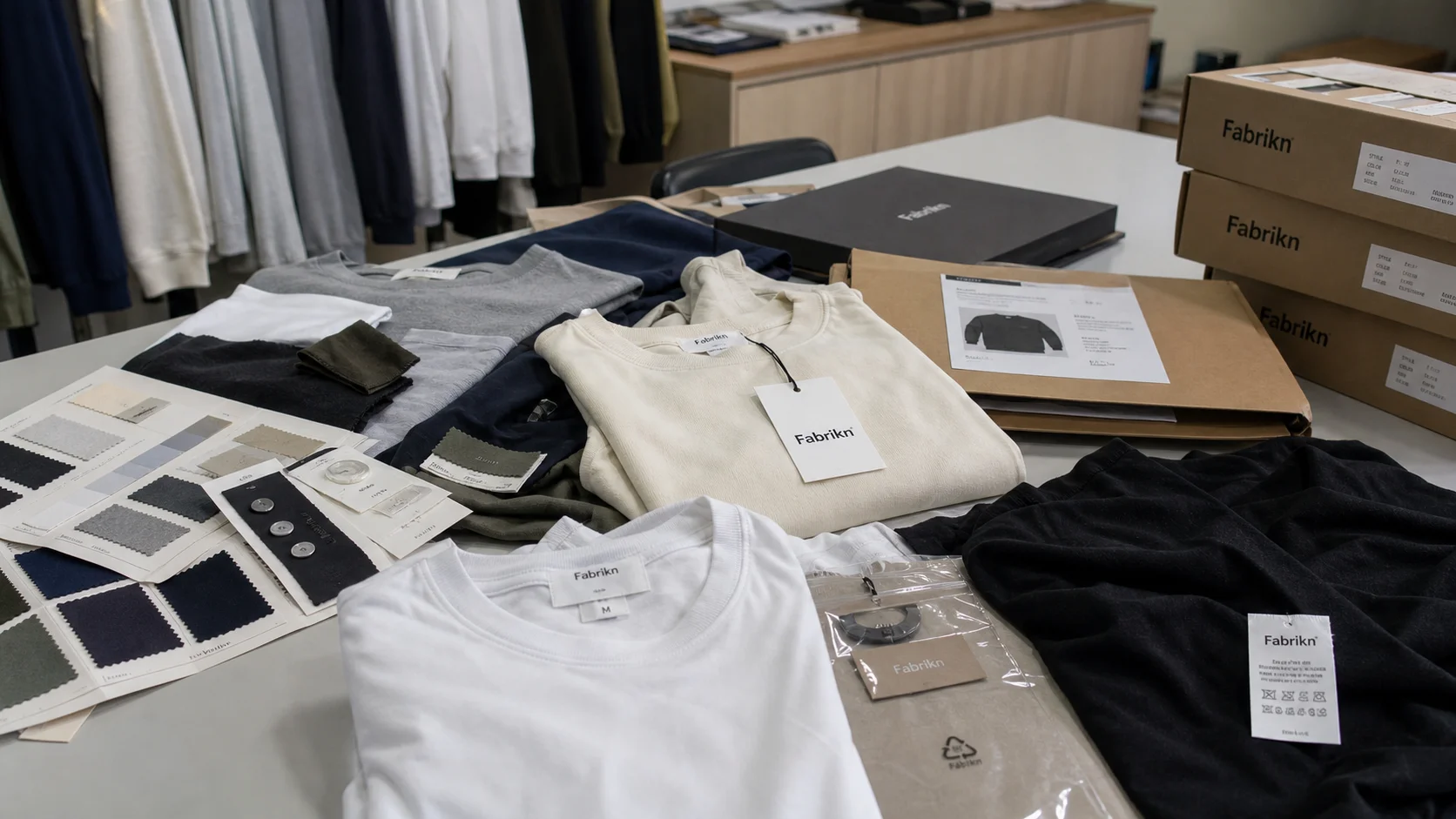
Custom Barcode Stickers for Clothing Packaging China compared by sample evidence, fabric or trim specs, MOQ, AQL terms, cost lines, delivery timing, and...
Fast answer: Custom Barcode Stickers for Clothing Packaging China: Material, Print, MOQ, and QC Terms should be judged by production evidence, not by a generic sourcing promise. The buyer needs sample proof, cost breakdowns, QC checkpoints, and delivery buffers in writing.
Ask for recent sample photos, measurement tolerances, fabric or print test assumptions, decoration test notes, packing examples, and a named inspection checkpoint. These details show whether the team can repeat an approved sample at bulk volume.
Separate garment cost, decoration, labels, packaging, sampling, testing, freight, and rush charges. Clear cost lines make it easier to reduce colorways, adjust size depth, or reserve more time for sampling.
A single faint digit can strand a truck and turn a clean dispatch into a warehouse headache. In one Guangzhou packing bay, that tiny defect cost nearly 18 hours of rework before the shipment could leave. Custom barcode stickers for clothing packaging china matter because the label is often the last control point before money walks out the door.
One barcode error can stall a shipment for 12 to 48 hours. On a mid-size order of 20,000 units, even a 1% mislabel rate means 200 garments need manual verification, relabeling, or repacking. I have watched it happen in plants making 800 pieces a day and in factories pushing 30,000 units a week. Larger Chinese facilities usually run tighter QA on print registration and carton checks; smaller subcontractors can still miss barcode legibility tests at dispatch. Ho Chi Minh City outfits show the same pressure points, only with cleaner packing lines and more variation in label stock because they switch between white BOPP, metallic PE, and low-temperature PET films each season. Dhaka's knitting clusters lean on thermal paper rolls but treat barcode validation like a warehouse task instead of a print-room obligation, while Istanbul-based converters who feed the European private label market have borrowed the same Cantonese QA rituals to keep customs brokers happy.
Clothing packaging is rough on labels. Polybags flex. Folded cartons abrade. Humidity softens weak adhesive. Cold-chain storage, especially for performance basics and exported babywear, can turn a mediocre sticker into curled waste within days. A label that scans beautifully on a desk may fail after three turns through a packing line and two weeks in transit. That is why buyers who source through clothing packaging solutions should think of the barcode as inventory control, retail compliance, and returns prevention, not decoration. Staying on the right side of the scanner means pairing durable substrates with proven adhesives like 3M 300LSE or Avery Dennison V-400 that have passed 72-hour humidity and 180° peel tests.
For a China-based manufacturer, the label either protects margin or destroys it. No middle ground.
Vague briefs create bad quotes and worse labels. A supplier cannot price, print, or test what you have not specified. For custom barcode stickers for clothing packaging china, I ask buyers to send a one-page sheet with the barcode type, label dimensions, quiet zone, serial rule, variable data fields, and finishing requirement. If the barcodes are EAN-13, UPC-A, Code 128, or QR, say so. If the file needs sequential numbering from 000501 to 005000, write that down. A good spec sheet also states whether the sticker is for folded cartons, tissue wraps, polybags, or outer shipping boxes.
Material choice matters just as much. Coated paper works for short-life packing. Thermal paper keeps cost low for high-volume logistics labels. PP and PET handle moisture far better, which matters in coastal China, southern Vietnam, and ports where cartons may sit 2 to 5 days before export release. Tamper-evident films make sense for premium goods, especially private label basics with higher chargeback risk. If you supply babywear, I would push traceability harder; the same discipline that helps custom baby clothing manufacturing audits also keeps small packaging mistakes from becoming safety complaints.
Adhesive selection is its own decision. Permanent adhesive suits retail cartons. Removable adhesive works for temporary packing stickers. Freezer-grade adhesive is needed for cold storage. High-tack adhesives stick better to textured garment bags and recycled cardboard with rough surfaces. Black-on-white printing gives the highest scan reliability, and glossy laminates can create glare if the scanner angle is not controlled. I have seen printers nail the artwork color and still fail the job because barcode contrast was too weak. That is the real risk: not aesthetics, but read rate.
If you know your supplier runs an HP Indigo 20000 digital press, a Nilpeter FB-330 flexo line, or a MPS EF-K 60 for in-line thermal transfer, include that information so the prepress team can set the right DPI and dot gain. Spell out whether you need UV varnish, lamination, hot-foil numbering, or rotary die cutting. The machines have different glue chemistries, so note any requirement for 3M 300LSE, Avery Dennison, or LG Hausys adhesives that match your substrate, whether it is 60-gsm FSC coated paper, 70-micron BOPP, or 50-micron matte PET.
Pricing shifts fast when material, print method, or variable data rules change. Standard paper barcode labels usually sit at the lowest price tier because the substrate is cheap and the press setup is simple. Synthetic films cost more, and sequential variable printing pushes the quote higher again because each roll needs extra inspection. In the factories I have visited, a basic one-color paper label might land around 2,000 to 5,000 labels per order before the unit price looks truly competitive, while the same design in PP or PET can rise by 15% to 40% depending on adhesive and finish.
Quantity changes everything. Small runs can cost 2 to 4 times more per 1,000 labels than bulk orders because setup and plate costs are spread over fewer units. That is why a 1,000-label job may look expensive next to a 20,000-label run, even when the artwork is identical. Digital print usually starts around 500 to 1,000 labels, which helps with new SKUs or a limited seasonal drop. Flexo or offset becomes more rational above 10,000 to 20,000 labels, especially when repeat orders are likely. If you are building a private label line, that threshold matters; private label clothing services often depend on repeatable packaging economics, not one-off novelty.
For a premium two-color PP tamper-evident sticker printed on a Nilpeter FB-330 with hot-foil numbering and 3M 300LSE acrylic adhesive, expect to pay roughly $2.50-4.00 per unit at 500 MOQ. Complex UV-coated synthetic labels with sequential numbering and GRS-certified recycled content can take 18-22 business days to print, laminate, die-cut, run adhesion, and low-temperature peel tests before they are ready for packing.
My budget rule is simple. Under 2,000 labels, pay for speed and proof control. Above 10,000 labels, focus on unit economics and insist on scan testing. That is where the savings are.
Factories in China usually print barcode labels through digital, flexo, or thermal transfer systems, and each one solves a different problem. Digital is agile. It handles 500-piece test runs, 3-day reprints, and multiple SKU changes without forcing the plant into expensive setup work. Flexo wins on long runs because unit cost falls when the order climbs past 10,000 labels. Thermal transfer is the workhorse for on-demand logistics labels, especially where each carton or polybag needs unique serial data.
I compare methods on scan performance, color consistency, and durability, not on theory. Digital gives strong flexibility but can vary slightly from batch to batch if an HP Indigo 20000 or a Xeikon CX3 is not routinely recalibrated; flexo is stable on high volumes, though it needs stronger prepress discipline and UV-curing systems like the IST UV LED arrays we ran in Guangzhou. Thermal transfer produces crisp data and good abrasion resistance, but it is not the right answer for decorative packaging that must survive retail handling for weeks. When I toured the Guangzhou plant with a Nilpeter FB-330, the cast-coated films moved at 200 meters per minute through three stations—primer, print, and lamination—then through a rotary die cutter with a Mathews servo driven stacker. That line also checked every roll with Cognex vision inspection to catch any barcode jumps.
The best factories pair these presses with in-line finishing: laminators for matte or gloss overlays, hot-foil dies for sequential numbering, and flatbed die cutters for bubble-free application. Adhesives are dispensed via Nordson heads, and operators run peel strength, shear, and humidity tests every 3,000 labels using an Elcometer 510. My favorite plants have a second camera after the adhesive station that verifies the presence of 3M 300LSE or Avery Dennison V-400 or even a WRAP-compliant solvent adhesive before the labels are peeled and wound.
Materials and adhesives go hand in hand, and regional conditions drive the selection. Coastal Guangzhou plants rely on moisture-resistant PP and PET films delivered in 500mm-wide rolls from suppliers in Zhongshan. They pair those films with 3M 300LSE or LG Hausys 60°C hot-melt adhesives because Guangzhou’s humidity can soften less resilient glues in just 24 hours. Dhaka converters, by contrast, often build labels in-house from locally sourced 70-gsm coated paper paired with a pressure-sensitive permanent acrylic from a local adhesive house; the price is lower, but if the goods will sit on a damp Kolkata dock for 4 to 5 days, those labels may lift unless you specify a freezer-grade tack.
Vietnam’s Ho Chi Minh City, with its busy distribution centers for Southeast Asia, favors polypropylene films with metallized layers that mimic metallic retail packaging. These factories laminate 40-micron PET over PP using UV-LED curing and adhesives such as Avery Dennison V-400 or Lohmann’s DuploCOLL for better adhesion to textured woven bags. In contrast, Istanbul-based converters servicing European retailers blend GRS-certified recycled PET with OEKO-TEX Standard 100-approved adhesives and back those stocks with tamper-evident holographic overlays to satisfy German retail compliance. The result: a high-performance sticker that can withstand Istanbul’s dry heat and still peel cleanly at the checkout.
Always specify not only the substrate but also the required certifications for the paper or film, whether that is FSC for paper, GRS for recycled polyester, or OEKO-TEX Standard 100 for babywear. Those certificates dictate the adhesives. GOTS-certified soft-touch tissue, for instance, needs a solvent-free adhesive to maintain the organic claim.
Auditing a supplier starts with certification paperwork. Ask for GOTS or OEKO-TEX Standard 100 certificates when the barcode label touches organic textiles, WRAP or BSCI for labor compliance, and GRS when recycled film is in the bill of materials. These documents confirm that the adhesive and ink suppliers align with your own sustainability goals.
On-site, check that the plant performs adhesion tests with a controlled peel speed (300 mm/min) and records pass/fail data in a quality log. Demand a sample run that includes your actual barcode data. Confirm the supplier uses a press like the Nilpeter or Gallus with a RIP system that prints barcodes from the same vector art you'll supply. Ask for a video of the label being scanned three times consecutively by a Cognex or Zebra verifier at 2 mil contrast, and review the verification report.
Finally, audit the finishing and packing operations. Look for credible certifications on adhesives (such as the FDA-compliant grades on their invoices) and insist on a digital traceability sheet that tracks the label from ink mixing to palletized shipment. If your garments are exported through Guangzhou or Istanbul, the packaging vendor should already know the required export documentation and have an export carton-packing protocol that includes the label SKU, roll width, and quantity per tube.
Start with your spec sheet and a photo of the carton, polybag, or tissue you will wrap. The supplier will reply with a quote that includes press method, substrate, adhesive, die cut, and a first-article sample. Expect an initial lead time of 18-22 business days for complex PP or PET stickers with UV varnish and tamper-evident features, including time for proofing, lamination, and low-temperature peel tests. If you ship from Guangzhou to Los Angeles, allow that much time plus transit, since a standard published transit from Nansha to the west coast is also around 18-22 business days.
Once you approve the digital proof, the plant will lock the job, print the labels on an HP Indigo, Nilpeter, or MPS, laminate them if needed, and send them through mandatory scan verification. At that point, they will forward the test reports (adhesion, humidity, scan read rate) and an export-ready packing list. Confirm whether the labels will travel by air, express, or sea, and plan for a 5% to 15% buffer for artwork corrections, die changes, or extras needed to satisfy customs.
Q: How should I choose the right adhesive for polybags?
A: Select adhesives rated for the bag’s surface—textured woven bags often need a high-tack acrylic such as 3M 300LSE, while film-on-film applications do better with an acrylic removable adhesive like Avery Dennison V-400. Ask the factory for their peel strength data and specify freezer-grade if the goods cross cold-chain sections.
Q: What certifications should I request?
A: Request OEKO-TEX Standard 100 or GOTS for baby or organic apparel, WRAP and BSCI for labor standards, and GRS if recycled film is used. These certificates reassure retailers and help the supplier match inks and adhesives that do not compromise the label’s sustainability claims.
Q: How long does it take to receive a finished run?
A: Digital low-volume runs can ship in 3 to 7 days, but expect 10 to 20 days for medium and large flexo jobs. Complex orders with tamper-evident features or hot-foil numbering can stretch to 18-22 business days before they leave the Guangzhou or Istanbul facility, plus transit time to your distribution center.