
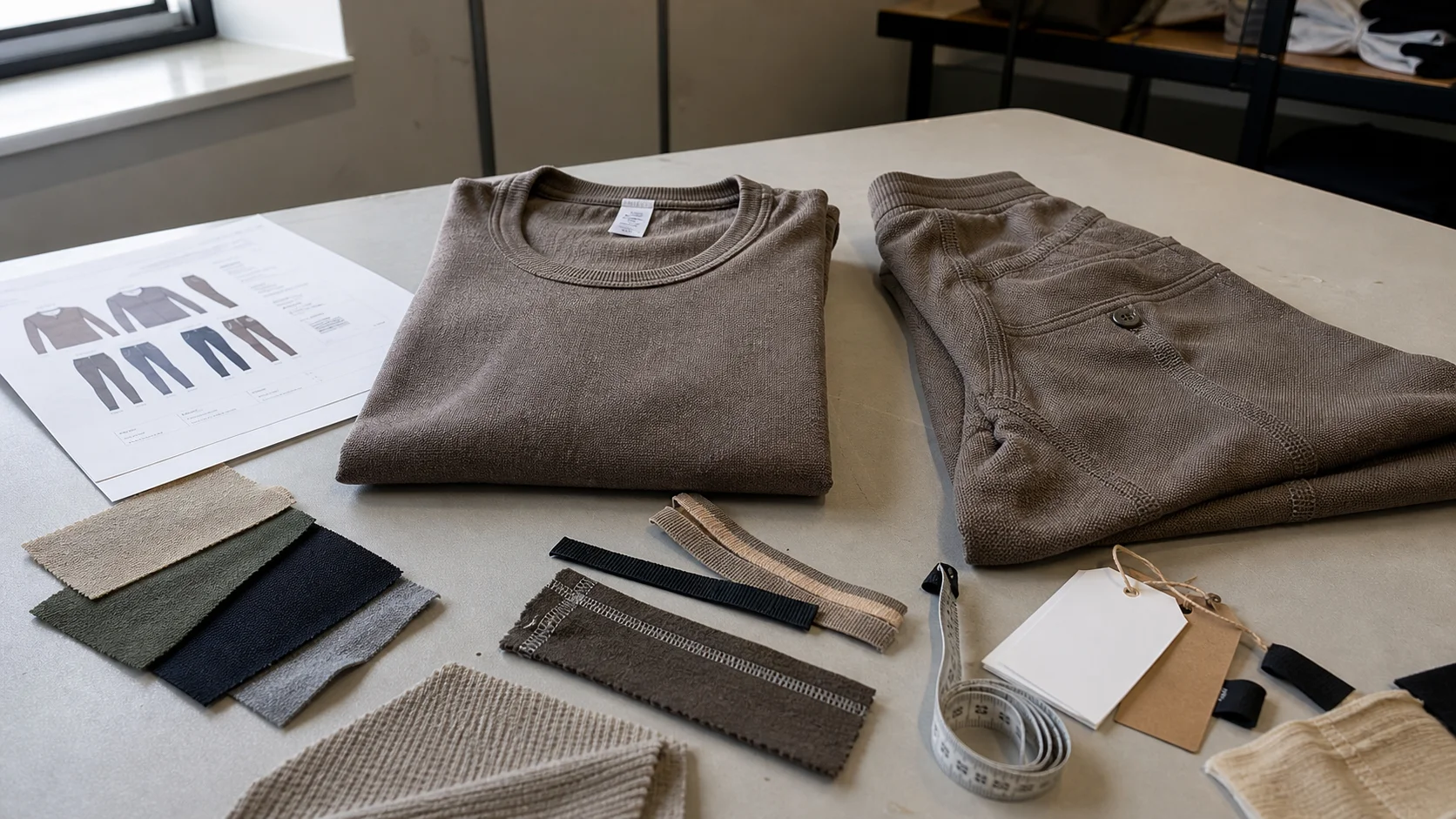
A practical shrinkage control plan for custom base layer sets used by cleaning crews, covering fabric selection, pattern allowances, wash testing,...
Custom base layer sets for cleaning crews sit in a practical part of the uniform stack. They are worn under polos, work shirts, jackets, or outerwear, and they need to stay close to size after repeated laundering. Shrinkage control matters because cleaning teams wash often, use warm or hot cycles in some facilities, and need consistent fit across shifts. A base layer that tightens after the first few washes can change mobility, create discomfort, and trigger avoidable size exchanges.
A good shrinkage control plan starts before production begins. It covers fiber choice, knit construction, fabric finishing, sample approval, wash testing, trim selection, and packaging instructions. Buyers often focus on color and hand feel first, then discover the problems later when garments are already in circulation. A better approach is to treat shrinkage as a specification issue, not a post-production complaint.
For sourcing support, it helps to work with a vendor who can discuss fabric performance, sampling discipline, and QC limits in plain language. Fabrikn’s services page is a reasonable starting point if the goal is to align product development with bulk production controls, and the contact-us page is the place to request a factory discussion on fit, fabric, and wash performance. A quick review of about-us can also help confirm whether the supplier is structured for repeat uniform programs rather than one-off fashion runs.
Custom Base Layer Set Shrinkage Control for Cleaners - Fabrikn production reference
Cleaning crews need movement more than style. Base layer tops and bottoms must support bending, kneeling, reaching, and long periods of wear without the garment riding up or binding at the waist, crotch, or wrists. Shrinkage changes that fit equation quickly. A 3% to 5% loss in length may sound small on paper, yet it can be enough to expose the lower back, shorten sleeves, or make a leg opening feel tight.
Uniform buyers also need consistency across the team. A shrink issue that appears only in one size run creates a support burden for supervisors and procurement teams. That problem becomes more visible when orders are reordered months later and the replacement batch fits differently from the original delivery. Stable shrinkage performance is one of the simplest ways to protect repeatability.
For cleaning crews, the practical target is not zero shrinkage. The real goal is controlled shrinkage that stays within an agreed tolerance after normal care. In many uniform programs, a buyer will accept a small amount of dimensional change if the supplier can prove the garment stabilizes after the first wash and still meets the size spec afterward.
Shrinkage comes from the interaction of fiber, yarn, knit structure, finishing, and laundering. Cotton fibers tend to relax and contract after washing if the fabric is not pre-shrunk or stabilized. Polyester has better dimensional stability, while spandex adds stretch but can complicate heat resistance and recovery if the blend is not properly engineered. Rayon and modal can feel soft, yet they require tighter control because they may react differently to moisture and heat.
Knit structure also matters. Single jersey is comfortable and common, but it can be more vulnerable to lengthwise and widthwise change than a more stable interlock or rib structure. Tightness of the knit, yarn twist, and finishing method all influence whether the garment grows or shrinks after repeated wash cycles.
Heat is a major driver. Hot wash temperatures, hot tumble drying, and aggressive drying times can accelerate shrinkage in cotton-rich fabrics. Cleaning crews often wear uniforms in environments where garments are laundered frequently and not always gently. That reality should be built into the specification from the start.
A shrinkage plan fails when the buyer assumes the fabric will behave like a retail athleisure item. Workwear wash conditions are usually harsher, and the fabric spec needs to reflect that.
The most reliable path to shrinkage control is to choose a fabric that matches the care environment. A cotton-rich base layer can be acceptable when softness and breathability matter, but it needs pre-shrinking, stable yarn selection, and realistic wash testing. A polyester or polyester-spandex blend usually offers better dimensional stability and faster drying, which can be useful for crew uniforms that go through frequent laundering.
Common fabric directions for custom base layer sets include:
Blends can solve one problem while creating another. Higher polyester content usually improves stability, yet it may hold odor more than a cotton blend if the work environment is demanding. Cotton improves comfort but can shrink more. Spandex improves fit and movement, yet too much heat can degrade recovery over time. A practical fabric spec usually balances those tradeoffs instead of chasing one feature at the expense of the rest.
Fabric finishing is just as important as fiber content. Pre-shrunk fabric, compacted knit, enzyme treatment, and heat setting can improve dimensional stability. The buyer should ask which finishing step was used, not simply whether the fabric is labeled “pre-shrunk.” That phrase is often used loosely and does not guarantee performance under repeated industrial laundering.
A shrinkage control plan works best when the buying team defines measurable targets early. The spec sheet should include fabric composition, fabric weight, wash basis, tolerance limits, trim details, and acceptable appearance after wash. Without those details, sample approval becomes subjective and bulk production can drift.
Useful spec points include:
Typical MOQ ranges for custom base layer sets often fall between 300 and 1,000 sets per color or style, depending on the fabric, print method, and trim package. A low MOQ can be possible, yet the price per set usually rises because the factory has less room to spread setup costs. Higher MOQs usually improve cost efficiency and make better sense for uniform programs with stable staffing levels.
Size grading needs the same discipline. A well-fitting medium that shrinks too much may be less useful than a larger size that can be adjusted through grading. The buyer should review finished garment measurements after wash, not only before wash. That distinction matters more for bottoms, where inseam and rise changes affect mobility and coverage.
Sample approval should be treated as a control gate, not a formality. The first prototype confirms silhouette and fit. The second round should confirm fabric behavior, seam performance, and decoration durability. A pre-production sample or size set sample should then be washed under the expected care conditions before final approval.
There are three useful sample stages in most programs:
Wash testing should mirror the actual care environment as closely as possible. If the garments will be laundered in warm water and tumble dried, the test should reflect that. If the program expects commercial laundry, the test should be stricter than a home-care cycle. One wash is not enough. Multiple cycles reveal whether shrinkage levels off or keeps accumulating.
Buyers often ask for a single shrinkage number, but a better review includes both first-wash and cumulative results. A base layer may shrink 2% on the first wash and stay stable after that, which can be acceptable if the finished size spec accounts for it. The risk is repeated creep, where every wash removes a little more length and the garment slowly falls out of tolerance.
Any sample approval should also check decoration. Heat transfers, reflective logos, woven labels, and printed size tags can all behave differently under wash. A stable garment is still a failed uniform if the decoration cracks, curls, peels, or creates discomfort at the neck.
Bulk production needs controls that keep the approved sample from drifting. Fabric lot consistency is one of the biggest factors. A factory may source the same nominal fabric from different dye lots or mills, yet the shrinkage behavior can still vary. That is why buyers should ask for lot tracking and clear approval of bulk fabric before cutting.
Cutting accuracy also matters. If panels are cut off-grain, the garment can twist after wash even when the fabric itself is stable. Seams may pucker if the thread tension is wrong or if stitching density is too tight. Elastic components should be tension-tested because overextended elastic during sewing can shorten the useful life of the waistband or cuff.
Good bulk control usually includes:
Workwear buyers should be cautious about trim substitutions. A label, zipper pull, or elastic from a different supplier can change comfort or wash response. Even if the garment body stays within spec, a trim issue can create the impression of poor quality. That is why the approved BOM, or bill of materials, should be locked before the bulk order is released.
Inspection for shrinkage control should look beyond dimensions alone. The common failure points are often subtle and only appear after the garment is washed and worn. A top can pass pre-wash measurement yet still fail because the side seam has twisted or the neck opening has tightened uncomfortably.
Inspection risks include:
Inspection should include both visual and dimensional checks. A garment can be technically within tolerance and still be unsatisfactory if the shape looks unbalanced after wash. Cleaners move constantly during the workday, so shape retention is not a cosmetic issue. It affects comfort, confidence, and how often garments are replaced.
Third-party inspection is useful when the order is large or the delivery schedule is tight. A basic AQL check is not enough on its own if shrinkage is the key risk. The inspection plan should include washed samples pulled from the production lot, not just unopened cartons. That extra step helps catch issues before shipment.
Lead time depends on fabric readiness, sampling cycles, lab dip approval, decoration method, and factory workload. A simple knit base layer set with an existing fabric can move faster than a fully custom thermal program with special trims and branded packaging. Buyers should plan for extra time if the fabric must be knitted, dyed, and heat-set specifically for the order.
Typical lead time for a basic custom base layer set can range from 30 to 60 days after sample approval and deposit, while more complex programs may require 60 to 90 days or longer. That window can extend if there are multiple sample revisions, slow lab dip approval, or rework caused by wash-test failure.
Lead-time dependencies include:
Buying teams sometimes compress the schedule and then ask the factory to “fix shrinkage in production.” That is rarely a good bet. Shrinkage control comes from fabric and process decisions made before cutting. A rushed timeline may still deliver usable product, but the risk of inconsistency rises quickly when approval steps are skipped.
A practical shrinkage control plan is easier to manage when the buyer keeps a short checklist during sourcing. The most effective programs are usually the ones that are specific and boring: clear specs, approved samples, documented wash tests, and disciplined incoming inspection.
Before placing a bulk order, confirm the following:
Buyers should also think about end-user behavior. Cleaning crews may wash garments frequently and in mixed loads, with detergents and temperatures that vary by site. The uniform should be specified with that reality in mind. A product that looks strong in a controlled test but fails in daily turnover is not a reliable uniform program.
If the program needs a stable supply relationship, it is worth confirming whether the vendor can handle repeat orders with the same fabric and construction details. A supplier who can document previous approvals, keep records of BOM versions, and hold the same shrinkage target across reorders will usually be a safer long-term option than a purely price-driven source.
Custom base layer sets for cleaning crews need more than a comfortable fit on day one. They need predictable size retention after repeated wash cycles, stable seams, and trims that do not distort or fail under regular laundering. Shrinkage control is not a single test. It is a plan that starts with fabric selection and ends with final inspection and packing discipline.
For buyers, the best return usually comes from clear specifications, realistic wash testing, and cautious use of fabrics that match the care environment. Cotton-rich garments can work, but they need tighter control. Polyester-rich blends reduce shrink risk and often improve durability. The right choice depends on the laundry conditions, comfort target, and budget.
A clean sourcing brief makes the job easier for both buyer and supplier. When the fabric, trim, wash test, and tolerance limits are all agreed before production, the result is usually more consistent and easier to reorder. That is the standard worth aiming for in activewear and teamwear programs built for cleaning crews.
Get a free quote from Fabrikn — your trusted B2B clothing manufacturer with 10+ years of experience. MOQ as low as 200 pieces.
Get a Free Quote →That depends on the fabric and the wash method, but many buyers aim for low single-digit shrinkage after the first wash and stable performance after repeated cycles. The key is to define separate length and width tolerances in the spec sheet and to test them under the expected laundry conditions.
Polyester or polyester-spandex blends usually offer the most dimensional stability. Cotton blends can also work if the fabric is compacted or pre-shrunk and the wash expectations are realistic. The safest option depends on whether the priority is durability, softness, stretch, or moisture handling.
Yes. A pre-production sample should be washed using the same method the garments will face in service. A dry fit sample can confirm sizing, but it does not prove shrinkage control.
Typical MOQs often range from 300 to 1,000 sets per style or color, although that varies by fabric, decoration, and factory setup. Lower quantities are possible in some cases, but pricing usually rises.
For a relatively straightforward custom base layer set, lead time may fall around 30 to 60 days after sample approval. Complex fabric development, custom trims, or repeated sample revisions can extend that to 60 to 90 days or more.
Length shrinkage, seam puckering, spirality, waistband distortion, and decoration failure are the most common issues. Those problems can reduce comfort and shorten garment life even when the product looks acceptable in a dry pre-shipment check.