
A product-focused outline for retail buyers evaluating cut and sew custom bomber jackets for streetwear assortments, with attention to fit, fabric,...
Custom Bomber Jackets Cut and Sew Buyers Want - Fabrikn production reference
Custom bomber jackets sit in a useful part of the streetwear market. They are familiar enough to sell quickly, but flexible enough to carry strong brand identity through fabric choice, fit, trim, embroidery, and print placement. For retail buyers, the real question is not whether the silhouette works. It is whether the factory can build it consistently at the right price, with repeatable fit and clean finishing that holds up after wear and returns.
When sourcing custom bomber jackets cut and sew for streetwear retail buyers, the best programs are built around clear specifications, realistic minimums, and an approval process that protects the margin. A bomber can be simple on paper and still fail in production if rib quality, zipper choice, lining shrinkage, or stitch balance is weak. Buyers who manage those details early usually get fewer surprises later.
Bomber jackets continue to work because they bridge fashion and function. The shape is recognizable, gender-neutral in many assortments, and easy to adapt across seasons. A buyer can push the garment toward premium streetwear with heavyweight satin, matte nylon, recycled polyester, brushed twill, faux leather, or wool blend body panels. The same silhouette also supports lighter entry-price programs when the construction is kept simple.
From a retail standpoint, bomber jackets are useful because they allow clear differentiation without changing the basic fit structure every season. A brand can adjust color, lining, rib stripe, embroidery density, patch work, or appliqué placement and still keep the core block intact. That reduces development risk if the supplier already understands the base pattern and grading.
There is a commercial tradeoff. Bomber jackets are easy to recognize, which helps sell-through, but they are also easy to overdesign. Too many trim changes can push cost up quickly, and decorative features often create more production risk than they add retail value. Buyers should treat every extra pocket, contrast panel, or special zipper pull as a costed decision, not a styling freebie.
In cut and sew production, the jacket is built from individual pattern pieces rather than using a stock blank. That matters because streetwear buyers usually want control over body fit, sleeve volume, rib length, collar shape, pocket placement, and trim combinations. For bomber jackets, cut and sew is the difference between a generic outerwear item and a branded product with a distinct retail point of view.
Buyers should expect the factory to manage pattern development, grading, marker efficiency, cutting, stitching, assembly, and finishing as a coordinated process. The garment may look simple, but the sequence is not. Shell fabric, lining, interlining, and rib components all need compatible shrinkage behavior and stable sewing performance. If any one of those materials behaves badly, the finished jacket can twist, pucker, or fit inconsistently.
The right cut and sew partner is usually less about flashy samples and more about disciplined execution on the details that repeat across sizes and colorways.
Buyers often start with aesthetic references and only later define the production details that actually control quality. That approach usually creates delay. For bomber jackets, the core spec package should be clear before sampling begins.
Streetwear bomber jackets commonly use nylon twill, polyester satin, recycled polyester woven, cotton canvas, fleece-backed shell fabrics, or wool blend cloth depending on the desired price point and hand feel. Typical shell weights range from about 100 gsm for lighter fashion programs to 280 gsm or more for structured or cold-weather pieces. The right choice depends on whether the jacket is meant to drape, hold shape, or carry embroidery without distortion.
Lining is often overlooked until fit or comfort complaints appear. Polyester taffeta is common for value programs, while quilted or insulated linings raise warmth and cost. Buyers should confirm whether the lining will be dyed to match, printed, or left in a standard neutral shade. Lining shrinkage must be checked against the shell and rib measurements, especially on programs that will be washed or heat-set.
Rib quality has a disproportionate effect on the final impression. Waistband, collar, and cuffs should be specified by composition, gauge, and stretch recovery. A cotton-poly rib with adequate elastane usually performs better than a soft but unstable alternative. Rib width also matters. Narrow ribs can look cleaner in fashion-driven programs, while wider ribs give a more classic bomber profile.
Zipper choice changes both cost and reliability. Metal zippers can elevate the garment, but they may add weight and cost. Coil zippers are more common in moderate-price streetwear and usually provide smoother operation when sourced from a consistent supplier. Buyers should specify zipper tape color, puller finish, and whether the main zip needs locking function. Loose tolerances here cause a lot of avoidable complaints.
Seam type, stitch density, topstitch spacing, and reinforcement points all affect wear life. High-stress areas such as pocket corners, shoulder joins, and zipper ends should be reinforced. Buyers should ask for construction callouts in the tech pack rather than assuming the factory will default to the expected method. Assumptions are expensive in production.
Streetwear buyers often use embroidery, chenille patches, woven labels, screen print, heat transfer, or appliqué as the main branding strategy. Each method has a different risk profile. Dense embroidery can distort lightweight fabrics. Heat transfers may crack if the garment is washed aggressively. Patch applications need secure edge finishing and consistent placement. Brand marks should be chosen with the shell weight and target price in mind.
MOQ for custom bomber jackets varies widely by factory capability and fabric availability, but typical starting ranges often fall between 100 and 300 pieces per color or style for smaller cut and sew programs, with many more established factories preferring 300 to 500 pieces or higher. Complex trim packages, special washes, or multiple colorways can push the minimum up. Buyers should confirm whether the MOQ is set per style, per color, or per size run.
Price is shaped by the fabric base, lining, trim, embroidery coverage, stitching complexity, and packaging requirements. A cleaner jacket with standard shell and rib combinations will usually be more cost-efficient than a heavily paneled style with custom zipper pulls and large-scale appliqué. Printing and embroidery can look inexpensive in development but often become material cost drivers once production volume is real.
A practical buying judgment: spend where customers can feel or see the difference immediately. That usually means shell hand feel, rib recovery, zipper quality, and front-facing branding. Money spent on hidden details that do not influence wear or first impression is harder to recover at retail.
Program Type Typical MOQ Cost Pressure Buyer Note Basic streetwear bomber 100-300 pcs Lower to moderate Best for testing new artwork or color Midweight branded bomber 300-500 pcs Moderate Common sweet spot for retail programs Premium embellished bomber 500+ pcs Higher Needs tighter sample approval and QCGood bomber jacket sourcing depends on a staged sample process. Buyers should not jump from concept straight to bulk order without passing through pattern review and material validation. A disciplined sample flow reduces fit errors and gives the factory a chance to correct construction issues before volume production starts.
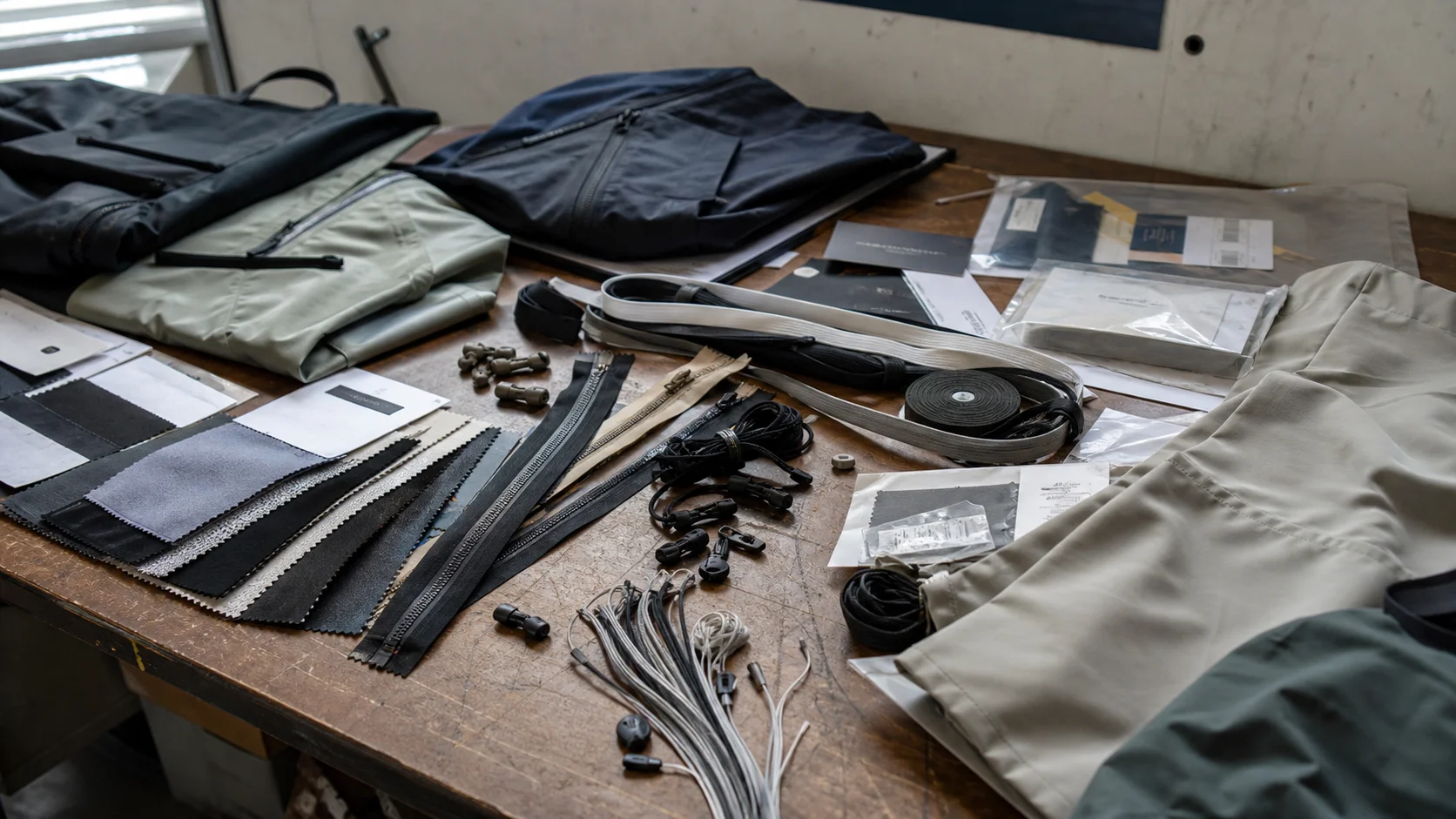
The usual sequence includes a tech pack or spec sheet, pattern development, proto sample, fit comments, revised sample, size set or sales sample if needed, and then pre-production approval. For more technical programs, buyers may also ask for a fabric hand approval or trim board before production starts. Each step should be signed off in writing, not only discussed on a call.
What tends to go wrong is avoidable: sleeve balance is off, collar stands too high, rib length does not recover, pocket angle looks wrong on body, or a lining pulls the shell when the garment is closed. The sample stage is the place to catch that. A factory that resists revision is not necessarily efficient; it may just be trying to preserve its own schedule.
Lead time for custom bomber jackets is not fixed. Fabric sourcing, trim development, sample revisions, and inspection capacity all influence the schedule. A straightforward jacket with in-stock fabric may move faster than a program that requires custom-dyed shell, branded zipper pulls, and bespoke rib knit.
Buyers should expect more time when they specify multiple colorways, special washes, or large embroidery placements. Any material that requires lab dip approval or bulk dyeing adds calendar time. So does a change after sample approval. Even a small edit, such as widening a cuff or moving a pocket, can force a new pattern step and sometimes a revised marker.
A reasonable planning mindset is to treat lead time as a chain of dependencies rather than a single promise. Development might move in a few weeks, bulk fabric approval may take longer, and production itself still needs cutting, sewing, finishing, and packing time. A factory that quotes a fast schedule without asking for trim or material specifics is usually not pricing risk properly.
Bomber jackets look simple from a distance, which makes quality lapses easy to miss until the garment hits the rack. Buyers should inspect beyond visual shape and into the construction details that drive long-term wear and return rates.
Inspection should include measurements, workmanship, seam strength checks, and visual consistency under good light. Buyers working at retail level should also consider carton packing and transport damage. A jacket can pass sewing inspection and still arrive with crushed rib, creasing, or loose hardware if packaging is weak.
One useful tradeoff to understand: a more elaborate jacket may photograph better, but it often gives quality teams more opportunities to fail. Simple, well-built pieces can outperform more expensive designs if the market is more sensitive to fit and finish than to decoration.
For streetwear retail buyers, the bomber jacket is usually part of a broader story rather than a one-off item. The product has to sit alongside hoodies, tees, cargos, and caps without feeling disconnected. That means the jacket should reflect the brand’s fit language, graphic treatment, and price architecture.
The most reliable retail programs usually define the bomber as either an everyday layering piece or a statement outerwear item. Everyday versions rely on better basics: good shell hand feel, clean lining, and a sharp but simple logo treatment. Statement versions may justify heavier embroidery, contrast sleeves, or a premium zipper, but the total package still needs to make sense at shelf price.
Buyers should also think about seasonality. Lightweight bombers work well as transitional pieces and can extend sell-through when heavier outerwear is no longer appropriate. Insulated or quilted versions may support colder markets but usually require tighter planning around fill, bulk, and shipping volume.
A supplier for custom bomber jackets should be evaluated on pattern capability, communication speed, material sourcing, workmanship, and consistency across repeats. Past experience with jackets matters more than broad “cut and sew” claims. A factory that can make T-shirts well is not automatically ready for outerwear.
Ask for detail on how the factory handles grading, sample revisions, and bulk approvals. Check whether it can source or approve the shell, lining, rib, and zipper as a system. A useful supplier will ask practical questions about wash method, labeling, packout, and whether the jacket is intended for direct-to-consumer or wholesale retail. Those questions show that the factory understands how product failures turn into commercial losses.
For buyers comparing suppliers, the cheapest quote is rarely the best signal. The better comparison is whether each vendor has priced the same materials, same construction, and same approval scope. If one quote is much lower, the missing cost is usually somewhere in the trim, lining, stitching quality, or service level.
For buyers who need a production partner or sourcing support, it helps to work with a team that can handle specs, sampling, and communication cleanly from the start. Fabrikn’s service pages provide a direct entry point for development conversations, company background, and contact details.
Review the services page for the production scope, check about us for company context, and use contact us when you are ready to discuss a jacket program or request next-step guidance.
The right conversation starts with the garment details, not the color name. Bring shell fabric targets, lining preferences, trim direction, target MOQ, size range, and desired delivery window. That gives the supplier something real to quote against and reduces wasted back-and-forth.
Get a free quote from Fabrikn — your trusted B2B clothing manufacturer with 10+ years of experience. MOQ as low as 200 pieces.
Get a Free Quote →There is no single best fabric. Nylon and polyester woven fabrics are common for classic streetwear bombers, while cotton canvas, satin, and wool blend options support different price points and looks. The best choice depends on the hand feel, budget, and expected season.
Many programs start around 100 to 300 pieces per style or color, though some factories prefer 300 to 500 pieces or more. MOQ depends on fabric type, trim sourcing, and how much custom work is involved.
A basic program often needs a proto sample and one revision round before pre-production approval. More complex jackets may need additional fit samples, size sets, or fabric approvals if the construction is technical or heavily branded.
Common delay points include custom fabric dyeing, zipper or rib sourcing, sample revisions, and late design changes. Inspection scheduling and packing specifications can also affect the timeline.
Check measurements, rib recovery, zipper function, embroidery quality, seam finish, lining behavior, and overall symmetry. It is worth reviewing the jacket on body, not only on a hanger, because fit problems often show up in wear.
Yes, when the fit and finish are controlled. The silhouette is familiar, commercially flexible, and easy to refresh through color, fabric, and branding. The category works best when buyers avoid overcomplication and hold the supplier to clear construction standards.