
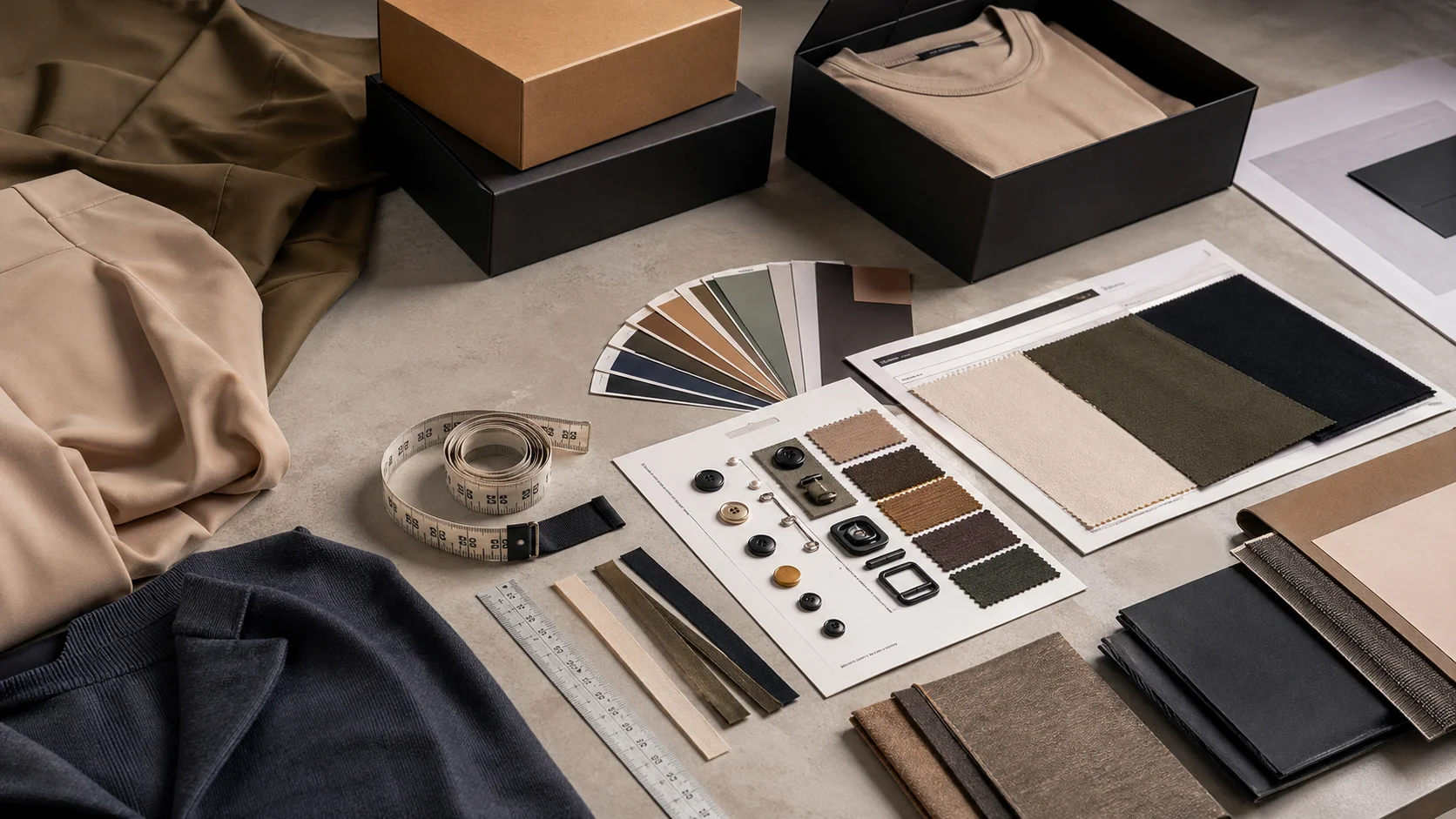
Custom box packaging for private label clothing with checks for samples, fit, MOQ, QC evidence, pricing terms, and delivery risk.
Fast answer: Custom box packaging for private label clothing: costs, design, ROI should be judged by production evidence, not by a generic sourcing promise. The buyer needs sample proof, cost breakdowns, QC checkpoints, and delivery buffers in writing.
Ask for recent sample photos, measurement tolerances, fabric or print test assumptions, decoration test notes, packing examples, and a named inspection checkpoint. These details show whether the team can repeat an approved sample at bulk volume.
Separate garment cost, decoration, labels, packaging, sampling, testing, freight, and rush charges. When every cost line is visible, it becomes easier to reduce colorways, adjust size depth, or reserve more time for sampling.
A box can do more than hold a shirt. In the right setting, it can raise repeat purchase rates by 10% to 20%; in the wrong one, it can quietly shave 3% to 8% off margin. That is why custom box packaging for private label clothing has moved from “nice touch” to hard-nosed line item. I have seen a $14.50 tee in a rigid drawer box feel like a $38 product, while the same tee in a thin poly mailer still looked like a $14.50 tee. The garment did not change. The perceived value did.
Across factory visits in Vietnam, Turkey, and Portugal, the pattern kept repeating. Mass-market labels pushing $18 to $28 retail often overspend on decorative packaging that gets ripped open in 8 seconds. Boutique labels at $60 to $120 retail usually get the balance right: one sturdy box, one tissue sheet, one insert. In one Istanbul factory, I watched cartons for a knit polo go from a plain folding box at $0.32 to a foil-stamped rigid box at $1.74. The retail tag was only $42. The premium package swallowed too much margin for a customer who was unlikely to keep the box.
What the floor reveals is simple. Packaging quality shows up at the first touch point: board thickness, print alignment, glue lines, corner crush. Waste shows up too. If the box is shipped inside another carton and never seen before delivery, why pay for soft-touch coating and a magnetic closure in the first place? For private label clothing, that judgment matters more than a logo on a lid.
According to ISO packaging standards, packaging performance depends on transport stress, drop resistance, and material consistency, not just appearance. That matches production reality: a 1.5 mm grayboard box can protect a folded hoodie through three transfers and two warehouse touches, while a decorative 0.9 mm board may buckle after one rough parcel leg. The question is not whether packaging looks premium. It is whether it earns its freight, labor, and returns cost.
Custom packaging is a family of structures, not one product. Rigid boxes use thick board, usually 1.2 mm to 3 mm, and suit premium shirts, knitwear, and gift sets. Mailer boxes are lighter, often E-flute or B-flute corrugated, and work well for tees, loungewear, and subscription drops. Folding cartons are the cheapest option, common for intimate apparel, socks, and accessories at 500 to 5,000 unit runs. Sleeve systems add a printed wrap over a plain carton, giving more branding without full rigid-box cost.
Different categories need different behavior. Tees and leggings can travel in mailer boxes with a tissue wrap and one insert card. Denim prefers a stronger mailer or corrugated set-up because the weight climbs fast; a size 32 jean can exceed 700 grams before packaging. Intimates and babywear need cleaner presentation, but they also benefit from smaller packs that reduce void fill and warehouse handling. Outerwear often deserves a rigid or reinforced mailer because bulk and zippers create pressure points.
Print and finish choices shape both cost and damage rates. Foil, embossing, magnetic closures, satin ribbons, and soft-touch coatings all raise unit price and can delay production by 5 to 10 days. Tissue paper and branded stickers are cheaper, usually under $0.08 to $0.22 per unit, and still improve opening perception. Inserts matter too: a folded card can cut returns on fit questions by 2% to 4% if it explains care, sizing, or exchange policy clearly.
I have seen brands overcomplicate packaging for products that already win on fit. A crisp tee with good stitching and a clean fold often needs only a strong structure and one well-placed graphic panel. That is where clothing packaging solutions become strategic rather than decorative: they carry the item, reduce shipping damage, and make the product feel intentional before the customer even reaches the hem.
Pricing moves with quantity more than most founders expect. At 500 units, a simple printed mailer box can land around $1.10 to $2.40 per unit offshore, and $2.50 to $4.50 domestically. At 1,000 units, the same spec often drops to $0.78 to $1.80 offshore and $1.80 to $3.60 locally. By 5,000 units, you may see $0.38 to $1.10 offshore and $1.20 to $2.40 domestic. At 10,000 units, efficient specs can reach $0.24 to $0.85 offshore, while local production still usually sits higher unless the design is very plain.
That spread looks dramatic until freight, duty, and lead time enter the room. Offshore production from China or Vietnam can save 15% to 35% on unit cost, but ocean freight, import paperwork, and 4 to 7 additional weeks can erase part of the gain. Domestic production gives tighter communication, faster reorders, and less cash tied up in transit, which matters if your collection turns every 6 to 10 weeks. In the United States, I have seen brands choose local packaging simply because their launch calendar could not absorb a 35-day shipment delay.
Board grade and finishing can double unit cost. A 350 gsm folding carton with one-color print is cheap. A two-piece rigid box with full-wrap art, foil, and a matte lamination may jump from $0.95 to $2.10 even before inserts. Hidden costs sit outside the quote too: samples at $25 to $120 each, plates or dies at $75 to $400, tooling for a new dieline, and warehousing if you cannot store 5,000 flat-packed boxes. For heavier items, an extra 2 mm in board thickness can reduce crush issues, but it also raises freight weight.
Last year I worked with a brand that made custom baby clothing manufacturing part of its launch plan, and the box quote changed after they switched from a 3-piece set to a tuck-end carton. The price fell from $1.62 to $0.88 at 3,000 units, while the product damage rate stayed at 0.6%. That is the kind of cost tradeoff that matters. Not pretty spreadsheets. Actual landed cost.
Data from trade and import guidance from the U.S. government shows that transport, tariff exposure, and lead time vary sharply by origin and shipment mode. For private label apparel brands, those variables can make a 20-cent difference on paper turn into a 70-cent gap by the time boxes arrive at the warehouse.
Brand position should decide the box, not the other way around. If your line sells $22 basics, a matte black rigid box with foil edges sends the wrong signal unless the box is used for gifting or a limited drop. If your shirts retail at $78 to $95, a strong mailer with a clean inside print can feel sharper than a heavy rigid box that adds $1.50 to your cost and 180 grams to shipping weight. Minimal packaging often wins because it looks deliberate, not cheap.
Visual hierarchy is where budget gets protected. One logo, one accent color, one typography system. I have walked factories in Portugal where six-color artwork produced a 14% reject rate on a small run because the ink density kept drifting. The same factory reduced rejects to under 4% after the brand moved to two colors and a single spot Pantone. Fewer colors can improve consistency and lower waste. That is the part most founders miss.
The thing nobody tells you: a simpler print spec can save more money than switching factories. In one run of 8,000 mailer boxes, reducing from four process colors to two spot colors cut rejects from 11% to 3% and saved nearly $1,100 in rework, even though the per-unit print quote barely changed.
Size optimization matters too. A box that is 12% too large forces more void fill, more tape, and higher dimensional weight charges. On e-commerce shipments, that can add $0.40 to $1.20 per parcel depending on the carrier and zone. For sweater sets, I prefer a snug box that holds the garment under 35 mm of compression and still leaves enough room for a tissue fold. Better fit means less shifting, fewer scuffs, and a cleaner opening moment.
I have also seen brands spend on luxury finishes where the customer never touches them. If the box ships inside a poly mailer or shipper carton, skip the soft-touch coating. Put money into board strength, print clarity, and a neat interior fold. That is practical brand building, not theater. For labels that also run cut and sew manufacturing, packaging should match the discipline of the garment, not distract from it.
A supplier audit starts with substrate sourcing. Ask where the board comes from, whether it is recycled or virgin fiber, and what caliper tolerance they hold. Then inspect the print line. Can they run offset, digital, or flexo in-house, and do they control color with a spectrophotometer? Storage matters too. Boxes flattened in humid warehouses can warp by 2 to 3 mm, which is enough to ruin assembly speed on a manual packing line.
There are three supplier types. Brokers source quotes but may not control the factory. Converters manage print and finishing but often outsource specialty work. Full-service packaging factories own the process from dieline to carton packing, which usually gives better defect control and faster problem solving. In my factory visits, the lowest quote often came from a broker; the most reliable on-time delivery came from a converter with clear QC logs and a dedicated prepress team.
Ask direct questions. How many pieces fail drop testing per 1,000 units? What is the standard color tolerance, and how many proof rounds are included? What is the turnaround for a revised dieline, 24 hours or 5 days? If they cannot answer with numbers, the quote is not mature enough. You want someone who can explain why a 300 gsm SBS board works for folding cartons but a 1.5 mm chipboard is better for premium apparel sets.
Red flags show up early. Vague specs. No dieline support. Sample photos that look different from the final proof. Color proofs that shift between warm and cool tones. Weak vendors also struggle with inventory planning, which leads to partial shipments and mixed lots. A good supplier protects defect rate, delivery reliability, and scale. That is especially true if your order will move from 1,000 to 10,000 units within a single season.
A realistic timeline from concept to landed boxes runs 3 to 6 weeks for simple mailers and 6 to 10 weeks for rigid boxes with custom finishes. Sampling usually takes 5 to 12 days. Artwork proofing can eat another 2 to 4 days if your files are not press-ready. Production itself may take 10 to 20 days offshore and 7 to 15 days domestically. Add freight, customs, and warehouse intake, and a “fast” packaging order still tends to move slower than the clothing sample set.
Rush jobs exist, but they are expensive. I have seen a 2,000-unit rush add 18% to 30% to the quote because the factory had to interrupt another run, buy board at a higher spot price, and pay overtime on the finishing line. If your launch window is fixed, stage the packaging order beside garment production, not after. A sweater line cut and sewn in week 1 cannot sit packed and ready in week 5 if the boxes only arrive in week 7.
MOQ traps create cash pressure. A factory may quote 500 units, but the real economics improve at 1,000 or 5,000. That can tempt founders to overbuy. The risk is obvious: 5,000 boxes at $0.62 each tie up $3,100 before freight, and if your SKU sells slowly you may sit on inventory for 4 to 8 months. Ask whether the supplier can split a master run into smaller lots, or hold a reprint plan with the same dieline and artwork.
My advice is to align packaging with your garment calendar. If you are launching 12 SKUs but only one is expected to carry 40% of sales, prioritize that box first and keep the rest plain until volume proves itself. That is cleaner than forcing every style into the same expensive package and hoping margin survives.
Start with a prep sheet before you request quotes. List every SKU dimension in millimeters, not guesses. Add garment weight, folding method, target margin, monthly forecast, and shipping method. If you sell a 220 gsm heavyweight tee, a French terry 320 GSM hoodie, and a satin slip, those are three different packaging problems. One box size will not serve all three well. Include brand assets in vector format, Pantone references if you use them, and your expected reprint window, whether that is 30 days or 90 days.
Then test before you scale. I recommend a 3-sample plan. First, a drop test from 1 meter onto hard flooring, repeated 5 times, to see whether corners crush or lids pop open. Second, a shelf test for 14 days, so you can check warping, color fade, and adhesive lift under ambient warehouse conditions. Third, an unboxing review with 3 people who have never seen the product. Time how long it takes to open, what they notice first, and whether the garment feels worth the price.
Compare quotes on identical specs only. That means same board grade, same print method, same finish, same insert, same packing method, and same delivery term. A quote that is $0.28 lower may be hiding a thinner board, weaker glue, or a smaller approved color range. I have seen brands lose more than $2,000 in rework because they compared a rigid box quote against a simplified mailer quote and called it a win.
Roll out in stages. Start with one hero SKU, ideally the one with the strongest review rate and lowest return rate. Order 1,000 to 3,000 units, measure damage, open rates, and customer photos, then expand to adjacent styles. That approach keeps risk contained and teaches you which specs actually matter. In my view, smart packaging is not about impressing everyone. It is about paying for exactly what the customer sees, what the carrier abuses, and what the margin can survive.
For brands still building product architecture, packaging should sit beside garment development, not behind it. If you already know your fit blocks, trim standards, and production calendar, the box decision becomes cleaner. If not, pair packaging with your next development round and treat it as part of the same approval cycle. That is how to avoid dead stock, missed launches, and a shelf full of beautiful boxes that never justified their cost. For a sourcing roadmap, review private label clothing manufacturing and packaging support before you place your next order.
More brands now ask whether custom box packaging for private label clothing can meet both brand and sustainability goals. The answer is yes, but only if you specify materials carefully. Recycled fiber board, soy-based inks, and water-based coatings can reduce environmental impact without hurting presentation. If your supplier is a manufacturer or factory in China, ask for documentation on recycled content, FSC chain-of-custody, and testing reports before you approve production.
Quality control matters just as much as sustainability claims. An eco-friendly board that warps in transit creates waste at the warehouse and frustration for the customer. That is why a reliable supplier should provide proof of print adhesion, glue strength, and assembly consistency. In many cases, a simpler custom design with fewer finishes delivers better quality, lower MOQ risk, and easier wholesale or bulk replenishment.
If sustainability is part of your brand story, verify certifications with trusted industry sources. Textile Exchange publishes guidance on preferred fiber and material standards, while OEKO-TEX explains testing for harmful substances in textile-related products and packaging components. You can review those resources at Textile Exchange and OEKO-TEX. For import and trade planning, the U.S. government also provides useful guidance on customs and sourcing at trade.gov.
For private label clothing brands, sustainable packaging is not only a marketing choice. It is a production decision that affects lead time, cost, and customer trust. The best results come from balancing material savings with a box that still looks premium, ships safely, and supports repeat orders at scale.
For simple mailer boxes, offshore pricing often lands between $0.24 and $1.10 per unit at 5,000 to 10,000 pieces. Domestic pricing is usually higher, often $1.20 to $3.60 depending on board grade, print, and finish. Rigid boxes with foil or magnets can push well above $2.00 per unit.
Simple packaging usually takes 3 to 6 weeks from concept to landed goods. Rigid boxes with custom finishes often need 6 to 10 weeks, including sampling and freight. Rush orders can shave time, but they commonly add 18% to 30% to the cost.
Many suppliers will quote starting at 500 units, but the cost per box usually improves at 1,000, 5,000, and 10,000 units. Small runs are useful for testing, yet they raise unit cost and can create higher setup fees. If cash is tight, start with one hero SKU.
Yes, if the packaging helps protect the garment and communicates size or care clearly. A well-designed insert can cut fit-related returns by 2% to 4% in some categories. Strong boxes also reduce crush damage during transport, which lowers replacement shipments.
Check substrate sourcing, print capability, QC records, dieline support, and storage conditions. Ask for sample control procedures and color proof standards before you approve a run. The best supplier is the one that keeps defects low, ships on time, and can scale from 1,000 to 10,000 units without changing the spec.