
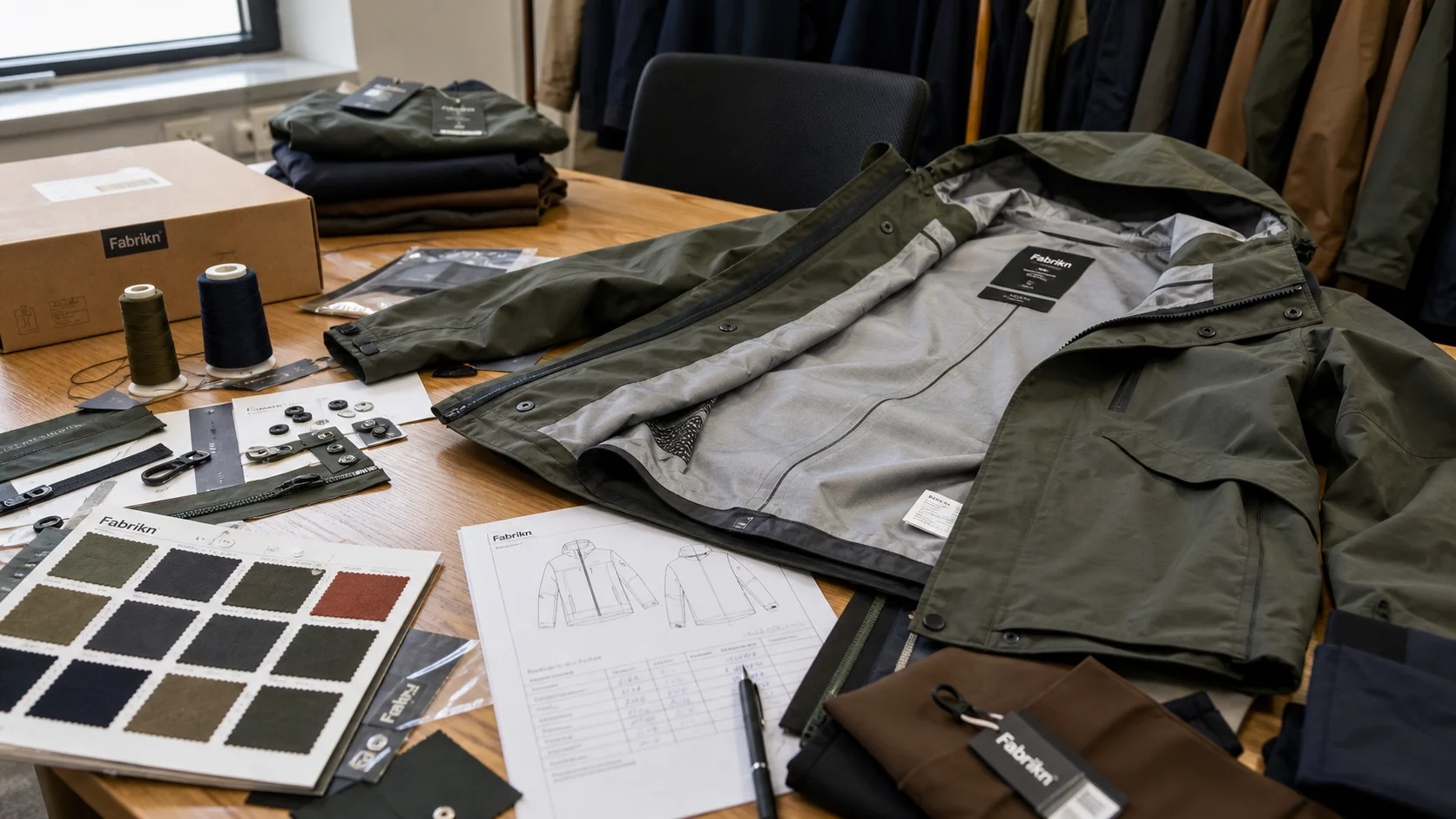
Ecommerce Clothing Packaging Selection with checks for samples, fit, MOQ, QC evidence, pricing terms, and delivery risk.
Fast answer: Ecommerce Clothing Packaging Selection: Mailers, Boxes, Inserts, and Cost should be judged by production evidence, not by a generic sourcing promise. The buyer needs sample proof, cost breakdowns, QC checkpoints, and delivery buffers in writing.
Ask for recent sample photos, measurement tolerances, fabric or print test assumptions, decoration test notes, packing examples, and a named inspection checkpoint. These details show whether the team can repeat an approved sample at bulk volume.
Separate garment cost, decoration, labels, packaging, sampling, testing, freight, and rush charges. When every cost line is visible, it becomes easier to reduce colorways, adjust size depth, or reserve more time for sampling.
The wrong package can bleed margin long before a customer ever sees the garment. When brands ask what is the best packaging for fashion ecommerce, they usually start with the unboxing moment. They should start with the shipping bill. In factory visits across 8 countries, I’ve watched return rates swing from 4% to 18% on the same style after a brand switched from a flat poly mailer to a crushed corrugated box with poor inserts. A box can look premium and still wreck margin if it adds 120 grams of dead weight, 20% more void fill, and a higher dimensional weight charge on every shipment.
Across DTC brands, marketplace sellers, and wholesale spillover programs, packaging expectations do not line up. A $28 tee sold on a marketplace can survive a plain mailer because the buyer expects speed. A $220 dress sold direct needs a cleaner opening experience because packaging becomes part of the product. North American brands often pay $0.68 more per order for rigid cartons, only to save less than half that in perceived value because the inner build is still sloppy. In Europe, labor costs can push manual packing to €0.25-0.45 per unit, so right-sized formats matter more. In parts of Asia, carton access is cheaper, but freight and export rules make oversizing expensive fast.
What factory floors reveal is blunt. Returns are usually driven by creasing, wet corners, broken buttons, and presentation damage, not catastrophic product failure. On a knitwear production line in Vietnam, the team told me damage claims fell 31% after they moved from oversized cartons to a 1.5 mm corrugated mailer with snug internal folds. A packaging supplier in Portugal showed me premium-looking packaging lifting conversion by 3-5% for luxury basics, while overpackaging added 18% to shipping volume and filled 2.4 cubic meters of landfill per 1,000 orders. Protection, presentation, sustainability, and cost rarely peak in the same format.
For brands building clothing packaging solutions, the real question is not which package looks best on a mood board. It is which one survives the lane, fits the item, and does not punish the margin twice.
A folded cotton tee in 180 GSM jersey does not need the same armor as a structured wool blazer. The best packaging for fashion ecommerce shifts by fabric, embellishment, and crease sensitivity, not by brand image alone. A basic tee, sold at $18-35, often ships best in a simple poly mailer or paper mailer. Once embroidery, foil print, or a heavyweight French terry 320 GSM hoodie enters the mix, structure matters because folds hold memory and seam bulk creates pressure points.
Low-price basics often beat premium labels on packaging efficiency. Mass-market brands use fewer components, smaller SKU counts, and tighter pack-out standards. A $24 active tee may ship in a 6x9 inch mailer at 38 grams total pack weight, while a $260 knit cardigan arrives in a box that weighs 190 grams before the garment is even counted. That is not luxury. That is waste. Premium brands sometimes leave 30-40% empty space because they confuse generous dimensions with premium presentation.
Denim is its own problem. Raw denim, coated denim, and distressed washes need crease control and abrasion resistance. A $75 pair of jeans can ship in a corrugated mailer if folded correctly, but a rigid box may be justified above $150 when the brand wants to reduce edge wear and preserve hanger creases. Knitwear is more sensitive to pressure marks. Outerwear needs crush protection around hardware, zips, and down fill. Accessories sit at the other extreme. A hat shipped through custom hat manufacturing programs often needs shape retention more than thick walls, especially for caps with structured crowns and embroidered fronts.
Price does not decide the carton. Geometry does. Fabric behavior does. So does whether the piece springs back after a 72-hour compression test. Silk blouses, pleated skirts, and anything with beads or rhinestones usually merit a corrugated mailer or rigid carton. Cotton basics, fleece, and jersey can usually stay lighter and cheaper.
Poly mailers remain the cheapest option in ecommerce packaging. Virgin plastic versions can cost $0.08-0.18 each at scale, weigh as little as 6-12 grams, and protect well against moisture. Recycled plastic mailers cost more, usually $0.12-0.25, but they reduce fossil feedstock use and still keep tare weight low. Paper mailers look better on a sustainability slide deck, but they can tear at seams and absorb water in humid lanes. In monsoon-season shipments from South Asia to Europe, I’ve seen paper mailers fail after the adhesive strip softened at 40-50 hours in transit.
Corrugated mailers sit in the middle. Heavier than poly, often 35-90 grams depending on flute and size, they handle compression and scuffing better. Folding cartons deliver the most premium presentation, especially for unboxing, and they print beautifully with low-ink coverage branding. They also create more waste if sized poorly. Molded fiber sounds responsible, yet it can absorb moisture, shed fibers, and arrive with more variation than buyers expect. Kraft paperboard works for light items, but it struggles with sharp hardware edges and dense multi-item packs.
End-of-life claims are where marketing often outruns reality. Compostable packaging sounds noble, but most commercial shipping networks are not composting systems. If a film is contaminated with tape, labels, ink, or wet residue, it usually exits the recycling stream and ends up in landfill or incineration. That is why I prefer suppliers who can prove regional recyclability, not just theoretical compostability. According to Textile Exchange, material claims should be paired with traceable inputs and realistic recovery pathways, not just broad sustainability language. For chemical safety and responsible materials verification, OEKO-TEX standards are also a useful reference point.
Freight emissions are also shaped by tare weight, not just material story. A lighter recycled poly mailer can cut shipment weight by 30-60 grams versus a box system, which lowers air freight emissions and dimensional charges at the same time. A 20-gram reduction per order sounds tiny until you ship 100,000 orders. Then it becomes 2 metric tons of material moved every month. Brands that obsess over print finishes while ignoring weight are usually paying for glossy vanity, not better performance.
At 1,000 units a month, packaging decisions are about cash survival. At 10,000 units, they are about consistency. At 100,000 units, they become a logistics system. I’ve built sourcing plans at all three levels, and the cost picture changes more than most teams expect. A basic poly mailer may land at $0.10-0.16 domestically, while a printed corrugated mailer can land at $0.42-0.85 depending on board grade and artwork. Add custom tissue, stickers, inserts, and you can easily add $0.12-0.30 more per order.
Unit cost is only the visible part. Labor to pack, tape, fold, and inspect often adds $0.08-0.40 per order. Void fill can add another $0.05-0.20. Dimensional weight can punish you harder than the packaging bill itself. I’ve seen a brand move from a 9x6x2 inch mailer to a 12x10x4 inch box for a 220-gram blouse set, and the shipping charge rose by $1.74 per parcel on average. That change erased the margin from the “premium” pack.
At 1,000 units, domestic supplier options often win because MOQ 250-500 pieces keeps inventory risk low, and turnaround is 2-4 weeks. At 10,000 units, offshore factory sourcing starts to matter. Lead times of 6-10 weeks are common, especially if you need custom print, die cuts, or recycled board. At 100,000 units, ocean freight, warehousing, and cash tied in inventory become the real costs. You may save $0.04 per unit offshore, but a 90-day lead time can force larger safety stock and expose you to style changes.
The strange part is that a 20-gram weight reduction can beat a prettier finish in ROI almost every time. Ship 50,000 orders and remove 20 grams per order, and that is 1,000 kilograms less freighted material. According to U.S. Commercial Service trade guidance, cross-border trade is sensitive to transport friction and packaging weight because every extra gram compounds through the network. The savings are rarely dramatic on one parcel. They are dramatic across a season. For brands buying packaging wholesale or in bulk from China, that is where production scale changes the math.
Green claims are easy to print and hard to prove. A box with 80% recycled content is not automatically better if it is 40% larger than necessary, laminated with non-recyclable film, and sealed with aggressive adhesive. I audit packaging claims the same way I audit fabric claims: I ask for the spec sheet, the testing method, and the waste stream that will actually receive it. Brands love “recyclable.” Consumers assume that means recycled. Those are not the same thing.
Regional infrastructure matters. In Germany or parts of the Netherlands, paper and board recovery is strong, and clean corrugated can re-enter the system quickly. In some North American markets, mixed-material packs face lower recovery because contamination rates are higher and collection rules vary by city. A compostable mailer sent through a standard parcel route often fails before it reaches any composting facility. Moisture, tape, labels, and food residue from unrelated parcels all weaken the stream. That is not a theory. It is what I’ve seen in sorting facilities.
Factory reality can ruin a “recyclable” claim in three seconds. Heavy ink coverage makes de-inking harder. Hot-melt adhesive can contaminate pulp. Lamination on a folding carton can block fiber recovery. I watched one supplier in India convert a promising paper mailer into a non-recyclable pack simply by adding a glossy coating for print pop. The cost rose by $0.06, and the sustainability story got worse. That is the kind of decision that looks tiny in procurement and huge in waste audits.
Right-sizing beats material swapping more often than brands admit. A smaller carton cuts board use, filler, shipping weight, and storage space in one move. I’ve seen box size reductions of 12-18% lower packaging material use by 14% and shipping costs by 6-9% without changing the external brand look. For guidance on material integrity and responsible chemical use, I often check OEKO-TEX standards alongside supplier declarations. It keeps the discussion anchored in measurable quality and compliance, not adjectives.
Before I place a sample order, I want hard answers. What is the substrate weight in GSM or microns? What is the print method, flexo or offset? What drop-test standard was used, and at what load? What recycled content is verified, and by whom? If a packaging manufacturer cannot answer those questions in 5 minutes, I keep walking. A vague quote usually hides vague quality.
Domestic sourcing gives speed. I can usually get a sample in 5-10 days and a pilot run in 2-3 weeks. Offshore packaging supplier quotes can beat unit cost by 10-25%, but lead times of 6-12 weeks are common once you include proofing, sampling, and ocean transit. If your assortment changes every 30-45 days, slow freight becomes a hidden tax. If your core package is stable for 2-3 seasons, offshore can make sense, especially for high-volume private label clothing services and custom programs that need consistent presentation across SKUs.
The red flags are always familiar. Uneven glue lines. Sizing that varies by 3-5 mm across units. Weak seams at the fold. Recycled-content claims with no lab certificate. I’ve seen all four in factory audits. One supplier in Turkey sent 500 sample boxes with a 7% failure rate on corner crush. Another in China printed the right artwork on the wrong board thickness, which changed the actual fit and pushed the bag-in-box ratio off by 12%. A reliable packaging factory should be able to explain production controls, QC checks, and MOQ trade-offs clearly.
Pilot runs matter more than polished mockups. Test 200-500 units before scaling. Track returns, dents, customer comments, and warehouse pack speed. If you produce niche garments through cut and sew manufacturing, your package must match the garment’s pattern volume, not just its size label. Measure how long it takes to assemble one pack, how many units fail drop testing, and whether the insert actually reduces movement. A supplier who welcomes that scrutiny is usually safer than one who promises perfection on day one.
The first 90 days should be simple. Prototype. Stress test. Roll out in a limited lane. That is the only sequence I trust after seeing too many brands scale packaging on guesswork. Start with 3-5 candidate formats. Run compression, drop, humidity, and abrasion tests. I like a 1.2-meter drop test, a 48-hour humidity exposure, and a 72-hour compression hold for folded apparel. If zippers dent the board or printed surfaces scuff after one transit simulation, reject the option.
During the pilot, monitor five KPIs: damage rate, return rate, packaging cost per order, weight per shipment, and customer complaint rate. I also watch pack time per order because a “cheap” package that slows the warehouse by 8 seconds per order can cost more than a better material. Set a review at day 30, day 60, and day 90. Compare the results by SKU group, not just by channel.
My decision rule is blunt. Choose the lightest package that protects the item, fits the brand, and survives the lane. Not the prettiest one. Not the greenest-sounding one. The one that keeps garments clean, creased correctly, and profitable across 500 shipments, then 5,000, then 50,000. That is how packaging stops being a cost center and starts behaving like a control system. If you want a starting point for custom clothing packaging, build around the item, the route, and the MOQ before you think about finishes.
For basic tees, a poly mailer or reinforced paper mailer is usually enough, especially at price points below $40. Keep the pack weight around 10-25 grams if possible and use a size that leaves minimal empty space. If the shirt is heavyweight, such as 240 GSM or higher, a corrugated mailer can reduce creasing and corner damage.
Most brands spend $0.10-0.85 per order on packaging materials, depending on format and print complexity. Labor, void fill, and tape can add another $0.08-0.40, and shipping charges can rise if the box is oversized. A 20-gram weight reduction can save more than a decorative print upgrade at scale.
Premium apparel often performs best in a right-sized corrugated mailer or rigid carton with low-ink branding and minimal empty space. For silk, embellished, or structured garments, protection matters more than the container’s appearance. If the package adds more than 100-150 grams of dead weight, it usually hurts margin faster than it helps presentation.
Domestic sourcing can take 2-4 weeks for samples and short runs. Overseas production usually takes 6-12 weeks once you include sampling, approval, and transit. If you need seasonal changes every 30-45 days, stick with suppliers that can keep lead times tight and MOQs around 250-500 pieces.
Yes, but the format has to match the item and shipping lane. Corrugated mailers, recycled poly mailers, and plain paperboard can all work if adhesives, coatings, and print coverage stay low enough for recovery. The best answer is often right-sized packaging, which cuts board use, freight weight, and filler waste in one move.