
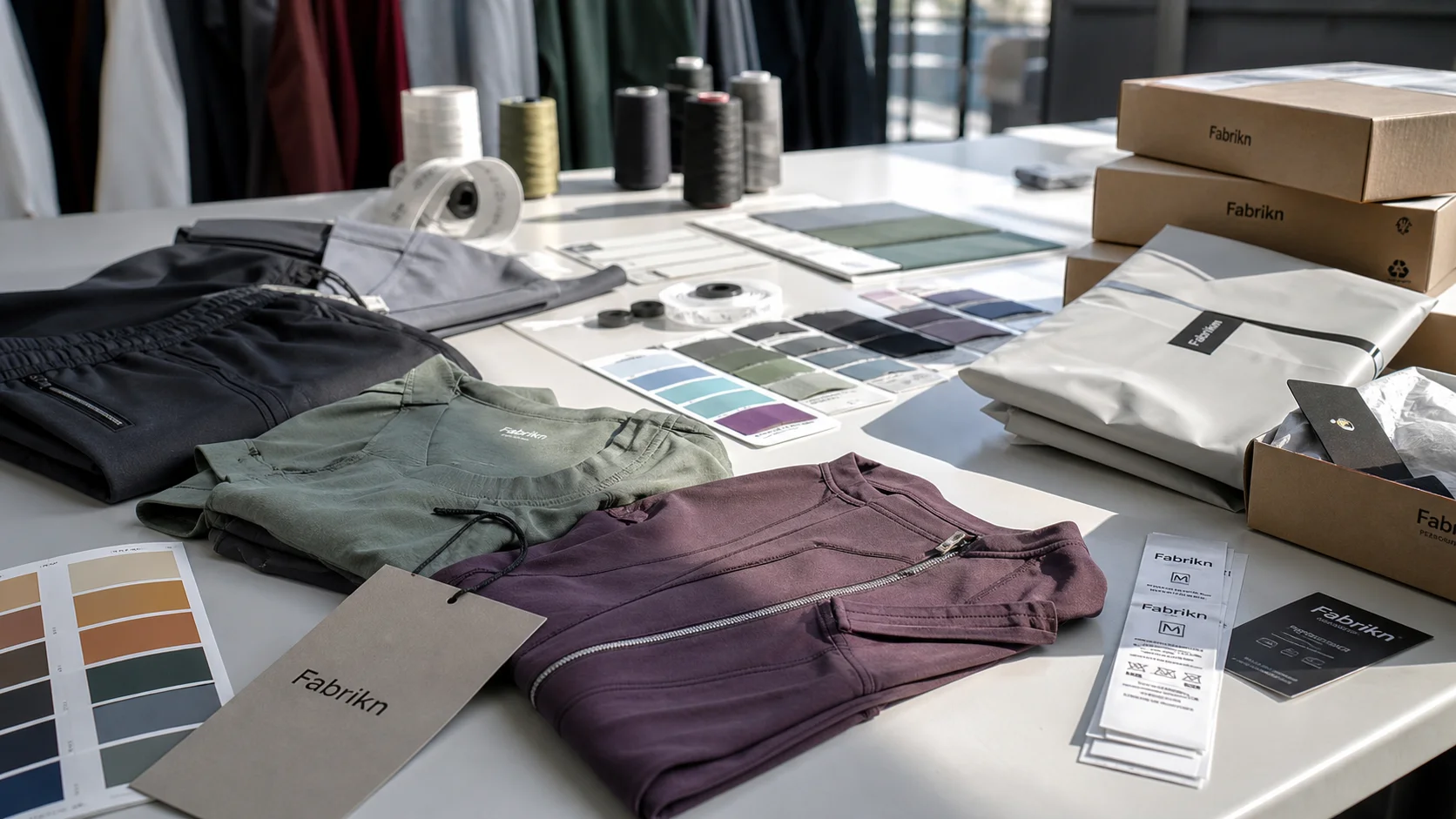
Clothing Subscription Boxes with checks for samples, fit, MOQ, QC evidence, pricing terms, and delivery risk.
Fast answer: Clothing Subscription Boxes: Board, Inserts, Cost, and Design should be judged by production evidence, not by a generic sourcing promise. The buyer needs sample proof, cost breakdowns, QC checkpoints, and delivery buffers in writing.
Ask for recent sample photos, measurement tolerances, fabric or print test assumptions, decoration test notes, packing examples, and a named inspection checkpoint. These details show whether the team can repeat an approved sample at bulk volume.
Separate garment cost, decoration, labels, packaging, sampling, testing, freight, and rush charges. When every cost line is visible, it becomes easier to reduce colorways, adjust size depth, or reserve more time for sampling.
After 200-plus factory visits, one truth keeps walking out of the production line with me: the brands that treat packaging like a footnote lose repeat orders, while the ones that engineer the first opening can lift retention by 8-15% over six to nine months. That kind of swing is enough to decide whether a subscription business stays skinny or starts paying its own bills. In the case of custom branded boxes for clothing subscriptions, the box is not a container. It is the first fitting room.
Folding-carton plants in Vietnam. Rigid-box specialists in Poland. Corrugated converters in Ohio. Same story, different accents. The strongest subscription boxes did not always use the thickest board; they used tighter structure, cleaner print registration, and fewer design mistakes. A 1.5 mm greyboard rigid can feel more premium than a 2.0 mm board if the edges are sharp, the wrap is taut, and the logo sits exactly 12 mm from the corner. Precision wins. Excess often looks nervous.
Asia offered the widest choice of materials and the fastest quoting. In Shenzhen and Ho Chi Minh City, I saw suppliers offering recycled kraft mailers at MOQ 500 pieces and four-color offset rigid boxes at MOQ 1,000 pieces, with print lead times of 10-18 days and ship-ready samples in 5-7 days. Europe felt more disciplined. Factories in Portugal and Poland were less flexible on minimums, often starting at 2,000-3,000 units, but color control was tighter and FSC paperwork was usually cleaner. North America sat between the two: faster transit, higher labor cost, and better communication, with domestic MOQs often around 250-1,000 units depending on structure.
The thing nobody tells you is that a box can look more expensive because it is simpler. I saw premium apparel brands use plain white SBS board with a single spot color and a blind emboss. No foil. No laminated gloss. Just ruthless discipline. The result felt more luxurious than a busy 6-color package because the printer held a tighter tolerance, sometimes within 0.5 mm on alignment, while the glossy alternatives telegraphed every scuff and dent. The box is a signal. The signal must be clear.
That matters even more for subscription fashion, where the customer sees the package every 30 days, not once. I’ve seen brands that sell $29 basics use a better box than some $180 outerwear services, because the recurring touchpoint pays back over 6, 12, and 18 shipments. The rest of this piece breaks down where packaging earns its keep, where it wastes money, and how to choose a specification that can survive real logistics instead of a mock-up table.
Packaging acts like a silent sales rep. It speaks before fabric does. In subscription apparel, that opening statement matters because the customer is not evaluating one purchase; they are evaluating a relationship that may last 3 months or 3 years. Brands that improve first unboxing perception can reduce early churn by 5-12% and lift referral rates by 4-9%, especially when the service sends monthly or biweekly assortments.
I’ve seen the emotional math in returns data. When garments arrive wrinkled, crushed, or loosely packed, complaints spike fast. In one warehouse review, 17% of returns from a mid-priced women’s knitwear box were not about fit at all. They were about presentation, staining from scuffed inserts, or items arriving folded so poorly that the customer assumed quality was lower than the MSRP suggested. A package can create trust, or drain it.
A one-off order can survive a clumsy opening if the product is right. A subscription cannot. The customer sees the box 10 or 12 times a year, so every weak crease compounds. I’ve tracked brands that spent $0.40 extra per shipment on better board and custom fit, then saved $1.20 to $2.10 in avoided reships, refunds, and service tickets. That trade is hard to ignore.
There is also a physical side. Thinner boxes can flex in transit, and flex creates crease lines on garments, especially rayon blouses, brushed cotton tees, and lightweight knits. A 320 GSM French terry hoodie can survive a fair amount of movement, but a silk camisole or a pleated skirt cannot. For services that resemble private label clothing programs, the box becomes part of quality control, not branding theater.
Over-packaging can feel wasteful, and under-packaging feels cheap. I prefer a design that protects the garment first, then adds one deliberate brand moment: a message panel, a tissue sleeve, or a fold that reveals the product in sequence. That sequence changes how value is perceived in the first 8 seconds, which is long enough to shape the rest of the customer’s judgment.
Three formats dominate: rigid boxes, corrugated mailers, and folding cartons. Each solves a different problem. Rigid boxes are the premium choice. They usually run on 1.5-2.0 mm greyboard or chipboard with wrapped paper, and they communicate permanence. Corrugated mailers use E-flute or B-flute board, often 1.5-3.0 mm depending on compression needs, and they are the practical option for shipping-heavy programs. Folding cartons are the lightest and cheapest, typically using 250-400 GSM SBS or kraft, and they work best when a parcel outer mailer already provides protection.
For premium apparel clubs, rigid boxes make sense when the average order value sits above $80 and the customer expects a curated reveal. They look strong on a shelf, stack neatly, and can absorb minor shipping abuse if the insert is correctly engineered. Yet they add weight. A rigid box with wrap, magnet closure, and insert may weigh 180-260 grams before product. That matters once freight is priced by dimensional weight.
Corrugated mailers are the workhorse. They are lighter than rigid, usually cheaper by 20-40%, and more forgiving in cross-border shipping. A kraft-printed mailer with aqueous coating can be recycled in many curbside systems, while a foil-laminated rigid box often cannot. According to trade.gov trade data, packaging input costs swing with paperboard and freight volatility, so a lighter structure can protect margin when rates rise.
Folding cartons are underrated for capsule subscriptions, accessories, socks, and low-bulk basics. They offer strong print real estate and low unit cost, often $0.28-$0.75 at 5,000-10,000 units, but they need outer protection. They also store flat, which cuts warehouse space by 60-70% versus assembled rigid boxes. For custom baby clothing manufacturing, where softness and cleanliness matter more than theatrical weight, this often becomes the smarter route.
Sustainability choices sit inside the specification, not around it. Recycled content can be 30%, 60%, or 100%. Coatings may be aqueous, UV, or lamination. Inks can be soy-based or petroleum-based. The more mixed the material stack, the harder end-of-life recycling becomes. Data from Global Organic Textile Standard discussions often pushes brands to think beyond the product label and into the entire delivery system, which is exactly where subscription boxes live.
My bias is simple. Choose the lightest structure that can survive transit, then spend the saved budget on print discipline and fit. A premium-feeling box should not require a forklift to justify itself.
Design has less than 10 seconds to do its job. That means the box must communicate price tier, assortment type, and brand attitude almost instantly. The fastest premium cues I’ve seen are not elaborate graphics. They are restraint, proportion, and consistency. A two-color box with a confident logo and disciplined whitespace often outperforms a crowded six-color layout that tries to sell personality with volume.
I favor limited palettes for most subscription apparel brands: one primary color, one neutral, and one accent. Typography should be legible at arm’s length, with hierarchy that keeps the brand name dominant and the program name secondary. If a box is built for $40 essentials, it should feel clean and organized. If it supports $150 tailored pieces, it can tolerate heavier stock, deeper embossing, and a more formal tone.
Inside printing is where many brands overdo it. A full flood of art inside the lid can look clever in a sample photo and expensive in production, but it raises waste, ink use, and defect risk. I’ve watched print crews lose 6-8% more sheets to misregistration when the inside carries dense graphics near fold lines. White space is not laziness. It is production intelligence.
Scuff resistance matters too. Matte finishes hide fingerprints better than gloss, but matte can scuff if the coating is weak. I prefer soft-touch only on premium tiers where the tactile signal justifies the cost. A well-calibrated aqueous matte with a 1,000-1,500 rub test can hold up better than a cheap lamination that scratches after one warehouse transfer. Color consistency across batches should stay within a tight delta, especially if the brand ships monthly and customers compare box one to box four.
At one factory in Ningbo, I saw a design team cut defects by nearly 11% simply by moving the barcode and return panel 8 mm away from the side seam. Small shift, real savings. For brands using cut-and-sew products, especially tailored pieces from cut and sew manufacturing, the box should echo the precision of the garment: cleaner folds, fewer visual interruptions, and an opening sequence that reveals the item in one calm motion. That is how a package feels premium without shouting.
Pricing moves fast because so many variables stack together. Size, board grade, print method, finishing, inserts, freight mode, and order quantity all affect the unit cost. For custom branded boxes for clothing subscriptions, I usually model three tiers. Startup runs sit around 500-1,000 units. Growth orders land in the 3,000-10,000 range. Premium programs often order 20,000 units or more. Each tier behaves differently.
At startup scale, expect $1.10-$2.80 per box for a corrugated mailer with one- or two-color print, depending on size and location. A rigid box at the same volume can land at $3.50-$6.50, especially if it includes a magnetic flap or custom insert. Add foil, embossing, or a special coating, and cost rises another $0.25-$1.20. The box is not expensive because it is luxurious. It is expensive because low volumes carry setup and tooling.
At growth scale, costs usually improve. I have seen a 12x9x3 inch corrugated mailer drop to $0.78-$1.35 at 5,000-10,000 units, while a simple rigid set can fall to $2.20-$4.10. In many cases, a domestic supplier beats an overseas quote once you factor in 20-30 days of ocean transit, $0.18-$0.55 per unit in freight allocation, and higher damage risk from longer handling. A cheaper quote on paper can become the more expensive box in practice.
Premium brands often choose higher-end finishes and pay for the privilege. A heavy wrap, custom tissue, debossed logo, and printed insert can push packaging over $5.00 per shipment, which is rational only if the average order value and repeat rate can absorb it. That is where margin math matters. If packaging adds $1.20 but reduces returns by $2.00 and boosts repeat orders by even 6%, it earns its place.
There is also the hidden cost of poor engineering. Oversized boxes require void fill, which adds labor and materials. Weak corrugated board may save $0.14 per unit but cost $0.60 in crushed corners, rework, and complaint handling. I advise brands to calculate total landed packaging cost, not just unit price. Include assembly labor, warehousing space, freight by volumetric weight, and breakage. That is the only number that tells the truth.
Supplier screening starts with specifications, not price. I ask for board caliper, paper grade, printing method, coating, tolerances, and expected compression strength before a factory ever quotes the job. A strong partner will send dieline advice, preflight checks, and QC photos without being chased. Short-run specialists are best for 250-2,000 units. Large converters handle 10,000-plus with lower costs. Sustainable packaging vendors often excel in recycled content and material traceability, but some are slower on finishing.
Sample approval should be ruthless. Check print alignment within 1 mm, color tolerance against Pantone references, fold accuracy, and glue lines. Ask for a drop test and a compression test, especially if the box ships with apparel inserts or accessories. According to ASTM standards used in packaging testing, measurable methods reduce dispute risk because “looks okay” is not a quality metric.
Factory visits reveal the same weak points again and again. Inconsistent glue lines. Scored folds that crack on opening. Lid flaps that don’t sit square. A 2 mm error sounds tiny until a subscription box opens crooked on every third shipment. I also check humidity storage, because warped board shows up fast in monsoon climates and poorly conditioned warehouses. The best factories keep defect rates under 2%, while weaker ones drift to 5-8% without noticing.
As volumes rise, relationship management becomes essential. A brand sending 800 boxes a month can survive a delay. A brand shipping 8,000 cannot. If your clothing program expands into categories like lingerie or intimates, the packaging supplier should understand discreet presentation and smaller insert formats, much like the detail discipline required in custom bra manufacturing. Precision compounds when the order cadence speeds up.
Start with a clear brief: box type, dimensions, product weight, shipping method, target price, and brand mood. By day 3, lock the dieline and artwork files. By day 7, request prototypes from 2 suppliers. By day 14, compare samples side by side for print clarity, closure fit, and transit resistance. By day 21, run a pilot order of 100-300 units with real subscribers. By day 30, decide whether to scale, revise, or scrap the specification.
Document everything. You need the dieline, vector artwork, Pantone references, dimensions, packout instructions, shipping specs, and defect tolerance. If the product varies by season, note the thickest and thinnest garments in the box, from lightweight tees to heavier outerwear. I also recommend testing the fit with the same folding method your warehouse uses, not a hand-packed sample from the design team.
An A/B test should be simple. Try one sturdier box and one lighter box. Track damage rate, opening satisfaction, customer comments, and how many subscribers share photos without prompting. Monitor the first 90 days closely. If complaints about crushed corners exceed 2%, if reorders are delayed more than 7 days, or if packout labor rises above plan by 15%, the spec needs adjustment.
For brands that package gender-specific or fit-sensitive assortments, the box should also support product integrity. That can matter for categories adjacent to intimates or bodywear, where fit and protection shape satisfaction as much as branding. If a line extends into baby or family products later, the same logic applies with tighter hygiene and softness requirements, especially in private label clothing programs that expand across categories.
Do the first launch with discipline. Track numbers. Change one variable at a time. Packaging mistakes are expensive, but they are fixable before the second shipment, which is usually when the customer decides whether the subscription feels curated or careless.
At 500-1,000 units, expect roughly $1.10-$2.80 for corrugated mailers and $3.50-$6.50 for rigid boxes. At 5,000-10,000 units, those ranges can drop to about $0.78-$1.35 and $2.20-$4.10, depending on size, print, and finishing.
Typical timing is 10-18 days for samples and 3-5 weeks for production once artwork is approved. Overseas freight can add 2-5 weeks, while domestic shipping is usually faster but more expensive per unit.
Corrugated mailers suit most shipping programs, rigid boxes fit premium tiers, and folding cartons work for lighter assortments or when outer mailers handle protection. Recycled content of 30-100% is common, and aqueous coatings are usually easier to recycle than heavy laminates.
Yes. Better presentation can lower complaint-driven returns because customers perceive higher product value and fewer items arrive wrinkled or crushed. In my factory and warehouse reviews, improved box spec and packout often cut presentation-related issues by 10-20%.
Confirm dielines, dimensions, board caliper, print tolerance, glue quality, and compression strength before placing the first order. Ask for prototypes, QC photos, and a small pilot of 100-300 units so you can test fit, damage rate, and customer reaction before scaling.