
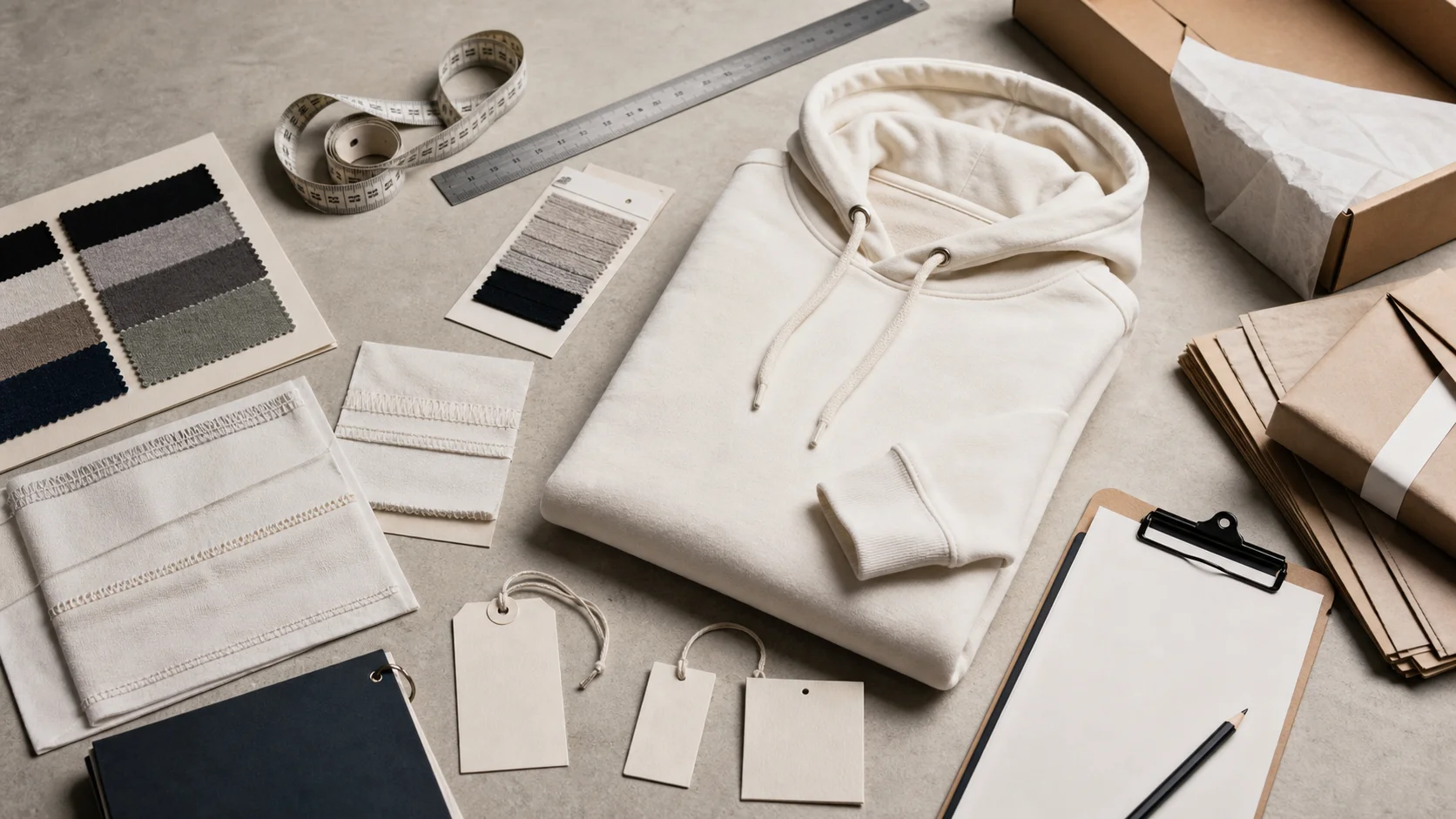
Spot UV Fashion Retail Boxes with checks for samples, fit, MOQ, QC evidence, pricing terms, and delivery risk.
Fast answer: Spot UV Fashion Retail Boxes: Finish Area, Proof, Cost, and Impact should be judged by production evidence, not by a generic sourcing promise. The buyer needs sample proof, cost breakdowns, QC checkpoints, and delivery buffers in writing.
Ask for recent sample photos, measurement tolerances, fabric or print test assumptions, decoration test notes, packing examples, and a named inspection checkpoint. These details show whether the team can repeat an approved sample at bulk volume.
Separate garment cost, decoration, labels, packaging, sampling, testing, freight, and rush charges. When every cost line is visible, it becomes easier to reduce colorways, adjust size depth, or reserve more time for sampling.
A limited drop sold out in 17 minutes, and the box did more talking than the hoodie inside. On a boutique shelf, spot uv branded boxes for fashion retail can pull the eye from 3 meters away because a glossy logo catches light while a matte carton disappears into the wall of sameness. During factory visits across Vietnam, Turkey, Italy, and China, the same retail truth kept surfacing: packaging is the first physical touchpoint, and first-touch bias is brutal. Packaging studies often put first-impression formation at under 7 seconds, with premium cues lifting perceived value by 20% to 30% when the finish feels controlled rather than flashy.
Influencer unboxings sharpen that effect. A box that opens cleanly, resists scuffing, and flashes a logo under ring light can generate 2 to 4 extra seconds of watch time, which matters when a viewer decides in a blink whether a brand feels worth a click. Plain matte cartons do the opposite. They can make a $48 tee look like a $12 promo item, while a $180 knit set in a weak carton can look oddly cheap. Mass-market basics survive with simple print because the price promise is low; mid-market apparel usually needs one premium cue; premium labels need restraint, not noise.
Smaller brands often get sharper results than large ones. Fewer revisions, usually just 2 rounds instead of 5, and faster approval loops. They protect finish consistency because one bad shade shift hurts a 500-piece launch more than a 50,000-piece program. A brand that locks artwork early and tests under 500 lux store lighting gets better gloss registration than a giant label chasing sign-off across 6 departments.
What factory visits reveal is harsher than the branding decks admit. Buyers think they are paying for a box; they are really paying for disciplined approvals, stable board supply, and a finishing line that can hold a 1 mm logo edge without haloing. A glossy accent is small. The signal it sends is not.
Spot UV works because contrast reads as intention. On matte stock, the gloss sits above the paper like a second message, and that raised visual tension says premium before the buyer touches the box. In boutiques, a 350 gsm SBS carton with a gloss mark can outperform a plain uncoated box priced 15% lower, simply because the higher-contrast finish looks more expensive from 1 to 2 meters away. According to ASTM, visual and rub-resistance testing are not cosmetic extras; they are part of consistency. If the coating scratches on the shelf, the premium story collapses fast.
The categories that benefit most are practical, not glamorous. Hosiery, accessories, athleisure, basics, gifts, and seasonal capsules all gain from a disciplined gloss accent because the packaging is often the only branded surface before purchase. A 6-pack sock box can move better in department stores when the logo and size panel are spot UV, while a fully glossy carton looks more like discount stationery. For direct-to-consumer mailers, a matte mailer with a spot UV brand mark can improve perceived value without adding the cost of a rigid setup. In a boutique, that same finish can support a 25% higher ticket perception, especially on items under $75.
Region matters too. In Milan and Seoul, restrained gloss reads as tailored. In parts of the US and the Gulf, stronger reflectivity can work on premium gift sets, but only if the rest of the layout is quiet. Department stores reward visibility. DTC mailers reward identity. Fast-fashion racks punish overstatement. A box covered in shine can signal cheapness because it imitates plastic blister packaging more than fashion packaging. That is where brands lose the plot. Gloss should punctuate, not shout.
A box that feels considered can support repeat purchase signals, especially when consumers keep the carton for storage or gifting. In one mid-market test, boxes with a single spot UV logo were remembered 18% better in post-purchase surveys than identical cartons with no finish contrast. That is not art. That is retail math.
Board choice determines whether the gloss sits cleanly or turns muddy. SBS usually gives the sharpest print holdout and the cleanest white base for logo work, especially on 300 gsm to 400 gsm folding cartons. CCNB can be cost-efficient for inner components, but its recycled face often shows more fiber variation, which can soften the gloss edge. Kraft has character and performs well for earthy brands, yet the brown base reduces contrast unless the design is deliberately bold. Recycled boards are attractive for sustainability claims, but buyers should test scuff resistance carefully because fiber content and coating absorption vary by mill.
Coating layers matter just as much. Matte lamination gives the best gloss contrast, though it can slightly mute deep colors. Aqueous coating is faster and often cheaper, but the spot UV can look less dramatic on low-absorbency stock. Soft-touch layers feel luxurious, yet they can create adhesion problems if the UV is applied too thick or if curing time is rushed below 24 hours. A beautiful mockup can fail because the coating thickness was off by only 3 to 5 microns. Tiny numbers. Big headache.
Box structure should match use case, not fantasy. Folding cartons suit basics, hosiery, and lightweight accessories. Rigid boxes fit premium gift sets, jewelry, and special launches. Mailers work best for e-commerce and subscription packaging, where the outer shipper is part of the brand reveal. For brands developing broader apparel programs, structure choices should sit alongside cut and sew manufacturing planning, because garment lead times and packaging lead times must land together within 2 to 6 weeks. Brands lose drops because the clothes are ready in 21 days and the boxes need 35.
Before signing off, ask the manufacturer, factory, or supplier for coating thickness specs, drying time by line speed, adhesion test results, and color shift risk under daylight and warm LED. In some plants, a 0.3 delta E shift is acceptable; in others, they will hold tighter at 0.2. That difference shows up on shelves. Packaging is not a side quest. It is a production system with its own tolerances.
Pricing changes sharply by run size. For 500 units, digital short-run production on folding cartons may land around $1.10 to $2.40 per piece before freight, while offset production with spot UV often lands higher at the beginning because setup costs are spread across fewer units. At 2,000 units, offset usually becomes the better value, often falling into the $0.65 to $1.20 range depending on board, size, and finish coverage. At 10,000 units, the unit cost can drop to $0.28 to $0.72 for a standard carton with spot UV on the logo only. Freight can add 8% to 18% for domestic moves and 12% to 25% for offshore shipments, especially if cartons are bulky and packed in 50-piece inner bundles.
The setup stack matters. Plate costs can run $80 to $250 per color on offset jobs. Die tooling might add $120 to $600 depending on structure complexity. Spot UV plates and screens can add another $90 to $300, and a second pass for extra gloss coverage raises the line time. A brand can pay more for “cheap” packaging because it needs three revisions, two extra proofs, and a last-minute air shipment. Slow decisions are expensive. Bad ones are worse.
Compared with embossing, spot UV is usually faster and cheaper at moderate volumes. Foil stamping can create stronger luxury cues, but it often carries higher setup cost and can slow production by 2 to 4 days, especially if the design has fine text or large coverage. Plain print is fastest, but it can make a premium garment feel underdeveloped. For brands building around private label clothing, finish choice should match the margin target. A $22 leggings set does not need a $3 rigid box. A $160 blouse gift set may justify one.
Timeline is where many buyers misread the calendar. Sampling usually takes 5 to 8 days domestically and 10 to 15 days offshore. Prepress can take 1 to 3 days if artwork is clean, or a week if the UV mask files are wrong. Production runs 7 to 14 days for domestic suppliers and 15 to 28 days offshore. Curing and packing add 2 to 4 days. Delivery can be 1 to 5 days locally or 20 to 35 days by sea freight, with customs adding another 3 to 7 days. If your launch date is fixed, backward-plan from retail receipt, not from purchase order issue.
Here is the practical spread I give clients:
Total landed cost matters more than the quote on page one.
Design restraint wins. Put spot UV on the logo mark, one border frame, or a repeat pattern that breathes with at least 35% negative space around it. A full-gloss front panel often looks busy and, at lower price points, slightly desperate. A single accent on minimalist labels works better, because quiet brands need one sharp note, not a chorus. Streetwear can take bolder pattern density, though even there the UV should serve hierarchy. Luxury houses often use tiny gloss cues on typography or monograms. Value retailers should keep coverage under 15% of the panel or the box starts to look promotional.
Typography should be tested at real size, not on a screen. Fine serifs under 7 pt can blur when the UV mask is misaligned by 0.5 mm. Bold sans serif logos hold up better on high-volume runs, especially on 250 gsm to 350 gsm cartons. Color choice matters too. Black matte with gloss black UV can look sophisticated, but only if the lighting is strong enough for the contrast to register. In a dim store corner, the effect can disappear.
Prepress is where brands trip. Low-resolution UV mask files are the classic mistake, followed by trapping errors and mismatched dielines. I have seen a 2 mm fold shift turn a beautiful border frame into a crooked band. If your packaging also needs garment integration, check it against the pattern and trim process used in custom bra manufacturing or other intimate categories, where small registration errors look larger on tiny boxes. The same discipline applies across sectors. Precision is visible.
Quality checks should begin before production, not after the pallet is wrapped. I ask factories to confirm register accuracy within 0.3 to 0.5 mm for logo placement, gloss consistency across the run, rub resistance after 50 to 100 rub cycles, corner crush performance, and scuff testing using packed samples under simulated transit. If the UV layer shows whitening at the edge, the board or coating stack is wrong. If corners crush at 1.5 kg of pressure during handling simulation, the shipper design needs more reinforcement.
Regional performance is uneven, but the pattern is useful. In my factory visits, Vietnam often delivered strong efficiency on repetitive box programs, with waste rates around 2% to 4% on stable lines. Turkey was stronger on flexible short runs and faster sample approval, often within 3 to 5 days when files were clean. Italy delivered exceptional finish control on premium cartons, though unit cost could be 25% to 40% higher than East Asia. Mainland China had the broadest equipment range, but QC discipline varied heavily by plant specialization. The factory down the road can be excellent. The one next door can be chaos.
The thing nobody tells you: some lower-cost suppliers outperform on finish consistency when they run only one board type and one UV line. Their staff know the machine cold, so gloss thickness, drying, and stack pressure stay stable from the first box to the last. I have seen a specialist plant with fewer bells and whistles beat a larger competitor that was juggling six substrates and three finishing systems in the same week.
Before mass production, buyers should demand a signed golden sample, a light box review under 4000K and 6500K lighting, and a post-transport damage test after 24 hours of compression. If your packaging is shipping with apparel, the carton must survive being stacked 8 to 10 high without rubbing the logo off. Data from OEKO-TEX does not govern boxes directly, but the mindset matters: verified inputs and tested outputs reduce surprises. Packaging deserves the same rigor.
Start with the retail target, not the finish. Define your shelf price, margin, and launch window, then choose the board and structure that fit the business. Request finish swatches, not just digital renderings, and approve the sample under store lighting plus daylight. If your garments are part of a broader sourcing plan, align the carton order with get a free quote early so production and freight can be synchronized. A box that arrives after the stock lands is a mistake, not a support act.
Give suppliers a clean RFP. They need dimensions, quantity, artwork coverage, finish type, shipping terms, and carton packing specs. Add target board thickness, target retail segment, and whether the box must pass mailer compression or shelf-display standards. If you want an accurate quote, specify whether the order is 500, 2,000, or 10,000 units, and whether the finish is spot UV only or paired with matte lamination, foil, or embossing. Vague briefs cost money.
My recommended approval flow is simple: quote, structural sample, printed sample, golden sample, then mass production. Allow 5 to 8 days for samples domestically and 10 to 15 days offshore. Build in 2 review cycles at most. If a supplier cannot hold the finish on the sample, they will not hold it on 8,000 boxes. Packaging should earn its keep by improving sell-through, not just by looking expensive on a mockup.
They are used to make apparel, accessories, hosiery, gifts, and seasonal drops feel more premium at shelf and in unboxing. The gloss accent helps the logo and key artwork stand out without making the whole carton look loud.
At 500 units, expect roughly $1.10 to $2.40 per box before freight. At 2,000 units, many offset jobs fall around $0.65 to $1.20, and at 10,000 units, standard cartons can drop to $0.28 to $0.72 depending on board, size, and coverage.
Domestic sampling usually takes 5 to 8 days, while offshore sampling can take 10 to 15 days. Production is often 7 to 14 days domestically and 15 to 28 days offshore, with curing, packing, and freight adding another 3 to 35 days depending on transport mode.
SBS is often the cleanest option for sharp logo contrast, while kraft and recycled boards can work well if the design is adjusted for the base color and fiber variation. Ask for scuff resistance tests and a golden sample before approving bulk production.
Yes. Bulk and wholesale orders usually get better unit pricing, especially at 2,000 units and above. The best MOQ depends on the manufacturer, factory, and printing method, so it is worth comparing short-run and offset quotes before committing.