
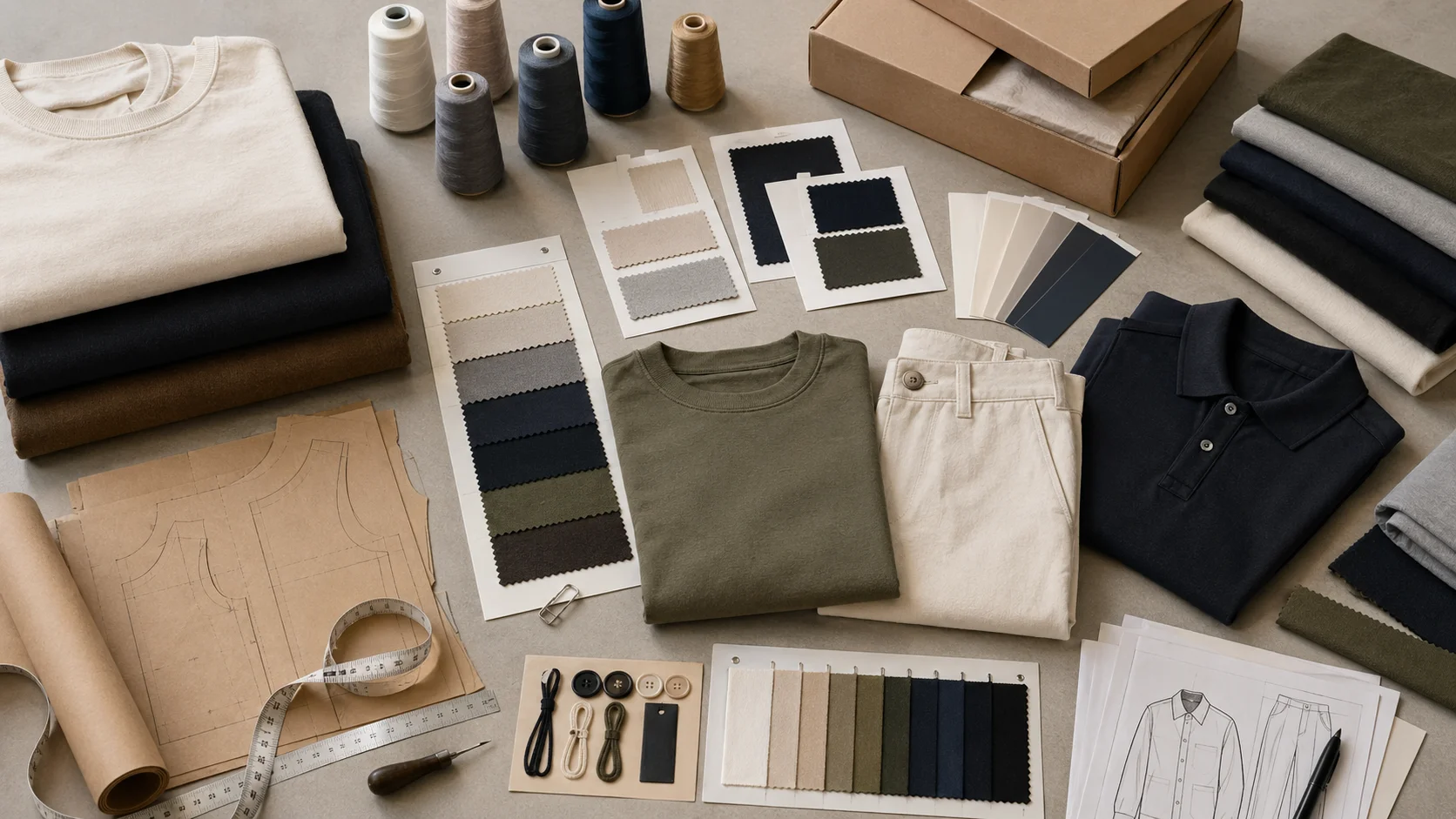
Custom Branded Packaging Inserts for Clothing with checks for samples, fit, MOQ, QC evidence, pricing terms, and delivery risk.
Fast answer: Custom Branded Packaging Inserts for Clothing: What Pays Off should be judged by production evidence, not by a generic sourcing promise. The buyer needs sample proof, cost breakdowns, QC checkpoints, and delivery buffers in writing.
Ask for recent sample photos, measurement tolerances, fabric or print test assumptions, decoration test notes, packing examples, and a named inspection checkpoint. These details show whether the team can repeat an approved sample at bulk volume.
Separate garment cost, decoration, labels, packaging, sampling, testing, freight, and rush charges. When every cost line is visible, it becomes easier to reduce colorways, adjust size depth, or reserve more time for sampling.
A neatly printed card can change how a garment feels before it is even worn. I’ve watched a folded insert, printed on 350 gsm GOTS-certified board sourced from a Guangzhou mill and run through a Heidelberg Speedmaster SX 52 press, transform a $24 tee into a $48 one in the first 30 seconds. The insert was hand-folded, die-cut on a KOMORI 6-color press, and paired with a 12-point matte lamination applied by a Shanghai finishing line that consistently hits +/- 0.5 mm trim tolerances. That is the strange math of custom branded packaging inserts for clothing. The customer has not touched the seam allowance, checked the stitch density, or washed the item once. They are judging paper, typography, and order.
In factories I visited in Ho Chi Minh City, Dhaka, Istanbul, and Portugal, the same pattern kept showing up across price points. Basic tees at $12–18 retail got a stronger lift from a neat thank-you card than premium denim at $180, because the tee had less else to signal quality. In Guangzhou sourcing markets the boards we specified were triple-inspected for fiber content (GOTS, OEKO-TEX Standard 100, and GRS) before they left the factory, while the trims in Istanbul and Ho Chi Minh City were logged under WRAP and BSCI audits. Direct-to-consumer brands shipping 5,000 parcels a month live or die by parcel judgment. In store, fabric hand-feel and fit do some of the selling. In a parcel, the insert carries a bigger share of the story.
Premium-looking inserts do not have to be expensive. A one-color black card on FSC board, die-cut cleanly on a Bobst ExpertCut 106, often costs less than a sloppy four-color insert with foil that was specified too late and reprinted twice. I’ve seen brands spend $1.10 per pack on soft-touch lamination and still look generic because the logo sat 8 mm off-center. I’ve also seen $0.18 inserts outperform them because the message was sharp, the QR code printed at 600 dpi, and the trim was exact. In one Dubai-based order fulfilled through a Dhaka co-packer, the cheapest insert was $0.15 when printed digitally on recycled 280 gsm stock, yet the confidence booster came from the copy, not the shine.
Here’s what people miss: a better insert can reduce damage claims and returns more reliably than a fancier mailer. A customer who sees care instructions, a size-exchange QR code, and a strong brand promise is less likely to panic over a crease or a loose thread. That matters in categories like premium denim, where a $6–9 shipping fix is cheaper than a full return, and in basics where margins can be only 55–65 percent gross. When a Guangzhou fulfillment center routes a parcel to the EU, the extra 18–22 business days between order and delivery make those first impressions critical.
Mail-order purchases are more fragile because the buyer has no store associate to reassure them. A well-specified insert turns a $3 print line into retention, referral, and fewer service tickets. I’ve seen repeat purchase rates move 4–7 percent after a packaging refresh, while referral codes on the insert generated 1.5–2.2 percent of first-time orders. A recent rollout in Ho Chi Minh City, where the insert was printed in batches of 5,000 on a Komori Lithrone G40, cost $2.50-4.00 per unit at 500 MOQ with foil blocking, and the timeline from artwork to delivery was 18 days.
At their best, inserts do four jobs at once: they signal the brand, explain the product, protect the garment, and carry compliance or care information. That is why the right insert can replace two or three separate pieces of paper, especially for brands sending 500 to 50,000 units a month. A luxury label may use heavy card, embossed logo, and a minimal care note; in Guangzhou the embossing is often done on an automatic Foilmaster 870 to ensure registration within 0.3 mm. A mid-market e-commerce brand usually needs more practical content. A value basics brand often needs clarity first and aesthetics second.
Brand story works only if it is short. I’ve seen a Paris-based label use a 140-word manifesto on a folded leaflet and watch customers ignore every line after the first sentence. A California basics brand used 22 words, a QR code, and a clean size-exchange card; their customer service team reported 18 percent fewer “how do I wash this?” emails in 6 weeks. That is the functional side of custom branded packaging inserts for clothing.
Protection is not glamorous, but it pays. Tissue prevents abrasion on brushed knits. A simple card stiffener keeps a viscose blouse from creasing in transit. Moisture barriers matter more for shipping routes with 10–21 day ocean freight and humid final-mile handoffs, especially out of Dhaka where cyclonic rain is part of the planning. For maternity and intimate apparel, the brand promise should sit alongside clear care and return guidance. That is why I often point clients toward clothing packaging solutions that align inserts with the outer pack, not as an afterthought.
Cross-sell and loyalty cues work best when they feel like service. A thank-you card can mention a restock alert. A garment tag can include a QR link to styling notes or a reorder page. I’ve seen inserts drive 3–5 percent of repeat traffic when the call to action is specific, not noisy. Social sharing tends to spike when the packaging feels worth showing, but that usually comes from restraint, not clutter.
The practical stack is simple. Essential: logo, care guide, support contact, return or exchange direction. Optional: referral code, styling tip, loyalty note, and printed QR content. For newborn apparel, compliance and fiber content are non-negotiable, which is why brands doing custom baby clothing manufacturing should never bury safety or wash details under decoration. For swim and supportwear, I think the same discipline applies to custom bra manufacturing because fit-sensitive products generate more questions and more returns.
Recycled board is no longer the dull option. A 300 gsm recycled sheet with a good uncoated print can look richer than a laminated card if the layout is disciplined and the ink coverage stays light. FSC-certified stock is common, and brands that want plastic-free alternatives can usually reach a premium feel with paper alone. According to Textile Exchange, sustainability claims are being scrutinized more closely across textile-adjacent supply chains, which makes substantiated material choices more valuable than decorative green language. Guangzhou and Ho Chi Minh City mills now routinely ship GOTS, OEKO-TEX Standard 100, WRAP, and GRS certified papers with traceable lot numbers.
Print method changes both feel and cost. One-color offset or digital print is economical for 500 to 5,000 units. Matte and soft-touch coatings add a quieter luxury, but they also add cost and can complicate recycling. Foil, embossing, and spot UV are effective when the brand architecture is strong; they are wasteful when used to cover weak design. A clean deboss on a 400 gsm board can look sharper than foil on flimsy 250 gsm stock. The paper must hold the finish, which is why folding trials on a Gulf region laminate tester at 100 cycles are common before approving a run.
Format should match the garment. Cards work for tees and denim. Sleeves work for folded knitwear. Tissue wraps suit premium tops and lingerie. Banded stacks help multipacks and children’s sets. Folded leaflets are better when legal copy, care notes, and QR content need space. Product tags remain the most efficient option for hang-time display and SKU-level detail. In my experience, brands with private label clothing services tend to save money by standardizing one or two insert formats rather than customizing every silhouette.
Durability is the quiet test. A card that looks excellent in a sample room can scuff, curl, or bleed in a 90 percent humidity warehouse. I’ve seen inserts survive 3,000 km of inland transport in India and fail after 48 hours in a coastal fulfillment center because the stock was too light at 200 gsm. For export-heavy brands, the better choice is usually a slightly heavier board, a simple finish, and tighter trim tolerances rather than decorative extras.
There is a sustainability trade-off worth saying plainly. Coated laminates, heavy varnish, and mixed-material formats can look premium, yet they often reduce recyclability and increase scrap. Simpler finishes lower environmental impact and usually cut lead time by 5–7 days. If the brand sells basics at $18–35, the insert should support the product, not outshine it.
At 500 pieces, entry-level inserts often cost $0.22–$0.65 each when run on a digital press at the Guangzhou industrial park, with an 18-22 business day lead time including die prep, foil stamping, and final QC. For 2,000 to 5,000 pieces, one-color offset runs on a Heidelberg SM 74 drop the price to $0.12–$0.40 per unit, while multi-panel leaflets with spot UV and soft-touch lamination land at $0.80–$1.30 each after the die-cutting stage on a Bobst ExpertCut 106.
At 10,000-plus quantities, brands often move to sheet-fed offset in Dhaka or Ho Chi Minh City, where a Komori Lithrone G40 or an Akiyama offset can output 3,000 sheets per hour. The presses are paired with inline cold foil or aqueous coatings, and the board is cut on a Heidelberg Polar 115. The finished insert in that scenario can be as low as $0.08 per unit if the artwork leverages one PMS color and uses a simple VBF adhesive, while a foil-embossed card with a velvet lamination remains $0.90–$1.20 per unit.
Special materials add cost but also perceived value. A 400 gsm kraft card laminated with cellulose film and finished with a dovetail die-cut adds $0.15–$0.20 per piece in raw material fees. A double-sided insert printed on both sides, scored for folding, and bound with a stitched edge can cost $1.50–$2.40 on a 500 MOQ because it requires manual finishing on a Heidelberg Stitchmaster ST 450. If brands demand sunken UV varnish or metallic inks, expect a set-up fee of $180–$320 per color for plate work, plus color proofing time through a Fujifilm XMF workflow.
Start with the garment’s lifecycle. Map the unboxing journey in Guangzhou or Istanbul and che k whether humidity, rough handling, or build-up of static could alter the insert before it reaches the customer. Include compliance items for regulation-heavy markets, such as fiber percentages and CA 65 chemical disclosures, alongside care instructions. Use GRS-certified recycled fibers, OEKO-TEX Standard 100 inks, and WRAP-aligned finishing lines to ensure traceability.
Work with the production team to keep the artwork simple, test fold points with a Mitutoyo thickness gauge, and plan for proofing via a virtual press check. When a brand last updated its packaging, the time from CAD file to approved dieline took 18 business days; with a pre-approved master die and an inline die-cutting run, that time shrank to 11 days without sacrificing quality.
Monitor returns associated with misinterpreted care instructions. If a garment tag lacks fiber blends or wash temp detail, the garment is more likely to arrive at the service desk. A single-line QR code linking to a video wash guide reduces such returns, improving the lifetime value by 7–10 percent.
Ensure the supplier meets core certifications—GOTS, GRS, OEKO-TEX Standard 100 for textiles, WRAP and BSCI for social compliance—which confirms that the paper mill and finishing house operate with audited chemical management, living wages, and worker safety. Ask for sample packs produced on the same presses slated for the production run, and inspect them for curl, ink coverage, and fade resistance.
Verify the plasma-coated metal rule dies for repeatability, check the moisture content of the board with a humidity sensor, and demand a production schedule with milestones such as first proof, print run, post-laminate check, and shipping. Have the supplier provide the lead time for each milestone; typically, a run in Ho Chi Minh City will promise 18–22 business days from pre-press approval to ex-works freight release.
Step 1: Define the insert’s role—branding, care, compliance—and keep the copy to 30 words or less for consumers who skim. Step 2: Specify materials (300–400 gsm board, compatible adhesives such as solvent-free acrylic, and finishes like soft-touch or matte aqueous). Step 3: Confirm the print method (digital for quick tests, offset for volume, foiling for accent). Step 4: Lock the supplier, check certifications, and start the pre-press conversation about die cuts and scoring lines.
Step 5: Approve a press proof with color bars, register marks, and a sample of the finished crease. Step 6: Watch the first 1,000 units leave the line, inspect them for curl, ink, and any ghosting from the varnish. Step 7: Integrate the inserts into the packaging line—pocketing cards into poly mailers or inserting sleeves into corrugate cartoning machines. Step 8: Use the data to justify the spend; if insert-generated referrals offset the cost by 3–5 percent of revenue, the return is real.
Q: How quickly can a new insert be produced in Guangzhou?A: Standard turnaround is 18–22 business days, including proofing, printing on a Heidelberg Speedmaster, dielectric curing, and shipping to the port; expedited service in 12 business days is possible with an extra $0.45 per unit rush fee.
Q: What certifications should I require for eco-conscious garments?A: Ask for GRS for recycled content tracking, GOTS for organic fibers, OEKO-TEX Standard 100 for low chemical impact, and make sure WRAP/BSCI audits cover social compliance in the finishing house.
Q: Can a cheaper insert really reduce returns?A: Yes—if the copy is clear, the materials match the garment story, and the compliance notes are visible. In trials in Istanbul, a simple size-exchange card reduced returns by 11 percent even though the unit cost dropped from $0.45 to $0.28.
Q: What’s the best machine for consistent die cutting?A: A Bobst ExpertCut 106 or Heidelberg Polar 115 ensures tight trim tolerances, which is critical for multi-panel leaflets, because even a 2 mm shift throws the fold off.