
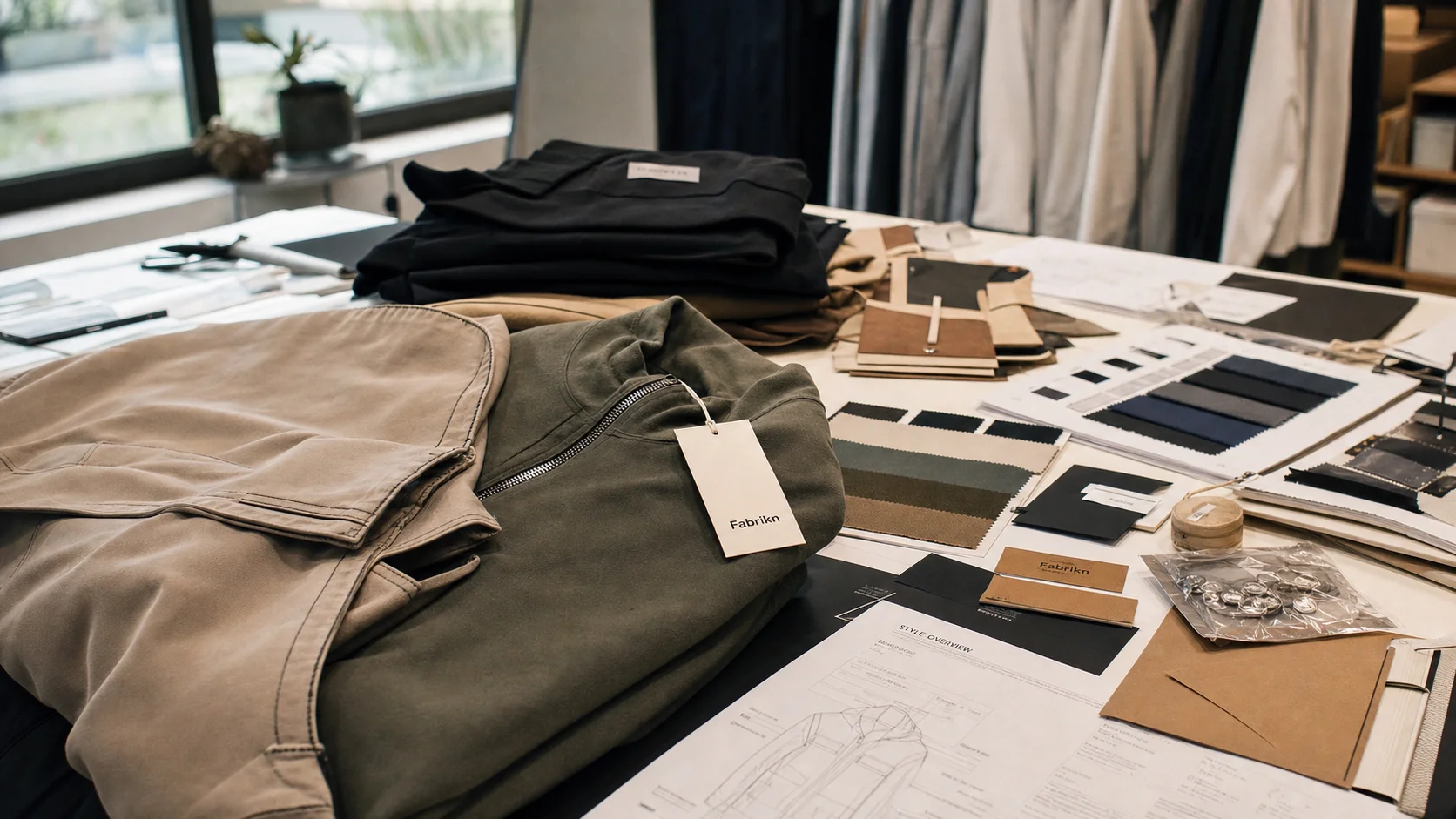
Source Private Label Clothing Manufacturer with checks for samples, fit, MOQ, QC evidence, pricing terms, and delivery risk.
Fast answer: Source Private Label Clothing Manufacturer: Tech Pack, MOQ, Sampling, and Risk should be judged by production evidence, not by a generic sourcing promise. The buyer needs sample proof, cost breakdowns, QC checkpoints, and delivery buffers in writing.
Ask for recent sample photos, measurement tolerances, fabric or print test assumptions, decoration test notes, packing examples, and a named inspection checkpoint. These details show whether the team can repeat an approved sample at bulk volume.
Separate garment cost, decoration, labels, packaging, sampling, testing, freight, and rush charges. When every cost line is visible, it becomes easier to reduce colorways, adjust size depth, or reserve more time for sampling.
Same cotton T-shirt. Different number. I’ve watched identical-looking specs come back at $1.85, $3.20, and $6.75, and that spread is exactly why so many founders get trapped when they try to figure out how to source a private label clothing manufacturer by chasing the lowest quote first. Cheap usually means something is missing: fabric weight, tolerance control, lab testing, or a factory that quietly adds costs later.
After 200+ factory visits across eight countries, the quote itself still isn’t the decision. Guangzhou, Porto, Istanbul — the pattern repeats everywhere. Price does not predict execution. A plant quoting 2,000 pieces can ship worse consistency than a 500-piece workshop if quality control is weak or the line runs like a traffic jam.
Margin erosion is the sneaky part. A $2.10 unit can turn into $3.40 once sampling, lab dips, courier charges, and a defect allowance show up. I’ve seen brands accept “free sampling” and then discover the cost was tucked into bulk pricing. Not free. Just delayed.
Compliance is another trap. Aggressive quotes do not protect you from failed fiber tests, restricted substances issues, or broken country-of-origin paperwork. According to the ISO, documented quality systems matter because consistency comes from process control, not sales talk. Sounds dull until 800 units are sitting at customs.
Finding a factory is easy. Finding the right fit is the work.
Product type, volume, lead time, compliance needs, brand position — that combination decides the winner. Premium loungewear needs a different partner than a promotional basics supplier. If you are building private label clothing for a tight seasonal drop, speed can beat a 7% price edge every time.
Precise brief, cleaner quote spread. When I visited factories in Vietnam and Portugal, vague specs produced an 18% pricing gap. Add full measurements, trims, and finishing, and the spread dropped to 6%. Vague briefs often inflate pricing by 15-30% because factories have to pad for uncertainty.
If you want to know how to source a private label clothing manufacturer successfully, start with a tech pack that leaves almost no room for interpretation. Reference garment. Measurement chart with tolerances. Fabric composition. Knit or woven construction. GSM or yarn count. Trim callouts. Label placement. Packaging spec. Folding method. Wash finish. For a crewneck, “100% cotton” is too thin to price properly. “French terry 320 GSM, 100% combed cotton, garment dyed, enzyme wash, rib 2x2 at cuffs and hem” gets you real numbers.
Commercial structure comes before outreach. Tell factories your target order quantity, expected reorder cadence, and quality threshold. A brand planning 600 units every eight weeks gets treated differently from one asking for 5,000 units twice a year. I’ve watched suppliers drop prices by 9% simply because they knew reorders were likely.
Brand position changes the equation. Basic tees and hoodies live in tighter margin territory, with unit costs often in the $2.50-$6.00 range depending on region and fabric. Premium lines can justify $12-$28 landed costs when cloth, handfeel, and construction support the retail price. Sustainable programs add another layer: certified cotton, recycled polyester, traceable dye houses — costs usually rise 8-20% before freight even enters the picture.
Babywear is stricter still. Miss a snap specification or leave a fabric note vague, and you invite re-sampling and delay. That is where specialized custom baby clothing manufacturing requirements differ from adult basics. Softer trims. Smaller tolerance windows. More testing. Different quote structure from the start.
A narrow brief does more than reduce the price spread. It changes how the manufacturer behaves. Exact inputs push suppliers to compare line capacity instead of guessing. Cleaner quotes. Faster sampling. Fewer “surprise” revisions at the eleventh hour.
Region decides more than price. Speed, paperwork, defect rates, and even the number of emails needed to approve a lab dip all change with geography. China, Vietnam, Portugal, Turkey, India — each one has its own shape, and the cheapest option is rarely the most efficient for every product.
China still has the broadest fabric access and the deepest trim ecosystem. Basic tees often land in MOQ ranges of 300-1,000 pieces, sample lead times of 7-14 days, and bulk lead times of 20-45 days. Unit costs usually sit around $1.80-$5.50 for basics and $8-$18 for more complex garments, depending on fabric origin and dyeing. Compliance paperwork tends to be strong, though it does not arrive by magic.
Vietnam is competitive on knitwear and cut-and-sew work, with MOQs often starting at 500-1,000 pieces. Samples can take 10-18 days. Bulk production often runs 30-50 days. Labor costs are generally lower than China for some categories, but fabric development slows down if mills are not already synced with the factory.
Portugal caught me off guard. Small runs can move faster there than in Asia, especially when an order sits at 150-500 pieces and the buyer needs two to three weeks, not two to three months. Prices run higher, often $8-$22 for basics and more for heavyweight or dyed garments, yet sampling can move fast because patterning, cutting, sewing, and finishing may sit close together. Turkey often wins on knitwear turnaround, especially for jersey, fleece, and sweater programs.
India is strong for cotton-heavy programs, though consistency still swings by tier and location. Excellent embroidery. Real handloom capability. Attractive prices. And then, sometimes, more sampling rounds than anyone planned for. For complex dye work or special finishes, lead times can stretch four to six weeks before bulk even begins.
Traceability matters everywhere. According to Textile Exchange, certified fiber systems keep expanding, but the paperwork only helps if the factory can trace yarn, fabric, and finishing down the chain. I cross-check trade data through trade.gov and customs documents when the origin story sounds polished enough to be fake. Sustainability is not a tagline. It is a documentation test.
For brands that need structured construction rather than simple blanks, cut and sew manufacturing is a better filter than country alone. A region may look cheap on paper, but if it cannot handle graded patterns, specialty wash processes, or low-defect finishing, the hidden cost shows up later in returns and markdowns.
I never approve a factory from an email chain alone. Vetting starts before sampling and before price negotiation. Ask for business licenses, export history, client references, machinery lists, compliance certifications, and category-specific capacity. If a supplier makes knitwear and denim, I want monthly output numbers for each, not a cheerful claim that it can “do everything.”
Communication quality matters as much as technical capacity. A factory that replies in four hours with clear answers is often safer than one that replies in 24 minutes with vague claims. If they cannot explain whether rib, thread, and labels are sourced in-house or through subcontractors, that is a signal. Outsourcing itself is not the problem. Hidden outsourcing is.
Red flags show up early. No factory photos. Sample quality shifts between rounds. Suspiciously low quotes that ignore trims or packaging. Evasive answers on testing or subcontracting. I’ve also walked sample rooms where the showpiece garments looked excellent, but the production floor had no clear size-set control or shade-banding process. That gap is where orders break.
Ask for proof, not promises. Recent audit summaries. Line photographs. Inspection reports. References from brands placing 300-3,000 units, not only 50,000-unit accounts. Smaller orders expose process weak points because the factory cannot hide behind scale. If you are producing small to mid-size runs, discipline matters more than marketing gloss.
One more filter: ask how they handle measurement tolerance and defect rework. A serious supplier can tell you whether it accepts +/- 0.5 cm or +/- 1.5 cm on key points, who signs off on inline checks, and how many AQL inspections it runs before shipment. That kind of specificity saves money later, especially in get a free quote conversations where the first estimate is only the beginning.
Sampling is where many founders lose time and confidence. A basic tee sample can cost $25-$60 for pattern development, $15-$40 for the first proto sample, and another $20-$50 for courier shipping. Add $30-$80 for lab dips if color needs approval, plus $40-$120 for a size set. Fashion pieces with prints, embroidery, or special washes can push sample rounds to $150-$400 before bulk even starts.
MOQ changes the math fast. A low-MOQ factory may accept 100-300 pieces per color but charge 10-25% more per unit because line setup, cutting loss, and admin are spread across fewer garments. A standard-MOQ factory might require 500-1,000 pieces, yet its bulk price can drop enough to improve gross margin by 4-12 points if you can sell through inventory. Cash flow matters too. A 30% deposit on 1,000 units at $4.20 each is $1,260 upfront, not counting samples.
Practical ladder from the field: a basic jersey tee — $1.60-$3.50 in bulk, 2-3 sampling rounds, 2-4 weeks development, 18-30 days production. A fashion sweatshirt with enzyme wash and embroidery — $6-$14 in bulk, 3-5 sample rounds, 3-5 weeks development, 30-45 days production. A performance top with bonded seams and moisture management — $9-$24 in bulk, 3-6 sample rounds, 4-6 weeks development, 35-55 days production.
Small costs hide everywhere. Thread changes. Print strikes. Shrinkage correction. Re-cutting after wash failure. Fabric itself can swing hard too: French terry 320 GSM might be economical in one country and expensive in another because the mill chain is tighter or the dye house charges more for reactive color consistency. I’ve seen a 12-day delay from one bad shrinkage test save a brand from 700 returned hoodies later.
Development time is not wasted time. One extra week in sampling can prevent one extra month of rework. For a 500-piece order, that trade usually pays for itself. Better to reject a sleeve pitch by 1 cm now than fight a full shipment later.
Compliance is where sustainability stops being marketing copy. Ask for fabric test reports, fiber content verification, chemical compliance documents, social audit summaries, and country-of-origin records. For recycled claims, verify chain-of-custody paperwork. For organic claims, ask for transaction certificates, not just a logo on a quote.
Meaningful certifications answer different questions. GOTS addresses organic fiber handling. OEKO-TEX checks harmful substances in finished goods. GRS tracks recycled content through the chain. Data from OEKO-TEX and the Global Organic Textile Standard helps buyers separate verified claims from vague “eco” language. A factory saying it is sustainable is not evidence. Documents are evidence.
Factory reality is messier than the brochures. I’ve visited polished facilities with clean compliance files but weak waste segregation and sloppy dye bath discipline. I’ve also seen smaller plants with excellent water reuse and careful cutting-room waste management, yet almost no documentation. Both matter. You need proof and process.
Sustainability affects cost in real terms. Certified inputs can add 5-15% to fabric price. Wastewater controls can add another 2-8% in certain regions. Traceable supply chains may add weeks to lead time and a few cents per unit, especially for smaller orders. That premium is not trivial, but neither are chargebacks, seized goods, or greenwashing risk.
Once you have five to eight shortlisted factories, send every one the same brief. Compare quotes apples-to-apples. Score them on quality, cost, lead time, communication, and compliance. I use a 100-point sheet and weight quality and delivery at 30 points each because a cheap factory that misses deadlines is expensive by any honest measure.
Negotiate with precision. Ask about lower minimums on a first run, payment terms such as 30/70 instead of 50/50, defect allowances, and reorder pricing after the first production. Do not squeeze every penny out of the supplier. A strained relationship tends to show up later in slower replies and less useful problem-solving.
Then pilot before you scale. A pilot order of 150-300 units can test wash performance, measurement tolerance, packaging, and carton labeling without risking a full season. Pass/fail criteria should be written before production: shrinkage under 5%, no color bleed after three wash cycles, measurements within tolerance, and packing accuracy above 98%. If a factory cannot meet those thresholds, it is not a fit, no matter how attractive the quote looks.
Build a sourcing spreadsheet that records contact names, sample dates, quote versions, MOQ, lead time, defect notes, and reorder terms. The first season is about getting product right. The second is about creating a repeatable system. That is how you stop depending on one supplier and start building resilience into your supply chain.
Start with a detailed brief, then shortlist five to eight factories and send identical specs to each one. Compare quote ranges, sampling speed, and communication quality before choosing two or three finalists for prototypes. For a first collection, I would keep the pilot order between 150 and 500 units so you can test fit, wash, and packaging without overcommitting cash.
For basic tees, bulk pricing often falls around $1.60-$5.50 per unit depending on region, fabric, and MOQ. Sampling can add $50-$300 per style once you include patterns, lab dips, shipping, and revisions. Premium or sustainable programs can run 8-20% higher because certified inputs and testing increase the factory’s cost.
Look for factories that already serve startups or niche brands, because their production lines are set up for smaller runs. Expect MOQs from 100-500 pieces for some categories, though price per unit may be 10-25% higher than a standard-MOQ supplier. Ask for reorder pricing too, since the second order often improves the economics.
Sampling usually takes two to six weeks, depending on fabric sourcing, print work, and revision rounds. Bulk production commonly takes 20-55 days after approval. If the product needs special dyeing, embroidery, or testing, add another one to two weeks so you do not rush into avoidable mistakes.
Request transaction certificates, test reports, social audit summaries, and proof of chain of custody for any recycled or organic claim. Check whether the supplier can link its fabric source, mill, and finishing steps with paperwork. If the claim is real, the documents should line up in two to three minutes of review, not two to three hours of follow-up.